
January celebrates two notable dates in science-fiction history, “National Science Fiction Day” on January 2 and Arthur C. Clarke’s HAL 9000’s birthday on January 12. Accordingly, I’m dedicating January to celebrating sci-fi in an event I call “Sci-Fanuary”.


Released: 24 August 2015
Originally Released: 28 December 1990
Developer: Digital Eclipse
Original Developer: Capcom
Also Available For: GameCube, Mobile, Nintendo 3DS, Nintendo Entertainment System (NES), Nintendo Switch, Nintendo Wii, Nintendo Wii U, PlayStation, PlayStation 2, PlayStation 4, PlayStation 5, PlayStation Portable, Tiger Electronics, Xbox, Xbox One, Xbox Series S
The Background:
Capcom was eager to move beyond simply producing arcade titles in 1987, and thus made a dramatic debut on the revived home console market with Mega Man (or “Rockman” in the East), an Astro Boy (Tezuka, 1952 to 1968) inspired run-and-gun notorious for its difficulty. Despite widespread praise and being seen as an NES classic, Mega Man wasn’t successful enough to warrant an immediate sequel and it was only by enduring a great deal of stress that the developers improved upon the original with Mega Man 2 (Capcom, 1988). The sequel was a big hit that many regard as one of the best in the series, but it would again take two years for a third game to emerge. In that time, lead supervisor Akira Kitamura quit Capcom and artist Keiji Inafune noted that Mega Man 3’s development was chaotic as a result. Despite Mega Man’s arsenal, versitality, and lore being expanded upon in the third game, Inafune felt the final product was unpolished and full of begrudging compromises that saw many elements being excised. Yet, Mega Man 3 has continued to be met with praise; reviews noted the continued improvement of the graphics and gameplay and lauded the action and franchise appeal it helped establish. Though criticised for its excessive difficulty, Mega Man 3 sold over one million copies worldwide. Like its predecessors, it was completely remade for the SEGA Mega Drive and ported to several consoles, including this Legacy Collection release that came with quality of life features and additional bonuses to celebrate the long-running franchise.
The Plot:
Shortly after his latest defeat at the hands of Mega Man, Doctor Albert Wily apparently has a change of heart and works with Doctor Thomas Light to build a peace-keeping robot named “Gamma”. However, when eight new Robot Masters go berserk and steal Gamma’s power crystals, Mega Man must team up with his new robotic canine partner, Rush, to retrieve them.
Gameplay and Power-Ups:
Mega Man 3 does little to break the mould of its predecessors. Like the first two games, it’s a 2D, sidescrolling run-and-gun action platformer that tasks you (as Mega Man) with traversing eight levels and defeating a batch of new (and old) Robot Masters. Although you can still pick the order you challenge each stage (something made much easier with the helpful cheat sheet included with this Legacy Collection, which tells you each Robot Master’s weakness), there’s no difficulty settings like in Mega Man 2. Still, you can choose to play either the US or Japanese versions, enable a turbo mode, and customise the button layout. Not that you really need to given how simple the controls remain. A lets you jump, X fires your currently equipped weapon, Y offers an autofire option, and you pause the game to select another weapon with the Xbox’s Menu button. Mega Man 3 introduces a slide action, performed with down and A, to let you slip through narrow gaps and tunnels and beneath jumping enemies and certain projectiles, though it’s not implemented all that much. Each of the eight new Robot Masters gifts a new Special Weapon upon defeat, and Doctor Thomas Light upgrades Rush with new functions as you progress. Like in Mega Man 2, you can’t replay previous stages but there are some optional paths at times, hidden power-ups such as extra lives, Energy Tanks (great for restoring your health in a pinch), and boosts for your health and weapon energy. Mega Man 3 also offers a password system that lets you continue your progress at any time, or gain additional bonuses, though this is largely superfluous thanks to the Legacy Collection’s save state and rewind features.

While Mega Man’s trusty Mega Buster will serve you well for the most part, your battles against the eight Robot Masters will be made much simpler by equipping one of the new Special Weapons. Each has an energy meter that depletes as you use them so you’ll need to grab Weapon Energy capsules to keep this topped up, often requiring you to “farm” enemies that conveniently respawn when you move offscreen. Although they’re new weapons, some are again similar to the ones seen before (Shadow Blade, for example, is functionally identical to the Metal Blade as you can fire it upwards, downwards, and diagonally), though only the Hard Knuckle has a use outside of boss battles as it destroys certain blocks. The Magnet Missile travels horizontally unless there’s a target above, then it homes in vertically; the aforementioned Hard Knuckle is slow but deals damage on impact; the Gemini Laser fires a laser that ricochets about, and the Top Spin adds a whirlwind spin to your jump but is finnicky to control. I already mentioned the directional Shadow Blade, the Spark Shot stuns enemies, the Needle Cannon rapidly fires needle projectiles, and the Search Snake sends three small snakes across floors, walls, and ceilings. I had little use for most of these, honestly. I used the Magnet Missile the most, followed by the Shadow Blade (which is great for dispatching enemies on ladders), but had little use for the Snake Search or Spark Shot outside of boss battles so I never worried about these running out of energy. Mega Man 3 also introduces Mega Man’s robotic canine, Rush, who effectively replaces the Items from previous games. Rush Coil springs you high into the air, Rish Jet flies across gaps for as long as your energy meter lasts, and Rush Marine does the same but when underwater. These latter two turn the action into something of a sidescrolling shooter, which helps break up the gameplay a bit, though you need to snag the energy refills as you go or you’re liable to drop to an untimely end.
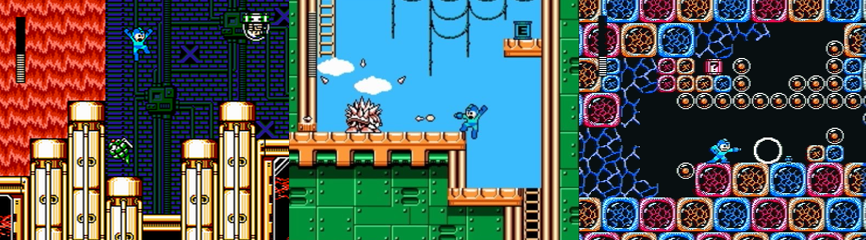
Mega Man 3 is much bigger than its predecessors, and therefore much tougher as a result. Ladders, tricky platforming, insta-kill hazards like spikes and bottomless pits, and disappearing/reappearing blocks are commonplace, often over huge gaps. Turrets also crop up a lot, as do tunnels for you to slide through (sometimes with the risk of a drill hazard), and some stages feature a lightbulb enemy that blankets the environment in darkness until they’re destroyed. Some stages have more unique elements built into them; Magnet Man’s stage, for example, incorporates a magnetic gimmick where turbines attract you, causing no damage but putting your jumps at risk. Spark Man’s stage includes a moving electrical hazard that forces you to time your jumps to avoid damage (or a drop down a pit) and rising blocks over a bottomless pit with insta-kill ceiling spikes above, and Snake Man’s stage includes giant snake head turrets that spit massive fireballs and make the ground uneven until they’re destroyed. Gemini Man’s stage features underwater sections where your jump is much higher and your progress is blocked by destructible Pole eggs that spawn in Pole enemies when destroyed. Often, you’re tasked with making tricky jumps to small or moving platforms, usually while enemies or projectiles rain down. Sometimes these platforms are temporary, sometimes they’re moving, and sometimes you’ll need to make your own using Rush’s abilities. Four of the stages are remixed into harder challenges once you’ve defeated the eight Robot Masters, adding small cogs to Spark Man’s stage, upping Rush Coil’s use in Needle Man’s stage, increasing the spikes and Pole eggs in Gemini Man’s stage, and adding more spiked shafts to Shadow Man’s stage.
Presentation:
Mega Man 3 offers same 8-bit stylings of its predecessors, adding only a new sliding animation to Mega Man’s repertoire and little else. Sure, his sprite changes colour when a Special Weapon is equipped but the presentation is starting to feel quite samey at this point. Although bigger sprite art is used when Mega Man acquires a new Special Weapon, and in-game graphics are used for the few story cutscenes near the endgame, the title screen is a dramatic step back, being simply the game logo on a plain black background. While many large enemy sprites appear in the game, and the game is much bigger than the last two, Mega Man 3 still suffers from slowdown, sprite flicker, and screen tearing when too much is happening onscreen. The music is still a highlight, with jaunty tunes accompanying each stage and the iconic Mega Man theme kicking in, but again it’s all very familiar at this point and feels like an extension of Mega Man 2 rather than necessarily improving upon it. There’s possibly even less story here than before, at lest until the endgame. Occasionally, you’ll be challenged by Proto Man, who announces his arrival with a whistling tune and opens new areas upon defeat, but there’s no story text about this until you’re ready to track down Dr. Wily. Indeed, if it wasn’t for Doc Robot’s presence in the four remixed sages, you’d be forgiven for not even realising that Dr. Wily was supposed to have repented his evil ways. Instead, he shows up in his UFO and flees to another impressive castle, forcing you to brave six additional stages to track him down. There are a few additional flourishes to this, to be fair: Mega Man 2’s Robot Masters dramatically fuse with Doc Robot before each bout, Dr. Wily’s revealed to be a puppet at one point, and there’s a lingering mystery about Proto Man by the end.

Mega Man 3’s stages are a touch more detailed than before, but again aren’t really offering much new. Exposed wires, pale pastels, and ugly electronics are rife in Magnet Man’s stage, Hard Man’s stage takes place atop and within a rocky mountaintop, Top Man’s stage features a particularly garish blue and green pastel aesthetic that’s barely tolerable with the grass effects in the foreground, and Shadow Man’s stage appears to take place in a sewer, but one filled with red water. Spark Man’s stage is full of gears and conveyors in the background, and Snake Man’s stage has a green scale effect to every surface that makes it seem like a gigantic extension of the titular Robot Master but ends up in the clouds. Gemini Man’s stage is perhaps the most visually striking with its ice crystals, flashing blocks, and underwater coral reefs, and Needle Man’s stage is set in a futuristic city and features girders, drills, and skyscrapers. Dr. Wily’s fortress is your typical mechanical hellhole where you must breach his outer defences before tackling the tight corridors and sewer system within. While most stages have a horizontal progression, it’s not uncommon to find yourself dropping down shafts (often while dodging insta-kill spikes) or platforming across gaps. While the visual identity of the franchise is as strong as ever and the big enemy sprites are impressive, things again feel very safe and very familiar. I applaud Mega Man 3 for avoiding using cliché elemental tropes to differentiate stages, but it would perhaps have helped this title to stand out a little bit more, or maybe if there was more focus placed on the story and the mystery of Proto Man.
Enemies and Bosses:
A gaggle of new robotic foes stands between you and victory in Mega Man 3 but don’t worry, Metall is still here and now they can fly with little propellors and a giant version even acts as a sub-boss. Sniper Joe is not only missing (thankfuller!) but poorly replaced by Hammer Joe, an armoured foe who tosses a ball and chain and can only be damaged when their eyes glow, but are otherwise immobile and easy to attack. For the most part, enemies are stranger and weaker than ever: Poles can surprise you, parachuting Parasyu and annoying Elec’n’s appear at the worst times, and Peterchy’s wander about and drop down from above, but they all die in one hit. Things get a little tougher when Have “Su” Bees drop a swarm of Chibees onto you or the porcupine-like Hari Harry’s come rolling along, or the large, frog-like Bikky springs at you, but by far the most amusing and strangely dangerous for me were the pole-vaulting Bubukans. Large enemies are far more commonplace here with the likes of the Giant Springers, Gyoraibos, Penpen Makers, and the cat-like Tamas appearing often. Like the Giant Metall and Big Snakeys, Tamas act as sub-bosses; though they’re less of a hazard than the likes of Bikky as they’re completely stationary, their projectiles are large and difficult to avoid. Robotic apes, walking bombs, floating orbs, and the spinning top-firing Matasaburo round out the enemies, who appear in multiple stages, and even the Pickelman returns from Mega Man, now driving a cute little digger!
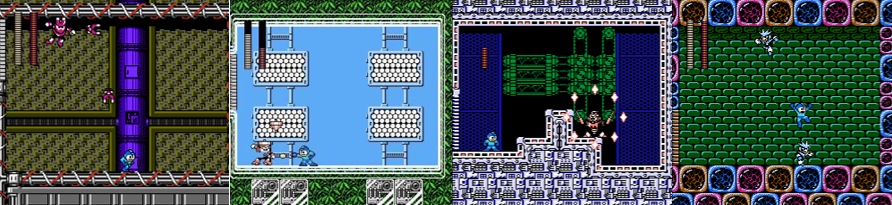
Yet again, you’ll face a Robot Master at the end of every stage and, as ever, the order you challenge them dictates how difficult the battle is since each one is weak to a different Special Weapon. All eight are battled again in Dr. Wily’s fortress, as is tradition, in bland arenas and when you’re at full power, making the rematches much easier. I tackled Magnet Man first, who’s weak to the Spark Shock, Shadow Blade, and even his own Magnet Missile but the Mega Buster will do him in just fine despite his magnetic shield and projectiles. His Magnet Missile makes short work of Hard Man, who blasts you with his Hard Knuckle and stuns you with a screen shaking slam. His Hard Knuckle is the key to besting Top Man, though the weapon is slow and Top Man is invulnerable when spinning; he also fires spinning tops that can be tricky to avoid thanks to Mega Mans large hat box. The Top Spin lets you whittle down Shadow Man, though I found it strangely difficult to use. Shadow Man jumps about tossing his Shadow Blade shuriken and sliding into you, so be sure to attack from the air. The Shadow Blade is great at hitting Spark Man when he leaps high into the air to fire electrical shots in all directions or charge up his big shot. I took on Snake Man next, who’s primarily weak to the Needle Cannon but can be bested with the Mega Buster. It’s a tough fight in this instance though as Snake Man jumps about and fires his little Search Snakes, which are difficult to avoid in the uneven area. The one time I used his Special Weapon was against Gemini Man, a super-fast Robot Master who duplicates himself and fires his ricocheting laser about the room. This Gemini Laser makes Swiss cheese out of Needle Man, despite his rapid-fire projectile and extendable head. As mentioned, you’ll battle all eight of these guys again in Dr. Wily’s fortress, with each dropping some health afterwards (but no energy), but you’ll also battle three Maga Man duplicates. Top Spin is the key here, and targeting the right one (he’ll teleporting the same was as you do).
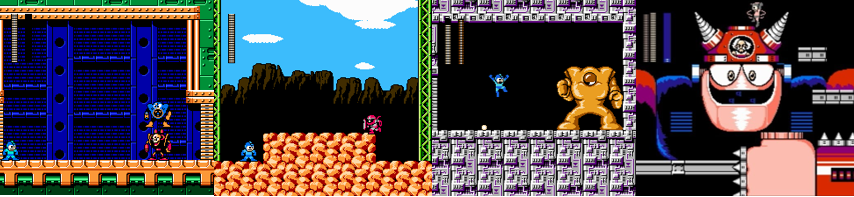
After you defeat all eight, you’ll play through four remixed stages and battle the eight Robot Masters from Mega Man 2, two per remixed stage, with each one inhabiting Doc Robot. They sport all their familiar attacks and are vulnerable to your new Special Weapons (use Spark Shot against Air Man, for example, Shadow Blade against Bubble Man, and Top Spin against Heat Man). Occasionally, you’ll battle Proto Man, who doesn’t have a health bar and simply runs and jumps about shooting at you; he’s particularly weak to the Magnet Missile and begrudgingly aids you as the game progresses. Dr. Wily’s fortress is also home to two additional bosses, the Kamegoro Maker (simply destroy the frog-like Kamegoro it spawns) and the Yellow Devil MK-II (which is actually easier than its predecessor as its blocks are easier to void, though you do need to watch for its projectiles and deal with the Hard Knuckle’s slow fire rate). Best all of these threats and you’ll finally battle Dr. Wily once more, this time in two two-phase battles. The first is against one of his trademark machines; simply blast the lower antenna with the Spark Shot and avoid his large spinning projectiles, then watch for his pin-like legs and time your Hard Knuckle shots to hit his cockpit when it lowers. When he’s defeated, Dr. Wily will pilot the gigantic robot Gamma, which fires three projectiles from its big, stupid head in the first phase and adds an energy shot and a big fist attack in the second. Just clobber him with Hard Knuckle shots then finish him off with a Top Spin to win.
Additional Features:
There are twenty-four Achievements in the Mega Man Legacy Collection, with one specifically awarded for beating this game. Alongside different display options (such as borders and filters), the Legacy Collection offers a character database, production art, and a series of tough, time-based challenges for additional Achievements. The more challenges you complete, the more you’ll unlock, including additional remixes of Mega Man 3’s stages and even gauntlets that pity you against multiple Mega Man titles and bosses against stricter time limits. Otherwise, there’s not much else to return to in Mega Man 3 thanks to the continued lack of a high score table or avenues for exploration.

The Summary:
Mega Man 2 improved upon the first title a lot, being bigger and better while still retaining the same charm and appeal despite the increased difficulty. This is true of Mega Man 3; it’s a good two times the size of the first game and is definitely bigger than the second, but I have to say I expected a bit more by the third title. Whether that be more creativity in the weapons, more focus on the narrative, or more interesting gameplay mechanics; just give me something to make me feel its unique experience. As is, I felt Mega Man 3 didn’t quite live up to its potential; it’s still a great game, but no better or worse, overall, than its predecessor. I would’ve liked to see more focus on the Rush mechanic, perhaps even making him a secondary character or offering entire sections or bonus rounds where you play as (or on) him. I would’ve liked to see more of the narrative address Proto Man’s appearances, perhaps even make him playable in the boss rematches or show up for the final battle. The slide was cool but it’s poorly implemented, with few chances to take full advantage of its potential. Mega Man’s Special Weapons also feel increasingly useless as gameplay mechanics thanks to the continued linear direction, and I just think things should have progressed a bit further by the third title. Mega Man 3 definitely expands and adds to the formula, the point where I’d say you could skip the previous two and start here, but it doesn’t truly innovate as much as it like a feels like a stop-gap before the next game, especially in terms of its narrative.
My Rating:
Pretty Good
Are you a fan of Mega Man 3? What did you think to Rush and the new slide mechanic? Do you agree that the formula was becoming a bit stale by this point? What order did you tackle the game’s stages and which Robot Master gave you the most trouble? Would you have liked to see and learn more about Proto Man? ? How are you celebrating the science-fiction genre this month? Whatever your thoughts and memories of Mega Man 3, please leave them below and be sure to check out my other Mega Man reviews across the site!

 Dr. K's Waiting Room
8 thoughts on “Game Corner [Sci-Fanuary]: Mega Man 3 (Xbox Series X)”