
January celebrates two notable dates in science-fiction history, “National Science Fiction Day” on January 2 and Arthur C. Clarke’s HAL 9000’s birthday on January 12. Accordingly, I’m dedicating January to celebrating sci-fi with an event I call “Sci-Fanuary”.


Released: 24 August 2015
Originally Released: 17 December 1987
Developer: Digital Eclipse
Original Developer: Capcom
Also Available For: GameCube, Mobile, Nintendo 3DS, Nintendo Entertainment System (NES), Nintendo Switch, Nintendo Wii, Nintendo Wii U, PlayStation, PlayStation 2, PlayStation 4, PlayStation 5, Xbox, Xbox One, Xbox Series S
The Background:
Prior to 1987, Capcom was primarily known for their arcade titles and Mega Man (or “Rockman” as it was known in Japan) was specifically conceived to be their first venture into the home console market, which was seeing a resurgence thanks to Nintendo’s efforts. Inspired by Astro Boy (Tezuka, 1952 to 1968), artist Keiji Inafune designed Mega Man’s iconic, chibi-style look that was absolutely butchered when Mega Man released in the United States. Mega Man was developed by a team of only six people and incorporated a “rock, paper, scissors” methodology to its bosses, which would be vulnerable to specific weapons. Despite its reputation as one of the hardest videogames of its era, Mega Man received critical acclaim. It’s widely regarded as one of the all-time NES classics, largely because of the challenge involved, and spawned a popular and sprawling series of videogames, comic books, and cartoons over the following decades. Over the years, Mega Man has been re-released several times: it was completely remade for the SEGA Mega Drive in 1994, rebuilt into a 2.5D PlayStation Portable-exclusive title in 2006, and finally came to modern consoles alongside its first five sequels with this Legacy Collection release, which included quality of life features and additional bonuses to celebrate the long-running series.
The Plot:
In the year 20XX, the kindly Doctor Thomas Light’s robots are turned into malevolent “Robot Masters” by Dr. Light’s rival, Doctor Albert Wily. In response to this threat, Dr. Light’s assistant, Rock, volunteers to become the fighting robot Mega Man, defeat the Robot Masters, and confront Dr. Wily in his dangerous robot factory.
Gameplay and Power-Ups:
Mega Man is a 2D, sidescrolling run-and-gun action platformer in which players assume the role of the chibi fighting robot Mega Man (despite what the atrocious American box art would have you believe) and blast your way through six levels to track down and defeat the six Robot Masters. You can freely select the order you want to play these levels, but you’ll have a much easier time if you consult an online guide (or the handy cheat sheet that comes with this Legacy Collection version of the game) and tackle the stages in a specific order as Robot Masters are extremely vulnerable to certain weapons so it makes the game a lot easier if you plan out which order you’re going to tackle its levels. The Legacy Collection release lets you pick between the Mega Man and Rockman versions, speed up the gameplay, and freely configure the button layout, but the basic setup is perfectly fine for gameplay. By default, A jumps, X fires your currently equipped weapon, Y enables an autofire function that’s more like a rapid-fire mode, and B does nothing. The Right Bumper brings up the in-game pause menu where you can select different “Special Weapons” to equip to Mega Man’s Mega Buster arm cannon, the Left Bumper allows you to rewind the game if you make a mistake, and you can manually save at any time from the main pause menu. Mega Man is a little limited in his abilities here; you can run, shoot, and jump and shoot and that’s about it. There’s no slide, dash, or wall jumping here, just the basics, but that’s enough to get through most levels if you’re skilled and patient enough.
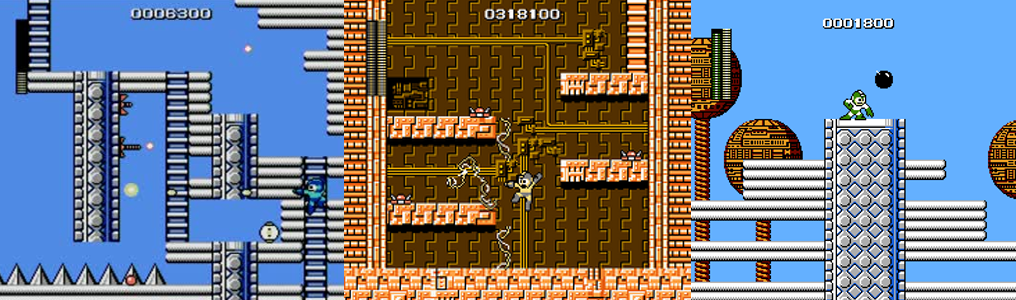
However, Mega Man’s abilities increase as you clear stages and defeat the Robot Master. Each victory adds the Robot Master’s signature ability to your Special Weapon list, providing additional means to traverse stages, defeat enemies, and easily dispatch subsequent Robot Masters. Unlike the Mega Buster, the Special Weapons have finite ammo; each has a bar that depletes upon use and you’ll need to pick up blue Weapon Energy capsules to partially or fully refill the meter. Since each Special Weapon has its own ammo, you’ll need to switch between them to fill each up, though smaller Weapon Energy capsules are often dropped by enemies easily defeated with the Mega Buster. Enemies also drop Life Energy cells to refill your health, and you’ll find larger variants of both and the odd extra life hidden in each level, usually near a death trap. Still, six Robot Masters means six Special Weapons: Cut Man’s Rolling Cutter sees you toss out a pair of boomerang-like scissor blades, Elec Man’s Thunder Beam fires electrical bolts above and ahead and is great for clearing large blocks out of your way, and Ice Man’s Ice Slasher fires arrow-shape ice projectiles that can freeze enemies and flame bursts to create temporary platforms. Fire Man’s Fire Storm blasts out a fireball and temporarily protects you with a flaming shield, Bomb Man’s Hyper Bomb sees you throw a large bomb that’s slow and takes a while to explode but deals heavy damage, and Guts Man’s Super Arm allows you to pick up and throw certain blocks. There’s also an additional power-up hidden in Elec Man’s stage; once you have the Thunder Beam or Super Arm, you can clear away the blocks to snag this item, which creates temporary energy platforms. Luckily, you can replay any level at any time to challenge the bosses again or acquire this item if you missed it the first time, and you’ll absolutely need it to clear Dr. Wily’s stages.

Mega Man is not a game to be taken lightly; every stage is full of bottomless pits, tricky jumps, annoying enemies with erratic attack patterns that respawn the moment you edge off the screen, and other hazards designed to sap your health or whittle away your lives. Every enemy you defeat awards you points, though these appear to be completely useless. If you exhaust all your lives, you can choose to continue as often as you like or return to the stage select screen with all your progress saved, which is helpful, though I’m sure it was exhausting back in the day having to replay the tougher stages right from the start. The Legacy Collection’s rewind feature circumvents that but Mega Man is still tough. You’ll be climbing up and down ladders, hopping to blocks that vanish almost immediately, dropping down shafts and avoiding instant death spikes, and taking out flying enemies to buy yourself enough time to make a jump before the next one pops up. Wall and ceiling turrets, slippery ice in Ice Man’s stage, flame bursts in Fire Man’s stage, electrical currents in Elec Man’s stage, flying platforms that also shoot projectiles, and riding broken tracks on platforms that drop under you in Guts Man’s stage can all be difficult challenges to overcome. Pretty much all these gimmicks are then recycled in Dr. Wily’s gauntlet at the end of the game. Here, you’ll have to plough through four additional stages, each with an abundance of instant death pits and hazards and rematches against the Robot Masters (and battles against other bosses) in even more restricted arenas, which all put your skills to the test. Truthfully, I was always intimidated by Mega Man because of its notorious difficulty, but it wasn’t as bad as I thought, though I wholeheartedly put this down to me making liberal use of the rewind feature.
Presentation:
Obviously, you’re going to need to temper your expectations for Mega Man; it’s an 8-bit title that originally released on the NES, a console not exactly known for its processing power. Still, everything is bright and colourful here; backgrounds aren’t always the most detailed and Mega Man is a pretty simplistic character sprite, but simple often works best in these types of games. Mega Man has a great deal of personality with his exaggerated head and arm cannon, blinking when left idle, wearing a look of agony when hit, and dramatically exploding into a shower of pixelated circles when killed. Every time you equip a Special Weapon, Mega Man’s sprite changes colour so you know what you have equipped (red for Fire Storm, yellow for Thunder Beam, etc) and he hops around with just the right level of control and dexterity, only really being unwieldy when skidding about in Ice Man’s stage. His hit box is quite large, though, as are those of his enemies, so there’s very little margin for error when battling enemies up close. Additionally, the game struggles a bit when there are a lot of sprites on screen. Screen tearing, sprite flickering, and collectibles quickly disappearing are commonplace and the action will slow down if too many sprites appear at once even with the Legacy Collection’s performance boosters.
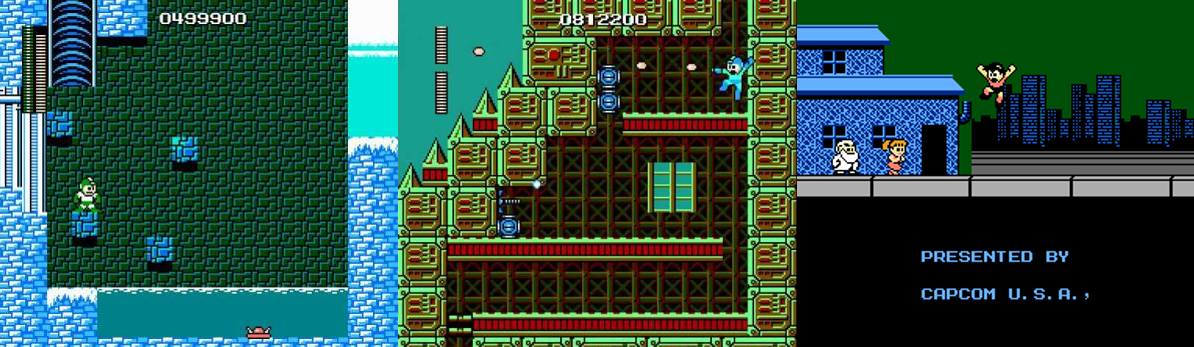
While each level is aesthetically very similar, primarily being composed of a series of mechanical platforms and surfaces, they do have unique elements and colour palettes to separate them. Elec Man’s stage focused more on vertical progression, for example, with different ladder-based routes offering different enemies and hazards to bypass, while Guts Man’s stage takes place in a mine, with mine tracks and a rocky aesthetic punctuating this. Ice Man’s stage is fittingly covered in slippery snow and ice and even features water-based sections where your movement speed is dramatically hampered, and Bomb Man’s stage features large gold spherical buildings in the background. Dr. Wily’s stages are probably the most impressive, with lots of blinking lights and mechanical trappings emphasising the danger of his lair, while boss battles take place in enclosed arenas fitting for their inhabitants. Mega Man’s story is only related in the ending, which shows Mega Man returning home to Dr. Light and shedding his armour, though it includes some of the catchiest bit-tunes of its era, so it’s nice that the Legacy Collection includes the complete soundtrack on the disc.
Enemies and Bosses:
A whole host of robotic minions will dog your progress in Mega Man, many of which spit projectiles either right at you, in a spread, or in an explosive burst, and some of which even shield against your attacks or can only be destroyed with specific Special Weapons. Enemies like the Bunby Helis, Kamadomas, Mambus, penguin-like Pepes, and Bullet Bill-like Killer Bombs will fly, float, and rocket across the screen to screw up your jumps, turrets sit on walls and ceilings, and the Adhering Suzies make traversing narrow corridors a massive pain as they wander back and forth and up and down. Mega Man so debuts some of the franchise’s most recognisable enemies, the Metall, a little robot who hides under a construction helmet and peeks out to spit projectiles at you, and Sniper Joe, a pistol-firing marksbot who hides behind a shield and requires the use of the Hyper Bomb to defeat. The Hammer Bros.-like Pickelman also carries a shield but tosses an endless supply of pickaxes at you, often hopping between platforms to up their annoyance factor, while spherical Watchers slowly float up and down, shooting projectiles and knocking you from ladders on Elec Man’s stage. Ice Man’s stage is also home to the wacky Crazy Razy, a robot who can detach its head from its body! Many stages also include a sort of mini boss, the Big Eye, a large robot that jumps about trying to crush you. Multiple versions of this enemy are found in Dr. Wily’s stage and they can take a lot of hits to defeat for very little reward, so it’s easier to simply run underneath them when they do a big hop and avoid them entirely.
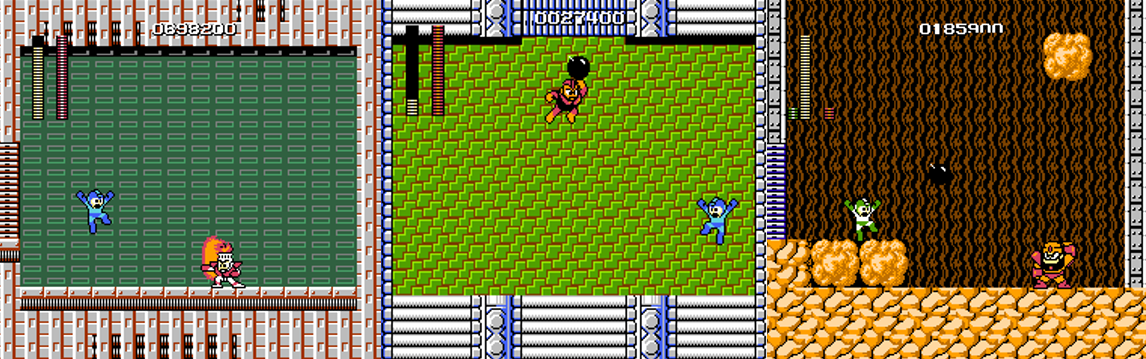
Each stage culminates in a battle against one of the six Robot Master’s. Before battling them, you usually have to bypass a Big Eye and a corridor full of enemies, hazards, and a few power-ups before you’re locked into an arena, the awesome boss them kicks in, and the bosses health meter appears onscreen. The difficulty of the Robot Masters is entirely based on what Special Weapons you have on hand. f you don’t have the weapon they’re weak to, they can be quite tough but, with the right weapon equipped, they become a joke. With this in mind, the first Robot Master I fought was Cut Man, who runs and jumps about tossing his boomerang-like scissor blades at you. You can easily avoid this and defeat him with the standard Mega Buster, and then use the Rolling Cutter to decimate Elec Man, whose three-way Thunder Beam is as nothing to this weapon. Similarly, while Ice Man fires three freezing arrow-like projectiles, the Thunder Beam will do him in in no time. His Ice Slasher makes quick work of Fire Man (though he’s still quite tricky thanks to his erratic movements and flaming shield), and the Fire Storm is the best way to take out Bomb Man, who jumps across the arena tossing large bombs. Bomb Man’s Hyper Bomb is the key to taking out Guts Man, who’s probably the most difficult of the six Robot Masters. He causes the screen to shake when he stomps, leaving you stunned, and tosses massive boulders at you, and the Hyper Bomb takes so long to go off that it’s easy to miss your target. All six Robot Masters are fought again in Dr. Wily’s stage, in new arenas with less room to manoeuvre, though you can simply use the same tactics to defeat them.

Alongside facing off with the six Robot Masters in Dr. Wily’s stage, you’ll also battle three other boss robots before confronting the mad scientist himself. The first of these is the now iconic Yellow Devil, a massive blob-like monstrosity that can dismantle itself to appear on either side of the arena. These blocks can be difficult to avoid, even with the rewind feature, and you only get a split second to attack its one, small weak spot (the eye, which also fires shots at you) before it dismantles itself again. Thankfully, there’s a brilliant exploit where you equip the Thunder Beam, fire it at the Yellow Devil’s eye, and rapidly pause and unpause the game as the shot hits its target, which will obliterate this boss in record time. Next, you must face an exact duplicate of Mega Man, who copies whatever weapon you have equipped and has all the same abilities as you. I found the best method was to equip the Fire Storm, hop over his attacks, and blast away, whittling down the doppelgänger’s health with the weapon’s shield ability. Finally, you’ll battle a series of CWU-01P robots underwater; these appear from one of three parts of the arena, rotate in a clockwise pattern, and are shielded by a bubble. You’ll need to jump over them and blast at their central cores to destroy them, though they get faster and faster the more you destroy. Once you’ve triumphed, you’ll face off with Dr. Wily, who attaches his flying saucer to a gigantic machine that slowly lumbers side to side firing projectiles in an arc that can be as hard to avoid as the machine’s hit box. Equip Fire Storm again and attack the giant gun arm on the front to expose Dr. Wily and begin the second phase, where the machine fires balls of energy in a spiral pattern. The weak spot is now on the top of the craft, so equip the Thunder Beam and blast away, doing your best to not get boxed into a corner, and you’ll soon have Dr. Wily begging for mercy.
Additional Features:
There are twenty-four Achievements available in Mega Man Legacy Collection, with one awarded specifically for beating this game. In addition to different display options (including borders and filters), the Legacy Collection allows you to view a character database and production art and take on a series of tough, time-based challenges for additional Achievements. “Challenge Mode” gives you six minutes and thirty seconds to conquer remixed stages from this game, five minutes and thirty seconds to defeat the Yellow Devil, and battle all six Robot Masters in a boss rush without the use of Special Weapons. The more challenges you complete, the more you’ll unlock, including additional remixes of Mega Man’s stages and even gauntlets where you play through multiple Mega Man titles and against the game’s bosses against stricter time limits. Otherwise, there’s not much else to return to in the base game. There’s no high score table so it’s a bit pointless to try and outdo your higher score, though it’s a fun enough game to play through again so you can always come back for that (and for the nostalgia factor).

The Summary:
I’ve always had a soft spot for the Mega Man series, despite never really playing any of the games. Until I got the Legacy Collection games, I’d only finished one Mega Man title and I’d always wanted to play more but was put off by the difficulty factor. Thankfully, the Legacy Collection includes a rewind and save state feature, making Mega Man much more accessible to someone like me, who grew up playing SEGA’s consoles and largely avoided some of Nintendo’s more infamously difficult titles. I’m happy to say that I really enjoyed Mega Man; I can see how it would be frustrating and tricky to play through without modern quality of life features, though the infinite continues and various hidden checkpoints throughout the stages is a benefit. While the levels are mainly defined by a few gimmicks and their steadily increasing difficulty, I liked the freedom of choice on offer. You can make the game much harder or easier depending on which order to take on the Robot Masters and nothing ever felt spitefully unfair, with hazards and enemies being a question of trial and error more than aggravation. Mega Man is a visually appealing character and I enjoyed utilising his Special Weapons, especially to cut through the Robot Masters, who also exhibit a lot of personality in their little introductory cutscenes. Dr. Wily’s final barrage of stages and bosses is a definite uphill battle but exploits and memorisation definitely swing things in your favour, and I was really enjoying the jaunty tunes that peppered the game’s stages. There’s some additional challenge and replay value added in the Legacy Collection version with the time trials and boss gauntlets, which will test seasoned players, so I’d absolutely recommend picking up this collection to experience the most accessible version of this original game.
My Rating:
Pretty Good
Was Mega Man a staple of your NES library back in the day or did you first play it on a different console? Which order did you tackle the game’s stages in and did you also have to replay Elec Man’s stage for the Magnet Beam as I did? Which of the Robot Masters and Mega Man’s Special Weapons was your favourite? What did you think to the difficulty of the game and the quality of life features included in this version? Which Mega Man game is your favourite and would you like to see more titles released in the franchise? How are you celebrating all things science-fiction this month? Whatever your thoughts and memories of Mega Man, feel free to leave them below and be sure to check out my other Mega Man reviews across the site!

 Dr. K's Waiting Room
15 thoughts on “Game Corner [Sci-Fanuary]: Mega Man (Xbox Series X)”