Toho’s famous atomic beast, and easily the most recognisable kaiju in the entire world Gojira first emerged from the waters of outside of Japan to wreck the city of Tokyo on this day all the way back in 1954. In 2016, the day was declared “Godzilla Day” and, as a result, I am also appropriating November 3rd to shine a spotlight on the undisputed King of the Monsters.

Released: 14 December 1991
Director: Kazuki Ōmori
Distributor: Toho
Budget: $12 million
Stars: Kōsuke Toyohara, Anna Nakagawa, Megumi Odaka, Chuck Wilson, Yoshio Tsuchiyam, Kenpachiro Satsuma, and Hurricane Ryu
The Plot:
Time travellers offer to get rid of Godzilla (Satsuma), Futurians create the terrifying King Ghidorah (Ryu), leaving science-fiction writer Kenichiro Terasawa (Toyohara) and remorseful Futurian Emmy Kano (Nakagawa) to desperately revive Godzilla ensure Japan’s survival.
The Background:
When he made his big-screen debut in Godzilla (Honda, 1954), Gojira (more popularly known worldwide as Godzilla) represented very real lingering fears regarding the threat and consequences of nuclear war. However, it didn’t take long for Godzilla to be recast from Japan’s destroyer to its a saviour. While he often caused a great deal of destruction, Godzilla would often team up with other kaiju, such as Mothra and Rodan, to fend off a greater threat and cement his place as an iconic figure in pop culture. Perhaps Godzilla’s greatest nemesis is the three-headed dragon King Ghidorah (also known as “Ghidrah” and “Monster Zero”), a titanic winged beast created by Godzilla creator Tomoyuki Tanaka and inspired by the Lernaean Hydra and the Orochi of Japanese folklore. Initially depicted as an ancient alien monstrosity from Venus, King Ghidorah’s debut feature was so successful that he reappeared the following year and was a natural choice to recoup some of the studio’s losses after the disappointing box office of Godzilla vs. Biollante (Ōmori, 1989). Believing audiences wanted time travel plots given the success of Back to the Future Part II (Zemeckis, 1989), director Kazuki Ōmori specifically tailored the script to include this and place greater emphasis on developing the personalities of the monsters rather than the human characters. The movie reused the Godzilla suits from Godzilla vs. Biollante, but with some modifications that slightly altered Godzilla’s face and allowed actor Kenpachiro Satsuma a better range of movement when in water, and the redesigned King Ghidorah featured far more advanced wirework puppetry than its predecessor. Ultimately, Toho’s hopes of surpassing Godzilla vs. Biollante were not to be as Godzilla vs. King Ghidorah made noticeably less than its predecessor and the film is generally regarded as a visually impressive, if convoluted, entry in the franchise. The film also attracted controversy for its depiction of events from World War Two but this wouldn’t be the last Godzilla film, or the last we’d see of King Ghidorah. Godzilla was back in action a year later and his nemesis returned to do battle time and time again in many forms.
The Review:
I have been a massive Godzilla fan since I was a little kid, but my exposure to the scourge of Japan was actually quite minimal growing up. Godzilla films weren’t exactly commonplace on TV back in the day so I (and a lot of kids my age) really started getting into the franchise with the impending release of Godzilla (Emmerich, 1998). To celebrate the release of that film, I believe it was BBC2 that dedicated an entire night to Godzilla and other kaiju, and this evening of documentaries, quizzes, and comedy was capped off by the first Godzilla movie I ever watched, Godzilla vs. King Ghirodah. Godzilla had battled his most famous nemesis before, back in the “Shōwa Era”, but this was their first meeting in the “Heisei Era”, which began in 1984 and basically rebooted the franchise with bigger and better suits and new, ferocious monsters for the Big G to fight. This is also probably my favourite era of Godzilla movies since this is when I really started getting into the franchise, though I feel it’s only fair to also point out that I am watching the dubbed version of the film (because I can’t get enough of that “You bastards!” line delivery!)
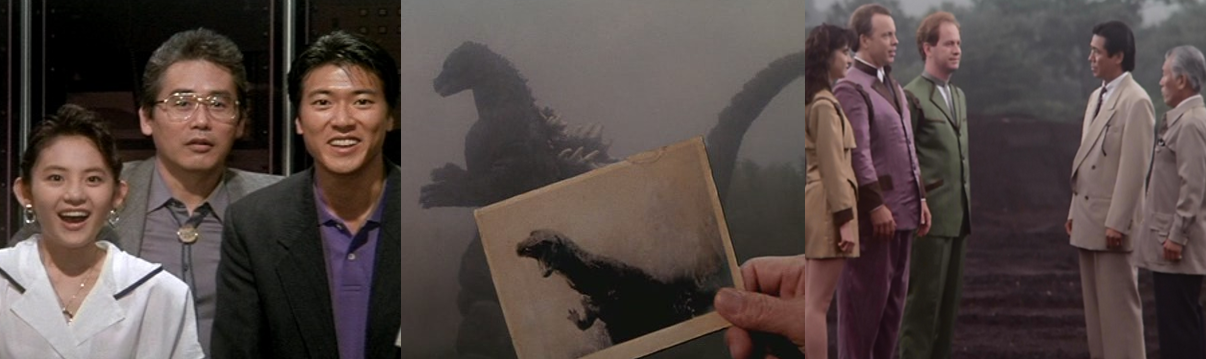
Oddly enough, as if all the kaiju action wasn’t enough, Godzilla vs. King Ghidorah heavily features a time travel plot. The film begins in 2204A.D., where King Ghidorah is little more than a mutilated skeleton at the bottom of the ocean, before jumping ahead to the then-present day of 1992 where all of Tokyo is shocked by the sudden arrival of a strange spacecraft on Mount Fuji. The unidentified flying object (UFO) instantly makes headlines but science fiction writer Kenichiro Terasawa has grown weary of the genre that has made him a “rich man” for his employers, Super Mystery Magazine, and is more interested in writing a detailed history of Godzilla. To that end, he interviews a number of World War Two veterans, including wealthy businessman Yasuaki Shindo (Tsuchiya), who were present on Lagos Island when Japanese troops were unexpectedly protected from the United States forces by the Tyrannosaurs rex-like Godzillasaurus, which they revere as a benevolent, powerful, protective spirit. Consequently, they believe the same to be true of Godzilla, especially as the world’s most famous kaiju is the mutated form of this dinosaur following hydrogen bomb tests. As is often the case in Godzilla films, the human characters are divided into journalists like Terasawa and the Japan Self-Defense Forces’s (JSDF) desperate attempts to combat the kaiju threat. In their efforts to uncover more information about the UFO, the JSDF turn to Miki Saegusa (Odaka), a character who has the rare distinction of appearing in subsequent Godzilla movies and is something of Godzilla expert and a budding psychic (because that’s often a thing in these movies, too). Because of this, she’s part of a team of specialists selected to ensure Japan’s future after the Futurians – Grenchiko (Richard Berger), Wilson (Chuck Wilson), Emmy, and their android, M-11 (Robert Scott Field) – deliver a morbid warning to Japan’s government, headed by the Prime Minister (So Yamamura).
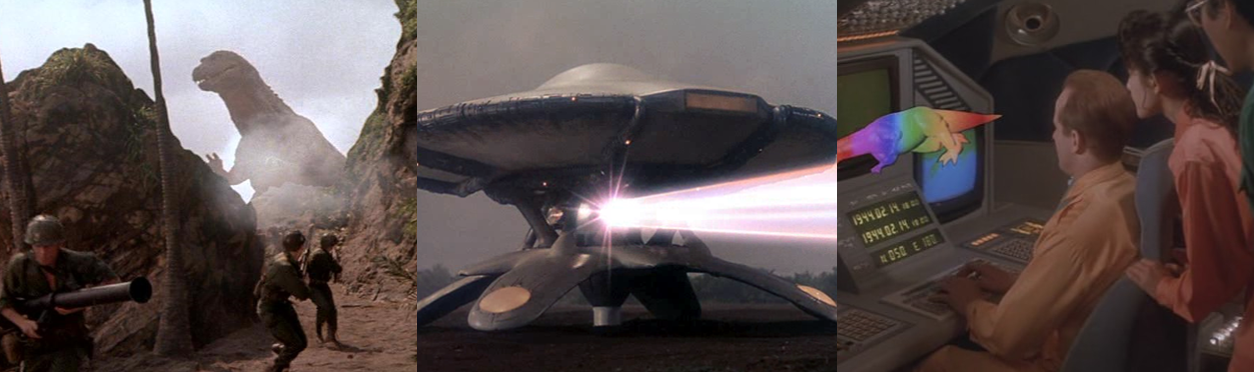
There, the seemingly benign Futurians completely disregard any sense of temporal paradoxes and time displacement to warn of a terrible future where Godzilla has decimated Japan following an unprovoked attack and devastating nuclear fallout. As proof, Emmy presents Terasawa’s book on Godzilla, thus bringing him into the JSDF’s investigation and confirming his theory that the Godzillasaurus became Godzilla. Thus, the Futurians propose travelling to Lago Island in 1944 and teleporting the Godzillasaurus to 1992, thereby sparing Japan’s social and economic future. Terasawa, Miki, and dinosaur expert Professor Hironori Mazaki (Katsuhiko Sasaki) join this expedition despite there being more qualified and experienced people, but Wilson hypocritically explains that this is because they can’t risk a temporal problem by sending, say, Shindo back to Lagos since he was already there as a young man (but changing the past by removing Godzilla is apparently fine…) Although Terasawa is disheartened to learn that his book didn’t make an impact in the future, he and the others are astounded by the Furtuians’ time ship. They travel through very Doctor Who-like swirls of colour to arrive in the past (spooking “Major Spielberg” (Daniel Kahl) in the process) and witness first-hand as the Godzillasaurus defends the brave and outnumbered Japanese troops. This is the first taste of kaiju action and it’s a little different from what we’re used to. Although it’s easily able to intimidate and crush the U.S. soldiers, the Godzillasaurus is far from the invincible titan we know and love and is easily felled by the Navy’s missiles. Badly wounded, the dinosaur is easily transported to 1992 by the Futurians, but they leave a substitute in its place: three small, winged Dorats that are hideously transformed by the nuclear radiation into a hydra-liked dragon!
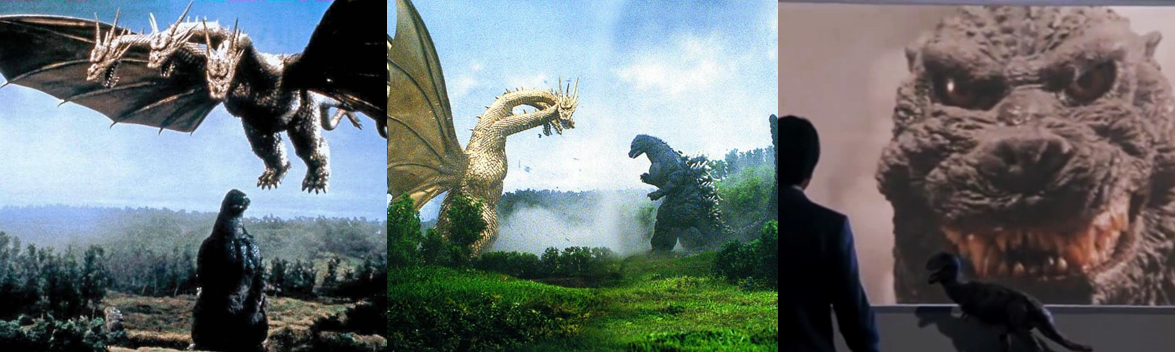
When Terasawa and the others return, expecting to face a more prosperous future without Godzilla (…though everyone still remembers Godzilla in another example of the film’s inconsistent time travel mechanics), they find Japan under attack by this three-headed mutate, the titular King Ghidorah. A screeching, golden-scaled, devil-like monstrosity, King Ghidorah mercilessly unleashes devastating lightning blasts upon Japan and the sight of it gliding through the skies and between skyscrapers is quite the nightmarish visage. Unrelenting and aggressive, King Ghidorah is controlled by the Futurians to wipe out Japan, which has actually become an economic superpower greater than the U.S., China, and even all of Europe. Feeling remorseful for her actions, and not wishing to see her home country annihilated, Emmy reveals the truth to Terasawa but their attempts to stop the government kick-starting the Godzillasaurus’s transformation into Godzilla with Shindo’s secret nuclear submarine fail when they’re intercepted by M-11. Thus, over forty minutes into the film, Godzilla and its iconic theme tune finally make an appearance as a newer, far bigger and far more hostile version of Godzilla is near-instantly created when it also absorbs the radiation from a crashed Russian submarine. It immediately clashes with King Ghidorah but not out of any sense of duty or to protect Japan as Shindo believes. This is purely a clash of territory and pride and Godzilla has no qualms about destroying parts of the city, and even obliterating Shindo himself, with its destructive atomic breath. Oddly, the two are said to be evenly matched, despite the fact that this new Godzilla is also said to be far more powerful than before thanks to being born from modern nuclear weapons. Godzilla thus topples its rival and lays waste to Tokyo, leaving Japan’s survival in the hands of Emmy and M-11, who jump to the future to augment King Ghidorah’s corpse and defend Japan against their violent attacker.
The Nitty-Gritty:
I mentioned up top that I purposely chose to watch the dubbed version of Godzilla vs. King Ghidorah. This is always my go-to viewing option for foreign-language films but it can’t be denied that the dubbing is pretty atrocious throughout the film, especially whenever the Futurians are speaking. Godzilla movies have always been deeply entrenched in the fallout from World War Two; the kaiju owes its existence to the War and is pretty much always surrounded by allegory of the dangers of conflict and nuclear power. However, it’s rare that a Godzilla movie actually tackles the Second World War directly and I believe that Godzilla vs. King Ghidorah was the first film in the franchise to actually depict events from the War and so many veterans from the conflict as being central to its story. Here, the U.S. is depicted as an invading, hostile force that overwhelmed the Japanese with ceaseless aggression. Though some American troops wish to see the conflict end, they do so under the shroud of victory for the stars and stripes rather than a more generalised end to the death and fighting. The Japanese forces are mercilessly cut down by their better equipped enemy and their final assault against the U.S. troops is framed as a brave and noble suicide run for the glory of the “motherland”, which is definitely a different perspective on the conflict and helps to humanise the Japanese forces.
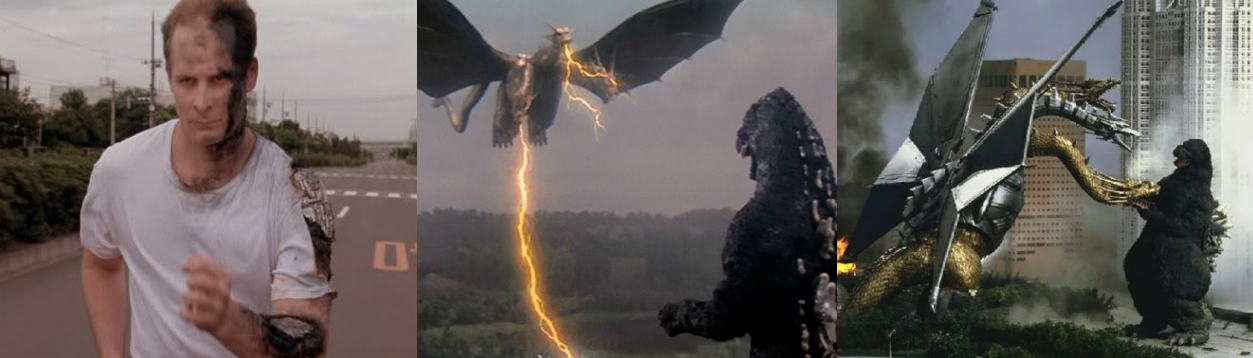
One of the major appealing factors of these Godzilla movies has always been the “suitmation” and practical special effects. Godzilla vs. King Ghidorah continues to evoke the Gerry Anderson aesthetic in its models, water scenes, and especially when depicting the UFO, which flails about unconvincingly compared to the awesome rubber kaiju suits. The UFO delivers such dated and questionable effects as a beaming technique and hologram effects that would put Star Trek: The Original Series (1966 to 1969) to shame and evokes the same concern and environmental message (and special effects) seen in The Day the Earth Stood Still (Wise, 1951), and offers a knock off of Skynet’s finest infiltrator units in M-11. Exhibiting superhuman strength, speed, and durability in ways that would make Colonel Steve Austin (Lee Majors) cringe, M-11 is perhaps their greatest weapon outside of their impressive teleportation device, which instantly transmits objects across both time and space. Thankfully, the film doesn’t rely on these dodgy optical effects and the rubber suits are soon out in full force. King Ghidorah is one of the franchise’s most technically impressive monsters, a combination of a man in a suit, animatronics, and puppetry that cuts through the sky, stomps around on elephantine feet, and constantly spews crackling electricity. Though far bigger and subjectively more powerful than Godzilla, King Ghidorah is hampered by the humans that control it, meaning it goes wild once Terasawa, Emmy, and the reprogrammed M-11 storm the Futurian time ship in a laser pistol fight. This allows Godzilla to blast off one of King Ghidorah’s heads and send it crashing into the ocean, leaving this aggressive and unfriendly Big G to rampage through Tokyo unopposed.
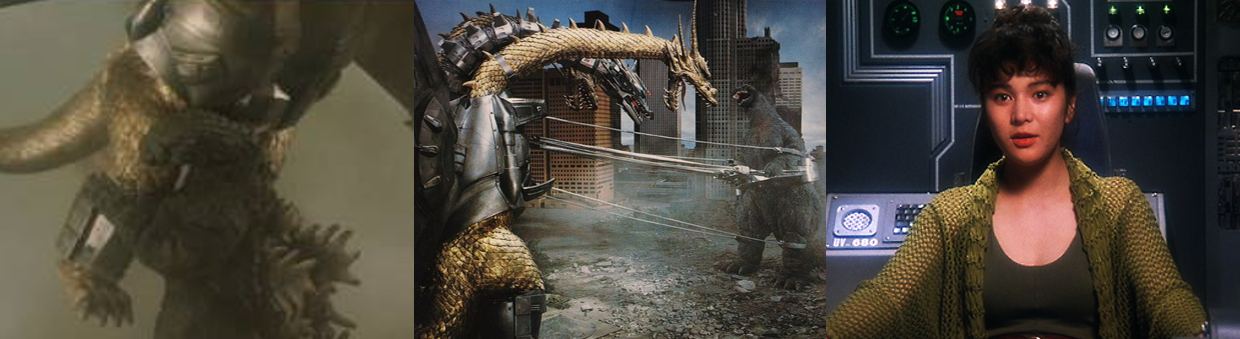
With Godzilla’s personality and aggression fundamentally altered and heightened, Japan has no hope of fending off her attacker with either conventional weaponry of the JSDF’s high-powered energy beams. Godzilla simply shrugs off attacks, topples skyscrapers and landmarks, and obliterates everything with its unmatched atomic breath. However, after a jaunt to the future, Emmy comes back piloting the cybernetically-enhanced corpse of King Ghidorah and battles with Godzilla to protect her beloved country. The humans we’ve been following become completely obsolete in this climatic and action-packed finale, which sees Grenchiko and Wilson atomised and the fate of Japan in the hands of Emmy and Mecha-King Ghidorah. Thus, the finale comes down to a rare case of a human piloting a mechanical kaiju-destroying creature rather than two wild monsters going at it. However, while Mecha-King Ghidorah is bolstered by future technology and armour, this new Godzilla is more powerful and aggressive than ever. It easily withstands Mecha-King Ghidorah’s boosted lightning and relentlessly attacks with its atomic breath, forcing Emmy to take a different approach, at great risk to herself. She grabs Godzilla in mechanical clamps and flies it to the ruins of Tokyo, dumping it in the sea. Though Mecha-King Ghidorah is destroyed, Emmy survives and reveals that she’s Terasawa’s ancestor (making the subtle attraction and flirtation between them a little awkward) before returning to the future. However, Godzilla soon reawakens at the bottom of the ocean but decides it would rather stomp away than resume its attack, making for an anti-climatic finish as it’s always disappointing when Godzilla is simply tossed aside rather than actually defeated.

The Summary:
I’m massively biased towards Godzilla vs. King Ghidorah since it was the first Godzilla movie I ever saw and got me hooked on the franchise, and there’s a lot to like here. The suits and monster-on-monster action are big, detailed, and very action-packed. King Ghidorah, especially, had never looked better prior to this film. While its design is a little clunky and bizarre since it lacks arms, its three heads, incessant screeching, and explosive lightning make for a formidable threat and it was pretty cool seeing it come back augmented with futuristic technology as Mecha-King Ghidorah. Godzilla is also pretty great in this film; while it takes a long time for it to show up, we get a revised origin for the kaiju and a return to its more aggressive personality as time travel shenanigans see it reborn as a hostile creature more akin to its original depiction. It is absolutely relentless in its rampage, spewing atomic breath all over the place and appearing more terrifying and formidable than ever. Sadly, the kaiju action takes way too long to kick in, leaving us with this bizarre time travel plot that’s full of temporal anomalies and reduces King Ghidorah to a puppet of these pantomime-like villains whose cringe-worthy lines and personality rob them of any menace. It was interesting, if a little unorthodox, to depict scenes from World War Two and explore an alternative origin for Godzilla, but the poor attempts to copy from better, big-budget science-fiction films really handicaps the overall plot. I feel like Godzilla vs. King Ghidorah overcomplicates and overstuffs things, making its human characters more inconsequential than usual as they don’t really get much to do except be stunned and betrayed. Also a disappointment is the film’s finale, which simply sees Godzilla dumped into the ocean…which is where it generally lives anyway so I’ll never understand how this is supposed to defeat it. Still, when the kaiju are actually going at it and when the dubbing is at its exaggerated best, the film is very enjoyable, but it does a drag a bit as the plot trips over itself to limp towards the titular clash of these two long-standing rivals.
My Rating:
Great Stuff
What did you think to Godzilla vs. King Ghidorah? How did you feel about its time travel plot and the changes made to Godzilla’s creation? Did you like King Ghidorah’s revised origin and what did you think to Mecha-King Ghidorah? Were you also disappointed by the film’s inconsistent and nonsensical time travel shenanigans and poor attempts to rip-off other sci-fi films? What is your favourite Godzilla movie and why? How are you celebrating Godzilla Day this year? Whatever your thoughts on Godzilla vs. King Ghidorah, or Godzilla and kaiju films in general, feel free to leave them below.

 Dr. K's Waiting Room