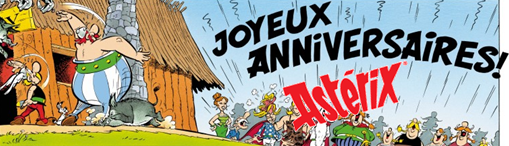
Asterix the Gaul (and his best friend Obelix) first debuted on 29 October 1959 as a serial in the French/Belgium magazine Pilote. Since then, the plucky Gauls have gone on to have many adventures in comic books, videogames, and feature-length productions and Asterix himself has become a popular and enduring character in his native France and around the world as Asterix’s stories have been translated into over a hundred languages across the world.


Story Title: “Asterix the Gaul” (French: “Astérix le Gaulois”)
Published: 29 October 1959 to 14 July 1960
Writer: René Goscinny
Artist: Albert Uderzo
The Background:
After years of struggling to find work as a comic strip writer, René Goscinny met reluctant artist Albert Uderzo while working for the World Press agency in 1951. The two worked on many projects over the next ten years before they created an instant hit in the pages of Franco-Belgian comics magazine Pilote with Asterix, a plucky Gaulish warrior who battled invading Roman forces alongside his wacky friends. The idea came about through a brainstorming session between the two. Inspired by the mostly overlooked Gaulish period in French history, the two were enthused at the potential and relished infusing the stories with as many puns as they could. After being serialised in Pilote, Asterix’s first adventure was released in a single volume, the first of an annual series, until 1997 when Goscinny tragically died. Although he continued solo for a while, Uderzo eventually signed the rights over to a new generation of creators so that Asterix’s stories could continue. Since then, Asterix has become an incredibly popular character all over the world, selling nearly 400 million books, and has been adapted into videogames, toys, and both live-action and animated features (the first of which was, fittingly, an adaptation of this very story).
The Review:
If you’ve ever read an Asterix book or watched one of the movies (or even played one of the games), you’ll know there’s always a little introduction piece that sets the scene for the story and the world of these books. Asterix the Gaul is, naturally, the first instance of that and expands upon this paragraph of text in its first few panels. The year is 50 B.C. and ancient France (known as “Gaul”) has been conquered by the Romans. In the face of such overwhelming military might, Gaulish chiefs like the legendary Vercingetorix (literally) lay their arms at the feet of the power-hungry Julius Caesar and “peace” reigns throughout conquered Gaul. However, while the Romans have laid claim to the entirety of ancient France, one small village of indomitable Gauls refuses to surrender. Baffled by the Gaul’s stubborn nature, Caesar sets up four Roman camps (Aquarium, Totorum, Laudanium, and Compendium) to surround the village and orders repeated attacks, only for his troops to be bested time and again by brave warriors such as our titular hero, Asterix, and his hulking friend, Obelix. Over a dinner of piping hot roast boar, Asterix laughs off the Roman threat, which he and his fellows constantly repel thanks to the magic potion brewed by their druid, the venerable Getafix. As luck would have it, Asterix is due his daily dose of the potion so he and Obelix pay Getafix a visit. Getafix cooks up a batch of the magic potion, whose recipe is a closely guarded secret amongst his kind and one sip of which bestows incredible superhuman strength, but only for a short time. Since he fell into a cauldron of potion as a baby and drank the entire batch, Obelix is permanently empowered and is denied any potion out of fear for his safety, though he believes the druid is treating him unfairly.
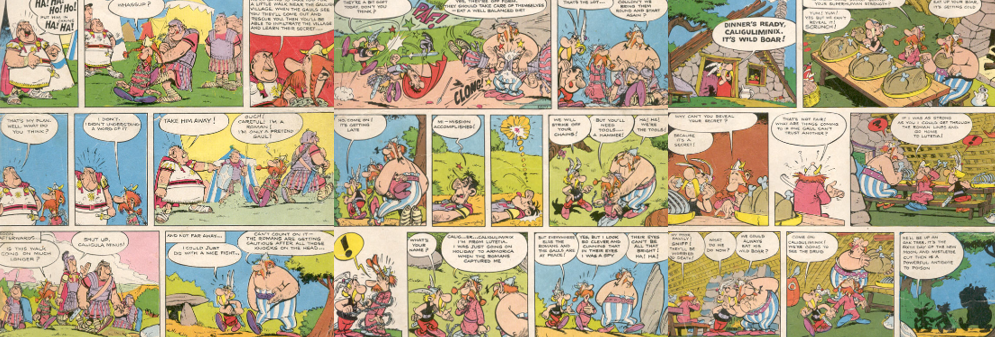
At Compendium, the camp centurion, Crismus Bonus, is enraged that four of his soldiers could be so easily bested by one measly Gaul and vows to discover the secret of their superhuman strength. However, the Gauls strength is so feared that volunteers to infiltrate their village are scarce. Thus, Crismus orders his troops to play musical chairs to decide on a volunteer, and poor Caligula Minus loses out. Since his only options are to act as a spy or be roasted alive, Caligula reluctantly agrees to be disguised as a Gaul, much to the amusement of his peers, and paraded through the forest as bait for the Gauls. Luckily, Asterix and Obelix just so happen to be strolling through the forest looking for a fight. They don’t suspect a thing and make short work of Caligula’s “captors”, rescuing him and bringing him back to their village to keep him safe, where he gives his name as “Caliguliminix”. Caligula is astounded by the Gaul’s village, where everyone (even the children) is armed and ready to fend off Roman attacks. He’s welcomed by the village chief, Vitalstatistix, and amazed to see that the Gauls use their bare hands to temper metal, deliver menhirs, and lug around giant carts full of felled trees. While eating with Asterix and Obelix, Caligula enquires about the secret to their strength and produces crocodile tears when Asterix initially refuses to share their secret. Deciding to help their fellow “Gaul”, the duo take him to Getafix, who’s equally convinced to help when Asterix and Obelix guilt-trip him into it to get Caliguliminix back “home” to his “family”.
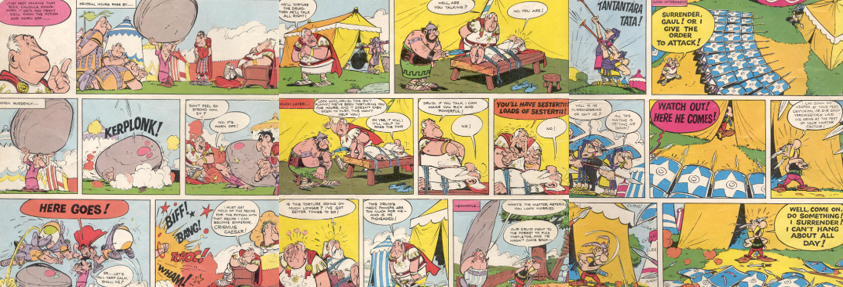
Though initially uncertain of the potion’s effect, Caligula revels in his ability to manhandle a giant boulder, but learns the hard way that the potion only makes one super strong, not invulnerable. His cover is quickly blown when his fake moustache is pulled off during a traditional Gaulish dance and he blasts back to Compendium at super speed before the Gauls can stop him. Back at Compendium, Caligula excitedly reveals the secret to Crismus and demonstrates the potion’s power, first by beating up a bunch of soldiers and then holding a large boulder over his head. Despite the Gauls stating that the potion’s effects are only temporary, it takes “several hours” before Caligula returns to normal. As the soldiers take their revenge for their earlier beating, Crismus dreams of stealing the potion for himself to usurp Caesar and orders his troops to kidnap Getafix when he goes into the woods for ingredients. When Getafix refuses to divulge his secret, Crismus straps him to a table and subjects him to the horrific torture of…having his feet tickled by a feather! Yet, the druid holds his resolve, even when Crismus tries to bribe him with “Sestertii”, the currency of the era. Concerned about Getafix’s welfare, Asterix searches the forest and comes across an ox dealer with a quandary: if he sells his oxen, he won’t be able to pull his cart. He’s so grateful to Asterix for providing him with a solution (selling his cart and keeping the oxen) that he gladly gives the Gaul a lift to Compendium after revealing he saw a druid being taken there in chains. After sneaking through the camp, Asterix first overhears Crismus’ plan to overthrow Caeser with the aid of his number two, Marcus Giantonicus (though the two secretly plan to betray each other), and then discovers Getafix. Rather than rescue the druid, though, Asterix decides to have some fun with the Romans and promptly surrenders to them, winding up in chains alongside his friend.
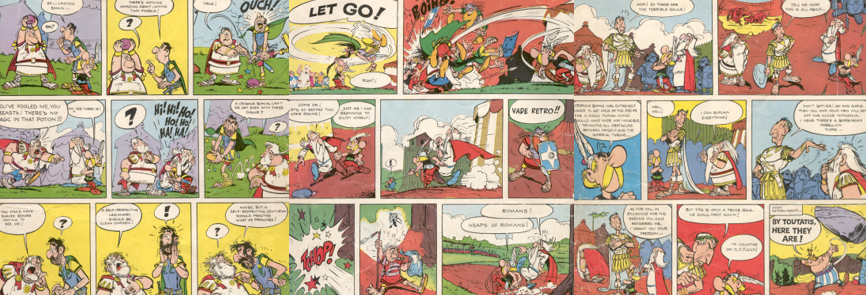
When Asterix refuses to speak, Crismus brings in his overly enthusiastic torturer and prepares to loosen Getafix’s tongue by having him witness his friend’s suffering. However, when Asterix comically pleads for mercy at the torturer’s merest touch, Getafix finally caves and requests to go into the forest for ingredients. After making fools of his escort, Getafix insists that he needs strawberries to complete the potion. Despite them being out of season, Crismus orders his troops to go find some and, days later, one soldier returns with a tiny (and expensive) punnet…only for Asterix and Getafix to scoff the lot and demand more! Driven to tears by frustration and rage, Crismus is ecstatic when Getafix whips up the potion regardless and forces the ox dealer to try it in case it’s poisonous. Since the Romans are reluctant to take another bashing, Asterix volunteers to test the man’s newfound strength and summarily drops to the ground as though the “sky had fallen on [his] head”. The ox dealer leaves, dreaming of profiting from his great strength, and Crismus and his troops greedily devour the potion, convinced of its potency, only to find it’s caused the hair of their heads and faces to grow uncontrollably! The duo tease Crismus with their lackadaisical attitude and hair-related puns, but promise to make an antidote. After another amusing trip to the forest, Getafix makes a big cauldron to cure the hair problem and a small pot of real magic potion for Asterix. Once they’ve had their antidote, Crismus orders his troops to attack, only for Marcus to summarily manhandled. Although the Gauls find themselves surrounded when they leave the camp and Crismus delights in his pending victory, they’re all stunned when Julius Caesar himself shows up for an update. After learning of Crismus’ ambitions, Caesar banishes him to out Mongolia and allows the Gauls to go free, though both promise to continue their vendetta.
The Summary:
As big a fan of Asterix as I am, I have to say that I’ve never been a big fan of this book, or the character’s early tales. The artwork is a little off; it’s less cartoony and more “sketchy” than in later stories, and the characters aren’t quite themselves yet. The most obvious example is Obelix, who’s less of a simple-minded, brutish oaf and more a morose bystander who doesn’t get much of anything to do here. The same is true for all the villagers who aren’t Asterix and Getafix; the only other one who stands out is Cacofonix, whose musical arts aren’t appreciated (unless they want to dance and then they’re all for it). I don’t say this to knock Asterix the Gaul; it’s the first story so obviously I don’t expect every character to be fully fleshed out and it’s true most of them become one-note caricatures as the books continue on, it’s just a little jarring when compared to later stories. Still, much of the patented Asterix humour is here; that means puns aplenty, especially in the characters’ names, and some fun fisticuffs. However, there’s a lot of padding here: the characters visit Getafix and pop into the forest more times than the story needs, repeating a lot of the same gags (like Getafix pricking himself on his sickle) and demonstrating the potion’s abilities in scenes that not only read the same, but look the same, too. It is essential, of course, for showcasing the effects of the magic potion to the Romans and the reader, but I do wonder if a bit of visual variety wouldn’t have worked better than seeing characters lift rocks over their heads all the time (though I do admit that the payoff – “I’ve done it! I’m a superman!” – always makes me giggle).
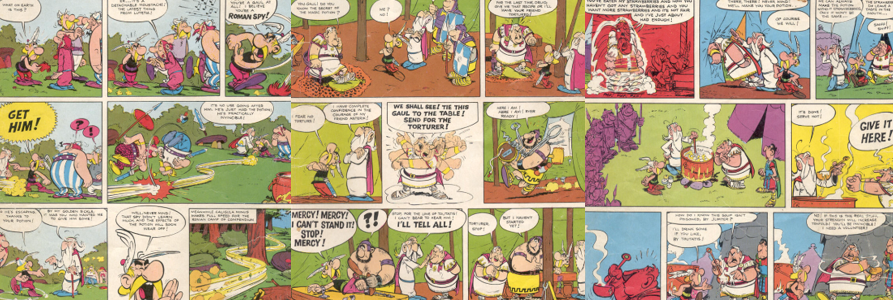
Much of the story is focused, fittingly, around establishing Asterix as a character. Not only is he a capable fighter, but he’s shown to be cunning, mischievous, and intelligent, too. He could’ve easily rescued Getafix and stormed out of Compendium, but he chose to stick around and have some fun with the bungling Romans, making fools out of them with needless tasks, mockery, and Getafix’s hair growth potion. He’s shown to be shrewd enough to sneak into the camp and adaptable enough to tattle on Crismus to Caesar, thereby ensuring his and Getafix’s safe return to the village and the first of many feasts. However, he’s not perfect; he’s as fooled as anyone else by Caligula’s Gaulish disguise and decides to help his fellow “Gaul” despite the village keeping their potion a closely guarded secret. While this doesn’t really result in any immediate consequences for the village beyond the Romans discovering the source of their strength is a potion and thus targeting Getafix, it does show that even the insightful Asterix makes mistakes, which the druid calls him out on. While I much prefer these stories to have a bit more Roman bashing, there’s some fun to be had in Asterix the Gaul. I liked the wild strawberry chase Asterix sends them on and him and Getafix messing with Crismus, and the book nicely lays the foundation for what would become long-running gags for the next seventy-odd years and, while I prefer other Asterix stories, this is still a highly recommended read.
My Rating:
Pretty Good
What did you think to Asterix’s first story? Did you like the less cartoony art style of his earlier adventures? Were you disappointed that Obelix and the others didn’t have more to do or did you like the way the story established Asterix’s character traits? Which of the puns was your favourite? How are you celebrating Asterix today and what are your favourite books or moments of his? Whatever your thoughts on Asterix, please leave a comment below and go check out my other Asterix content!

 Dr. K's Waiting Room
5 thoughts on “Back Issues [Asterix Anniversary]: Asterix the Gaul”