In Back to the Future Part II (Zemeckis, 1989), Marty McFly (Michael J. Fox) travels to October 21, 2015, which is known as “Back to the Future Day” to celebrate the franchise and science.

Released: 25 May 1990
Director: Robert Zemeckis
Distributor: Universal Pictures
Budget: $40 million
Stars: Michael J. Fox, Christopher Lloyd, Thomas F. Wilson, and Mary Steenburgen
The Plot:
After witnessing his eccentric scientist friend, Doctor Emmett “Doc” Brown (Lloyd), forcibly transported to 1885 in his time-travelling DeLorean, high school student Marty McFly (Fox) travels to the Old West to save his friend from an untimely death, only to discover Doc endangering the timeline by falling for schoolteacher Clara Clayton (Steenburgen).
The Background:
Back to the Future (Zemeckis, 1985) started as a passion project for long-time collaborators Bob Gale and Robert Zemeckis to recover from a few critical and commercial failures. After refining their script and securing Michael J. Fox for the lead, the duo succeeded in making the sleek and futuristic DeLorean an iconic cinema vehicle and a blockbuster commercial and critical success now recognised as one of the greatest science-fiction films of all time. As Zemeckis never planned for a sequel, the filmmakers faced script and cast issues but ultimately decided to film Part II (Zemeckis, 1989), also a critical, commercial, and influential release. It was apparently Fox who suggested setting Part III in the Old West, which involved constructing elaborate sets on location to depict the burgeoning Hill Valley. The film was not without its dangers: Thomas F. Wilson performed many of his own stunts and Fox almost died while filming the hanging scene! Industrial Light & Magic again worked on the film’s practical and visual effects, including an elaborate model train and track for the thrilling final sequence. With a box office of $245.1 million, it was the lowest-grossing movie in the franchise and yet is still highly regarded for bringing the trilogy to a satisfying close, the performances, and the new character dynamics introduced. With this film, Back to the Future is widely regarded as one of cinema’s best trilogies. While another film has been long rumoured, and the story has continued in comic books, videogames, and a short-lived cartoon, Zemeckis repeatedly stated that there would never be another entry as long as he’s alive.
The Review:
When I was a kid watching the Back to the Future trilogy for the first time, there was a clear hierarchy of preference for me: the second one was the best because of all the fun future stuff, the third was the second best as it had more action than the first, and the first took the bottom spot as it was a little slower and had less visual appeal for me. This was somewhat begrudgingly as I’ve never been a big fan of Westerns; I find them visually dull and narratively repetitive, so it helps when Westerns have a sci-fi or horror bent to them. Over the years, I’ve come to regard Back to the Future III even higher because of the satisfying and emotional way it repeats, continues, and wraps up these characters and the entire franchise to make for one of the most consistently strong trilogies in all of cinema. The film begins by once again replaying the final moments of the first film, in which Doc helps a time-displaced Marty return to 1985 by redirecting a lightning bolt into the time machine. Elated at seeing one of his inventions finally working, and by the prospect of the future to come, Doc celebrates in the street and prepares to head home, eager to get started on his greatest invention, only to be shocked when Marty suddenly reappears before him! This is, of course, a slightly different, older, and more experienced version of Marty, one who’s just seen Doc’s future self blasted back to the Old West by an errant lightning bolt after having revisited 1955 to fix his mistakes from the last film, but the sudden shock is enough to cause Doc to faint in the street.
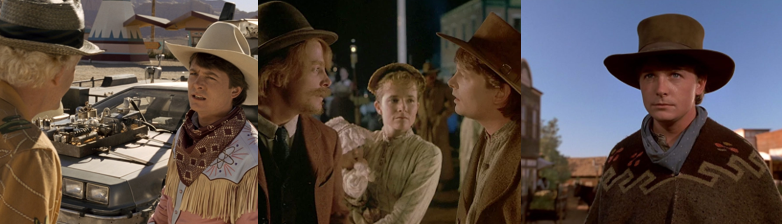
Marty takes Doc back to his house and desperately tries to explain the situation to him. I like this scene as it recalls the disbelief and confusion Doc showed towards Marty in the first film (Doc even sarcastically calls Marty “Future Boy!”) However, thanks to Future Doc sending Marty a letter corroborating these events, Past Doc’s adventure with Marty, and the fact that the film needs to get moving, this confusion doesn’t last too long and the two are soon working together like before to unearth the time machine from an abandoned mine at the cemetery. While there, both are horrified to discover Doc’s tombstone stating that he was shot dead by Buford “Mad Dog” Tannen (Wilson) just one week after writing the letter, meaning he never got to enjoy the retirement he’d always dreamed of in Old West. After reading up on Tannen and confirming that the tombstone is real since Doc’s family line didn’t arrive in the United States until long after 1885, Marty resolves to take the repaired time machine and rescue his friend. Thanks to Doc’s detailed schematics, Past Doc makes the necessary repairs and uses his knowledge of fourth dimensional science to get Marty on his way. This is a recurring aspect that Marty struggles with in the film; he has to put his faith in Doc (“You’re the doc, Doc”) that he knows what he’s talking about since he doesn’t understand spatial or quantum physics. What he does know, however, is Westerns. He’s not impressed with the clown-like getup Doc dresses him in and even more embarrassed when his ancestor, Seamus McFly (Fox), helps him avoid social faux pas by gifting him a hat, neither of which fit his idea of Western icon Clint Eastwood. Indeed, Marty even uses the actor’s name as a pseudonym but, rather than being seen as a bad-ass, he’s routinely mocked by the locals. It therefore makes it all the more cathartic for him when he not only adopts a poncho and outfit resembling Eastwood’s “Man with No Name” but also borrows the same “bulletproof vest” trick from A Fistful of Dollars (Leone, 1964) to best Tannen.
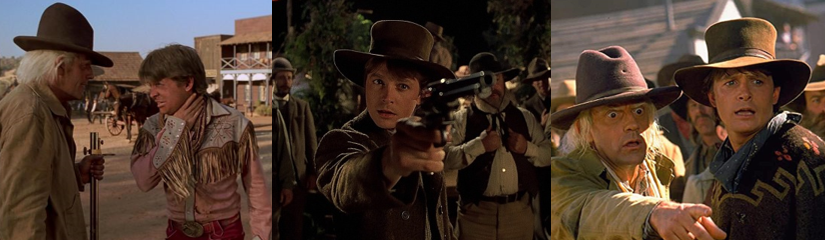
Marty’s friendship with Doc is at the forefront of Back to the Future Part III. Before, Marty relied on the eccentric scientist to advise him and the youngster was mainly cleaning up messes that he’d made. This is still true here but Marty’s whole motivation for defying Doc’s wish to stay in the past is entirely predicated on him wanting to save his friend’s life. However, thanks to an errant arrow, the time machine suffers a fuel leak and the two are stranded in the past similar to the first film. With no gas stations and horses proving ineffectual, the two scramble to find a viable way to get the DeLorean to eighty-eight miles per hour before Tannen makes good on his threat to shoot Doc dead. Doc takes the threat very seriously and, while he’s happy to live out his boyhood dream working as a blacksmith in the Old West, immediately recognises the danger. However, things are further complicated when they happen upon an out of control carriage and rescue schoolteacher Clara Clayton from a fatal fall. Despite being a man of science, logic, and reason, Doc is immediately smitten by Clara and re-evaluates his situation accordingly. This has the unique knock-on effect of briefly switching Marty and Doc’s roles (Marty becomes the voice of reason and Doc becomes the irrational, emotional one), which is further emphasised when Marty also runs afoul of Tannen. Like the first film, this sees their actions impact the future and the tombstone depict the death of “Clint Eastwood” by Tannen’s hands. This comes about because of Marty’s refusal to back down to a challenge and him getting triggered whenever anyone brands him a “chicken” (or “yellah”, in this case). Marty is so riled up by accusations of his cowardice (a holdover from his previous life where his father was a snivelling coward and Marty’s attempts to avoid the same stigma) that he readily agrees to a shoot-out with Tannen, confident that he and Doc will have returned to 1985 by then. However, he’s both horrified to learn he could be forced into a fatal dual and angry at Doc’s suggestion that his pride has negative consequences in his future, something we saw in the second film but which Marty remains unaware of. Thus, Marty’s character arc here is listening to his friend and ancestor over the jeers and opinions of others and realising that it’s better (and braver) to turn the other cheek rather than to step up to an unwinnable fight just to prove himself to a bunch of strangers and assholes.
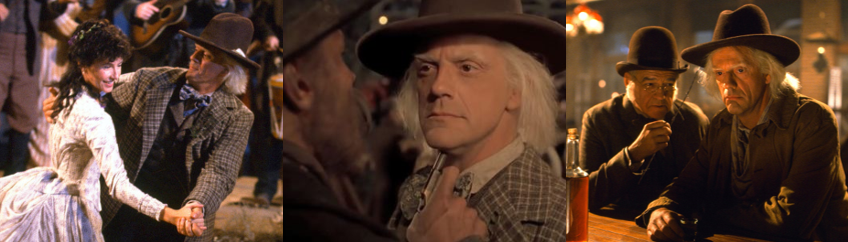
Doc also undergoes some significant character growth here. Having devoted his entire life and fortune to science, Doc’s dreams of seeing the progress of mankind and understanding the nature of existence have been tarnished by witnessing the dangers of time travel. Thus, his instructions and intentions are explicitly clear: he wants the time machine destroyed once they’ve returned to 1985. It’s because of this that he’s perfectly happy living out the rest of his life as a blacksmith in the Old West. He’s quickly established a reputation in the small settlement of Hill Valley and has clearly been enjoying cobbling together steam-powered apparatus and would’ve gladly stayed there if not for the threat against his life. He’s completely caught off-guard, then, when he falls for Clara; initially dismayed to learn that they altered history by saving her, he’s quickly smitten by their shared love for science, astrology, and Jules Verne. Although he scoffs at the idea of love at first sight, Doc can’t deny his feelings for Clara, and he’s fully prepared to stay in 1885 with her but is left heartbroken when she angrily rebuffs him after he’s convinced by Marty to tell her the bizarre truth. In despair, he turns to alcohol and rambling about the future to the locals. After being sobered up by Marty, Doc re-commits himself to their elaborate train heist, having deduced that the only possible way to get the DeLorean to eighty-eight miles per hour is to hijack a train, strap the time machine to it, and boost the train’s engine with controlled explosions. I enjoyed the new wrinkles to Doc’s character here; unlike Marty, he’s comfortable in the Old West and he’s definitely come out of his shell, standing up to Tannen and socialising with the locals. I liked seeing him discover there’s more to life than just science, and his friendship with Marty was explored in new ways through this altered dynamic that saw Marty being the voice of reason for a change.
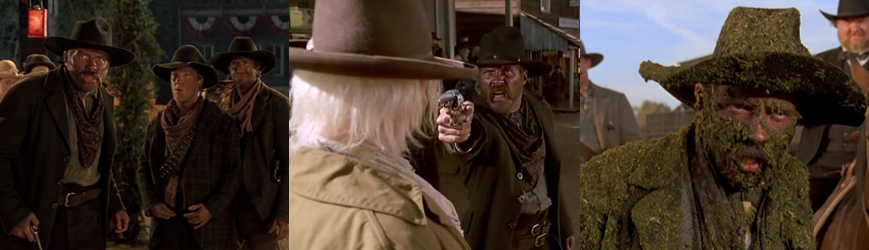
Once again, Marty and Doc are opposed by one of the Tannen family. This time, it’s Biff’s (Wilson) surely and uncivilised ancestor Buford, who is also accompanied by cackling underlings and has a reputation as a cruel gunslinger and thief. Tannen makes his entrance as all in his line, by confronting a McFly in a bar, and regularly flaunts the law (represented by Marshal James Strickland (James Tolkan)) by dragging Marty through the streets and threatening to hang him as well as sneaking a gun into the town festival. While there is a lawmaster in town, Buford thinks nothing of publicly threatening those who he feels have wronged him and challenging them to a dual. While Buford is as dumb as previous Tannens, easily confused by words and phrases (even those not from beyond his time period) and numbers, he’s a ruthless and callous individual. Although he may hate the nickname “Mad Dog”, it’s entirely appropriate given his drooling, snarling, brutish disposition and he’s little more than a growling thug in a Stetson. Tannen believes Doc owes him $80 after his horse threw a shoe and refuses to be placated by reason since he believes he’s been slighted. When Marty openly defies him at the festival, saving Doc’s life in the process, Tannen shifts his aggression towards the youngster and challenges him to a morning shoot-out, much to the chagrin of Seamus and Doc. Marty, however, is confident he won’t have to think about drawing a gun but that doesn’t end up being the case. Although they have the DeLorean ready and a plan to escape, Doc’s heartbreak causes them to be late and forces Marty to face Tannen in the streets. However, Marty wisely chooses to fight smarter, not harder, once again outwitting the bullish gunslinger and sending him crashing into a pile of manure.
The Nitty-Gritty:
Back to the Future Part III continues the formula established by the last two film that time often repeats. This means we get a sweeping shot of Hill Valley and the clock tower (before still under construction), a McFly/Tannen confrontation in a bar, a chase through the streets, and ruminations on the dangers of messing with time travel. However, rather than being derivative, these are all re-framed in new and visually interesting ways. The Old West setting is an extreme reconfiguring of the 1955 setting of the first film, with Marty and Doc being hampered and severely limited by the technology and resources of the time, only things are way more dangerous now as everyone’s walking around with a gun on their hip and even things as simple as petroleum are impossible to come by. Like in the first film, time itself is a major antagonistic force here. Marty and Doc have less than a week to figure out how to get the DeLorean running and the photograph of the tombstone is a constant reminder of this ticking clock (though, strangely, they never once consider hopping on a train and leaving town for a bit. Considering Buford is later arrested for robbery, this might’ve actually worked!) This is only exacerbated when Buford grows restless for a gun fight and Doc falls into despair over Clara, which is naturally all in service of Marty again getting the better of a Tannen and a thrilling train heist for the finale.
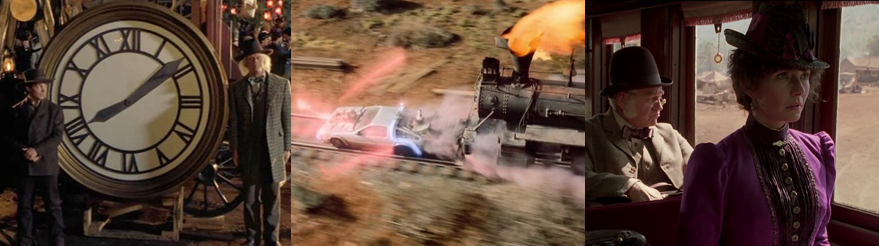
Although it takes Marty a bit to adapt to the Old West, I’d argue both he and Doc acclimatise to 1885 much faster and better than either did to 2015. Both enjoy walking the streets in their era-appropriate getup, Doc revels in applying his scientific acumen in new ways as a blacksmith, and Marty definitely gets a kick out of parading around with a gun and calling himself Clint Eastwood. While Marty’s gunslinging was mocked in 2015, he impresses in 1885 and he still finds new ways to adapt to the times, such as tossing a Frisbee-branded pie plate and protecting himself with a furnace door. One of the reasons I dislike Westerns is because of how visually repetitive and boring they can be but that’s not the case here, largely because I’m so familiar with Hill Valley from the last two films and it’s fun seeing it reimagined as a dangerous and often disgusting smattering of wooden structures in a desert. While I prefer the fantastical technology of the future setting, I’ve grown to appreciate the simplicity of the Old West aesthetic and I liked seeing stuff like Marty’s Nikes and modern slang being completely lost on the locals. For me, Clara is a more prominent downside to the film. I never found her to be particularly interesting or charismatic and she seems oddly plain in a way that I find distracting. I like that she’s just an unassuming schoolteacher, a slightly insecure and mousy woman who is as uncertain about her newfound feelings as Doc, but I feel like she could’ve been given more to do. Mostly, she’s just kind of there and bolstered only by her convenient fascination with science and literature and she’s often in peril a little too much for my liking. I appreciate that she stands up to Buford, and her physicality in the finale as she rushes to reconcile with Doc, but I think it might have helped to see her at work in her profession or exhibiting a little more personality. On the plus side, this allows the new dynamic between Doc and Marty to shine brighter but I can’t help but feel like the romance between Doc and Clara is a little rushed and flat. The film tries to salvage this by stating that it’s unexplainable love at first sight and by Doc’s obvious inexperience with romance, but just a little more agency like she showed at the festival to make her seem like more of an equal would’ve gone a long way for me.
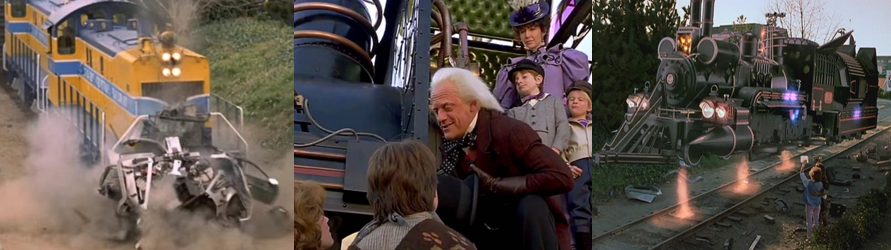
As ever, Back to the Future Part III makes use of some fantastic practical and traditional effects and models shots. While the film isn’t as grandiose as the last one, the stunt and horse work on display is impressive and the costume design alone should be a selling point for any fan of Westerns. Marty cuts a resplendent, mature figure in his Clint Eastwood cosplay and it’s exhilarating seeing him and Doc frantically chase after the train on horseback. Once aboard, they clamber over the carriages and politely hijack the main engine, decoupling all the carts and attaching the DeLorean to the cow catcher. Thanks to some specially prepared explosives, Doc pushes the train’s speed and capabilities further than intended, but staggers the explosions so as not to destroy the train prematurely. However, Clara catches up with them, having heard of Doc’s distress over her and become convinced that he was telling the truth, and almost falls from the train in a bid to join them on their journey. Doc’s character growth comes full circle as he braves the trip back to get to her and Marty also puts aside his personal feelings to help save them by slipping them the hoverboard. His friends then glide to safety as the DeLorean finally hits eighty-eight and returns to 1985, the train crashing into a ravine thanks to a spectacular model shot. Fourth dimensional science sees Marty safely arrive in 1985 but his elation is short-lived as he has to quickly abandon the time machine and can only watch, with a mixture of despair and gratitude, as Doc’s wish comes true and the DeLorean is obliterated by an oncoming train. Marty immediately reconnects with his girlfriend, Jennifer Parker (Elizabeth Shue), not only finally telling her the truth but also altering his future when by refusing to race Douglas J. Needles (Flea). While mourning the loss of his friend, Marty is stunned when Doc suddenly arrives in a time travelling steam engine…alongside not only Clara but their young children, Jules (Todd Cameron Brown) and Verne (Dannel Evans). Although the film makes no attempt to explain how Doc built this contraption, this ridiculous oversight is secondary to the heartfelt farewell he and Marty bid to each other and Doc’s impassioned, enthusiastic speech about Marty and Jennifer being free to decide their own futures.
The Summary:
Even now, it’s hard to name a film trilogy that’s as consistent and enjoyable as the Back to the Future films. Each one has strengths and unique, enjoyable aspects that help to keep the themes fresh and engaging, and the story arc for Doc and Marty across the three movies is beautifully realised here. I loved how Marty was now much more confident and surer of himself in his new setting and how he took on the more adult voice of reaso. Him realising that he doesn’t have to answer every challenge to prove himself was also nicely resolved here to show that he’s really learned from his adventures. Similarly, I enjoyed that Doc found something else to live for besides science and his work. Although disillusioned with time travel, he discovers love for the first time, its highs and lows, and is a better person for it, with him and Marty become more well-rounded characters by learning from each other. While I would’ve liked to see more from Clara, she was serviceable enough and I think Buford may be the best and most dangerous Tannen we’ve seen yet. He’s a dog of a bloke and it’s great to see him bested once again. Add to that the visuals, thrilling action, and emotional finale and you have a film that wraps up the franchise in such a perfect way that it really would be a shame to spoil it with a remake (although I would’ve loved to see a re-quel with an older Marty dealing with a rebellious son). While I still prefer the imaginative visuals and high stakes of the second film, Back to the Future Part III has become a firm favourite of mine for how well it uses its Old West setting and its thematic and emotional conclusion to one of the best sci-fi stories (and cinema trilogies) of all time.
My Rating:
Great Stuff
Are you a fan of Back to the Future Part III? How do you rate it compared to the other two films and which of the trilogy is your favourite? What did you think to the Old West setting and the pitfalls facing Doc and Marty? Were you a fan of the romance between Doc and Clara and the role reversal between Doc and Marty? Can you name a better cinematic trilogy? Where would you go if you had a time machine? How are you celebrating Back to the Future Day today? Whatever you think about Back to the Future Part III, feel free to share your thoughts below.

 Dr. K's Waiting Room
3 thoughts on “Movie Night [Back to the Future Day]: Back to the Future Part III”