

Released: 8 March 2024
Originally Released: 24 March 2023; 11 January 2005
Developer: Capcom
Also Available For: PC, PlayStation 4, PlayStation 5, Xbox One, Xbox Series S
The Background:
Headed by Shinji Mikami, Resident Evil’s (Capcom, 1996) focus on atmospheric horror and limited resources popularised the “survival-horror” subgenre. Despite its blocky graphics, clunky controls, and cringe-worthy voice acting, Resident Evil was a critical and commercial success, kickstarting an entire franchise that continued to tweak the gameplay mechanics, expand the lore, and prove equally successful. During the sixth-generation of the gaming industry, Mikami (after a lengthy development process) spearheaded Resident Evil 4 (Capcom Production Studio 4, 2005). The game reinvented the series by shifting away from tank controls and restrictive angles to an over-the-shoulder perspective and a greater emphasis on player control and action. Resident Evil 4 became the second best-selling Resident Evil title and is universally regarded as one of the best (if not the best) entries in the franchise. Despite receiving a high-definition port in later years, the success and popularity of the game saw Capcom prioritise a modern remake over other Resident Evil titles, especially as they’d seen considerable success with remakes of previous entries. The project was not one that directors Kazunori Kadoi and Yasuhiro Anpo took lightly. Although they wished to capture the spirit of the original, the developers minimized the use of quick-time events (QTEs), expanded the narrative and capabilities of the notoriously annoying Ashley Graham, and placed greater emphasis on knife attacks and parrying. Like its predecessor, Resident Evil 4 was met with widespread critical acclaim. Reviews praised the updates to the graphics and mechanics, the expanded characterisations, and the brutal gore, though some criticised the retention of some of the original’s weaker moments. Regardless, Resident Evil 4 sold over five million units by July 2023 and was subsequently bolstered by some downloadable content (DLC). “The Mercenaries” mini game was made available for free from April 2023, microtransactions were added to speed up weapon upgrades, and a remake of the “Separate Ways” side story was released to high praise in September 2023. All this DLC was then re-released alongside the base game as this physical Gold Edition in early 2024.
The Plot:
After escaping Raccoon City, Leon S. Kennedy, now a government agent, is sent to rescue Ashley Graham, the daughter of the United States President, from a mysterious cult in a rural Spanish village. There, he encounters hostile villagers pledged to Los Iluminados and infected by a mind-controlling parasite known as Las Plagas.
Gameplay:
Resident Evil 4 is one of the all-time classics not just of the Resident Evil franchise, but in all of gaming. It changed the survival/horror formula into a more action-oriented genre and directly influenced later remakes of similarly classic Resident Evil titles. However, I was disappointed when I heard it was getting the remake treatment, especially as the previous HD version still holds up really well (despite you not being able to move and shoot). I would’ve much preferred to see Resident Evil – Code: Veronica (Capcom Production Studio 4, 2000) brought up to modern standards but I guess I understand the logic behind prioritising one of the most profitable and popular games. Resident Evil 4 offers six different control types and a wealth of modern options to choose from. You can toggle aim assist, the run and crouch functions, the size of the aiming reticle (which largely replaces the laser sight from the original game), various camera settings, and the intensity of the heads-up display and damage indicators. The default controls see you aiming with the Left Trigger, readying your knife with the Left Bumper, shooting or stabbing with the Right Trigger, and running with the Right Bumper or by pressing in the left stick. Y brings up your inventory (still nicely arranged in attaché briefcases), X reloads, A interacts with the environment to pick up weapons, ammo, treasure, and files, and you can crouch through small gaps with B. You can use the left stick in conjunction with RB to perform a quick turn, hold A to pull certain objects (bookcases, filing cabinets, etc) when prompted, and switch weapons using the directional pad. Two weapons can be assigned to each direction this time, which is great for mixing up your attack strategies and conserving ammo, though there’s no quick-heal option here.
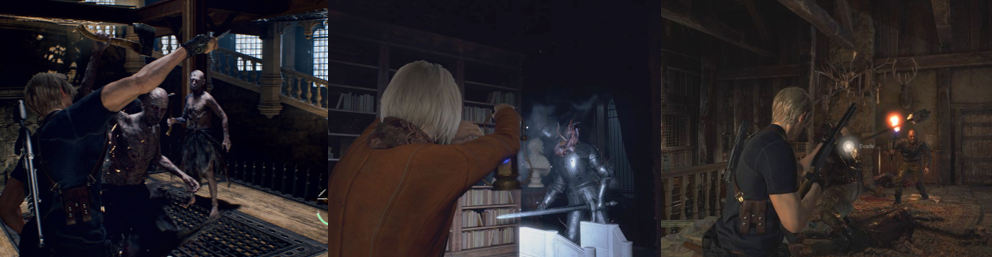
Resident Evil 4’s newest gimmick is placing increased emphasis on the knife. Before, you could cheese the knife to a ridiculous extent, stunning enemies and opening them up for Leon’s over the top melee attacks. While that’s still true here, Leon’s knife also parries certain attacks from the likes of the Chainsaw Ganado and other weapon-wielding enemies with LB. This will wound or stun enemies so you can run in to press A to hit a suplex, but you can also sneak up behind them or finish them off with your knife with a press of RB. Leon’s knife now has a durability meter; eventually, it’ll break and he’ll need to spend his hard-earned pesetas upgrading it at the mysterious Merchant. Weaker, disposable knives are often found dotted around the environment, in addition to stronger ones, and it really makes you think twice about going all gung-ho with your knife like before and opens up interesting ways to battle the likes of Major Jack Krauser since all the previous QTEs have been replaced by these new parry mechanics. In what’s now a franchise tradition, there is also a part where you lose your gear and must stealthily take out enemies to retrieve your stuff. As before, Leon will partner with some allies; suave ladies’ man Luis Sera has an expanded role here, helping you at key points and providing both ammo and extra gunfire when besieged by enemies or battling the troll-like El Gigantes, but your main partner is still Ashley Graham. Now wearing more sensible attire and with her bratty persona toned way down, Ashley is far more capable and useful than before. You command her to wait, hide, and follow you by pressing in the right stick, hiding her in the odd cabinet or cupboard and having her climb over walls to unlock doors or lower ladders. While she can die (and you can accidentally shoot her), you no longer have to worry about wasting your healing items on her and she typically just gets “incapacitated”. You can revive her and get her back on her feet, though you’ll still have to cover her as she helps solve puzzles and shoot enemies that try to spirit her away or else you’ll get a game over.
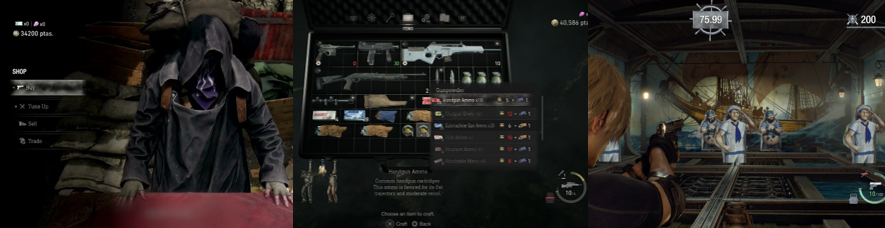
I actually felt like Ashley wasn’t even partnered with Leon as much as in the original game and, when she is, it’s so much easier to look after her. Her solo section has also been expanded somewhat, moving from a primarily stealth-based interlude to a more puzzle-based section where you stun Armaduras with her special lantern. Leon also has a few more combat options available to him: he can occasionally dodge bigger attacks with B, has more control over the boat he uses to cross the vast lake, and can again use giant cannons to splatter enemies and shatter doors. As is now the standard in Resident Evil titles, Leon can also craft ammo and health from the inventory screen. By picking up resources, gunpowder, herbs, and purchasing instructions from the Merchant, you can craft ammo and various coloured herbs that will partially, fully, or even extend your health. This has also been expanded to the treasures; you can increase the value of goblets and crowns and other large treasures by inserting coloured gemstones, which is great for earning extra cash. You once again save at typewriters with no fear of running out of ink (though the game has a generous autosave function), can use a limited Item Box when doing so, and can once again take a break from all the killing and horror at the many shooting ranges. Here, you test your marksmanship skills to earn letter grades and tokens to purchase charms for your briefcase that’ll give you certain buffs. The Blue Medallion system has also been expanded to include side missions set by the Merchant. These include shooting hidden Blue Medallions, disposing of rats, and confronting tougher enemies, all for greater treasures.
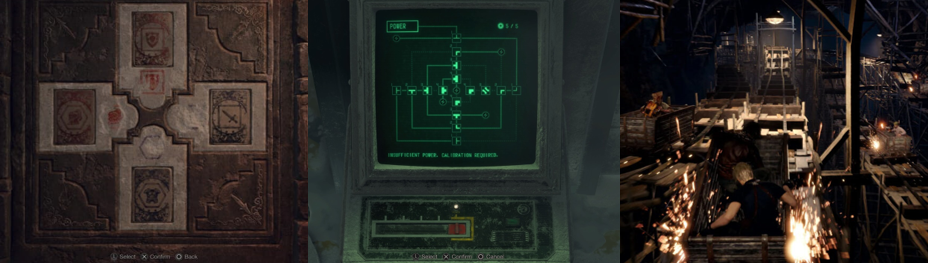
While much of Resident Evil 4 is familiar to anyone who’s played the original game, some of the puzzles and sections have been reworked. You’ll no longer run away from a giant stone version of Ramon Salazar or deal with that flame-filled room, for example, but these elements have been reworked into the tower section, meaning you not only have to avoid barrels coming down the spiral staircase but also take out Salazar’s giant stone visage to avoid being roasted alive. The light puzzle in the church is different, I’m pretty sure I don’t remember exploring a bunch of different caves to find shrines in the original, and I believe the dissection lab has a new power reroute puzzle that wasn’t there before. I do recognise some of the puzzles, though; you’ll still be traversing that damn hedge maze, still have to wait for the lift to come while fending off the Verdugo (now pulling levers to temporarily freeze it with liquid nitrogen and parrying it when it destroys these controls), and you’ll still have to watch your step when crossing rickety wooden bridges. You can still save a dog for an assist later on, still shoot lanterns to set enemies on fire, and still use explosive barrels to take out hordes of enemies. You and Ashley will sometimes have to turn wheels or levers or simultaneously pull switches or create new paths or open doors, or you’ll command her to do this while you explore further and protect her. You’ll be finding keys to unlock doors and drawers, taking the long way around to unbolt doors and create shortcuts, upgrading key cards, finding spheres that need to be rotated to form the Los Illuminados’ symbol, shooting gongs, sitting at the right tables as dictated by paintings, completing sword puzzles, and racing along on minecarts at breakneck speed, struggling to stay on the track, take out enemies, and avoid dead ends. If things get too tough for you (and it can get a bit hairy when you’re surrounded by enemies that only become stronger when you defeat them), you can lower the game’s difficulty. “Assisted” mode enables a health regeneration system and lowers the cost of items, but generally you can get by on “Standard” if you conserve ammo and make good use of the melee attacks, knife, and environmental aids dotted around the place.
Graphics and Sound:
While I was sceptical about remaking Resident Evil 4 since the previous version still holds up really well, it can’t be denied that the game has never looked better than here. The remake engine makes fantastic use of lighting and shadows to give everything a far creepier and more horrifying atmosphere. The level of detail at work throughout the game’s environments is astounding, with rain and water effects being a constant standout. Areas feel real and lived in, with blood trails and splatters, damage and debris, and little things like photographs, ticking clocks, and even enemies hiding in toilets and giant ovens all adding to the immersion. Leon, especially, benefits from the graphical upgrade; he can now move and shoot, dynamically reloads, and reacts to his environment, shielding himself from rain, resting against walls when low on health, and crashing through destructible objects with the same gusto as before. Character models, in general, are much improved here; Ashley has a more sensible wardrobe, Luis has never smoked a cigarette better, and even the diminutive Salazar looks far less comical here. Faces are still a bit unnerving at times, appearing a bit plasticky (especially when wet) but the level of detail is greater than ever before, so I can forgive it. This extends to the blood and gore, too; enemies can be blown to pieces, exploding in a splatter of guts and viscera, their bodies writhing on the floor, reanimating with renewed aggression, or their heads bursting open as horrific tentacles parasites writhe about. More of them appear than ever before, too, with their variants and mutations causing serious trouble when you’re low on health and ammo and must survive until the game decides to let you continue.
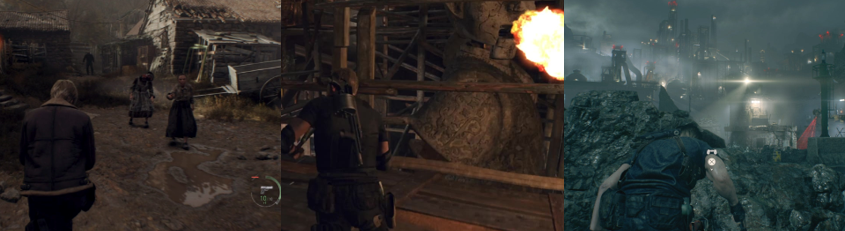
All the key areas from the original game return here, including the main village, a sprawling castle, a network of dank caves and mines, and the fortified island the serves as the finale. You’ll visit graveyards, churches, houses (both abandoned and occupied), forgotten laboratories where bizarre genetic experiments lurk, medieval dungeons and hallways, and a veritable war zone in the end game as you navigate past barricades, narrow corridors, and ransacked areas where enemies lurk around every corner. Everything has a much higher level of detail; you can push obstacles out of the way as well as hop over or through them, files are scattered about to flesh out the local lore, and gameplay is frequently interrupted by exposition dumps from Ingrid Hunnigan or taunts from Saddler and his cohorts. Every cutscene and comms chat can be interrupted, which is great for subsequent playthroughs, and the sheer sense of foreboding atmosphere is unparalleled here as you’re never sure what’s lurking around even the most familiar corridors. Enemies can toss weapons at you, clamber up ladders, and will shout for help when they spot you. Later on, spider-like parasites will scuttle about and attach themselves to regular enemies, making them more formidable, and you’ll be constantly deactivating explosives, avoiding those ever-annoying bear traps, and redirecting gun turrets to clear your path. As ever, music plays a key role in alerting you to when there’s danger present; when it dies down or is more tranquil, you’re safe to explore and regroup. The dialogue and script has also been slightly tweaked; while Leon still has a lot of sass, some of the cheesier lines have been removed. There’s also an additional haunted quality to Leon as he struggles to reconcile the horrors he saw in Raccoon City and make amends for his mistakes with his newfound training.
Enemies and Bosses:
Like in the original game, there are no zombies here. Instead, you primarily fight the cult-like, parasite-infested minions of Los Illuminados. Ganados are far more intelligent than zombies, but no less durable; they can take multiple shots, even to the head, and keep going, utilising weapons like hatchets, pitchforks, and dynamite to cause you headaches. Thankfully, any nearby traps and hazards (and larger enemies) can hurt and kill them, but they are a real pain in the ass when they start wielding crossbows, hiding behind shields, and their heads burst to reveal disgusting tentacles and voracious parasites. The robed summoners will force this transformation and obscure your vision, so be sure to take them out quickly, while flash grenades are your best bet against the naked parasites or the armour-clad Armaduras. You’ll also battle Plagas-infested Novistadors, giant bugs that hover around, spawn from hives and can camouflage into the environment. Later, the Ganados better arm themselves and protect themselves with flak jackets helmets, and other military gear, making it even harder to score a good headshot.
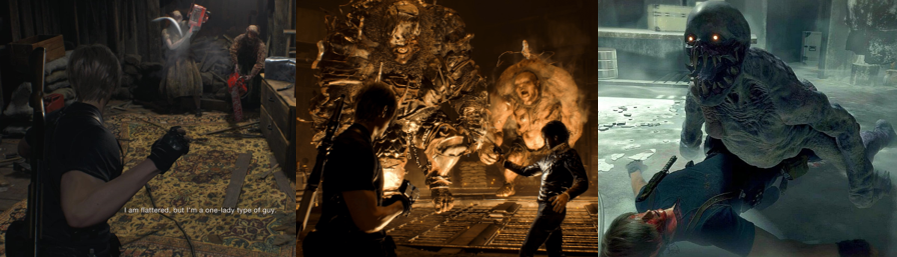
Larger, more monstrous enemies are also commonplace and act as mini bosses. The first you’ll encounter is the Chainsaw Ganada, a burlap-sack wearing madman who will lop your head clean off if you don’t make good use of the parry system. As if their sporadic appearances aren’t bad enough, you’re also forced to fight the Bella Sisters again, this time in an enclosed room (which actually makes it easier to track them), and the aggravating, claw-handed Garradors. Though brutish, heavily armoured, and extremely dangerous, Garradors are also slightly easier here as you’re not locked in a small cage and have more room to manoeuvre behind them to shoot the parasite on their back, stunning them for a more effective attack. Similarly, sledgehammer-carrying Brutes often show up, though their wild swings can just as easily wipe out nearby lesser enemies, as well as lumbering El Gigantes. This time, when you battle the two of them in the furnace, Luis is there to help; though he’s more of a distraction and hinderance as he needs to get clear before you can drop their asses into the molten steel. As ever, two of the more disturbing enemies-cum-mini bosses are the cackling, slug-like Regenerators and spiky Iron Maidens, two intimidating creatures that shrug off bullets and grenades, rapidly heal even when blasted in two, and pounce on you to try and eat your face and skewer you. The only way to effectively destroy them is by finding and equipping the Bioscope Sensor to your rifle so you can see and shoot the parasites lurking in their bodies, which can be easier said than done thanks to their erratic movements and extendable limbs. Another memorable boss encounter is, of course, the massive, mutated salamander Del Lago. You’ll need to use LB and RT to throw your unlimited supply of harpoons and the beast, avoiding the obstacles floating in the lake and chucking your spiked implements into its mouth when it leaps from the water. Thankfully, your encounters with the Verdugo are much more manageable this time; instead of running around a maze of shipping containers and fighting it in a cave, you must simply freeze it with liquid nitrogen and avoid or parry its lashing tail attacks when prompted.
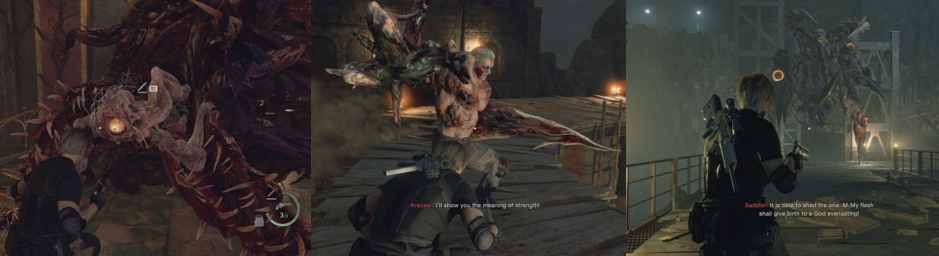
Bitores Mendez once again hounds Leon throughout the story, though you are spared him lumbering after you like a Mr. X or Nemesis figure. He’s still fought in a burning barn, assuming a scorpion-like mutated form where he swipes with his tentacles, requiring you to either dodge or parry his limbs to blast at his big, ugly eye. In the second phase, the fires rage out of control and can really eat away at your health, as can the barrels he tosses at you, but the key is staying in the safest place you can find, parrying when prompted, and hitting RT when he’s stunned to deal big damage. Ramon Salazar’s mutated plant form is more agile than I remember it. He scuttles about on the walls and ceilings, belching corrosive bile and explosive pods, and can eat you in one bite if he gets too close. You need to constantly stay on the move and not miss the opportunity to fire when the pod opens and reveals him, which will eventually stun him to the ground so you can use your knife, but I found this a particularly gruelling boss battle. Krauser is fought twice this time; the first is a straight-up knife fight where you must parry or dodge his attacks, landing slashes and melee attacks until he flees. This repeats in the ruins, but Krauser also fires at you, tosses flash grenades, and mutates a giant arm blade for the finale. The fight isn’t timed this time, but Krauser is extremely agile, so you’ll need to keep him in view, taking shots and using any nearby knives to parry his slashes while also getting around his bio-organic shield. Finally, Osmund Saddler transforms into a rampaging, tumour-filled arachnid monster that stomps about an unstable mining platform. For such a big creature, it’s difficult getting a good shot at the eye-like growths on his limbs but doing so leaves his main weak spot open. Repeat this a few times, watching out for the limited ground, and Ada Wong will eventually toss you a rocket launcher to finish him off after he envelops the entire arena in a mess of putrid limbs.
Power-Ups and Bonuses:
As you explore the game’s environments, you’ll find key items to progress and useful pick-ups to aid you. Small keys, cuboid blocks, medallions, and such access treasures, ammo, or healing items, or resources for crafting. Defeated enemies will invariably drop an assortment of supplies and you can smash open crates to acquire them, too (just watch out for snakes!) First-Aid sprays and herbs will restore your health, as ever, but you can also eat eggs and fish to do the same. You can combine green, red, and yellow herbs to recover more health and extend your health bar, which is always handy. Treasures come in many forms, from various jewels to ornate masks, clocks, and the like. The bigger ones house your smaller jewels to increase their value and you can also sell unwanted ammo, guns, and items to the Merchant for more cash. The Merchant’s stock is constantly changing, allowing access to new ingredients and weapons, so my advice is to wait for the more powerful weapons before you upgrade them to save your money and have stronger weapons later in the game. The Merchant also sells attaché case upgrades, allowing you to carry more and providing specific buffs, and degradable body armour to upgrade your durability. He also trades you special weapons, items, and add-ons for your arsenal if you complete his side missions. Leon uses many different weapons, from grenades and flash bombs to his trusty knife, pistols, and shotguns. You’ll eventually utilise heavier weaponry, like the assortment of submachine guns and assault rifles to single-use rocket launchers, as well as revolvers and magnums, sniper rifles, and a surprisingly handy bolt rifle. This is useful for destroying Blue Medallions, shooting rats, or finishing off enemies as you can recollect the bolts; you can also press the left stick to attach explosives, which is super handy in a tight pinch. These weapons can be upgraded to increase their power, ammo capacity, and reload time. Upgrade them fully (or acquire a special ticket) and you can unlock their special bonus ability, and you’ll also equip add-ons, such as stocks and scopes. Completing the shooting ranges earns you tokens to play for charms to attach to your briefcase; these increase how much ammo you craft, item drop rates, and provide other buffs, though you can only attach three at a time.
Additional Features:
There are thirty-nine Achievements on offer in Resident Evil 4 by default, with many unlocking simply by completing the story chapters, besting the monstrous bosses, and beating the various difficulty modes. While you won’t get an Achievement for aggravating Del Lago or looking up Ashley’s skirt, you will for rescuing her as she’s being carried away, for parrying incoming attacks, destroying all of a Regnerator’s parasites in a single shot, and selling an item for many times its usual value. Achievements also come from fully upgrading weapons, finding and destroying all of the Clockwork Castellan toys scattered throughout the game, escaping certain areas without taking damage, defeating certain bosses in specific ways, and finding every treasure (something greatly aided by purchasing the Merchant’s treasure maps). Not only are you graded on your time and performance at the end of the game, each chapter ends with a rundown of your accomplishments. These are tied to the Achievements and the in-game challenges that earn you Completion Points (CP) to spend in the “Extra Content” section. This is where you’ll unlock character models, concept art, and additional costumes and weapons. Beating the game on different difficulty modes unlocks various rewards, such as a dapper noir outfit for Leon, sunglasses and masks, the even harder “Professional” mode, and all your weapons, charms, and remaining treasures carry over to your next save file. Sadly, however, unlocking Ashley’s super useful suit of armour is much harder this time, requiring at least an A-rank completion of “Hardcore” mode. You’ll also need to destroy sixteen Clockwork Castellans to get an unbreakable knife, clear “Professional” mode for a bad-ass hand cannon, and shell out a whopping 2,000,000 pesetas for the infinite rocket launcher.
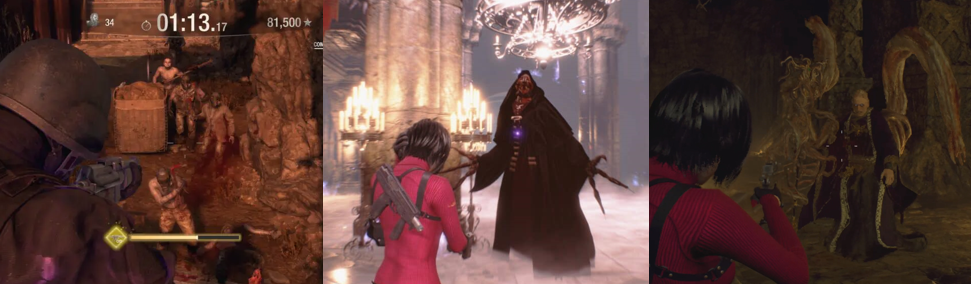
You can also play the “Mercenaries” mini game to dispatch as many enemies as possible against a time limit, building up your “Mayhem Meter” to unleash character-specific special moves and playing as either Leon, Luis, Krauser, or the returning HUNK, each with their own weapon loadouts and attributes. DLC packs also contain funky extra costumes, weapons, and even the original game’s soundtrack. Finally, there’s the Separate Ways side story that focuses on what Ada was up to during the main game and comes with seven additional Achievements. Separate Ways has been expanded upon in many ways. Not only does Ada have access to the same weapons, knives, items, crafting, treasure, and abilities as Leon (including the Merchant and her own melee attacks) but her grapnel gun now plays a significant part in her gameplay. You’ll often be prompted to grapple to (or find yourself traversing) the rooftops and upper levels in recycled locations, tapping RB to swing across gaps, launch to ledges, and even remove shields from enemies and fly in for a quick melee attack once upgraded. Separate Ways also expands upon Luis’s story, teaming him with Ada at various points, and she utilises her ocular I.R.I.S. implants to track footprints and reveal fingerprints for keycodes. Separate Ways also adds content back into the game, including the laser hallway sequence (a simple QTE where you tap B a few times and the RB at the end, finishing off a gigantic, toad-like boss at the same time) and U-3 boss fight. This returns as the final form of Ada’s clingy stalker, the gruesome Black Robe, which distorts the environment, teleports and creates duplicates, and is fought numerous times before it transforms into this scorpion-like form for a two-phase showdown in the caverns. Ada also battles Garradors, Regenerators and Iron Maidens (without the benefit of the infrared scope, that I could find), and boar-headed brutes with machine guns strapped to their arms. She also tackles an El Gigante (battling from atop destructible huts) and has a unique showdown with Saddler. This was the most frustrating part of Separate Ways for me. Saddler has a rush attack, bursts tentacles from the ground, fires bullets from his fingers, and can spam-lock you with tentacle combos. You must blast his face until the eyeball appears in his mouth and keep firing until you can melee attack him, but this took me quite a few tries. After that, you must grapple around the final stage as Saddler’s Lovecraftian mass attacks Leon, blasting the eye tumours in its tentacles to reach the rocket launcher and bring the side-game to a close. Separate Ways has the same difficulty settings as the main game and you can unlock additional costumes and accessories to wear in it, and the main game, as well as complete similar challenges when playing.

The Summary:
I love Resident Evil 4. It’s probably my second favourite in the franchise after the second (both/either version) and it was a blast playing through this top-notch modern reimagining of the title. Sure, I don’t think I’ll ever get over Capcom prioritising remaking this title, which has stood the test of time extremely well, over Code: Veronica, which is still stuck in the tank control days of the franchise, but they absolutely delivered with this game, to the point that it almost makes up for them dropping the ball on the remake of the third game. The new graphical overhaul makes the game darker, moodier, and gorier than ever. There’s just so much detail, so much happening in the environment and with lighting and shadows, and Leon and the others have never looked more detailed and human (or inhuman) than here. I think it’s a testament to how well-crafted the original game was that very little has been changed or discarded. A few boss battles and hazardous areas are omitted or heavily altered, sure, but everything from the original game is retained but with a more serious tone, a greater degree of movement, and far more options for you to upgrade your arsenal. I thought I’d hate the degradable knife and parry mechanics, but they were implemented really well, making me think twice whenever I used the knife since I wouldn’t want it to break at a pivotal moment. While I actually enjoyed the quick-time events of the original, I’m glad they were replaced by playable sections; it really added to the immersion of Leon’s bouts against Krauser. Expanding on Leon, Luis, and Ashley to make them more well-rounded characters while still retaining the edge, arrogance, and characteristics that previous defined them was a great idea, as was altering Ashley’s solo section into something more enjoyable and never-wracking. In the end, I’m forced to admit that remaking Resident Evil 4 was a fantastic idea as it resulted in this gorgeous, gore-soaked, super tense and exciting game. I really hope Capcom give the same treatment to Code: Veronica next but it does make me wonder if they can improve upon Resident Evil 4’s sequels just as well later down the line…
My Rating:
Fantasic
Were you pleased with the remake of Resident Evil 4? Do you think it deserved the remake treatment so soon? What did you think to the new knife-based mechanics and the alterations to certain bosses? Did you like that Luis and Ashley’s roles were expanded and more flesh out? Did you ever find all of those Clockwork Castellans? Which Resident Evil videogame, character, monster, or spin-off is your favourite, and which game would you like to see remade next? Whatever you think, feel free to leave your thoughts down below.

 Dr. K's Waiting Room
One thought on “Game Corner: Resident Evil 4: Gold Edition (Xbox Series X)”