
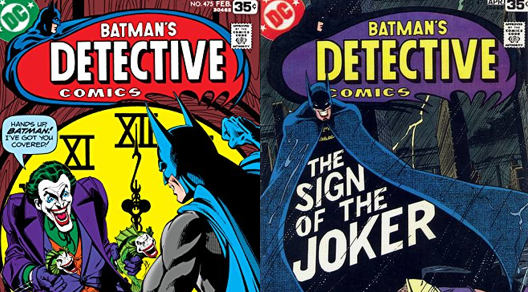
Story Title: “The Laughing Fish!”
Published: February 1978
Story Title: “Sign of the Joker!”
Published: April 1978
The Background:
After achieving success with Clark Kent/Superman, National Comics Publications tasked Bob Kane with creating a masked crimefighter to add to their superhero portfolio and, thanks to Bill Finger, the “Bat-Man” went on to become a mainstream cultural icon. Over the decades, the Batman has gone toe-to-toe some of comics’ most recognisable supervillains, though his greatest nemesis is unquestionably the self-styled Clown Prince of Crime, the Joker. Bob Kane, Bill Finger, and Jerry Robinson all claimed to have created the Harlequin of Hate, but it’s widely agreed that the Joker’s trademark visage was heavily influenced by The Man Who Laughs (Leni, 1928). A last-second decision from then-editor Whitney Ellsworth saw the Joker survive his first encounter with the Batman, though the character faded from the spotlight under the direction of editor Julius Schwartz. Dennis O’Neil and Neal Adams reinvigorated the Joker in the 1970s and 1980s with stories such as this classic two-parter that is such a pivotal Joker story that it was adapted for the hugely popular Batman: The Animated Series (1992 to 1995). The stories played a huge part not just in giving the Joker back his edge, but in reviving the character to terrorise Gotham City for years to come as the Batman’s number one antagonist.
The Review:
This classic two-part Batman story begins, appropriately enough, in the murky dead of night with the Batman prowling across the rooftops of Gotham City, preparing for the greatest confrontation of his vigilante career. At this point in time, billionaire philanthropist Bruce Wayne had been dated wealthy socialite Silver St. Cloud, a gorgeous platinum-haired woman who quickly captured Bruce’s heart. They became so close that Bruce suspected that Silver had figured out his dual identity, so he swings by her apartment in the guise of the Dark Knight to confirm his suspicions. Although Bruce is convinced that Silver is aware of the truth, she denies that she has anything to confess to the Batman and her demeanour convinces him that there’s a shred of doubt in his assumptions. Realising that it’d be foolish of him to simply unmask in front of her if there’s even a one percent chance he’s wrong, the Batman bids her goodnight and leaves, only for Silver’s resolve to falter once he’s gone. Wracked by her knowledge of Bruce’s dual life, Silver makes the difficult decision to take a hiatus from both men, and Gotham City, to get her head straight. The Batman is still mulling over his complicated love life and the dichotomy between his two identities when he’s aroused by local fishermen, who frantically show him that all the fish they’ve caught have been horrifically mutilated to carry the Joker’s signature smile, perplexing both them and the Dark Knight.
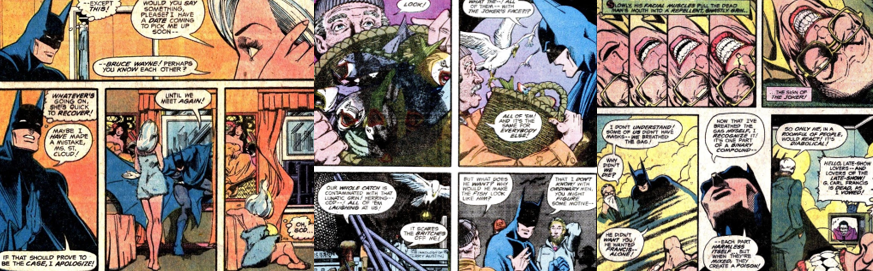
The phenomenon isn’t limited to Gotham City; over the next few days, reports of “laughing fish” come in from all across the country, shocking the nation. However, it’s G. Carl Francis who gets the biggest shock when the Joker himself, and his goons, storm into his office and demand that he helps to copyright the laughing fish so that the Joker can profit from every one sold. Unfortunately, Francis is duty-bound to inform the Clown Prince of Crime that fish can’t be copyrighted as they’re a natural resource, angering the Joker and causing him to threaten Francis to find a loophole before midnight or face his wrath. The Joker then pays a visit to crime boss Rupert Thorn, who’s already on edge after being seemingly haunted by the ghost of Professor Hugo Strange, whom he murdered tree issues prior. Since Thorn was one of many villains who tried to purchase the knowledge of Batman’s identity from Strange, the Joker warns him to stop trying to expose his rival’s identity as the Joker is eager to match his wits against the Dark Knight and believes unmasking him would rob his game of all its fun. With Thorn left slipping into insanity, Commissioner James “Jim” Gordon calls in the Batman to help with the threat against Francis’s life. After the Joker makes a televised promise to murder Francis, Batman meticulously checks the apartment and places him under lockdown, though he remains frustrated by the Joker’s madcap nature and unpredictable insanity. Still, the Batman acts swiftly when a mysterious gas suddenly floods the apartment. Be fixes a breathing apparatus to Francis’s face, but to no avail; Francis collapses, dead, his face twisted into the hideous smile of the Joker. Although Jim is confused since the gas didn’t harm anyone else, the Batman correctly surmises that the Joker must’ve secretly poisoned Francis at their meeting so the gas would have a lethal effect.
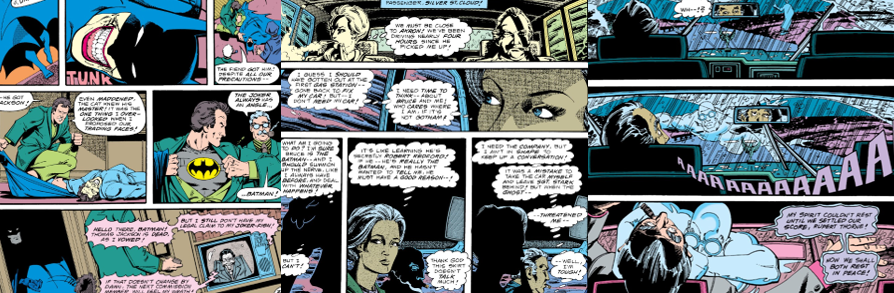
The Joker boasts of his victory through another pirate broadcast and vows to kill another bureaucrat if his legal claim on the fish isn’t approved by 3am, and the issue ends with the Batman aggravated and Silver skipping town courtesy of Rupert Thorn. The story continues in the next issue, with Batman, Jim, and Officer O’Hara keeping a vigil on the Joker’s next target, Thomas Jackson, lamenting that state laws prohibit them from simply executing the Joker since he’s clinically insane. Despite their best efforts, Jackson’s cat wanders in with a Joker fish in his mouth, which drives him to bite and instantly kill the Batman, leaving him with the pale grin of the Joker! However, Batman had actually switched places with Jackson using a clever disguise, but the cat recognised and attacked his master regardless. After the Joker mocks them through his broadcast, the frustrated Batman flees into the stormy night, momentarily spying Strange’s ghost and stumbling upon a vapor analysis meter. The story briefly jumps over to the Joker’s lair, where he somewhat breaks the fourth wall to chuckle at his wit and having bamboozled his foe, and even plots expanding his food-related antics to other products. Another detour delves into Silver’s troubled mind; she’s overwhelmed by her knowledge, unwilling to destroy the mystery of the Batman but pining for her lost love, while Thorn wrestles with the stress caused by his visions. When the radio mentions Batman, the two get into a heated debate about his presence and Thorn angrily ejects Silver from the car, leaving her by the side of the road. While she quickly finds another ride, Thorn is terrified when Strange’s ghost flies at him from the night and seemingly throttles him to death!
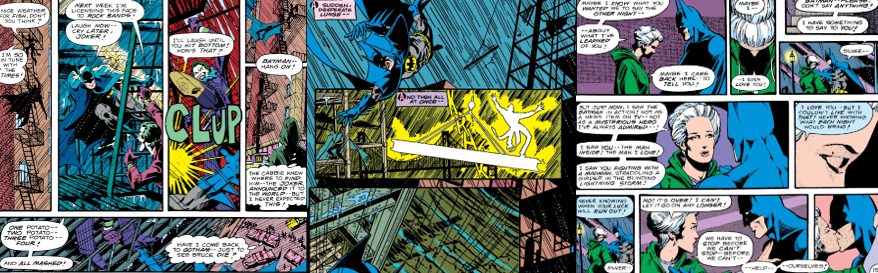
At dawn, the Batman and Jim prepare for the Joker’s next attack, but Jim is horrified when the vapour analyser drives Batman to suddenly attack one of his officers, who’s quickly revealed to be the Joker in disguise! Though rumbled, the Joker keeps the Dark Knight at bay with an acid-spitting flower and makes a hasty retreat using the fire escape. Arriving in town via a cab, Silver pulls up just in time to witness the Batman in action as he ventures into the rainswept night to apprehend his foe, surprisingly caught off-guard by an errant kick and almost tumbling to the street below. While the Joker gleefully taunts his rival, the Batman ponders his own mental instability since he’s the only one crazy enough to chase after the grinning madman, and their chase takes them to the city rooftops. The two come face-to-face atop a construction site, where the Batman is forced to take a desperate plunge to avoid getting a face full of acid, and the Joker is hit by lightning while laughing on a hanging girder. The Batman watches the Joker plunge into the raging river below and frantically checks for any sign of his foe, but it appears the Joker has finally perished. Batman is then stunned when Silver approaches him, confessing not only her love for him but also that that same love caused her great pain when she watched him in battle and realised that he could die at any moment. Unable to shoulder the loss of the man she loves, or expose his true identity, she tearfully begs him to leave her alone and runs off into the night, leaving him stoic and heartbroken. Even Jim’s news that Thorn was picked up, terrified out of his mind and spilling the beans on all his criminal activities, brings Batman little comfort and he simply swings off as a new dawn rises, his victory bittersweet and emotional.
The Summary:
These two stories are representative of the kind of Batman stories I grew up with. I had a handful of Batman annuals as a kid, which contained assorted stories from the 1970s and 1980s and featured names like Steve Englehart and Denny O’Neil prominently. Consequently, I have a real fondness for the gritty, dark, neo-pulp art style on show here. Gotham City is seeped in gothic darkness and flooded by incessant rain, making it grimy and claustrophobic and uncomfortable to behold, and characters are rendered with a stark realism. Although I’m not the biggest fan of Batman’s blue-and-grey ensemble, he cuts an intimidating figure here and it’s fun seeing him operate so openly with Jim and others. He’s still regarded as a bit of an urban myth, but also respected as an informed mind and necessary evil to help combat threats such as the Joker. His presence in Gotham City is the subject of much debate at this time. Thanks to Thorn’s influence, the people and council have started to question the Batman’s necessity and his impact on the city, aspects which come to be reflected in Silver’s conflict regarding her knowledge of his identity. Though these stories are all I really know of her, I like Silver and it’s not often Batman gets a love interest who knows of his dual life. I enjoyed the emotional conflict between them both, where they both knew the other knew but didn’t dare say it aloud for what it would entail, and it brings a real humanity to Batman when she has to reluctantly end their relationship to spare herself greater pain and perpetuate his myth.
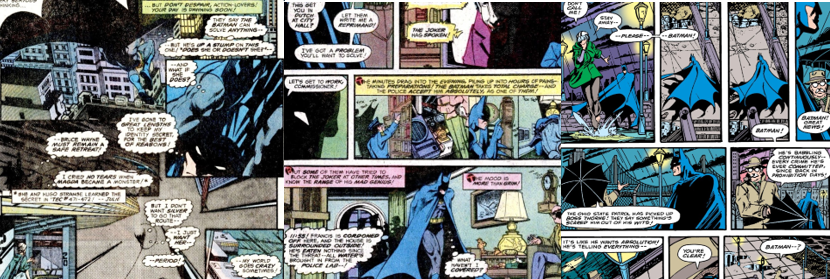
One aspect I really like about this time in Batman history is how much his detective skills are emphasised. Jim calls the Batman in as an advisor and immediately sets to work meticulously safeguarded each victim’s apartment, checking every inch for possible threats and desperately trying to prepare for every eventuality. Although his thoughts are shown to be completely focused on the task at hand, I think it’s pretty clear his frustration with the Joker’s antics is exacerbated by his personal issues with Silver. The Batman laments time and again that the Joker is nigh-impossible to predict as he just does whatever he wants for seemingly no reason, meaning Batman’s preparation and planning are meaningless as the Joker outwits him each time. Even swapping places with Jackson doesn’t help the Batman, and it’s only by utilising the analyser left for him by Strange’s ghost (or some other unknown ally) that Batman exposes the Joker’s disguise before he kills his last victim. The battle between the Batman and the Joker is depicted as a war of attrition, a game of one-upmanship, rather than a physical confrontation (at least, until the end). Like in his first appearance, the Joker hijacks television broadcasts to make threats and taunt his foe, and employs disguises and subterfuge to bamboozle even the World’s Greatest Detective. One thing I especially enjoyed here was that Bruce Wayne doesn’t appear in these stories. His personal life is of great concern to Batman, but he stays in costume throughout both issues, emphasising his unwavering focus on protecting the Joker’s victims and apprehending him. Another interesting aspect is, like in his first appearance, the Joker surprisingly holds his own against Batman thanks to being a slippery devil and surprising him with his acid flower, wild kicks, and daredevil nature.
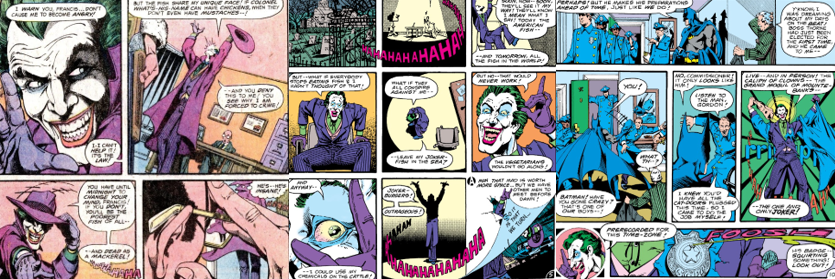
Indeed, this is a fantastic return to form for the Joker after years of being a buffoonish clown or being absent from DC Comics. Drawn as what I would define as the quintessential depiction of the character (tall, gangly, in a purple suit, coat, and fedora, and sporting an elongated jaw), the Joker is a cackling maniac whose newest plot is to spread fear and profit from his laughing fish. His scheme is ludicrous in its simplicity; he’s tainted the water supply with his Joker toxin, killing the fish, poisoning their meat, and leaving them with his signature cheshire grin, all with the intention of profiting from their sale! Obviously, these demands are preposterous but the Joker won’t take no for an answer and mercilessly targets and kills the bureaucrats he believes are denying him his intellectual rights. As mentioned, the story takes hefty influence from the Joker’s first appearance and is, in many ways, an expansion and remake of that first story. The Joker is an elusive, diabolical, and maniacal figure who tests the Batman’s mind as much as his resolve. However, the Joker is also prideful and overzealous. He enjoys toying with Batman so much that he threatens Thorn to stop trying to unmask the vigilante and arrives, in person and in disguise, to finish the job by the end, a decision that proves to be his downfall. However, there’s a clear suggestion that the Joker doesn’t care; he doesn’t care about winning, losing, living, dying, or being locked up. He simply enjoys jousting with Batman and takes glee in their conflict, and the death and terror he spreads, fully aware that the Batman’s moral code keeps him from cross that line. In the end, these are two essential Joker stories; they highlight his outrageous nature, his chilling menace, and his versatility as one of the Batman’s most enduring foes. It’s also a great showcase for the Dark Knight; not only of his detective skills and standing amongst his peers but also the complicated dichotomy of his dual identity. In a nutshell, I’d say this two-parter is a must-read Batman tale, as is most of this run since this really was a great time in the Batman’s publication history.
My Rating:
Great Stuff
What did you think to the Joker’s plot to profit off his laughing fish? Did you enjoy this era of Batman’s history? Are you a fan of more cerebral challenges for the Dark Knight or do you prefer it when he’s beating villains up? What did you think to the subplots involving Silver St. Cloud and Rupert Thorn? Do you consider these two stories essential reading for any Batman and Joker fans? What are some other Joker stories you enjoy? Whatever your thoughts, leave a comment below or and be sure to check out my other Batman and Joker content across the site.

 Dr. K's Waiting Room