

Released: 30 March 1988
Director: Tim Burton
Distributor: Warner Bros.
Budget: $15 million
Stars: Geena Davis, Alec Baldwin, Winona Ryder, Catherine O’Hara, Jeffrey Jones, and Michael Keaton
The Plot:
Recently deceased Barbara (Davis) and Adam Maitland (Baldwin) despair when real estate developer Charles Deetz (Jones), his artist wife Delia (O’Hara), and their goth daughter Lydia (Ryder) renovate their beloved home. In desperation, they turn to mischievous “bio-exorcist” Beetlejuice (Keaton) to scare the family away.
The Background:
Tim Burton is, perhaps, the textbook definition of an “auteur”, producing gothic, disturbing films that are instantly recognisable thanks to his unique aesthetic and frequent collaborations with certain actors and personnel. However, even after proving himself with Pee-wee’s Big Adventure (Burton, 1985) and getting approval to work on a Batman adaptation, it wasn’t until Beetlejuice became a surprise hit that Burton’s ability as a director was cemented. The original script was much darker, depicting far more disturbing scenes and the titular character as a more dangerous and perverted spirit, before it was rewritten with input from Warren Skaaren to focus more on dark comedy than out-right horror. While Sammy Davis Jr., Dudley Moore, and Sam Kinison were considered for the title role, Burton was impressed by Michael Keaton’s audition, signalling a long-time collaborative partnership between the two. $1 million of the budget went on the special effects, which employed traditional techniques like stop motion, prosthetic makeup, and puppetry, and Burton insisted that they be purposely cheap and fake to emulate the B-movies he grew up with. As mentioned, Beetlejuice was a surprise commercial success; it received widespread positive reviews praising the blending of horror and comedy and the creativity on show. Although it spawned numerous videogames, a beloved animated spin-off, and even a well-received Broadway musical, development of a sequel ran into frequent obstacles and it would take over thirty years for it to see the light of day.
The Review:
Beetlejuice is set in Winter River, Connecticut; a quiet little town where everyone knows everyone. It centres on married couple Barbara and Adam Maitland, who own and run a hardware store in town and live in a large, suitably gothic (despite its subdued colour scheme and interior) house atop a hill. This house is their pride and joy; they’ve worked hard to get it exactly the way they want it and are so happy there and proud of their work that they eagerly spend their vacation at home, decorating and indulging their hobbies, rather than away in the sun. A keen model-maker, Adam has built an elaborate miniature recreation of the town in the attic, including lights and various minute details that perfectly represent their sleepy town, while Barbara has painstakingly decorated every room to her standard. There are only two blights on their happiness: annoying nosey neighbour Jane Butterfield (Annie McEnroe), a local realtor constantly trying to convince them to sell their house, and their lack of children. Although the two are perfectly happy as they are, Barbara is visibly hurt by not being a mother, but more than happy to keep trying since she’s so lovey-dovey with Adam. They two have great chemistry, enjoying a dance and playfully presenting each other with gifts to aid their hobbies, and enjoy each other’s company so much that Barbara doesn’t think twice to accompany Adam to the store to pick up a few things for his model. Unfortunately, their whimsy is cut short by ridiculous happenstance; while swerving to avoid a dog, Barbara accidentally sends them plummeting into a river. The two return, rattled and disorientated, to a home now bathed in ominous shadow and far less cozy than they left it. Troubled by gaps in his memory, Adam attempts to retrace their steps only to find himself in a desolate, alien wasteland populated by monstrous sandworms. When Barbara yanks him to safety, that one brief instant is revealed to have lasted two hours and the two are forced to confront the fact that they died in the crash and are now ghosts tethered to their beloved home.
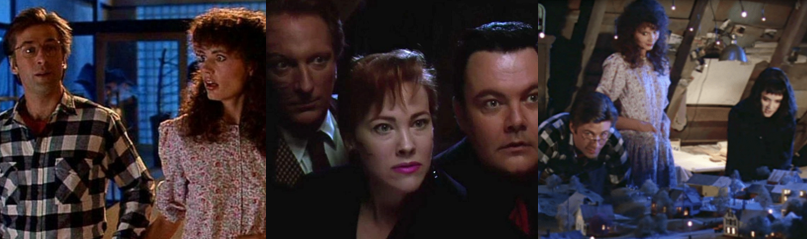
Confused and frustrated, their only source of information is the convenient Handbook for the Recently Deceased, a guidebook that’s needlessly obtuse but explains that they’re bound to that location and invisible to most living people, though they can freely interact with objects and don’t appear intangible. Just as they’re adjusting to their newfound unlife, the Maitlands are dismayed to find that Jane finally got her wish and sold their house to a family from New York, who immediately come storming in and criticise the décor. The two families couldn’t be more different; patriarch Charles, a real estate developer, has little authority next to his demanding and outspoken artist wife, Delia. Charles is the only one of the three to be excited by the move, revelling in the peace and quiet after what’s implied to be a nervous breakdown. The one time he puts his foot down is when he convinces Delia and her flamboyant interior designer, Otho Fenlock (Glenn Shadix), to leave Adam’s office as it is so he has a place to relax. However, Charles soon sets his sights on selling other properties to New York big-wigs like Maxie Dean (Robert Goulet). Already annoyed at having to uproot, Delia is immediately disgusted by the house and works with Otho to strip away everything the Maitlands worked so hard on, turning the house into a bizarre art-deco mishmash of styles that suit her surreal artistic vision. Desperate to express herself creatively, Delia focuses on little else other than impressing others with her art and hospitality, constantly berating Charles and ignoring her stepdaughter, Lydia. A sullen goth with an eye for photography, Lydia is overly dramatic at times but naturally inquisitive. Whereas Charles and Delia are happy to accept that the attic is locked, Lydia persists and soon discovers both the handbook and the ghosts in their house. Describing herself as “strange and unusual”, Lydia’s unique disposition means she can see and fully accepts the ghostly couple. She quickly bonds with them, gaining friendly, accepting parental figures who encourage her curious nature, and becomes enamoured by the allure of the afterlife.

Though the Maitlands like Lydia and are excited to have someone else to talk to, they cannot abide her family and are desperate to scare them away. Unfortunately, their initial attempts fail miserably since no one but Lydia can see them, rendering their face-ripping and elaborate murder scenes pointless. Turning to the handbook, Adam discovers a way to journey to the amusingly bureaucratic spirit realm, where lost souls are forced to wait in line and fill out forms for assistance. This puts them in touch with Juno (Sylvia Sidney), their caseworker, who chastises their naivety and tells them they must spent 125 years at the house before they can move on, meaning it’s up to them to practice with their abilities and study the handbook to scare away the Deetzes. However, after failing to scare the Deetzes with simple sheets and struggling to remain hidden, Maitlands are drawn to the services of “bio-exorcist” Beetlejuice, a gruff, dishevelled spirit whom Juno warns them against employing due to his troublesome nature. In desperation, the two call his name three times and are transported to Adam’s model, where Beetlejuice has set up home. They dig him up and immediately regret their actions; loud, lewd, and foul, Beetlejuice disgusts them with his perverted nature and bloodthirsty methods. They leave, preferring to possess the Deetzes to dance to Harry Belafonte’s “Day-O (The Banana Boat Song)”, but fail to put Beetlejuice back. Enraged and insulted, Beetlejuice spitefully attacks the Deetzes as a giant, demonic state, taking a perverse interest in Lydia and mocking the Maitlands at every opportunity. Tired of being handcuffed to his spiritual lot, Beetlejuice tries to convince Lydia to say his name and unshackle him, though she’s warned off him by the Maitlands, who decide to let the Deetzes stay so they can be closer to Lydia, who they’ve come to see as a surrogate daughter. However, when the Deetzes see the potential of their haunted house for aggressive expansion, the Maitlands find their afterlife threatened and Lydia’s forced to turn to the unruly Beetlejuice to help them, even going so far as to agree to marry him to spare her friends from harm.
The Nitty-Gritty:
Beetlejuice is unhinged, gothic Tim Burton at its finest. As he often likes to do, Burton juxtaposes the quaint, suburban normality with the twisted and macabre, infusing the film with a black and occasionally metatextual humour to deliver a strangely compelling film. While the Maitlands are a perfectly normal suburban couple, the Deetz adults are obnoxious and selfish; even Charles indulges Delia’s ransacking of the house to get a bit of peace and quiet and his more subdued respect for the home turns to greed when he sees the financial value in the town. Lydia is the typical Burton outcast; sullen and introspective, she’s detached from her family’s drama and hobbies and struggles to connect with the real world. Befriending Barbara and Adam only fuels her fascination with the macabre and she even contemplates committing suicide to escape her boredom, something the Maitlands thankfully talk her out of by finally accepting her family. Naturally, the lewd humour is embodied by Beetlejuice, who swears at, molests, and mocks everyone around him. A conniving, self-serving conman, he twists every request to suit his own sadistic desires and has little interest in actually helping the Maitlands and more interest in indulging his mean streak and making moves on Lydia. Burton’s attention to detail in the humour is great; smoke escapes the slit in Juno’s throat, Adam reacts with confusion when the lighting grows more ominous when learning about Beetlejuice, and the bureaucratic nature of purgatory is just so bleakly fitting I can’t help but laugh.
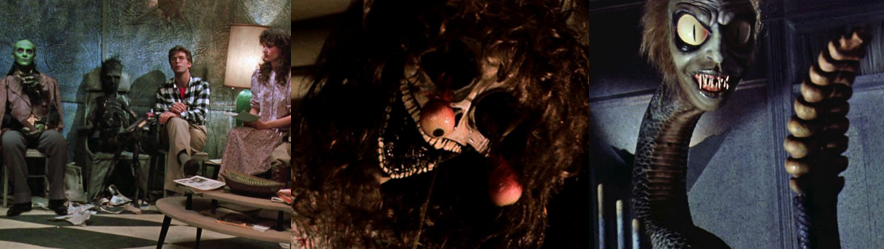
Given it’s Tim Burton and 1988, Beetlejuice also boasts some impressive practical effects and model work. The rear projection is purposely janky whenever characters talk to the miniaturised Beetlejuice or encounter the sandworms, which all adds to the B-movie charm of the piece and the amazing make-up effects only broaden the appeal. The afterlife is full of poor souls forced to either wait their turn or deal with paperwork, whether they’re squashed flat, hanging from nooses, or literally cut in half. An entire football team appears as confused, zombie-like spirits, one poor soul as their head shrunken and mouth sewn shut, and Barbara and Adam are even shown the disturbing “lost souls” room, where exorcised spirits exist in an extra level of undead hell. Although Barbara and Adam’s attempts to scare the Deetzes fail time and again, they sure look great doing it. Barbara rips her face off in a wardrobe and stands holding Adam’s severed head, Adam’s disembodied body desperately rushes to the attic (briefly sensed by Otho, a self-proclaimed supernatural hobbyist), and the two malform their faces into monstrous forms using a combination of stop-motion and practical masks. Stop-motion is also employed during Beetlejuice’s snake attack scene, a surprisingly disturbing scene brought to life by practical, almost schlocky effects that would make Ed Wood proud. Beetlejuice’s powers seem almost unlimited, though he’s incapable of appearing unless summoned or directly telling people his name, causing him to employ flyers, advertisements and charades to spell it out. He can conjure spikes, a gruesome visage so ghastly only Barbara and Adam get to see it, call forth a brothel, and even manipulate reality to a degree, though he’s very much restricted unless his name is spoken. He does fear the sandworms, however, gigantic, multi-mouthed creatures that burrow through the sands of the desolate dimension outside a ghost’s boundaries and which seemingly feast on souls trapped there.

Beetlejuice’s full powers come to the forefront in the conclusion, when Lydia’s forced to summon him to save the Maitlands. Rather than being scared of their ghostly inhabitants, the Deetzes plan to market the Maitlands and use them to sell Winter River as a tourist attraction. Though a natural braggart, Otho does have an understanding of the handbook and, after swiping it, uses it and his rudimentary knowledge of the supernatural to perform a ritual that summons the Maitlands in a séance. However, the two begin to rapidly decay, so Lydia begs Beetlejuice to help. He readily agrees, delighting in attacking the yuppy guests as a living carnival attraction, on the condition that Lydia marries him so he’s no longer shackled by restrictions. Surprisingly, Beetlejuice keeps his word and restores the Maitlands (albeit aggressively), then possesses Delia’s awful sculptures to bind Lydia’s family and render them helpless to keep him from forcing her to go through with her promise. He summons matching wedding outfits and a squat demon priest (Tony Cox) and desperately demands that the ceremony be completed as quickly as possible. Although the Maitlands try to interfere by saying his name, they’re no match for his powers and end up with their teeth falling to the floor, or their mouths being clamped shut, and being teleported to the model and the sand world. However, a distraction from Adam leaves Beetlejuice poised to be consumed by a sandworm Barbara somehow tames and rides into the real world, disrupting the ceremony and reconciling with the Deetzes. In the aftermath, much of the house has been restored as the two families reach a peaceful co-existence, sharing parenting duties over the more confident and adjusted Lydia, while Beetlejuice is forced to wait in line and endure a voodoo curse in the afterlife’s waiting room.

The Summary:
Beetlejuice is a wonderfully gothic, quirky horror/comedy that I first watched as a kid, during a time when horror disturbed me greatly. I’m surprised I wasn’t more horrified by Beetlejuice as some of the visuals are really terrifying, especially the way Barbara and Adam malform their faces and the ghastly forms Beetlejuice takes. While not gory, it is visually disturbing at times, something only exacerbated by the film’s depiction of the afterlife. In Burton’s twisted mind, dying is as much a chore as living; red tape, bureaucracy, and convoluted rules are paramount, making death just as stressful as life. As if that wasn’t bad enough, the Maitlands must deal with a couple of yuppies messing up their beloved home. The Deetzes and Otho are perfectly cartoonish, selfish antagonists, caring little for the town’s peaceful nature and wanting only to make their mark on the untouched landscape. Lydia is portrayed as an outcast, someone as torn between normality and the macabre as she is the living and the supernatural, and she struggles to exist in that bubble, with her character arc coming to reconcile both halves of her personality. Naturally, the crude, lewd Beetlejuice is a standout; he barely has any screen time but Michael Keaton steals the show, yukking up his performance and delighting in unleashing his devilish side. The special effects are also a highlight, bolstering the horror and surreal nature of the film with a schlock, B-movie aesthetic and metatextual humour that makes it almost timeless. Beetlejuice is the perfect gateway into Tim Burton’s unique an macabre imagination, and is just as enjoyable now as when I first saw it. In fact, it might be even more enjoyable since I can better appreciate the little touches and attention to detail that make this such a strange but ghoulishly delightful experience.
My Rating:
Great Stuff
Is Beetlejuice a favourite of yours? Where would you rank it against Tim Burton’s other films? What did you think to Michael Keaton’s scenery-chewing performance? Were you also freaked out by the ghastly visuals as a kid? What did you think to Burton’s depiction of the afterlife? Have you ever had an experience with ghosts or haunted houses? Either way, I’d love to see your thoughts and memories on Beetlejuice in the comments below.

 Dr. K's Waiting Room
Beetlejuice is an absolute favourite of mine and has been since I was a kid ♥️
LikeLike