
On this day, 8th September 1966, the first episode of Star Trek (1966 to 1969), “The Man Trap” (Daniels, 1966), first aired. Since then, Star Trek has become a massive cultural phenomenon that still endures to this day, spawning numerous continuations, spin-offs, and ancillary media to become, perhaps, the most influential science-fiction franchise of all time. Accordingly, the 8th of September has been deemed “Star Trek Day” and is thus the perfect excuse to dedicate some more time to, and celebrate, this massive sci-fi franchise.


Released: 26 November 1986
Director: Leonard Nimoy
Distributor: Paramount Pictures
Budget: $26 million
Stars: William Shatner, Leonard Nimoy, Catherine Hicks, DeForest Kelley, Walter Koenig, and James Doohan
The Plot:
After resurrecting their crewmate, Captain Spock (Nimoy), Admiral James T. Kirk (Shatner) and the USS Enterprise crew face a court martial for mutiny. However, when an alien probe threatens the Earth, Kirk seeks redemption by time travelling back to the 20th century to acquire the only thing capable of stopping it: long-extinct humpback whales.
The Background:
Although Star Trek: The Motion Picture (Wise, 1979) grossed almost $140 million, it was met with mixed to negative reviews that a disappointed Paramount blamed on Star Trek creator Gene Roddenberry. Luckily, the franchise bounced back with Star Trek II: The Wrath of Khan (Meyer, 1982), widely considered one of the best Star Trek movies, and Paramount was eager to capitalise with a third entry. Although Star Trek III: The Search for Spock (Nimoy, 1984) was the lowest-grossing Star Trek movie at the time, positive reviews encouraged the development of a fourth film. Although Nimoy was granted additional creative input, star William Shatner was initially unwilling to return, leading to talks of a prequel movie. When Shatner signed on, Nimoy aimed to craft a fun, light-hearted time travel adventure and initially planned for Eddie Murphy to have a starring role before Shatner insisted on having a love interest. Industrial Light & Magic created the film’s models and optical effects, including the mysterious alien probe, though many sets and effects were allegedly reused from previous films. The Voyage Home was the first Star Trek movie to extensively film on location, specifically in and around San Francisco, though the whales were brought to life using cutting edge robotics courtesy of Walt Conti. With a box office of $133 million, The Voyage Home proved to be a financial success. Reviews were equally positive, with the film’s comedic tone, performances, and insightful message counting it amongst the best of the franchise.
The Review:
Following a touching dedication to the tragic fate of the Challenger and the title sequence (featuring a suitably bombastic and celebratory score by Leonard Rosenman), The Voyage Home opts to recap the events of the last two films by way of a Starfleet tribunal concerning Kirk and his crew’s actions. Thanks to footage from the previous movies somehow being presented as video evidence, the Klingon ambassador (John Schuck) reframes Kirk as a terrorist who murdered a Klingon crew and stole their ship and accuses him of developing the Genesis Device as a weapon of mass destruction against the Klingon people. Luckily for Kirk, Spock’s father, Ambassador Sarek (Mark Lenard), is on hand to defend Kirk’s actions and equally condemn the aggression of his Klingon enemies. Although Kirk is guilty of violating many Starfleet regulations, the Klingon is dissatisfied and disgusted and vows that there will never be peace between the Klingons and Starfleet “as long as Kirk lives!” We then return to the planet Vulcan, where Kirk and his crew have been exiled for the last three months. In that time, they’ve made some modifications to the Bird of Prey they commandeered in the last film, christened it the HMS Bounty, and have unanimously agreed to return home to face the consequences of their actions.
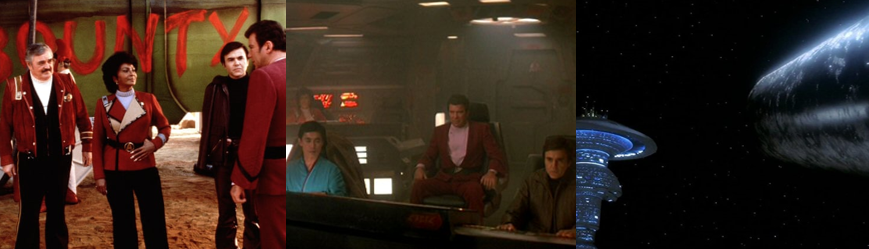
Seemingly no longer burdened by his midlife crisis, Kirk is more weighed down by the inevitable dishonourable end of his Starfleet career than even the death of his son. We get one scene where Lieutenant Saavik (Robin Curtis) tells Kirk about David Marcus’ (Merritt Butrick) bravery and Kirk looks a little forlorn and that’s pretty much it. He doesn’t seem traumatised or grieving and is instead focused on atoning for his actions and helping Spock to reacclimatise to the crew. Since his resurrection, Spock has been testing his intelligence and reasoning ability to retrain his mind and get himself back up to speed. Though seemingly the same logical half-human Vulcan as ever, he’s still a little out of sorts. He’s perplexed by the relevance of his feelings and the illogical nature of his humans, who sacrificed everything to save him only for him to have regressed slightly thanks to his rebirth. While Kirk is confident that Spock will regain his full memories and personality, cantankerous Doctor Leonard “Bones” McCoy (Kelley) isn’t so sure and is the first to point out how unnerving it is that the status quo has been restored like nothing happened. Feeling a sense of kinship with his Vulcan companion that he’s never had before and curious to discuss his experience with death, Bones is aghast to find Spock as stubborn as ever, a quality the Vulcan shares with Kirk as both are seemingly dead set on ignoring the doctor’s wry commentary on and objections to their situation. Interestingly, The Voyage Home is the first Star Trek movie since the dreadful first film to have an otherworldly threat that doesn’t that humanoid form. The alien probe (a pretty basic, cylindrical structure) floats through space continuously broadcasting an incomprehensible signal that is eventually identified as being whale song.
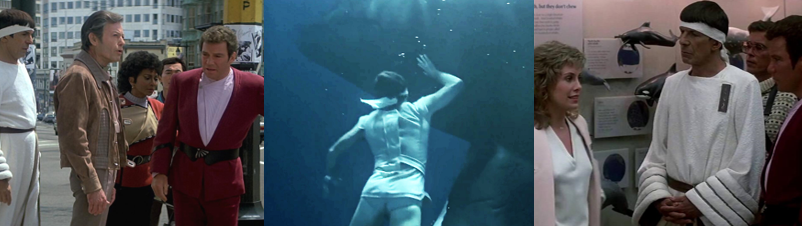
The mysterious probe defies all known sensor readings and explanations and disables the power systems of every ship that comes into contact with it, leaving them powerless and adrift and slowly succumbing the asphyxiation. After disabling both starships and spacedocks, the probe arrives at Earth and wreaks havoc with the atmosphere. This not only devastates all technology and power systems but also whips up destructive planetary storms and causes a thick cloud to block out the sun. With the Earth ravaged by the probe’s attack, Starfleet command have no choice but to warn all ships to stay away from the planet since they’re unable to communicate or engage with the probe. Though equally baffled by the probe’s signal, Spock theorises that it isn’t inherently hostile and that it’s actually trying to communicate with an aquatic lifeform. This allows Commander Nyota Uhura (Nichelle Nichols) to filter the signal and confirm Spock’s suspicions that only whales can respond to the probe. Since humans have hunted whales to extinction and an attack on the probe is deemed futile, the crew have no choice but to pull off a “time warp” by slingshotting the Bounty around the Sun at incredible speeds, a strangely simple concept that is almost laughable in its execution but, thanks to Spock’s “computations”, brings the crew to San Francisco, 1986. Determined to keep a low profile, Kirk and Spock head into the city to locate the source of the whales. Luckily, a bus billboard directs them to Cetacean Institute, a whale-themed facility where “George” and “Gracie” are under the care of cetologist Doctor Gillian Taylor (Hicks). Disgusted by man’s proclivity for hunting whales to the brink of extinction and the ineffectual means of preventing such heinous actions, Gillian greatly cares for George and Gracie, who have been kept in captivity since wandering into San Francisco Bay as calves. Gillian is heartbroken that the whales will soon be released into the wild due to budgetary concerns, which will put them at risk, and is astounded when Spock not only enters the whale enclosure but reveals that the whales are equally fond of her, and that Gracie is pregnant.
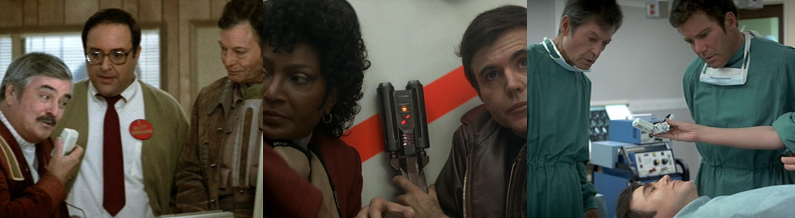
Spock’s mind meld allows him to explain the situation to the whales and gain their consent, and sparks Gillian’s curiosity to the point where she throws caution to the wind and relates her concerns about the whales’ safety. Despite Spock’s amusingly blunt honesty and his notable charisma, Kirk is forced to tell Gillian the truth to win her over and she’s surprisingly chill about his crazy story, primarily because it’s the only viable option she has to keep her beloved whales safe. One positive about The Voyage Home is that it actually gives the rest of the crew something to do for a change; the crew split into teams and sent across San Francisco with specific tasks relating to the success of their mission. Commander Montgomery “Scotty” Scott (Doohan) teams up with Bones and Lieutenant Commander Hikaru Sulu (George Takei) to reconfigure the Bounty’s cargo bay into a whale enclosure, while Commander Pavel Chekov (Koenig) and Uhura are tasked with locating Naval ships to recharge the crude Klingon Dilithium crystals that power the Bounty. Though confused by the era and time displacement, the crew eventually bungle their way to success despite the natives being confused by Chekov’s questions regarding “nuclear wessels”. Alongside Bones, Scotty poses as a professor and meets with Plexicorp manager Doctor Nichols (Alex Henteloff) and provides him the formula for “transparent aluminium” in exchange for using his facilities to build the whale tank in an assumed example of a predestination paradox (i.e. Scotty was fated to provide the formula). While Sulu is relegated only to acquiring and piloting a helicopter to transport this tank, Chekov ends up hospitalised while acquiring the nuclear photons, resulting in a brief bit of drama as the crew infiltrate the hospital so Bones can wake him from his coma.
The Nitty-Gritty:
The Voyage Home is clearly a far more light-hearted film than its predecessors. After battling to defend the Earth from certain death, facing down a deeply personal enemy, and sacrificing everything for their comrade, it’s nice to have a fun, whimsical adventure that offers wry commentary on the state of society in the obnoxiously excessive 1980s. Despite this more light-hearted tone, there’s a strong environmental message at work here. Humanity is doomed to destruction in the far future thanks to overhunting humpback whales and their arrogance to assume that extraterrestrial life would only be interested in communicating with humans, and there’s a clear commentary on the beauty and wonder of these magnificent creatures that that are still tragically low in number. However, despite the catastrophic threat posed by the alien robe, there’s a distinct lack of stakes here. Wonky time travel logic means that the crew don’t even face the danger of a ticking clock and can effectively take as long as they like to acquire the whales since they can just travel back to the future at any time. Thus, the drama comes from them bungling through 1986 culture to recharge and prepare the Bounty and Kirk’s attempts to woo Gillian into aiding them in bringing George and Gracie to the 23rd century before they’re let loose into the wild.
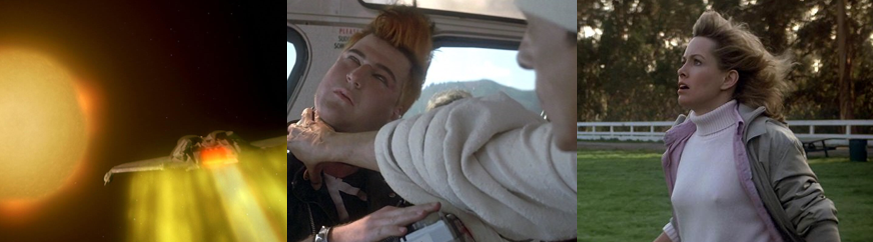
One aspect of The Voyage Home that has always irked me is how cheap the production is; almost everything is recycled from the last two films, including the crew’s wardrobe, the sets, and the models. I can’t totally begrudge this as it makes sense, in continuity, to carry these elements over but you’d think that Kirk and the others would’ve had some Vulcan clothing after spending three months there! This is most obviously felt in the fact that the film largely takes place in 1986 thanks to some janky time travel physics, meaning a lack of space action and battles. This is a bit of a shame as the model work and practical effects remain as charming as ever and the depiction of time warp, through the use of surreal imagery and conflicting sound bites, is very interesting. I also liked seeing the crew on the dingy Bounty and forced to adapt to its less refined Klingon specifications, and that the ship was almost shaken to pieces by travelling at such impossible speeds, but it spends most of the film parked and cloaked in Golden Gate Park since the focus is more on the comedic shenanigans of placing the crew in the primitive then-modern day. There’s a fair bit of comedy to be had in this setting, though; the crew are like fish out of water and are confused that whales are in the city (since I guess zoos aren’t a thing in the future), puzzled by the clothing and “colourful metaphors” of the less civilised inhabitants, and with little idea of the concept or value of money and the primitive technology of the time. This leads to some of my favourite scenes of the film, such as Kirk and Spock encountering a particularly abrasive bus passenger (Kirk Thatcher), Scotty trying to communicate to the PC through the mouse, Chekov’s madcap infiltration of a military submarine and subsequent interrogation, and Bones’ grumbling disregard for the primitive medicine of these “Dark Ages”. Still, it is a bit disappointing that so much of the film is set in 1986; it makes for some fun moments, but it hardly screams big-budget sci-fi adventure, and the focus is more on comedy and awkward interactions between the crew and the inhabitants of the time.
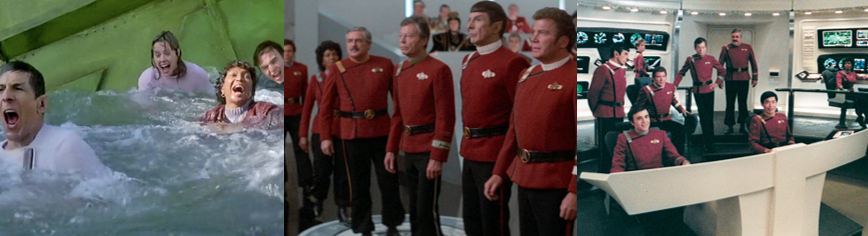
Although Kirk could head to the open sea to get the whales they need, he’s determined to take George and Gracie since it’s not only “better” for everyone but also much easier. Scotty makes the modifications to the Bounty, Sulu acquires a helicopter, and Uhura successfully recharges the Dilithium crystals, but Chekov is injured escaping military custody and the window for acquiring the whales becomes narrower when they’re unexpectedly released early. Gillian is finally convinced to trust Kirk when she learns of the whales’ early release; beamed aboard the Bounty, Gillian quickly overcomes her confusion and awe of the future technology to provide Kirk with the means to track the whales. However, he makes a detour to rescue Chekov from the hands of “butchers” (with even Spock voicing his approval of the effort since it is the “human thing to do”). Although Kirk insists that Gillian can’t come with them, she leaps into his transporter beam and accompanies the crew as they track George and Gracie to Alaska, where they arrive in time to defend the whales from pirates, transport them aboard, and successfully return to the future based on Spock’s “best guess”. Upon arrival, the Bounty is immediately crippled by the probe and crashes into San Francisco Bay where, after a dramatic pause, they answer the probe and cause it to leave Earth space, thus ending its threat and restoring power to the ships it crippled. In the aftermath, Kirk and his loyal crew face the court martial but, in light of their heroic activities, Starfleet shows leniency. Kirk is demoted to Captain and given command of a new ship, the USS Enterprise-A. After bidding farewell to Gillian as she disappears forever to join the crew of a science vessel, Kirk and his crew return to the bridge of their iconic ship and prepare for new adventures into the great beyond.

The Summary:
I’ve never really been much of a fan of Star Trek IV: The Voyage Home. Even as a kid, I felt like it was a bit of a step back since I mainly watch Star Trek for fun, space-based actin and adventure rather than comical jaunts to the past or dull political intrigue. Still, there’s a lot of heart and charm to this film; the cast are all clearly having a lot of fun wandering the city streets and interacting with everyday people, and this is reflected even in the normally stoic Spock, who can’t help but show his joy in the finale. The environmental message is very on the nose, but I think it works as a bit of a wakeup call regarding our place in the world, and the universe. The very animals we hunt to extinction could be all that’s saving us from destruction, which is a relevant message, but the film delivers it a little awkwardly. For instance, George and Gracie’s bloodline probably won’t last long enough to defend the world if the alien probe returns and it’s a bit impractical to keep time travelling for more whales. Luckily, I don’t think Star Trek ever returned to this plot point, or used Gillian again, but this sadly makes The Voyage Home even less relevant. I would’ve liked to see more emotion from Kirk, maybe explore his grief over his son’s death, and a bit more emphasis on Spock’s renewed life. The status quo was restored a little too fast, robbing the film and characters of some potential depth, and the reliance on comedy only exacerbates that. I like the feeling of light-hearted relief, but I’m hardly invested in the mission as there’s no sense of urgency or threat. Ultimately, The Voyage Home is like an extended epilogue to the last film that serves only to restore the crew to their rightful ship and ranks. The message is poignant, and the film is enjoyable at times; I liked that most of the crew actually got something to do and had some little side missions. However, I prefer the more intense space operas of the other entries so I can’t rank this one much higher.
My Rating:
Pretty Good
Are you a fan of Star Trek IV: The Voyage Home? What did you think to the tonal shift towards comedy? Did you enjoy the time travel plot or did you also think it was a bit of a cheap follow-up? What did you think to the environmental message and the depiction of time travel? Would you have liked to see more focus on Kirk’s grief and Spock’s rebirth? Which Star Trek captain, crew, show, or movie is your favourite and why? How are you celebrating Star Trek Day today? No matter what you think, leave your thoughts down below or leave a comment on my social media and check out my other Star Trek content.

 Dr. K's Waiting Room
2 thoughts on “Movie Night [Star Trek Day]: Star Trek IV: The Voyage Home”