

Released: 5 November 2003
Director: The Wachowski Brothers
Distributor: Warner Brothers
Budget: $110 to 150 million
Stars: Keanu Reeves, Hugo Weaving, Carrie-Anne Moss, Laurence Fishburne, Jada Pinkett Smith, Harry Lennix, and Ian Bliss
The Plot:
Zion, the last bastion of humanity, faces imminent destruction from an all-out machine attack. While the city fortifies their defences, the fate of humanity is placed into the reluctant hands of Neo (Reeves) as he prepares for a final showdown with the rogue program Smith (Weaving) that will decide the fate of all lives, human and mechanical alike.
The Background:
In 1999, the aspiring writer/director duo of brothers Andy and Larry Wachowski (as they were then known) – inspired by manga and anime – combined a mixture of impressive martial arts, philosophy, and science-fiction to create an instant and lasting impression on action cinema, one that popularised “bullet time” and wire-assisted kung fu (or “wire-fu”) in movies. The Matrix was a massive critical and commercial hit and the Wachowskis made the brave decision to produce two sequels, back-to-back, alongside a varity of tie-in multimedia, including comics, videogames, and animated shorts. Although The Matrix Reloaded (Wachowski Brothers, 2003) made over $740 million worldwide, critics were torn: the film’s dense philosophy confused and divided many, though its intense action sequences were praised. Audiences only had to wait six months for the third, far more contentious entry, which the directors sought to resolve the emotional and spirutual journey of their characters while also delivering the same cutting-edge digital and practical effects and influential fight scenes. Perhaps it was the unrealistic expectations brought about by fan debate, the sheer influx of Matrix content, or the close release of the third film to the second, but The Matrix Revolutions was the lowest grossing of the original trilogy. Though its $427.3 million worldwide gross and persistent popularity later inspired a fourth film as much as greed, The Matrix Revolutions was largely dismissed by critics. Many felt that the film was anticlimactic, the performances wooden and strained, and that it focused too much on style over substance. Though it naturally has its fans, even star Keanu Reeves felt the movie disappointed as a finale but, since today is Keanu’s birthday, this seems like the perfect time to finish my ongoing retrospective of the franchise.
The Review:
I think it’s fair to say that The Matrix changed action cinema. It’s not really hyperbole to claim that The Matrix paved the way for not only a new wave of all-action films but also the superhero genre as we know it today, to say nothing of revitalising Keanu Reeves’ career. As celebrated as the first movie is, however, the sequels and subsequent multimedia spin-offs have had a mixed reaction, to say the least. I’m definitely in the minority of people who actually quite enjoyed The Matrix Reloaded, and even I’ll admit that it falls short of the original movie thanks to needlessly bogging down this unique cyberpunk world with dense lore and confusingly overblown dialogue. In the aftermath of The Matrix Reloaded, I remember there being a great deal of speculation about where the third movie would go, with a prevailing belief being that the post-apocalyptic real world would also turn out to be a simulation. I think this, and the expectations that the magic of the first movie would ultimately pay off, means that The Matrix Revolutions was always going to struggle as even now I’m not sure what would’ve constituted as a suitable finale for the ground-breaking franchise. The Matrix Reloaded ended on one hell of a cliff-hanger, with Neo demonstrating electromagnetic abilities in the real world and collapsing from the exertion and his rival, Smith, having downloaded a version of himself into Bane (Bliss) so he can expand his reach outside of the Matrix.
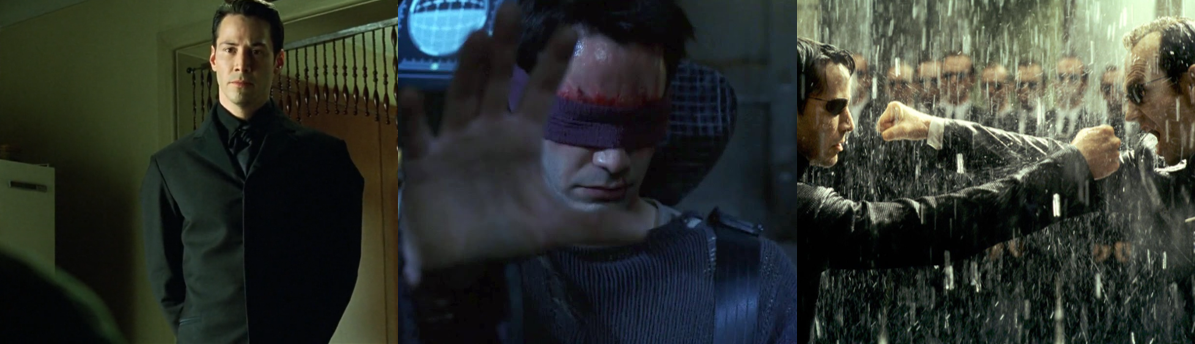
Thus, Neo begins the movie trapped in the subtly named “Mobile Ave”, a kind of backdoor environment through which the repulsive Trainman (Bruce Spence) ferries illegal programs with no purpose from the Matrix to the machine world. This in itself is a bizarre idea, that Neo could somehow “plug into” this cyberspace environment because he’s “not ready” to die, but it also directly ties into the film’s message regarding the Matrix and its programs. In Mobile Ave, Neo meets Rama Kandra (Bernard White) and Kamala (Tharini Mudaliar), two programs who have fallen in love and have made a deal with the Merovingian (Lambert Wilson) to get their daughter, Sati (Tanveer K. Atwal), to safety since she has no “purpose” within the confines of the machines’ digital realms. Neo’s interactions with Rama Kandra actually have lasting ramifications for his later decision to head to the machine city to broker a peace between humans and the machines and show that the programs are fully capable of adopting complex human behaviours such as love and faith. Although Neo is virtually unstoppable in the Matrix, he has no power in Mobile Ave and is thus reliant on his lover, Trinity (Moss), forcing the Merovingian to free him in order to return him to the fight. However, Neo returns as the barer of bad news: because of his decision to reject his predetermined destiny to continue the cycle of death and rebirth within Zion in favour of saving Trinity’s life, the last refuge of humanity is facing imminent destruction from an army of Sentinels. A final discussion with the Oracle (Mary Alice) reveals to Neo that his destiny is now to face Smith to the end, with the fate of both humans and machines in his hands, and he decides that the best way to approach this battle is to venture into the machine city to address their common enemy. Despite all his superhuman abilities and his messiah-like status within much of Zion, Neo remains as conflicted and troubled as ever. He knows that he’s betting the survival of the human race on his ability to best Smith and is reluctant to have Trinity accompany him since he knows it’s likely to be a one-way trip, and yet he fully commits to his mission even after he’s been permanently blinded in battle with Bane since he knows his sacrifice will bring an end to the conflict.
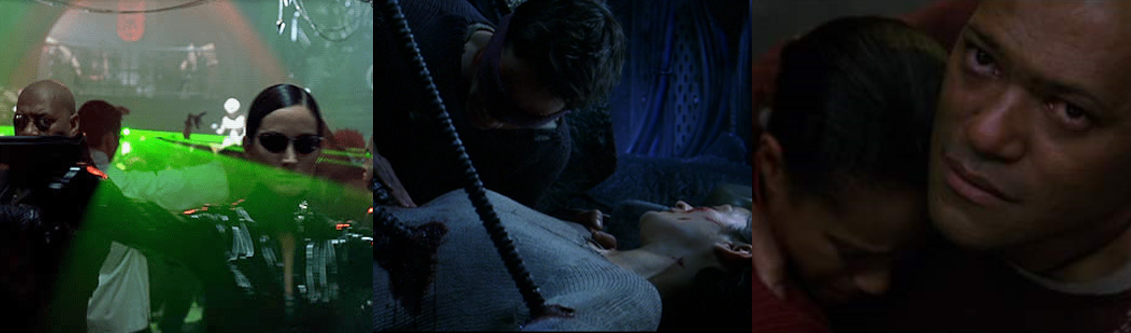
Once a prominent linchpin in Neo’s awakening as “The One”, Trinity has largely devolved into a desperate, lovesick sidekick. Her first priority over all else is to rescue Neo from Mobile Ave and, when the Merovingian attempts to blackmail her and the others into doing his bidding in return for Neo, she simply initiates a Mexican standoff and demands that Neo is returned or they will all die. This recklessness pays off and she’s apparently delighted to be reunited with her lover (it’s honestly hard to tell since there’s still very little chemistry between the characters and actors) and, from there, she resolves to stay by his side even as he embarks on a suicide mission. Trinity is horrified when a psychotic Bane attempts to sabotage their trip and Neo is blinded in the fight. From there, she acts as Neo’s pilot (even though he can still inexplicably see, only now in an ethereal golden glow) and pushes herself, and the Logos, to the limit to break through the Sentinel barricade protecting the city. Although this grants her a view of the untainted sky above the broiling dark clouds that have suffocated the world, this trip ends in tragedy as the Logos crashes into the city and she is fatally wounded. With her dying breath, she expresses her gratitude to Neo for changing her life and her love for him. However, while it’s a poignant moment and Neo’s heartache is readily apparent, it’s a sudden, anticlimactic, and underwhelming death scene thanks to how long it drags on and, again, the lack of chemistry between the two. It’s a shame that Trinity doesn’t get more to do here as she was quite the ass-kicking machine in the first movie, and even The Matrix Reloaded made her a pivotal component to the plot and Neo’s greater destiny, but she’s basically just his pilot and the object of his affections her. Seraph (Collin Chou) is similarly neutered; I remember there being so much speculation about him and even the Merovingian being former Ones and Seraph has such a reputation in the film as a “wingless” fighter who has “beaten” Smith before but, despite demonstrating his fighting prowess in the second film, he’s just here to make up numbers and fail to protect Sati from Smith and his duplicates and the film makes no attempts to delve into who or what he really is.
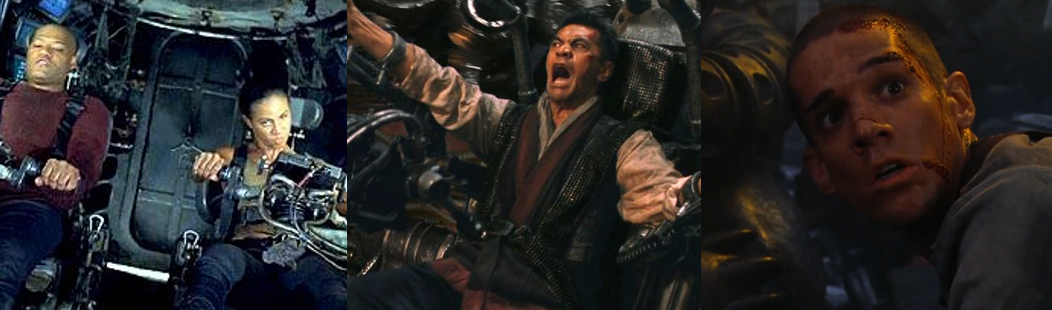
Morpheus (Fishburne) has also lost a lot of his allure; he went from this enigmatic figure who spoke in riddles and exposited information with a cool demeanour to an almost fanatical figure of controversy in the last film. Now, with the truth about the Matrix and the One revealed to him and having lost his beloved ship, Morpheus’s faith is shaken and he’s far from the charismatic leader he was once painted as. Largely a bit player, he’s forced to take a backseat to Niobe (Smith) as she expertly pilots the Hammer through “mechanical” lines towards Zion and further raises the ire of the cantankerous Commander Lock (Lennix) when he crashes through the city’s defences and sets of an electromagnetic pulse that disables a wave of Sentinels attacking the dock but also renders Zion temporarily vulnerable. Indeed, Morpheus is disappointingly ineffectual during the massive assault between the Sentinels and Zion, giving way to the strict Captain Mifune (Nathaniel Lees), who’s given the unenviable task of organising the inhabitants into a fighting force to repel the endless waves of Sentinels. Although the Zion forces are armed in durable mech suits, they’re vastly outnumbered, leading to Mifune reluctantly allowing the overly enthusiastic Kid (Clayton Watson) to join the fight despite being underage. While technically an impressive and visually elaborate battle, the clash between Zion and the Sentinel swarm is a bit of a mess. It’s more like an extended videogame cutscene than anything else and it drags on way too long, laying waste to Zion’s forces and leaving Mifune shredded to death and the Kid as their only hope of salvation. Through sheer determination and his unwavering belief in Neo, the Kid is able to lumber his mech to the gate and allow the Hammer into the dock, where it subsequently knocks out the Sentinels with its EMP blast but leaves the city on the bring of all-out destruction until the machines suddenly stand down and Morpheus realises that Neo is fighting on their behalf within the Matrix.
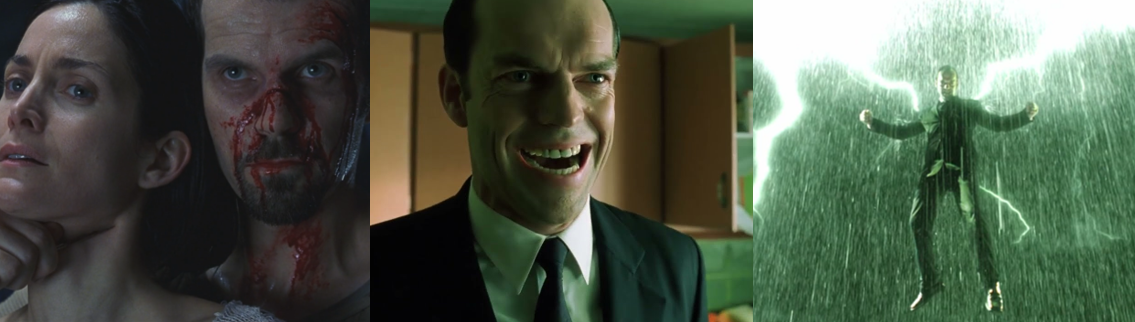
Once a loyal, if disgruntled, agent of the Matrix, Smith has since become his own man; thanks to his ability to endlessly duplicate himself by overriding other programs and inhabitants of the Matrix, his threat increases a thousandfold when he and his duplicates storm the Oracle’s apartment building and assimilate Seraph, Sati, and the Oracle herself! This gives Smith the “eyes of the Oracle” (the ability to see future events, to a certain degree) and allows him to spread like a literal virus throughout the simulation, and he’s even able to confront Neo in the real world by inhabiting Bane’s body. This initially catches Neo off-guard and ends up with him being horrifically scarred and blinded, but Smith is hampered by the fragility of his human body and ultimately defeated since a little thing like blindness is of no consequence to the One. Although we don’t really get to see Smith’s takeover of the Matrix happen since we’re too busy watching the never-ending battle in Zion, it’s effectively demonstrated when Neo confronts Smith in the finale, with the Matrix now a storm-ravaged hellscape populated only by Smith. After negotiating a peace treaty with a visual representation of the machine consciousness (subtly referred to as “Deus Ex Machina” (Henry Blasingame/Kevin Michael Richardson)), Neo is reinserted into the Matrix to fight on behalf of Zion and the machines against their common enemy and end the conflict between the two. Unlike in The Matrix Reloaded, Smith chooses to fight Neo one-on-one because he’s so confident of his victory. Indeed, his abilities have increased to the point where he can not only match Neo blow for blow but even emulate his superhuman abilities, allowing him to fly and pose a significant physical threat with just one of him. Still, it is a bit underwhelming after the madcap Burly Man Brawl of the last film, but I guess it allows for a more intense and personal battle between these two. Indeed, Smith’s power is now so great that, technically, Neo is unable to defeat him. Similar to his experiences in Mobile Ave, the Matrix is now so vastly corrupted and Smith’s power so vast that it’s all Neo can do to hold his own in the fight against the manic Smith, who desires nothing less than to assimilate all life, human and mechanical, and replace it with himself.
The Nitty-Gritty:
We’re far beyond deception, games, and subtlety in The Matrix Revolutions, and nowhere is this emphasised more than in Trinity, Morpheus, and Seraph’s infiltration of the Merovingian’s risqué club (literally descending into “Club Hel”, a place of sadomasochism, excess, and near-demonic denizens) to not bargain with the aristocratic Frenchman but to hold him to ransom. This emphasis on getting to the point continues in Neo’s discussion with the Oracle. Not only does she explicitly (and, in my view, unnecessarily) call attention to her different appearance, but she abandons all riddles and double talk and clearly spells out to Neo that he must defeat his dark opposite, Smith, to decide the fate of the world. In this respect, The Matrix Revolutions is perhaps the simplest of the films to understand: Zion is in danger and Neo must fight Smith to save them and the machines, and this simplicity is perhaps why I find the film so dramatically underwhelming. The protracted and frankly boring war in Zion doesn’t help. It really feels like the film has run out of steam and is thus extending its runtime with a lengthy and muddled war sequence, and it definitely feels like the balance between action and exposition is a little off in the two Matrix sequels. I did, however, enjoy seeing a bit of a role reversal in Niobe and Morpheus. Once a devout believer in Neo and the One, Morpheus’s faith is shaken by Neo’s revelations, but Niobe has become convinced that Neo is worth betting on after witnessing first-hand what he can do. To be fair, Morpheus’s trust in Neo does remain steadfast and is showcased both in their surprisingly emotional farewell and in his ability to intuit that Neo has chosen to fight for his friends and the world.
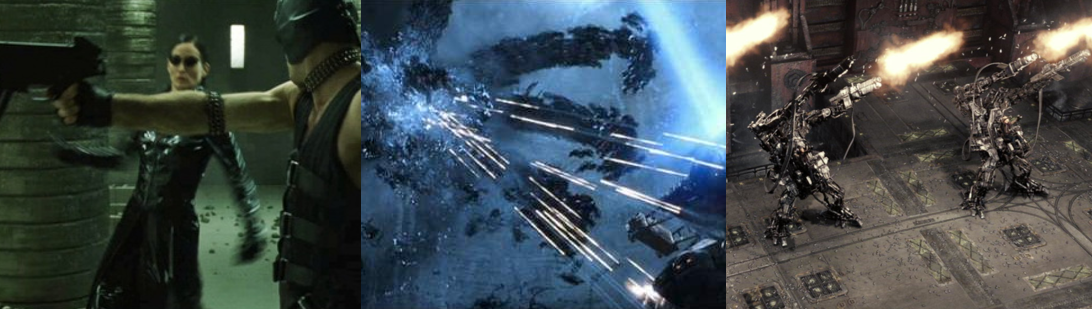
I think one thing that really brings The Matrix Revolutions down is the disappointing lack of wire-assisted, visually stunning kung-fu fight sequences. The Matrix Reloaded really impressed with some unique and fun fights, even if they were a little underdeveloped and a bit cartoony at times, but the third film meanders along for most of its runtime with only a brief ceiling-based scuffle between Trinity, Morpheus, Seraph and the Merovingian’s guards to tide us over until the action-packed finale. This, again, is another reason I find the battle for Zion so underwhelming and dull; there’s no fight choreography to marvel over, no physical skill to admire, and no fun CGI-assisted bullet time effects to spice things up. It’s just a boring mess of metal and screaming, a blur of indistinct characters jerking around in mech suits, bullets flying and shells clattering everywhere, and an uninspiring mess of Sentinels swarming the screen. Admittedly, it is impressive and imposing when they burst in as a cloud of writhing metallic limbs and tear through Zion’s forces, but there’s just way too much obvious greenscreen to really engage with it and it’s hard to really be invested since I know nothing about Captain Mifune (except that he doesn’t take any shit and never completed his training), don’t give two hoots about the Kid (who we’re never really given any reason to care about beyond him being a Neo fanboy), and couldn’t name any of their fellow soldiers who get decimated by the Sentinels. Perhaps if Morpheus had joined the fight, maybe even replacing Captain Mifune and dying in his place, this battle might have made a greater impression on me but, as is, it’s a slog that I just don’t find as interesting as the Hammer’s race to the city or Neo’s surprisingly brutal fight against Bane. Indeed, I simply find myself tuning about and pondering questions like how did Zion build all those mechs? Where is all that ammo coming from? How was Zion even built? We’re left to intuit that the machines helped build the city after the One resets the Matrix but it’s frustrating that questions like these (and how, exactly Neo’s abilities outside the Matrix work) aren’t answered. It’s almost as if the filmmakers couldn’t think of a suitable explanation and again makes it feel like it would’ve been far simpler to have the real world be another simulation, another “system of control”, to keep humans in line.
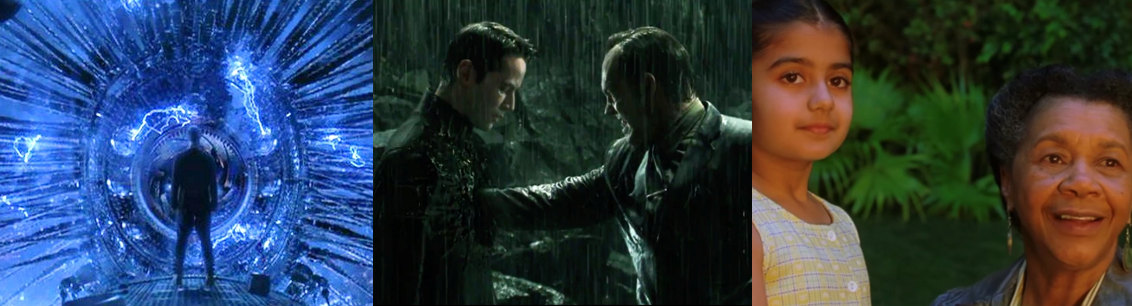
As mentioned, Neo’s fight with Bane ends with him being blinded; however, he’s still able to “see” at least the machines and their proxies, which are rendered in an ethereal gold light. This, and his ill-explained ability to explode Sentinels with his mind, allows him to direct Trinity towards the machine city, destroy much of their defences, and converse with Deus Ex Machina. This stubborn representation of the machine hivemind initially scoffs at the idea of “needing” Neo’s help but is forced to relent since Smith’s existence poses a very real threat to the machines inside and outside of the Matrix. Thus, an offscreen deal is reached: Neo will enter the Matrix to stop Smith and, if successful, there will be peace between the two races. Reluctantly, Deus Ex Machina agrees and we finally get our big, explosive final showdown between Neo and Smith. This fight is pretty much the only thing worth watching The Matrix Revolutions for; against a relentless rainstorm and a nightmarish city landscape, Neo and Smith collide both on the ground and in the air, delivering a superpowered brawl that far surpassed Superman Returns (Singer, 2006) three years later. Although Neo previously bested Smith, he’s outmatched but the goal was never for him to actually defeat his rival, but to lure him into a false sense of security so that Smith could assimilate him. Thanks to the eyes of the Oracle, Smith knows that his victory is inevitable and, despite a moment of uncharacteristic fear when Neo appears resigned to his fate, he plunges his hand into Neo’s chest and overwrites his code, breathing a sigh of relief at having finally bested his foe. However, it really was just “a trick” as Deus Ex Machina uploads a destruct sequence into Neo’s lifeless body that summarily destroys all the Smiths and allows the Matrix to be restored, now without its grainy green hue. A conversation between the restored Oracle and the Architect (Helmut Bakaitis) reveals that Neo’s sacrifice has earned a fragile peace, one where those who wish to be freed (both human and machine) are allowed to go and all hostilities have ended. The Oracle is left assuring Sati that Neo may return some day and that she always believed that he would end the war that had ravaged and oppressed the world.

The Summary:
The downward spiral of the Matrix films is probably one of the greatest disappointments in cinema history. I firmly believe there was more than enough goodwill and lore to support two or three follow-ups to the first film as it just barely touched upon the unique cyberpunk world it presented, but none of the sequels were truly able to really deliver upon this. I can just about give The Matrix Reloaded a pass as I enjoy the action and fight sequences and even the ham-fisted philosophy, which served to unnecessarily overcomplicate things rather than simply giving us straight answers or naturally developing this post-apocalyptic world. Sadly, I can’t say the same about The Matrix Revolutions, which is generally a bleak and boring limp to the finish line for these otherwise captivating characters. Trinity’s death is really an allegory for this movie: it’s long, overly dramatic, and underwhelming, and nowhere is this more evident in the battle for Zion, which is so tedious that I still feel like I’m watching it even now! The stakes couldn’t be higher in this film and yet I feel almost nothing in this fight as it doesn’t directly involve any of the characters I care about, resulting in a grim slaughter that acts more as a showcase for some lacklustre digital effects than a tense battle. The fight between Neo and Smith is the only reason to watch this film again, and even that is a little disappointing since it boils down to a one-on-one brawl that can’t help but be underwhelming no matter how hard the two fly at each other since we saw Neo fending off an army of Smiths in the last film. Also, I love Keanu Reeves but even I can’t defend him in this film. He’s stoic to the point of boredom, is severely lacking in charisma, and has absolutely zero chemistry with the equally bland Carrie-Anne Moss, robbing her otherwise poignant death of any real impact and causing the film to end with a whimper rather than a bang as it’s not massively clear what happened. It’s a shame as The Matrix was such a unique and ground-breaking film and The Matrix Reloaded tried really hard to inject some new ideas into the concept. But The Matrix Revolutions failed to live up to expectations or deliver a satisfying conclusion to the original trilogy, opting not to deliver a largely mind-numbing finale rather than play into the rabid speculations offered by the fanbase.
My Rating:
Could Be Better
Are you a fan of The Matrix Revolutions? Were you disappointed that it didn’t really provide a decent explanation for Neo’s expanded powers? Did you also find the battle between Zion and the Sentinels to be long and boring? What did you think to the idea of Neo battling Smith to the death to decide the fate of the world? What were you expecting from the film at the time and were you disappointed by the end? How are you celebrating Keanu Reeves’ birthday today and what are some of your favourite roles of his? Whatever you think about The Matrix Revolutions, drop a comment below or let me know your thoughts on my social media and be sure to check out my other Matrix reviews.

 Dr. K's Waiting Room
3 thoughts on “Movie Night: The Matrix Revolutions”