
As amusing detail in the Star Trek: The Next Generation (1987 to 1994) episode “The Pegasus” (Burton, 1994) is that the crew and children of the U.S.S. Enterprise-D celebrate “Captain Picard Day” on Stardate 47457.1, which roughly translates to this day, the 16th of June. They do this by producing drawings, models, and paintings that the bewildered Captain Jean-Luc Picard (Patrick Stewart) must then judge. I, however, am using this as another good excuse to delve into some more Picard and Next Generation content.


Released: 11 December 1998
Director: Jonathan Frakes
Distributor: Paramount Pictures
Budget: $70 million
Stars: Patrick Stewart, F. Murray Abraham, Brent Spiner, Donna Murphy, Jonathan Frakes, Marina Sirtis, and Anthony Zerbe
The Plot:
When Captain Picard uncovers a Starfleet conspiracy to steal the rejuvenating properties of the peaceful Ba’ku, the crew of the U.S.S. Enterprise-E rebels to protect the functionally immortal adopted inhabitants from being forcibly relocated by corrupt Admiral Matthew Dougherty (Zerbe) and the warmongering Ahdar Ru’afo (Abraham).
The Background:
Once the popular Star Trek: The Next Generation series came to an end, the crew followed in their predecessors’ footsteps and moved on to the big screen. Although the highly anticipated meeting between Captain Picard and Captain James T. Kirk (William Shatner) failed to live up to the potential of its premise, it did well at the box office. However, while the sequel (one of my favourite Star Trek movies), Star Trek: First Contact (Frakes, 1996), outdid its predecessor considerably with its $30 million gross, Paramount wished to lighten to tone for the next film. After some deliberation, writer Michael Piller based the story around the quest for everlasting youth; one draft saw Lieutenant Commander Data (Spiner) killed off, and star Patrick Stewart was adamant that the script remain true to his arc from First Contact by fighting an ethical battle. Star Trek: Insurrection was the first Star Trek film to replace traditional model shots with CGI sequences, though fifty-five full sets were constructed to build the Ba’ku village and the Son’a were brought to life through extensive prosthetics and make-up effects. With a worldwide gross of over $117 million, Star Trek: Insurrection made a bit less than its predecessor and was met with mixed reviews. Critics noted that the film was little more than an extended episode of the TV series and a sluggish experience, though others were impressed by the performances and character moments. Of course, the Next Generation crew would return regardless for an unmitigated critical and commercial, leading to a franchise reboot in 2009 before the cast and crew finally reunited almost twenty years after their last adventure.
The Review:
It’s a commonly held belief that all the odd-numbered Star Trek movies are bad, and all the even-numbered Star Trek movies are good; while this is naturally subjective (I prefer the fifth movie to the sixth, for example), I can’t deny that Star Trek: First Contact is one of my favourites in the franchise. After the snore-fest that was Star Trek Generations, First Contact delivered all the action and intrigue I’d expect from a Next Generation film so I was naturally excited to see what the crew would get up to in their next film. Imagine my disappointment to find that Star Trek: Insurrection was a more light-hearted, character-driven romp that was both a re-framing and a contradiction of the Next Generation episode “Journey’s End” (Allen, 1994). Don’t get me wrong, I fully understand that Star Trek is about much more than just space battles and action-orientated plots, but some of the worst episodes across the franchise are those that focus more on politics, philosophy, and slower, less engaging plots so I’ve often had a contentious relationship with this film. Ironically, Star Trek: Insurrection forgoes a lengthy title sequence and instead displays the titles while introducing us to the Ba’ku, who live a simple live free of technology. They’re people of the land who grow their own food and work together in peace and harmony, and have no idea that Starfleet are secretly monitoring them using special cloaked suits and a cloaked outpost. However, the Ba’ku are alerted to their presence when Lieutenant Commander Data suffers a sudden malfunction, attacking Starfleet’s officers and their Son’a allies, exposing them to the locals and terrifying children like Artim (Michael Welch).
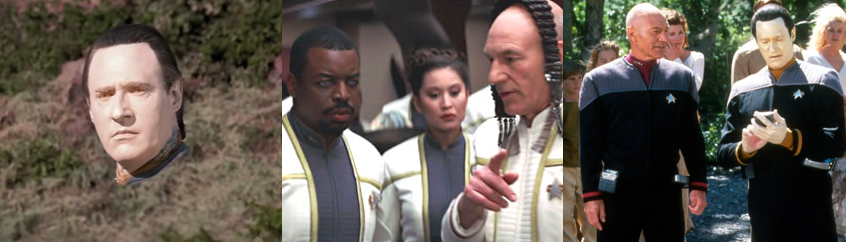
When we catch up with Data’s crewmates, they’re in the midst of welcoming a new, if technologically underdeveloped, race into the United Federation of Planets to help replenish the Federation’s losses at the hands of the Borg and the Dominion. This, sadly, just makes me wish that we’d had a Next Generation/Deep Space Nine (1993 to 1999) film that focused on the conflict with the Dominion. Not only was this a catastrophic and significant story in Star Trek lore, it also would’ve given the Deep Space Nine cast some time in the spotlight. Instead, we’re left with Picard’s awkward (if amusing) interactions with the relatively primitive Evora and an explanation for Lieutenant Commander Worf’s (Michael Dorn) presence that’s so weak the characters simply interrupt him rather than dwell on it. Luckily for Picard, Admiral Dougherty pulls him away from these diplomatic duties to request Data’s schematics; although Picard supplies this information, his concern for his friend and crewmate sees him disregard Dougherty’s suggestion to avoid coming in person because of “environmental concerns”. When they arrive, Data is said to have taken hostages and has stolen a Federation shuttle and Dougherty is under pressure from his Son’a ally, Ahdar Ru’afo, to destroy the android. Picard convinces the Admiral to let him and Worf attempt to shut Data down by distracting him with an amusing chorus from H.M.S. Pinafore; or, The Lass That Loved a Sailor (Sullivan and Gilbert, 1878), only to be embarrassed when Data’s “hostages” have been treated as guests by Anij (Murphy) and Sojef (Daniel Hugh Kelly). Picard is both disgusted to find that Starfleet have been wilfully disregarding the “Prime Directive” of non-interference by spying on the Ba’ku and surprised to find the Ba’ku are a warp-capable race with considerable knowledge of technology, they just choose not to employ it in favour of enjoying the tranquillity of their adopted world and the “metaphasic particles” that bestow rejuvenating effects upon them.
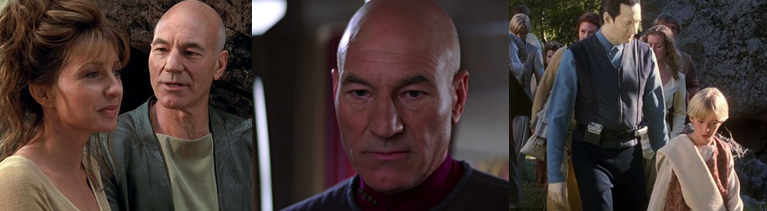
Picard feels a renewed vigour thanks to the Ba’ku and an intense admiration for the culture, alongside an obvious attraction to Anji that drives him to learn more about their people and their journey. Sojef reveals that the Ba’ku were once on the verge of self-annihilation and fled to establish a peaceful sanctuary some 309 years previously, and Picard is disgusted by the plot to relocate the Ba’ku, who refuse to take up arms and lower themselves to war. Thankfully, Picard is outraged by the blatant disregard for Starfleet’s guiding principles and is on-hand to fight for their continued survival. He’s in awe of their unique affliction, which enables them to live longer, healthier lives, continuing an ongoing theme of his advancing years and mortality that’s laced throughout the Next Generation movies. Although tempted to bask in the Ba’ku’s power, Picard’s knowledge of human history drives him to oppose Dougherty’s schemes; aghast by the Federation Council’s claim upon the Ba’ku, Picard has an impassioned, defiant confrontation with Dougherty and essentially goes rogue from Starfleet to prevent past atrocities happening gain. While initially somewhat hostile towards Picard, Anji is unique amongst her people in that she has a fascination for technology; she’s horrified to discover that the Federation are planning to covertly take her people off-world but warms to Picard after being amused by his curiosity. She encourages him to take the time to embrace the moment, to stop analysing and just give himself fully to life, a perception heightened by the Ba’ku and which allows them (and, eventually, Picard) to effectively slow down a single moment in time in order to appreciate life and survive fatal injuries. Although he’s now capable of expressing emotions, Data remains as curious and socially awkward as ever. Star Trek: Insurrection explores new layers of his humanity and character growth through his relationship with Artim, a Ba’ku boy both fascinated and afraid of the android’s capabilities since he’s grown up devoid of technology. Although it takes some effort for Data to convince Artim that he’s not a threat, Artim eventually teaches Data the value of playing and having fun, allowing Data to experience a degree of the light-hearted focus of the film despite not being affected by the metaphasic particles. Data also proves invaluable in setting the plot in motion since it’s his brief malfunction that attracts Picard to the Ba’ku, is instrumental in getting Picard and Anji to safety by acting as a flotation device, and he who exposed the Federation plot.
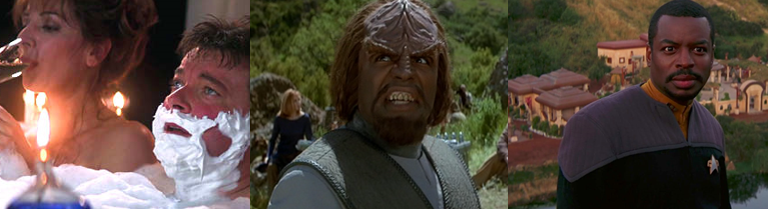
The Ba’ku’s metaphasic particles have a rejuvenating effect on the rest of the crew as well (strangely even before the Enterprise-E reaches Ba’ku), though it’s primarily played for laughs through Worf’s struggles withs Klingon boils and rising “aggressive tendencies” due to essentially suffering through Klingon puberty. The planet’s influence also gives Commander William Riker (Frakes) and Counsellor Deanna Troi (Sirtis) the chance to rediscover their passion for each other with carefree, adolescent playfulness. This not only sees Troi shave Riker’s trademark beard (in a sensual bubble bath, no less) after reacting with impish disgust to his facial hair and rekindle their romantic relationship, injecting a little flirtatious sexuality into the usually less romantically inclined Next Generation narrative. In addition to joining Picard’s rescue team, Doctor Beverly Crusher (Gates McFadden) reveals the extent of the planet’s rejuvenating effects to the captain through examinations of the crew, noting increased metabolism and energy from exposure to the metaphysic particles. She’s also the one who delivers crucial exposition into the Son’a, revealing that they and the Ba’ku are one and the same. Concerned for his friend’s welfare, Lieutenant Commander Geordi La Forge (LeVar Burton) puts his engineering expertise and knowledge of Data’s systems to work to discover that the android was damaged by a Son’a phaser after he discovered the elaborate holoship they plan to use to smuggle the Ba’ku off the planet. Throughout the film, Geordi struggles with his cybernetic optical implants, but sadly misses out on exploring the emotional potential of his restored eyes in any depth; however, Burton expresses profound emotion in conveying Geordi’s appreciation at seeing a sunrise with his own eyes for the first time in his life. Although Picard fully intends to go solo in his mission to defend the Ba’ku, Worf, Data, Troi, and Crusher rebel alongside him while Riker and Geordi appeal to the Federation Council. Although reluctant to rely on technology to safeguard his people, Sojef mobilises a mass evacuation to the tunnels in the surrounding mountains while Picard and his crew defend them from the Son’a attack
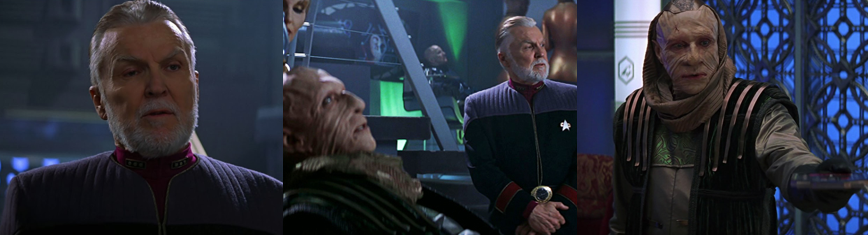
Dougherty has allied with the Son’a and their leader, Ahdar Ru’afo, in a bid to monitor and safely displace the Ba’ku so as to harness the metaphasic particles for wider use. This is an alliance of convenience since only the Son’a have the means to harvest the particles, but Dougherty sees Ba’ku as a chance to save and improve countless lives despite the fact that this will essentially leave the planet a barren wasteland. While Dougherty fully believes that he has every right to do this since the Ba’ku barely number six-hundred and aren’t indigenous to their world, he’s adamant that the mission falls within strict Federation procedures, meaning he values subterfuge and patience to avoid unnecessary attention and bloodshed. Ru’afo finds Dougherty’s insistence on rules and regulations first amusing and then increasingly aggravating since he believes it’s slowing things down when brute force would achieve the same means much faster. Riker and Troi’s research show the Son’a to an aggressive, oppressive, war-like race who conquer and subjugate others for riches and power, but Dougherty is forced to rely on their weapons and expertise since the Son’a are exiles from the Ba’ku people and thus offer unique insight into the planet’s metaphasic properties. Ru’afo’s frustration not only comes from his jealousy and desire to avenge himself on his former people, but also a desperate need to bask in the Ba’ku’s rejuvenating properties since he’s reached the limits of genetic manipulation and many of his people cannot afford to wait for the particles to naturally improve their condition. Ru’afo and his people are dangerous and driven, but essentially outcast adolescents lashing out at their parents; we see this in Ru’afo’s right-hand man, Gallatin (Gregg Henry), who begins to doubt their mission as Ru’afo’s mania increases. Played with an intense, psychotic glee by accomplished stage actor F. Murray Abraham, Ru’afo’s true nature is exposed as his aggravation increases. While he goes along with Dougherty’s plan to covertly relocate the Ba’ku, he convinces the Admiral to sign off on an attack on the Enterprise-E (in one of my favourite exchanges in the film) when they refuse to leave the area and violently ends their partnership when Dougherty and his “procedures” get in his way once too often, leaving Ru’afo free to harvest the metaphasic particles with destructive force.
The Nitty-Gritty:
I mentioned earlier about the themes of mortality; the idea of Picard’s days being numbered and time being against him permeates the Next Generation films and is a clear holdover from the Original Series movies, where the advancing age of these characters was often at the forefront. Star Trek: Insurrection gives the whole crew the chance to rediscover their youth; renewed by the Ba’ku, there’s a playful energy on the Enterprise-E that sees even Picard revelling in his newfound energy. Picard, who has spent most of his life in space going from mission to mission, is severely tempted to slow down and settle on Ba’ku, whose people are free from the burdens of responsibility, and feels more alive than ever thanks to the planet’s influence. This is in stark contrast to the Son’a; exiled from the planet after a destructive rebellion, the Son’a are bitter and twisted and clinging to life by any means necessary, desperate to avenge themselves on their parents like raging children. Finally, a huge aspect of Ru’afo’s frustration with Federation procedures is predicated on his belief (and that of many during this time) that Starfleet, like Dougherty, is “old”. Extremists such as he recognise that the Federation has suffered crippling losses recently and is losing support, allowing him to aggressively influence the Admiral’s reluctant approval for the Son’a to intercept the Enterprise-E.
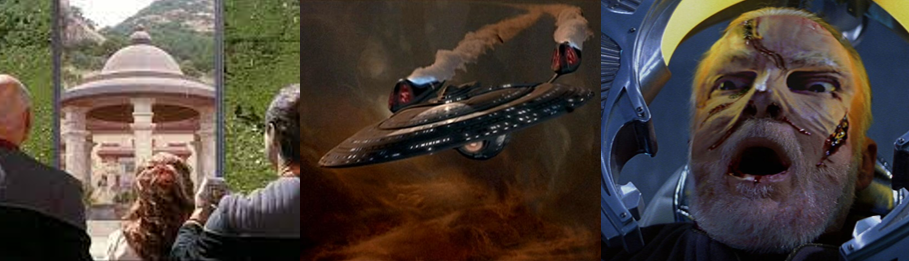
Star Trek: Insurrection does offer a few new visuals amidst its mostly middling plot; the opening sequence, in which Data attacks Starfleet personnel while partially cloaked, showcases some fun invisibility effects, as does the massive cloaked holoship that fascinates both Artim and Anji and reveals to Picard the blasphemous extent of Dougherty’s plan. However, I can’t help but notice that the ships and space action have taken a dramatic step back; CGI seems to have replaced all the traditional model shots and it looks down-right cartoonish at times, robbing Ru’afo’s flagship and its skirmishes with the Enterprise-E of a lot of their appeal. Once again Riker is left in command of the Enterprise-E and, once again, he’s hampered by environmental factors; the “Briar Patch” that surrounds Ba’ku makes space combat extremely dangerous, and the Son’a’s employment of a “subspace weapon” leaves Geordi with no choice but the eject the warp core to save the ship and Riker forced to manually highly volatile “metreon gas” to destroy the Son’a ships. However, most of action sequences take place on the planet’s surface; Picard and Data have a brief shoot-out with a Son’a guard aboard the holoship but the most prominent action sequences come as Picard and the others desperately defend the Ba’ku. This sees the village bombarded by phaser shots as the Son’a target the transport inhibitors, has Picard and the others fending off Son’a drones that forcibly transport the Ba’ku, and leaves Anij near death from the Son’a attack. Conversely, the Son’a are presented as one of the more unsettling Star Trek species; without the rejuvenating effects of Ba’ku, the Son’a have taken on a decrepit, almost mummified appearance. They’re forced to rely on genetic tampering and surprisingly gruesome cosmetic surgery to prolong their lives, warping and stretching their skin to the point where they are almost unrecognisable from their people, the Ba’ku, and often suffer from splits and lesions when they become too emotional. Although the CGI used to render their skin-stretching technology leaves a lot to be desired (especially compared to the more practical effects used to achieve the same means), it does result in a gruesome death scene for Admiral Dougherty when Ru’afo forces him into the machine and tears his face apart.
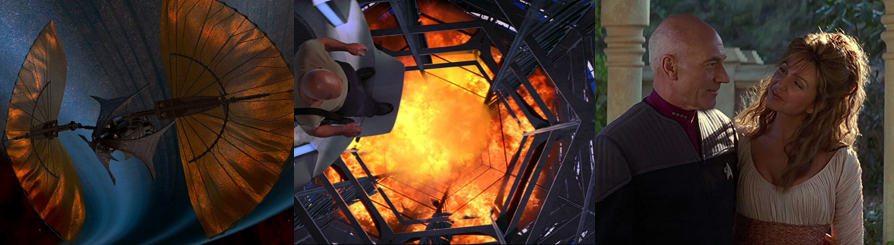
Despite Picard, Worf, and Data’s best efforts to get the Ba’ku to safety, most of them are abducted by the Son’a, including Anij and Picard, who’s more than ready to face a court martial if it means exposing Dougherty’s plot and reveals that the Admiral has gotten mixed up in a blood feud between the exiled Son’a. With the misguided Dougherty dead, Ru’afo orders the deployment of the “collector” (a set of sadly laughable CGI solar sails), despite Gallatin’s reservations about annihilating their former people. Picard appeals to Gallatin’s humanity and convinces him to aid him in opposing Ru’afo’s plan. Data then distracts Ru’afo with tachyon bursts to his flagship, forcing Ru’afo to reset their shield frequencies to avoid being destroyed by the “thermolytic reaction” the collector will produce. This creates an opening for an entertaining deception that sees the Son’a transported, en masse, to the holoship and momentarily fooled by a holographic simulation. Ru’afo quickly discovers the trick and is enraged; he transports himself directly to the collector to restart the process and Picard is forced to confront him, one-on-one, in the collector’s surprisingly sparse control room. After giving Ru’afo the runaround, Picard prepares to meet his end to destroy the collector and save the Ba’ku; luckily, the Enterprise-E arrives just in time to beam him to safety, leaving Ru’afo to go up in flames with his diabolical aspirations. Thanks to Riker, Starfleet halt the Ba’ku relocation plan and launch a full investigation and the remaining Son’a surrender, allowing Gallatin to bashfully reunite with his parents on Ba’ku. Although tempted to stay on the planet, and with Anij, Picard vows to continue protecting the universe from threats both foreign and domestic to ensure that the Federation doesn’t lose its way and repeat the worst mistakes of human history, and the crew return to the ship victorious, reinvigorated, and ready for their next adventure.

The Summary:
Even now, I remain conflicted about Star Trek: Insurrection: on the one hand, it’s a decent, surprisingly emotional adventure for the crew and a far more light-hearted escapade than the last film but, on the other hand, Star Trek: First Contact set a pretty high standard and Insurrection doesn’t come close to matching it. Fundamentally, they are two different films, however, just as different episodes of Star Trek told different stories and had different aspects that made them appealing. Some prefer the character-based stories; others the diplomatic stories or ruminations on age, humanity, and morality; and others prefer the more action-orientated episodes. For me, a Star Trek movie needs to hit all of those beats to have the most appeal and, while Star Trek: Insurrection does try to do this, it falls a little flat for me and comes across as a far too subdued production as a result. It’s a shame as there are some interesting elements here; the continued narrative of Picard’s age, for one thing, and the presentation of Starfleet as a less benevolent entity. Picard shines through his staunch defence of the Ba’ku but it’s interesting to learn that he had completely different stance on the same matter in “Journey’s End”. I liked seeing the crew be affected by the metaphasic particles, even if it is largely just played for laughs, and it’s mildly adorable to see Data explore what it means to be a child and Picard to consider settling down, even if neither of these plot points carry through to the next film. F. Murray Abraham was great as the conniving, desperate Ru’afo; I loved his frustration with Dougherty and his rules, but it’s not enough to salvage the film for me, especially when you remember the lacklustre special effects. Ultimately, it’s a more subdued and grounded Star Trek adventure but one I rarely find myself revisiting or really thinking about, so I’d still choose to watch Star Trek: First Contact any day.
My Rating:
Could Be Better
What did you think to Star Trek: Insurrection? Where does it rank against the other Next Generation and Star Trek films for you? Do you prefer its more light-hearted, grounded story? What did you think to Ru’afo and the gruesome depiction of the Son’a? Did you enjoy seeing the crew be more playful and relaxed? What did you think to the idea that Starfleet would so brazenly abandon their principles? How are you celebrating Captain Picard Day today? Whatever your thoughts on Star Trek: Insurrection, or Star Trek in general, go ahead and share them below and be sure to check out my other Star Trek reviews.

 Dr. K's Waiting Room
One thought on “Movie Night [Captain Picard Day]: Star Trek: Insurrection ”