
January sees the celebration of two notable dates in science-fiction history, with January 2 christened “National Science Fiction Day” to coincide with the birth date of the world renowned sci-fi writer Isaac Asimov, and HAL 9000, the sophisticated artificial intelligence of Arthur C. Clarke’s seminal 2001: A Space Odyssey (1968), being created on 12 January. This year, however, I’m spending every Thursday of January celebrating sci-fi’s toughest lawman, Judge Joseph Dredd!


Released: 30 June 1995
Director: Danny Cannon
Distributor: Buena Vista Pictures / Cinergi Productions
Budget: $85 to 90 million
Stars: Sylvester Stallone, Armand Assante, Diane Lane, Rob Schneider, Jürgen Prochnow, and Max von Sydow
The Plot:
In the year 2080, the world has become a scorched wasteland and the Judges enforce martial law in the overpopulated Mega-Cities and Mega-City One’s most efficient and decorated officer, Judge Joseph Dredd (Stallone), is framed for murder by his own half-brother, the psychotic Rico (Asante), who plots to usurp the oppressive regime with an army of superhuman clones.
The Background:
It was thanks to British science-fiction comic book 2000 AD and the work of John Wagner, Carlos Ezquerra, and Pat Mills that readers were introduced to Judge Joseph Dredd in March 1977, a tough-as-nails lawman known for his extreme political satire. Dredd’s subsequent popularity meant that Hollywood soon came calling, and long-time fan Danny Cannon pursued the project with a passion, even turning down the chance to helm Die Hard with a Vengeance (McTiernan, 1995) in favour of this adaptation. Although development stalled somewhat thanks to the similarly-themed action/sci-fi satire RoboCop (Verhoeven, 1987), production soon got underway once Sylvester Stallone was cast in the title role, beating out his action movie rival Arnold Schwarzenegger despite being unfamiliar with the character. The filmmakers looked to Blade Runner (Scott, 19982), to bring the sprawling Mega-City One to life and rejected designs from famed fashion mogul Gianni Versace for the film’s costumes. Initially shot to be an R-rated feature with a darker, satirical bent, Cannon clashed with Stallone over the direction of the film and was left so disappointed with the star’s insistence towards comedy that he vowed never to work with the Italian Stallion again. This was largely reflected in subsequent reviews, which criticised the film’s confused tone and disappointing production. While the visual appeal of the film has been praised, Stallone’s performance was not; the tie-in videogame was also a disappointment and a box office gross of under $115 million made the film a commercial flop. Both Stallone and Dredd co-creator John Wagner expressed disappointment with the film and it would take nearly twenty years for the character to return to cinema screens.
The Review:
As I mentioned in my review of Judge Dredd’s debut story, I’ve been a big fan of the character since I was a teenager, largely because of my dad. I was always ore drawn towards Dredd’s clashes against the Dark Judges and his more momentous storylines, such as “The Cursed Earth” (Mills, et al, 1978), “The Day the Law Died” (Wagner, et al,1978 to 1979), and “The Judge Child” (ibid, 1980), which is fitting since Judge Dredd draws several influences from these stories for its core narrative. I was just the right age for Judge Dredd; while I was regularly enjoying violent sci-fi romps like RoboCop, I also enjoyed colourful, action-packed sci-fi comedies like Demolition Man (Marco Brambilla, 1993), so my expectations for the film were simply to enjoy seeing a stern lawman of the future kicking ass in a visually entertaining environment. This means I have a certain level of nostalgia for the film; it was, after all, the only live-action Judge Dredd movie available for decades and it’s not as if the character had a more violent animated series to fall back on. At the time, if you wanted Judge Dredd, it was either this, the comics, or a handful of videogames, but that doesn’t mean that my opinion of the film hasn’t changed as I’ve gotten older and come to appreciate the subtle dark comedy and violent nature of the source material. It’s a shame as well since Judge Dredd gets off to a good start (it’s always a plus when James Earl Jones provides an opening narration) and has more positives in it than a lot of people like to acknowledge, but it fumbles on some of the most basic characterisations of its title character in order to appeal to a wider, more mainstream audience.
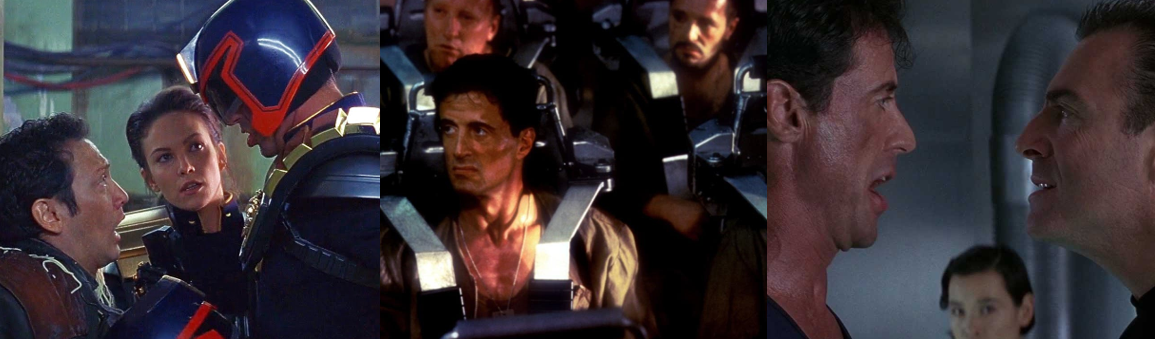
Don’t get me wrong, I totally understand this. R-rated movies like RoboCop might kick all the ass but they’re a bit of a risk for producers and investors, especially when it comes to comic book properties and especially back in 1993, when many superheroes where being bastardised commercialised for maximum profit. Thus, Judge Dredd, the straight-laced, grim-faced, by-the-book lawman of the future who is just as likely to prosecute innocent bystanders to nail a perp, is transformed from a tough, no-nonsense future cop into a more heroic figure over the course of the movie. Dredd starts out as a pragmatic and uncompromising officer; he shows no fear, even when outnumbered and outgunned, and has not hesitation in gunning down criminals to quell a riot. Similarly, he doesn’t hesitate to slap former convicted hacker Herman “Fergee” Ferguson (Schneider) with the maximum prison sentence simply for trying to save himself from being caught in the crossfire. Dredd’s rigid enforcement of the law has earned him quite the reputation; ordinary street punks fear him, and rightfully so, and his lack of humanity and propensity to favour summary execution draw criticism from fellow Judge Barbara Hershey (Lane) and Dredd’s mentor and father figure, Chief Justice Eustace Fargo (von Sydow), who orders him to spend time at the academy training the future generation of Judges not in combat but in the enforcement of ethics in an attempt to inject some humanity and compassion into Dredd’s approach. Although Dredd is clearly unhappy with this assignment, he follows his orders because he has such respect for his mentor and he truly believes in the world of the law, following the literal book to the letter and committing his very life and soul to upholding its ideals, even at the expense of his emotions and empathy.
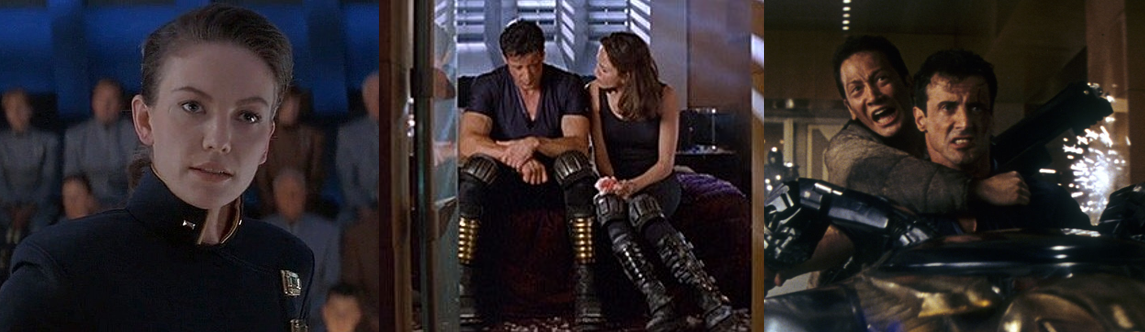
Dredd’s cold demeanour is contrasted by Hershey, the closest thing he has to a friend. Although Dredd has respect for all of his peers, he openly acknowledges that Hershey is “one of the smartest of the new breed” and turns to her to defend him when he’s accused of murder out of respect for her capabilities. Unlike Dredd, Hershey is far more empathetic; she chastises herself when her rookie Judge is murdered on her watch and openly disagrees with Dredd’s philosophy that Dredd’s must commit their lives to the law until they either die on the streets of venture out into the Cursed earth for “retirement”. Indeed, she’s perfectly happy to openly criticise him for being too harsh and lacking in humanity and is both hut and betrayed when the evidence condemns him as a traitor. Moved by the emotional depths Dredd displays after learning of his true origins, she agrees to help him track down Rico both out of a genuine loyalty and affection for him and to avenge the losses her and her fellow Judges have suffered at Rico’s hands. Much of Judge Dredd comedy is focused on Dredd’s stoic demeanour and the awkwardness of him relying on others after he’s betrayed by the very system he dedicated his life to. Have no fear, though, as Fergie is here to act as the comic relief of the film and boy, does it start to grate very quickly. Unlike his simple-minded comic book counterpart, Fergie is a former hacker who, after serving his sentence, finds himself in the wrong place at the wrong time. Naturally, he objects to Dredd’s harsh sentencing and cannot help but laugh at the irony of the grim Judge being convicted for a crime he didn’t commit, but Fergie has no choice but to rely on Dredd when they crash in the Cursed Earth and end up in the clutches of the notorious Angel Gang. From there, Fergie acts as Dredd’s bungling sidekick; a dead weight he’s forced to lug around. Indeed, Fergie’s hacking talents really have no relevance until the last act; Dredd has Hershey and tech-savvy cadet Nathan Olmeyer (Balthazar Getty) to offer more practical help, so Fergie is literally just there to offer manic “humour” that basically amounts to him being a nuisance. However, his presence does tie into the film’s attempts to humanise Dredd; Dredd’s stoic façade and aggravation towards Fergie noticeably lifts as they spend more time together and there’s a genuine sense that the two have become begrudging friends by the finale.
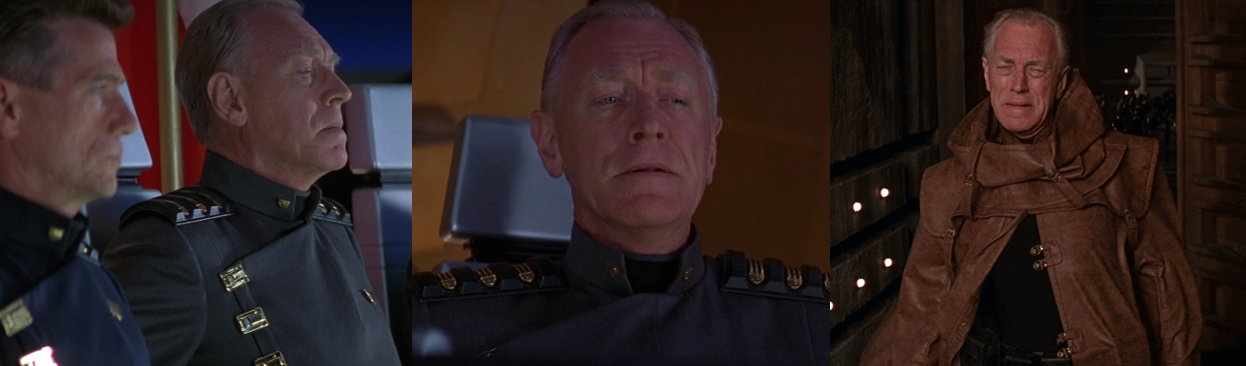
The Judges have a great deal of resources at their command, from Lawgiver pistols that fire an array of ammo to Lawmaster bikes that let them blast through the skies (when they actually work). What they don’t have, however, is manpower; with the city growing more volatile, Judges such as Dredd are forced to rely on more extreme measures to safeguard the citizens, and this draws them much criticism from the likes of news reporter Vartis Hammond (Mitchell Ryan). Hammond’s sentiments are echoed by Chief Justice Fargo, a well-respected and long-tenured senior Judge who is burdened by the responsibilities he feels towards the welfare of Mega-City One. He’s reluctant to enforce harsher methods as he wants the Judges to stand for freedom and justice rather than oppression and, while he’s a figure that commands great respect, it’s undeniable that his beliefs are opposed by Dredd and even those in his council, like Judge Jürgen Griffin (Prochnow). Fargo is equally reluctant to reactive “Project: Janus”, an abortive attempt at cloning Judges rather than recruiting them, and is conflicted by his guilt and affection for Dredd, whom he sees as a son since he was cloned from his genetic material. After seeing Rico, Dredd’s clone brother, descend into madness, Fargo fears that he’s made a mistake in placing so much faith in Dredd but ultimately agrees with Griffin’s suggestion to take the Long Walk and spare Dredd’s life rather than risk the truth about Project: Janus being released and what little faith the people have in the justice system being compromised. A compelling and commanding presence, Fargo delivers much of the film’s emotional gravitas thanks to Max von Sydow’s alluring performance; his death is an emotional moment not just for the audience but for Dredd, too, who struggles with his turmoil of emotions his mentor’s revelations and passing stir up in him.
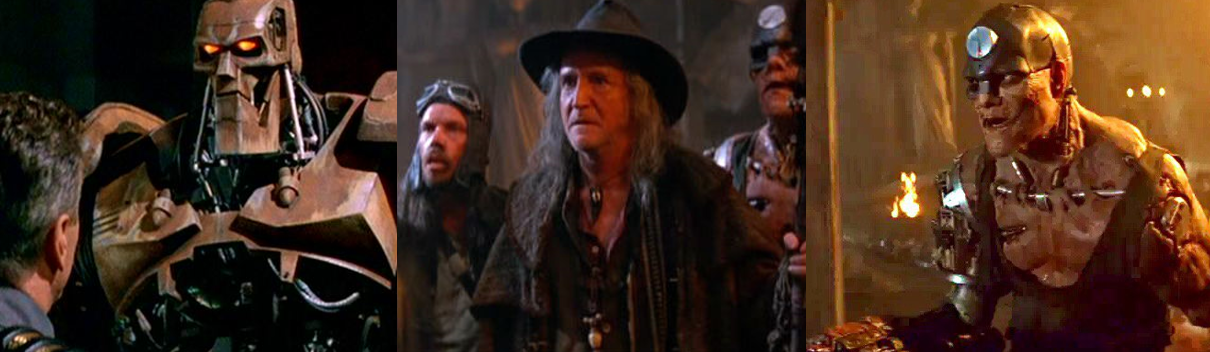
Of course, it turns out that Fargo’s retirement is orchestrated by Judge Griffin in a conscious effort to remove him from the council, ascend to the role of Chief Justice, and coerce his fellow councilmembers into reactivating Project: Janus. Griffin sees the escalation of crime and violence in the city as an epidemic, one that must be stamped out with every resource at their disposal, in order to bring about “an ordered society”, even if it means suppressing basic human rights. To this end, he conspires to release Rico from his imprisonment, frame Dredd for the murder of Vartis Hammond and his fellow councilmembers, and instil his own brand of order to the city through the deployment of a new batch of genetically enhanced clones. Of all the character sin the film, I’d say that Griffin is the most changed from his comic book counterpart; here, he’s an ambitious and antagonistic schemer who wants to reshape the Judges into his own image, but even he is aghast when Rico tampers with the clones so that they’re born from his genetic material rather than the wise and benevolent council. Griffin is contrasted by the admirably faithful Angel Gang; a mutated group of in-bred misfits who have turned to cannibalism and madness in the wastelands of the Cursed Earth, the Angel Gang are comprised of patriarch Pa Angel (Scott Wilson) and his backwoods sons Junior (Ewen Bremner), Link (Phil Smeeton), and Mean Machine (Christopher Adamson). Unfortunately, we don’t learn too much about them except that they’re God-fearing misfits who openly torture and kill anyone who stumbles into their territory; Mean Machine Angel, always the most visually interesting and tragic of the family, is an obvious standout thanks to his raging temper and cybernetic enhancements but, sadly, they’re mainly included as a brief obstacle for Dredd to overcome while stranded in the radioactive wastelands and could’ve easily been replaced by the same nameless, faceless Judges who later enter the scene anyway, but I appreciate the effort used to translate them to the screen, however brief it was.

Our primary antagonist is, of course, the psychotic and strangely alluring Rico. Like in the comic books, Rico is Dredd’s clone brother but, unlike in the source material Dredd is unaware of this until late into the second act. While Dredd embodies the law and everything it stands for, Rico embodies chaos; a former Judge and Dredd’s only true friend, Rico turned to wholesale mayhem and destruction and was sentenced to death as a result, which directly contributed to Dredd adopting his cold-hearted demeanour. However, Judge Griffin intervened and saw to it that Rico was simply incarcerated so he could use him as his agent to bring about his new order for Mega-City One. Griffin unleashes Rico, hoping he’ll stir up anarchy, but quickly loses control over the maniacal killer, who reprograms a battered old Atomic, Bacterial and Chemical Warrior (ABC Warrior) to act as his bodyguard, murders the council, and sets about birthing his own bath of clones. Rico is an undeniable highlight of the movie thanks to Armand Asante’s snake-like performance; he’s constantly walking the fine line between reason and insanity, flipping on a dime between the two and coming across as a volatile and unpredictable personality with a surprising amount of depth. Rico was hurt when Dredd brought him to justice and feels betrayed by him, but also wishes Dredd to join him in restructuring the justice society, with Dredd as Chief Justice, in a bid to build a true family. Rico is also assisted by Doctor Ilsa Hayden (Joan Chen), a woman who’s primarily there to help Rico with the clone science and to give Hershey someone to fight in the finale; otherwise, she may as well not be there and she’s just a one-dimensional piece of ass-kicking eye candy that just stands next to Rico and reacts to his monologues.
The Nitty-Gritty:
It’s interesting that the tone of the film veers so far away from the more violent and dark humour of the source material, especially as the opening credits consist of a collage of various Judge Dredd and 2000 AD comic book covers as an acknowledgement of the film’s roots. To be fair, there is an attempt at evoking the violence of the comics throughout the movie; squibs and blood effects are prominent when characters are shot, especially during the opening Block War and subsequent shootouts, and Warden Miller (Maurice Roëves) suffers a particularly brutal shot to the throat during Rico’s escape. A lot of the more gruesome violence is rendered offscreen, but this is actually beneficial; when Rico orders the ABC Warrior to rip off Chief Justice Fargo’s arms and legs, the noise is enough to know how horrific that fate is, and there’s even a brief shot of the Angel Gang’s latest meal being chargrilled on a spit roast. It’s pretty obvious that the film was cut to avoid being slammed with a higher rating, but my main issue with the tone is the over-reliance on Fergie’s comedic mishaps to counterbalance the few, fleeting violent moments, though I do enjoy the dynamic between him and Dredd, especially when Dredd begrudgingly considers Fergie’s usefulness as a good luck charm and some of the Judge’s stoic one-liners. And Stallone has some great quips here, from his booming declaration of “I am…the law!”, his surly growl of “Courts adjourned”, and his explosive outburst in the trial scene! I also have to compliment Alan Silvestri’s rousing score; it strikes a fantastic balance between heroic, military-esque, and stirring and really bolsters the onscreen action as only Silvestri can.
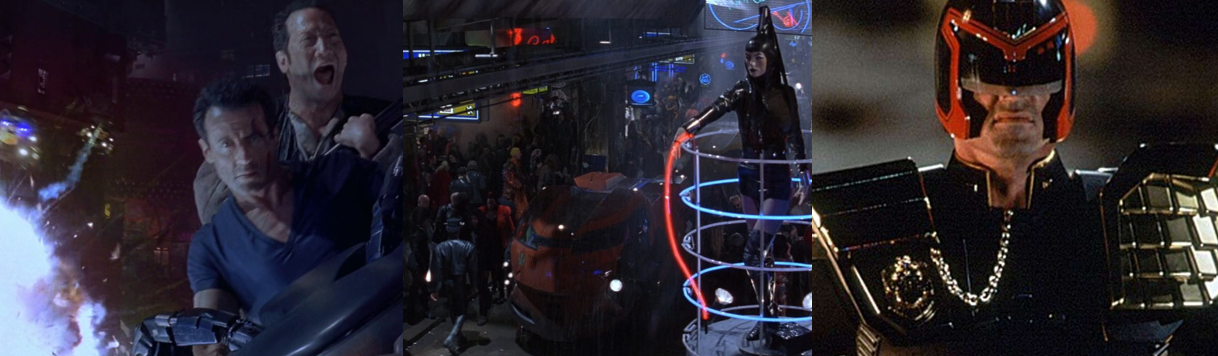
One area where Judge Dredd really excels is in its visual aesthetic and presentation; obviously drawing much of its inspiration from Blade Runner, the film’s rendition of Mega-City One is as a sprawling, technologically advanced, overcrowded super-city that merges recognisable landmarks like the Statue of Liberty with impossibly high, futuristic skyscrapers. Neon signs, holographic projectors, and impressive technology such as flying cars, artificial intelligence, and mechanical conveniences are commonplace and many of them, like the Judge’s Lawmaster motorcycle, are comically unreliable. Indeed, there’s a definite sense of the city being cobbled together and everything has a very “lived-in” look; while the Judges have access to sleek toys and vehicles in contrast to the gritter back alleys where riots are frequent, there’s a definite sense that everyone’s just trying to make the best of what they have on offer, which ties in perfectly to the rising tensions in the streets over strained resources and overcrowding. The special effects hold up really well thanks to being a combination of miniatures, matte paintings, and practical effects; even the Cursed Earth and the exterior of Mega-City One have a grand sense of scale and CGI use is sporadic and not too glaring, though the Lawmaster chase through the city skyline does look a bit suspect. I can forgive this, however, as the flying vehicles and visual presentation is, overall, very impressive and very reminiscent of the source material. This is true of the Judge’s uniform; if anything, the film adheres too close to the source material here, translating the uniform into a form-fitting body suit bolstered by gleaming armour when it should probably be realised as something a bit more practical. Still, the Judges look great, especially Dredd; their helmets, badges, and armour are all extremely faithful to the source material and the same is true of Mean Machine Angel. My favourite of the Angel Gang, this psychotic cyborg is brought to gruesome life through the use of heavy prosthetics and my only complaint is that he doesn’t get much screen time. Similarly impressive is Rico’s recommissioned ABC Warrior; styled after Hammerstein and brought to live as a fully functioning practical effect, the ABC Warrior has a real weight and presence in the film and all of these real-life special effects make up for the few wonky special effects and help Judge Dredd stand the test of time even to this day, at least in terms of its visual appeal.
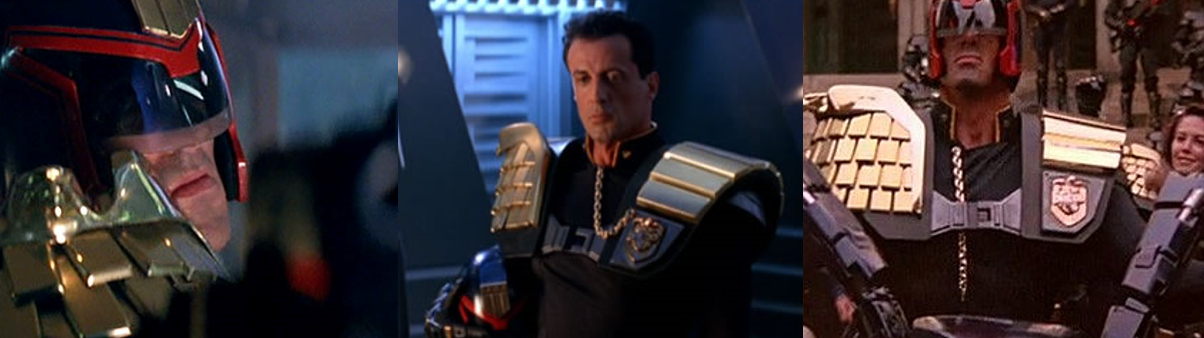
Of course, Judge Dredd betrays the very essence of the character within the first twenty minutes of its runtime when Dredd “[stands] at ease” and removes his helmet! I absolutely understand why this decision was made; if you’ve hired Sylvester Stallone, you want to see his face and it helps the character, and the actor, to express a greater range of motions but it undeniably goes against everything the character is known for. In the comics, Dredd essentially loses his humanity and individuality after Rico turns against the law, becoming the embodiment of the justice system, flaws and all, rather than a simple man. While he’s still that here and Dredd gives a particularly rousing speech to the young cadets regarding the level of commitment he expects from every Judge, the film is much more focused on humanising Dredd, turning him from a grim, almost robotic character and into a more compassionate, heroic figure… not unlike the narrative arc seen in RoboCop. Unfortunately this really doesn’t fit with Dredd’s characterisation and appeal; the whole point is that he’s a tough, but fair, enforcer of the law in an increasingly lawless society. Any political or social commentary is dumbed down in Judge Dredd, which approaches such aspects with a disappointingly toothless attack, but Dredd removing his helmet is basically a slap in the face to the audience, a way of saying “We’re here to make money”. The biggest irony of this is that the film has the perfect excuse to have its cake and eat it too; all they had to do was cast Stallone in a dual role, playing both Dredd and Rico, then he could’ve kept the helmet on and still been allowed to act with his face unobscured. Asante could’ve been cast as Judge Griffin since Prochnow isn’t exactly the most compelling presence in the movie (his performance is strangely exaggerated at times) and the script could’ve been rewritten to accommodate these alterations. I don’t know if that would’ve necessarily made the movie better but it would’ve at least stayed true to the spirit of the character and perhaps spared us the visual of the citizens cheering Dredd on in the finale like he’s a conquering hero, something his comic book counterpart would probably have deemed a public nuisance.
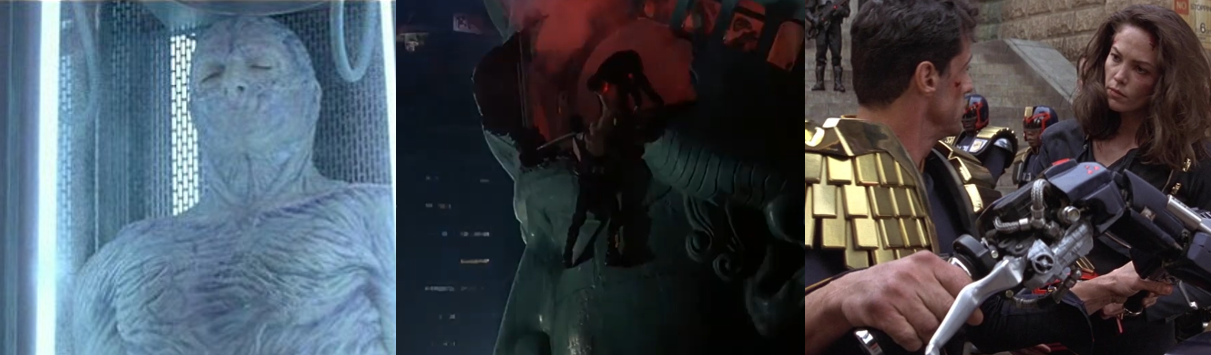
Still, it’s hard to deny the gravitas that Asante brings to Rico and how captivating his performance is; Stallone definitely can act and has always stood out from his action hero peers as being more than a slab of meat, but he’s a little in over his head here and largely bolstered by his supporting cast as he focuses entirely on tweaking Dredd’s persona from an uncompromising man of the law to a more empathetic individual. Dredd undergoes a great deal of emotional turmoil in the film, from being betrayed and convicted by the system to discovering that he’s a clone of Fargo and that Rico is his genetic brother. The trial is particularly hard on Dredd, who knows he’s innocent but is convicted because of irrefutable genetic evidence, forcing him to see the flaws in the system, but he’s absolutely devastated when Fargo dies before his eyes after revealing the truth to him. After finally opening up to Hershey, Dredd gears up to confront his brother in the remains of the Statue of Liberty, where Project: Janus is situated. In this elaborate laboratory, Rico has spawned a new crop of clones using his own genetic material and, after Dredd refuses to join him in his campaign, Rico orders that the clones are hatched before they’re fully gestated, briefly forced Dredd to contend with the gruesome copies that are little more than monstrous drones. Although injured (by a shot that really should’ve been fatal…), Fergie is able to disable to ABC Warrior and Hershey fends off Dr. Hayden as the laboratory explodes around them, leaving Dredd and Rico to face off in a brutal fist fight in Lady Liberty’s head after just… ignoring the clones, which are basically just there for a jump scare. Despite clearly being Rico’s physical superior, Dredd ends up dangling precariously over a fatal drop after they exchange blows; luckily for Dredd, Rico can’t pass up the chance for one final monologue in which he chastises his brother’s lack of loyalty and vision, given Dredd the opportunity he needs to distract Rico with a flare, deliver one last one-liner, and sent him plummeting to his death. In the wake of Rico’s death, the truth about Griffin’s actions is broadcast, exonerating Dredd and leaving him in prime position to ascend to the role of Chief Justice. Surprisingly, the movie adheres to the spirit of the comics by having Dredd decline and recommit himself to his daily duties, and then deviates from it wildly by having him exhibit only confusion and intrigue rather than insult when Hershey plants a kiss on his lips.

The Summary:
So, yeah… I’m a little torn. If anyone knows the complexities of adaptation, it’s me, and I totally get that some things need to change to bring a concept to life. generally, I go into an adaptation looking to see how it stands by itself, what it does differently, and how it works in its new medium and genre and judge it according to those standards. By that measure, Judge Dredd is a pretty by-the-numbers sci-fi action/comedy; it’s colourful and visually stunning, with some decent action set pieces and humour (when Rob Schneider isn’t trying too hard) that has a certain appeal, especially for younger viewers. If you’ve seen Demolition Man, which came out only a couple of years before this, and Blade Runner, this is very much a mash up of those two, with a sprinkling of RoboCop in there; it’s not exactly ground-breaking, but the practical effects and visual presentation go a long way to making it an entertaining flick. Stallone does a decent job here; honestly, he was a great choice to play Judge Dredd and (literally) fills the boots well, carrying himself with a grim, stoic demeanour that perfectly contrasts with his stellar supporting cast. Unfortunately… it’s just not really Judge Dredd for me. it captures some of the essence of the source material, but not enough to truly do it justice. I can understand toning down the violence and changing some aspects, but removing the helmet was a big no-no. Obviously, it would’ve been a very different movie if Stallone had kept it on (and again, I don’t know if it’d really be “better”), but the key thing here is that Dredd’s character is changed to make him a more heroic figure, when that’s really missing the point of what Dredd’s all about. Ultimately, I think the filmmakers just played things too safe; this wasn’t a time when comic book movies were known for taking risks and that really shows here, resulting in a fun action romp but one that is more like a taster introduction to Dredd’s world rather than truly being representative of it, which is a shame.
My Rating:
Could Be Better
What did you think to Judge Dredd’s live-action debut? Were you annoyed that he removed his helmet or do you think it made sense considering who was in the role? What did you like to Stallone’s performance and this interpretation of Dredd? Were you impressed by the film’s visuals, costume design, and special effects? What did you think to the plot regarding Dredd’s framing and his clash against Rico? Feel free to share your thoughts in the comments or on my social media and be sure to check out my other Judge Dredd content.

 Dr. K's Waiting Room
3 thoughts on “Movie Night [Sci-Fanuary]: Judge Dredd”