
Released: 30 May 2012
Originally Released: 17 March 1994
Developer: M2
Original Developers: Ancient and SEGA
Also Available For: GameCube, Mega Drive, Nintendo Wii, PC, PlayStation 2, PlayStation 3, PlayStation 4, PlayStation 5, SEGA Mega Drive Mini 2, Steam, Xbox One, Xbox Series S/X
The Background:
Since sidescrolling beat-‘em-ups were popular in both arcades and home consoles back in the day thanks to the likes of Double Dragon (Technōs Japan, 1987) and Final Fight (Capcom, 1989), Noriyoshi Ohba and his small team of developers were smart to create the Bare Knuckle Streets of Rage series (SEGA, 1991 to 1994), which was initially exclusive to SEGA’s home consoles. Streets of Rage (ibid, 1991) was incredibly popular and highly praised, and the sequel was even more lauded for its many graphical and gameplay improvements. A bigger, even more improved third entry soon followed; originally, Streets of Rage 3 included motorcycle stages, which can still be played through hacking, and the game featured far more regional differences than its predecessors, including a reworked plot, recoloured sprites, less provocative enemy sprites, and the entire removal of a potentially offensive miniboss. Despite these alterations, Streets of Rage 3 was as highly praised as its predecessors; while the graphics and gameplay were seen as the best in the series so far, reviews did criticise the soundtrack, difficulty, and the stale nature of the franchise despite the new features. While we wouldn’t see another game for nearly thirty years, Streets of Rage 3 was re-released and ported to other consoles over the years before it, and its predecessors, were brought to the Xbox 360 as part of the SEGA Vintage Collection, with this version including modern quality of life perks like save files, a replay feature, and other bonus content.
The Plot:
Following his two previous defeats, Mr. X establishes the RoboCy Corporation and begins creating robots to replace important city officials and then has his criminal syndicate place bombs all over Wood Oak City! Eager to get revenge against Mr. X for turning him into a cyborg, Doctor Gilbert Zan contacts former police officers Axel Stone and Blaze Fielding and their young ally, Eddie “Skate” Hunter, and joins them in bringing down the syndicate once and for all!
Gameplay:
In keeping with the style of the series so far, Streets of Rage 3 is a sidescrolling 2D beat-‘em-up that lets players pick from one (or two, if you’re playing with a friend) of four playable characters and hit the mean streets of Wood Oak City one more time to take out a whole new batch of thugs across seven levels (referred to in-game as “Stages”). Just like last time, the game supports two-player co-op and a friend can jump in at any time, but there are now only three difficulty settings to pick from (“Easy”, “Normal”, and “Hard”). Not only that, but you won’t get to experience the full game if you play on “Easy” as the game will end at Stage 5 in this mode, meaning you need to play on at least “Normal” to have a shot at completing the whole game and even then this mode is notable harder than in the Japanese release. You can still manually set your stock of lives from the “Options” menu, however, and switch to another character after exhausting all of your lives and continues (of which you have three on “Normal”). Unlike the last two games, Streets of Rage 3 drops the time limit (with the exception of Stage 6 and the final boss), and the game is bigger and more fluid than ever. The control scheme, while fundamentally the same, has been expanded to include six-button control options, and is once again fully customisable in both the in-game menu and SEGA Vintage Collection settings. By default, A launches a combination of punches and kicks (and this can be set to rapid fire mode so you can simply hold down the button to pummel enemies), B lets you jump to hit one of three jumping attacks, and X unleashes one of two special moves to clear away groups of enemies at the cost of some health.
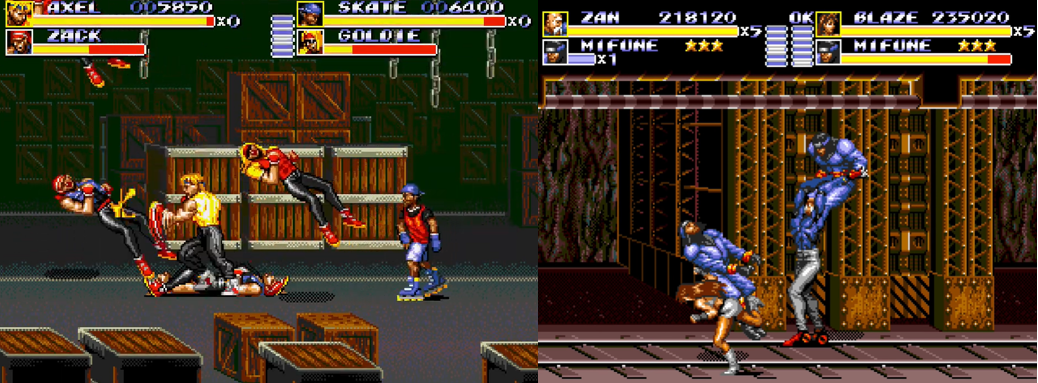
You can still perform a rear attack with A and B together (or assigning this to X, like I did) for better crowd control. You can also assign an “X Attack” (which appears to be a single, powerful attack from your combo) and you can still grab, pummel, toss, and slam enemies when you get close to them (and they can still do this to you, and can even perform co-op attacks and steal health items!) Streets of Rage 3 shakes up the roster once more; although Adam Hunter is still unplayable, he does make appearances in the game’s cutscenes, and lumbering oaf Max Thunder has been replaced by the cybernetic Zan. Axel, Blaze, Zan, and Skate continue to share the same basic attacks and controls and each again boast different skills according to five attributes (Power, Technique, Speed, Jump, and Reach). You can also see their height and weight listed in the character select screen, though I don’t think this really affects how the characters play; the other attributes certainly do, though, with Axel again being more of an all-rounder, Skate being the smallest, weakest, and fastest, and Zan having the best reach and able to zoom around on his rocket shoes but at the cost of having a shit jump and turning weapons into projectile attacks. As in the last game, each character is further separated by their different special attacks; Axel can still perform his flaming “Bare Knuckle” uppercut and spinning flaming fist, but Zan can electrocute enemies on contact and you can quickly pummel enemies with Blaze and Skate’s faster (but weaker) attacks. This time around, though, the game features a rechargeable meter; when full, your special attacks will be at their most powerful and won’t cost you any energy, and you’ll also gain a star under your life bar after accumulating high enough scores that will further power-up your special attacks. Every character can now not only dash ahead and perform a running attack (which also benefits from the star power-ups) but they can also vertically dodge out of the way with double taps of up or down, which is extremely handy when dealing with large groups of enemies.

If you’ve played either of the previous games (or any sidescrolling beat-‘em-up) then you’ll be acutely aware that your primary goal is to travel from the left side of the screen to the right dispatching enemies and smashing crates and such for objects and power-ups. Like the last game, each Stage is made up of multiple screens and areas, with transitions taking place to show characters smashing through doors or the time of day changing, and you’ll still be able to earn extra lives by adding to your score tally (with bonus points continuing to be awarded at the end of each Stage). Stages don’t seem as long as the last game, however, though each screen is longer, if that makes sense? You seem to spend more time in less screens, basically, and the game seems a little tougher this time around; I only found one 1-Up pick-up in my entire “Normal” mode playthrough and the sheer amount and variety of enemies onscreen can get a little frustrating. Enemies continue to be “shy” and linger offscreen, while also dropping down from the sky, emerging from the shadows, leaping from storage containers, hopping in from speedboats, and popping out from behind bushes to attack you, and it’s much easier to get surrounded by goons this time around. Not only that, but Streets of Rage 3 features the return of stage hazards; bottomless pits make a return in Stage 3 (though, thankfully, they’re not an instant-kill trap this time), barrels drop down from above, wind pushes you back, rising (and horizontal) platforms and elevator sections see you trapped with wave-upon-wave of enemies or tossing them to their doom, conveyor belts make movement and combat sluggish in Stage 7, and you’ll even have to dodge snare traps and laser turrets (though these can damage enemies, too). There’s actually a bit of gameplay variety thrown in here, too; not only do some Stages see you going to the left for a change, but you’ll need to smash through cinder blocks while fending off a digger machine in Stage 3, dodge hazards that fly at you along underground railroad tracks in Stage 4, and face a time limit in Stage 6. This is easily the most complex Stage in the game; you have fifty in-game seconds to clear out enemies, using an elevator to visit different floors, and destroy two control consoles before a lethal gas is emitted. If you take too long, the gas will not only whittle down your health, but cause the death of the captive police chief, Ivan Petrov, which will change the game’s ending accordingly.
Graphics and Sound:
I have to say that, while I enjoyed some of the tracks featured in Streets of Rage 3, the soundtrack is probably the weakest in the trilogy; Stages are punctuated by a thumping, techno beat that is just as likely to be catchy as it is a mess of garbled noise. The links to The Revenge of Shinobi (SEGA, 1989) continue to be found within the game, as well; while the cutscenes finally feature a unique font for the game, Revenge of Shinobi font, sound effects, and melodies are still found throughout (though, at this point, they’re probably more associated with this series of games so I can forgive it). The game’s presentation is better than ever; sprites are larger and more detailed (with Axel, Blaze, and Skate sporting new colour palettes) and enemies are more varied; while skin-heads, dominatrixes, and denim-clad goons still dog your progress, a whole bunch of new enemies are featured, each sporting a name and a health bar. Some even boast a life count of their own, which generally gives you a better indication of how tough the enemy is and how many tiers their health meter has, and weapons also sport their own health meters now and will break after consecutive use.
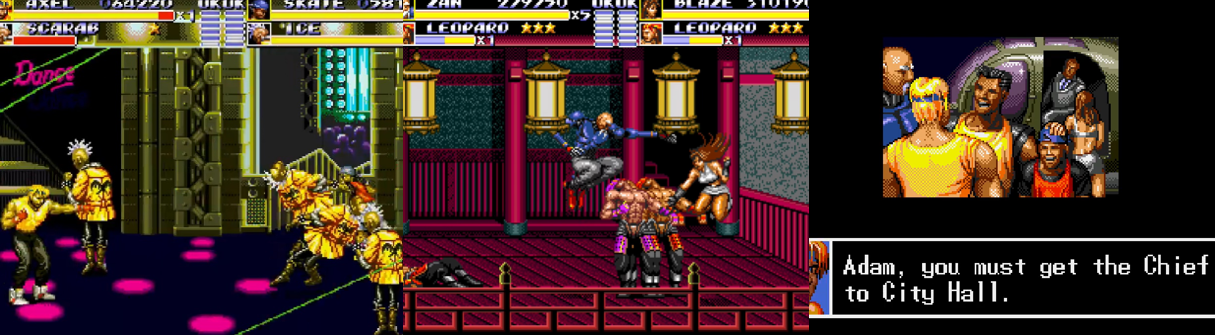
The environments are the biggest, most varied, and most detailed in the series yet, however. Little touches like chains shaking when you slam enemies to the ground, day turning to dusk, cats peeking out from bins, and wind blowing lanterns and rubbish about really help to make every Stage feel alive. There’s always a lot to catch your eye on the screen, from bushes rustling to indicate the arrival of a hidden enemy, to a bustling nightclub awash in strobe lights and dancing enemies, to glasses tumbling from bars, an aquarium in the background of the Stage 2 boss fight, and even an elaborate Japanese temple in Stage 5. Stage 5 also features a recreation of the final stage of the last game, once again having you fend off enemies in a rising elevator to Mr. X’s throne room, only this time it’s at night and the fight is notably different from the last two Mr. X boss battles and the big man himself is later revealed to be a brain in a jar within an underground laboratory! Everything is so much more detailed and varied this time around, which makes for an experience that finally captures the arcade-style aesthetic the series was going for with the first game, and this is even more evident in the heavier emphasis on story. Not only is there an introductory and ending cutscene, but cutscenes will also take place during and after certain Stages, with dialogue boxes appearing onscreen and different endings being shown depending on how you beat the final Stages of the game.
Enemies and Bosses:
Although long-time players of the series will be more than familiar with the vast majority of the enemies encountered in Streets of Rage 3, palette swapped variants are much more commonplace and they appear alongside some new additions to Mr. X’s syndicate. Denim-clam thugs, yellow-jacketed punks, skinheads, dominatrixes, bikers, and ninjas all make a return to charge at you with knives, slide at your shins, uppercut you out of the air, crack their whips at you, charge at you on their bikes, and flip about tossing throwing stars at you. Newcomers to the series are “Goldie” (a street thug not unlike Axel who can guard against your attacks), “Soozie” (a punk girl similar to Blaze who can pummel you with slaps and leaps at you with flying kicks), and “Zack” (a bandana-wearing goon who likes to grab you from behind). Rotund firebreathers and belly floppers like Ben Ben also make a comeback (and once again cause you damage when you try to slam them), but you’ll also contend with gun-packing Assassin Agents, jetpack-wearing Rockets, martial arts experts like Tiger, and even robotic, frog-like enemies who hop about, dash at you, fire projectiles at you, or explode and send shrapnel across the screen.
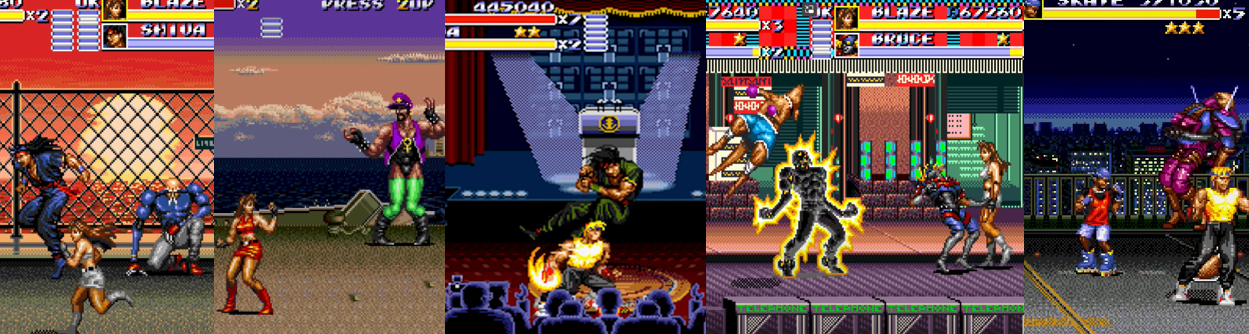
Streets of Rage 3 dramatically reduces the amount of sub-bosses you’ll have to face compared to the last game, with only two cropping up this time around; instead, certain regular enemies will receive a palette swap and an extended life bar to act as tougher mid-Stage enemies. Bosses will rarely be accompanied by an endless slew of thugs as well, which is definitely a plus, but three of them are recycled from Streets of Rage II and you’ll notice this right away when you reach the end of Stage 1 and face off with Shiva. Downgraded from a penultimate boss to the first boss of the game, Shiva isn’t quite as difficult as in the last game but still poses a challenge as he’s got a nasty leaping kick that can catch you off-guard after you knock him down. You won’t actually face Shiva in the Japanese version of the game, though; instead, you fight Ash, a stereotypically gay character who slaps you around, dances about, and can slam you to the ground. Both Shiva and Ash can be unlocked as playable characters after defeating them and holding B until the next Stage starts, but only Shiva actually makes a reappearance in the worst ending of the game where he serves as the final boss and is given a significant power boost alongside a new attire. Similarly, you can unlock the boxing kangaroo Roo if you take out his abusive handler, Bruce, in the sub-boss fight of Stage 2, after which you’ll battle the female tag team of Mona and Lisa once more who again prove to be slippery and annoying opponents as they continuously backflip away from your attacks and leap at you with kicks. Another returning boss is Jet, though he’s given a new look; he’s accompanied by Rockets, all of whom share his ability to swoop down at you and grab and slam you, but only Jet can blast you with flames from his thrusters. While you can land combo attacks on these guys, and grab and slam them, it’s still difficult to judge which plane they are on thanks to them constantly hovering about.
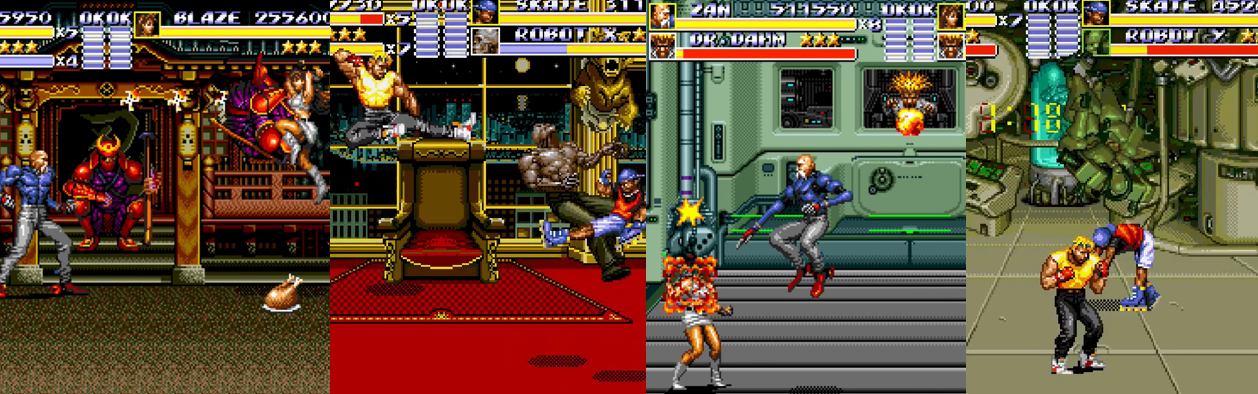
New bosses do appear in Streets of Rage 3, however. At the end of Stage 3, you’ll battle an exact copy of Axel; this duplicate has all of Axel’s abilities and special attacks, but changes colour and bursts into flames as you land hits and is eventually revealed to be a robot imposter upon defeat. One of the hardest bosses is Yamato, an armour-clad samurai who is actually three bosses in one. Each samurai will take it in turns to attack you, slashing across the screen with their katana, duplicating themselves, and performing a diagonal dash attack that can be hard to dodge. When you finally confront Mr. X, the game initially frames the confrontation as being exactly like in the last game but, after dispatching his goons, he’s also revealed to be a robot duplicate. Robot X dashes across the screen on rocket boots, fires at you from a wrist-mounted gun, and even shoots homing missiles at you! You’ll then encounter weaker versions of this boss as regular enemies in Stage 7, which also sees a unique boss battle as you’re placed on a vertical conveyer belt that constantly forces you towards an electrical barrier while Dr. Dahm tries to crush and electrocute you with his mechanical claw arm. While it can be tricky to land hits on this, and time your attacks to avoid being shocked, it’s nothing compared to the final encounter with Mr. X, in which his disembodied brain controls the heavily-armoured Robot Y. This hulking foe is made all the more threatening by its maniac attack patterns; it spins around the place, barely fazed by your attacks, and sports a four-tiered life bar and missiles. Not only can it shrug off your attacks and deliver big damage with its basic strikes, the bastard can even grab you out of the air and deliver a huge slam that can easily drain half your life bar. You’re also given just three in-game minutes to defeat it and get the game’s best ending, making for easily the most challenging boss battle not just in this game but in the entire trilogy.
Power-Ups and Bonuses:
As ever, you’ll find a whole bunch of destructible objects in the game’s Stages for you to smash to uncover apples and roast dinners to restore your health, bags of cash and gold bars to add to your high score, and weapons to use against your enemies. Weapons are a little more diverse this time around, but also notably different; not only do they each have a life bar of their own, as stated, but some are single-use only. Knives, for example, are now thrown by default, as are grenades, though you can throw every weapon with the press of a button. You can grab kunai blades, wooden planks, lead pipes, baseball bats, and swords to attack your enemies, but be warned as enemies can also acquire (and throw) these weapons, and even steal your health items if you’re not fast enough!
Additional Features:
There are four Achievements to earn in Streets of Rage 3, and two additional Achievements as part of playing all three games in the SEGA Vintage Collection. The four specific to this game require you to defeat the robot Axel as Axel, free Roo, save the Chief as Zan, and max out your special attack by acquiring three stars. As in the other two games, each of these (with the exception of the latter) are achieved by playing alone and there are no Achievements for playing alongside a friend, or finishing the game as each character, which remains a disappointment. Streets of Rage 3 has a number of endings that are dictated by your progress in the last two Stages and which difficulty you play; you won’t get Achievements for seeing all of these endings, though, and are required to just beat the game (and the other two) to earn 100G. The “Duel” mode from Streets of Rage II returns; now called “Battle”, this mode lets two players to go head-to-head as one of the four playable characters in a one-on-one fight (but, again, there are no Achievements tied to this). This version of the game comes with the same customisation options as the others, so you can set wallpapers, scan lines, and smoothing, listen to the soundtrack on the jukebox, switch between the Japanese, European, and North American versions of the game, save replays, and use save states to make things easier on yourself. Alongside the usual local and online co-op returns, you can still set a high score on the leaderboard and take on the “Trial” mode, which has you battling towards a high score on different difficulty stages against a time limit or extracting the Chief as fast as possible, with the lives you lose adding to your timer.

The Summary:
The question permeating all these reviews of the Streets of Rage games is: Which is better? Streets of Rage or Final Fight? While the first game fell quite short of matching its arcade counterpart, Streets of Rage II was much closer, and Streets of Rage 3 is right up there with some of the best arcade beat-‘em-ups. Everything about the game is bigger and better than the last two, expanding upon the gameplay and presentation to offer the best Streets of Rage experience yet. Reintegrating elements from the first game, such as stage hazards, and expanding upon the gameplay by removing the time limit but offering some variety in tense sequences that see you fending off a digger or desperately fighting to save the Chief really add to the overall experience and make things less monotonous. On the flip side, and what keeps Streets of Rage 3 from earning my coveted fifth star, the music isn’t as good as in the previous games and the difficulty spike is very noticeably, making for some frustrating moments as enemies have bigger health bars and the time offered to you to complete tasks is so tight that it’s easy to fail and be left with one of the bad endings. The gameplay mechanics have never been better, however; the additional of the power gauge for specials, new control options, and impressively detailed sprite work and backgrounds make the game slick to control and endlessly visually interesting, but the recycled boss battles are a shame, especially considering how much detail was packed into every Stage. Overall, I’d say Streets of Rage 3 is easily the best of the original trilogy, and would recommend it as the go-to title to play and own; bigger, better, with more variety, some fun bonus characters, and different endings to work towards, the only thing holding it back from five stars are a few minor missteps that can make it a little too challenging an experience.
My Rating:
Great Stuff
Did you enjoy Streets of Rage 3? How do you think it compares to the original, its sequels, and other beat-‘em-ups? Did you enjoy Zan’s inclusion or did you stick to a character you were more comfortable with? What did you think to the energy gauge and the recycled bosses from the last games? Have you ever gotten the game’s best ending? Which beat-‘em-up game or franchise is your favourite and why and what is it you enjoy about the genre? To share your memories of Streets of Rage 3, leave a reply below or comment on my social media and be sure to check out my reviews of another classic beat-‘em-up titles.

 Dr. K's Waiting Room