Toho’s famous atomic beast, and easily the most recognisable kaiju in the entire world, Gojira first emerged from the waters of outside of Japan to wreck the city of Tokyo on this day all the way back in 1954. In 2016, the day was declared “Godzilla Day” and, as a result, I’m only celebrating the undisputed King of the Monsters.


Released: 3 November 1954
Director: Ishirō Honda
Distributor: Toho
Budget: ¥100 million
Stars: Akira Takarada, Momoko Kōchi, Akihiko Hirata, Takashi Shimura, and Haruo Nakajima and Katsumi Tezuka
The Plot:
When a gigantic creature (Nakajima and Tezuka) born from nuclear radiation destroys a Japanese freighter, ransacks Odo Island, and rampages through Tokyo, Doctor Daisuke Serizawa’s (Hirata) experimental “Oxygen Destroyer” becomes the only hope of saving Japan!
The Background:
On August 6th, 1946, at the height of the Second World War, a nuclear weapon code-named “Little Boy” was dropped by the United States military on the Japanese city of Hiroshima, killing 70,000 people. A second bomb strike Nagaski three days later, killing a further 35,000 people, and in the Japanese Imperial Army summarily surrendered in aftermath of these devastating attacks. Since then, radiation and atomic fallout from the bombings have resulted in thousands of people falling sick and dying, and post-war Japan was gripped with fear regarding nuclear weapons and the threat of nuclear destruction. From this fear was born Gojira, the living embodiment of nuclear destruction, and was as inspirational to producer Tomoyuki Tanaka as King Kong (Cooper and Schoedsack, 1933) and The Beast from 20,000 Fathoms (Lourié, 1953) in Godzilla’s development. Director Ishirō Honda’s war-time experiences made him idea to the task of taking the concept seriously, while the titular creature went through a number of concepts before Teizo Toshimitsu, Akira Watanabe, and Eiji Tsuburaya settled on its final design.Combining elements of numerous dinosaurs, Tsuburaya initially planned to bring the creature to life using stop-motion animation but reluctantly utilised suitmation, resulting in a 220-pound suit that was so heavy, hot, and cumbersome that it took two stuntmen to wear it. Though the origin of the creature’s name is the subject of many tall tales, his iconic roar was the work of composer Akira Ifukube and Tsuburaya directed the film’s many complex models, miniatures, and special effects. In its original Japanese run, Godzilla was a modest financial success but was criticised for glorifying a real tragedy with an unbelievable, fire-breathing monster. Still, the film did well enough to receive an international release, where it was retitled Godzilla, King of the Monsters! (Morse and Honda, 1956) and featured a number of edits, including the insertion of Raymond Burr, where it made a further $2 million the original’s bleak themes. Since then, Godzilla spawned easily the greatest and most iconic monster movie franchise of all time and enjoyed a legacy that spanned over sixty years of invention, reinvention, and creativity and it all began here, with a metaphorical mediation on the horrors of nuclear war.
The Review:
I can’t actually remember off the top of my head when I first became aware of Godzilla; I think it was just one of those cultural phenomenon’s that I had just picked up from references and homages in other media as I certainly don’t remember the movies being on television when I was a kid. I know I was fascinated by the creature, and the concept, in my pre-teen years and jumped at the chance to stay up late to watch a whole evening’s worth of content celebrating kaiju films, which included the first-ever Godzilla movie I ever watched from start to finish, Godzilla vs. King Ghidorah (Ōmori, 1991), which was all produced to coincide with the upcoming release of the 1998 American version of the film. After that, I was as hooked as I could possibly be and made a point to tape any subsequent Godzilla movies when they aired, and even went out of my way to get box sets from Australia to own the films (since hardly any of them are available here in the United Kingdom). Consequently, I’m more a fan of the Heisei and Millennium eras of the franchise, but I’m always up for a bit of black Showa action since that is where the series started, after all. The first thing to note about this review is that I am watching the original black-and-white version of the film with Japanese subtitles, meaning there’s no Raymond Burr and no hilariously bad dubbing; however, this isn’t actually my preferred way of watching Japanese films or anime and I’m perfectly fine with dubs over subtitled films. Still, it would be remiss of me to mention that the film quality hasn’t actually aged all that well; it’s quite grainy and dark, and actually seems inferior to even King Kong, but I’m hardly going to begrudge the film based on the technology and film quality of the time.
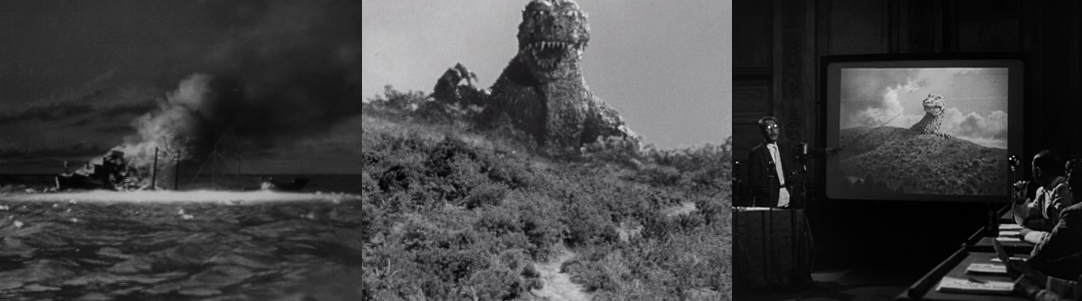
The film begins with a sudden and violent flash of light destroying the Japanese freighter Eiko-maru just outside of Odo Island; when the Bingo-maru is sent to investigate, it is also destroyed, the locals are thrown into a panic at the loss of life and the few survivors tell tales of the ocean simply exploding around them. Of course, the press catches wind of the story and speculation as to the cause of the accidents is only exacerbated after the natives of Odo Island find their fishing efforts ruined and stories of an ancient sea monster named “Godzilla” being blamed for it all by an elderly native (Kokuten Kōdō). Although these are initially dismissed, they turn out to be true when the island is ravaged by a fierce storm and a gigantic, dinosaur-like creature is briefly seen laying waste to the village. Traumatised by the devastation, the natives appeal for an investigation, which renowned palaeologist Doctor Kyohei Yamane (Shimura) agrees is the best course of action. Accordingly, he heads to the island to assess the damage and is accompanied by a team of scientists, his daughter Emiko (Kōchi), and Hideto Ogata (Takarada), a salvage ship captain who steers the boat. Amidst the wreckage on Odo Island, Yamane discovers that the village well has been contaminated by radioactive fallout and that massive radioactive footprints and extinct trilobites are littered throughout the village; the cause is immediately identified when the alarm bell rings and Godzilla is fully seen, and heard, for the first time, quite rightly sending everyone into a screaming panic! Although the creature disappears back into the ocean as soon as it emerges, Yamane has seen enough to postulate an original for the creature, believing that it is an ancient, sea-dwelling dinosaur of sorts that survived the extinction of its brethren to become the legendary creature the natives refer to as Godzilla and apparently disturbed from its long sleep at the depths of the ocean by recent atomic tests being conducted at sea.
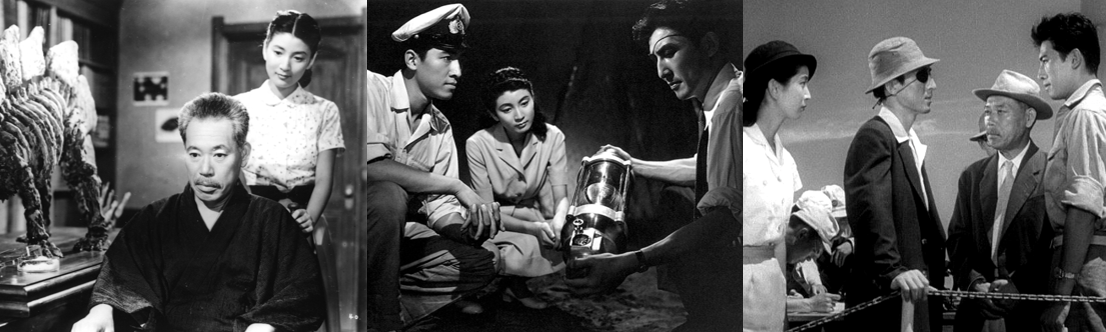
Although there is some debate about how public to make these events, the press print their story anyway, though few seem to take the impending threat of Godzilla seriously and find the idea of retreating to the safety of bomb shelters to be too much of an inconvenience. The military’s efforts to destroy the creature using depth charges are met with failure, and only cause further lives to be lost at sea when Godzilla retaliates, destroying both military and civilian vessels with its atomic breath. Yamane is distraught at the military’s efforts to kill Godzilla, as he wishes to study the creature further to discover the secrets of its biology and resistance to radiation, though he asserts that the creature is virtually indestructible since was able to absorb massive amounts of radiation and survive for millions of years without being harmed. One newspaper agrees one the scientific merit of the creature and sends a reporter, Hagiwara (Sachio Sakai), to interview Dr. Serizawa, a reclusive scientist horrifically scarred from and traumatised by the war, and to whom Emiko is engaged. Emiko agrees to take Hagiwara to see Serizawa since she wants to break off their engagement in favour of Ogata anyway, but he staunchly refuses to divulge any information on his latest research to Hagiwara. He does, however, provide a secret demonstration of his Oxygen Destroyer to Emiko, who is so traumatised by the devices ability to strip marine life to the bone through aggressive asphyxiation that she forgets all about mentioning their engagement. However, after Godzilla finally makes landfall and begins rampaging through first Shinagawa and then central Tokyo, shrugging off the fighter jets, missiles, and electrified fences erected to slow and stop its progress, she has no choice but to betray Serizawa’s confidence and goes to him with Ogata to plea for his help. Serizawa, however, is reluctant to employ the Oxygen Destroyer since he fears, and knows, that the military or other superpowers of the world will see its awesome destructive power as a weapon and force him to make more, but is spurred to assist after witnessing the sheer destruction caused by Godzilla.
The Nitty-Gritty:
As is to be expected from a Godzilla movie, much of Godzilla’s runtime is spent following a handful of human characters who react to the titular creature in different; thankfully, for a long-time Godzilla fan such as myself, the original film doesn’t actually set the template that so many others would follow and veers away from following reporters and/or soldiers and mostly focuses on Dr. Yamane, his concerned daughter, and her bland, would-be-lover. Yamane is different from every other character in the film in that he doesn’t want to see Godzilla destroyed; instead, he wishes to study the creature, to uncover the secrets of its strength and the potential benefits it could bring to mankind, and this even brings him into conflict with Ogata, who tries in vain to argue that the creature’s threat outweighs Yamane’s scientific curiosity. Were it not for the presence of Dr. Serizawa, Yamane would easily be the most interesting human character; while the reporters, soldiers, and government officials we do see are overwhelmed by Godzilla’s rampage, Serizawa is more concerned with the potential of others to pervert his research into something equally, if not more powerful, than nuclear weapons.
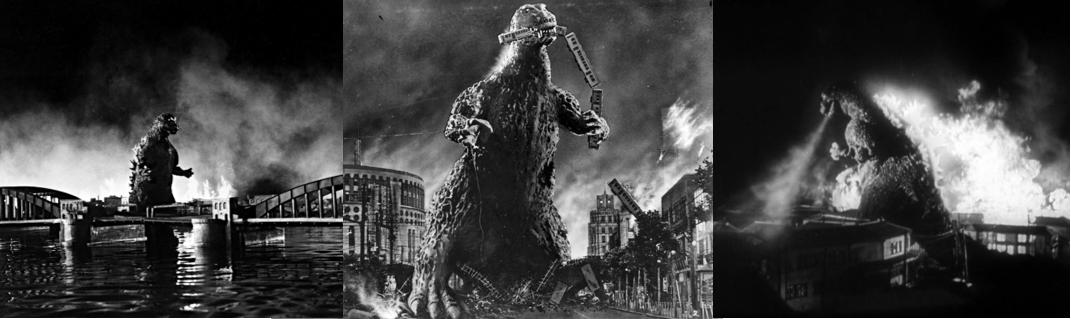
Considering that Godzilla is the embodiment of nuclear terror and exudes radioactivity, the scientists don’t really do all that much to protect themselves from radiation; Yamane handles radioactive evidence with his bare hands and his team simply tell bystanders to stand back when they pick up signs of radiation, however once it makes landfall, its threat is taken very seriously. While the miniatures and model shots would improve over time (vehicles, such as helicopters, cars, and trains, suffer the worst in this film, though houses and structures tend to simply crumble and topple with ridiculous ease), the rear-projection effects are pretty ambitious for the time. Honestly, the entire film is bolstered by being in black-and-white and the graininess of the film stock; this, and the darkness that constantly bathes Godzilla, goes a long way to hiding some of the cruder effects and presenting the creature as a terrifying force of nature. I do have to commend the suit work, though; sure, it’s probably cheaper, easier, and less impressive than stop-motion effects but it definitely allows for a far ore versatile kaiju, one who can crash through a miniature version of Tokyo with ease and leave thousands either dead or slowly dying from radiation sickness. Of course, the star of the show, and the main reason that anyone watches this and any of the Godzilla films, is the Big-G himself. The film spends a great deal of time building anticipation to Godzilla’s full reveal, showing merely the flash of its atomic breath or the dark shadow of its leg as it topples buildings; even when we see its head and torso emerge over the mountains of Odo Island and out at sea, were still barely have an idea of what it actually looks like, which is a great way to paint it as this mysterious, fearsome, and almost mythological being. Long regarded as a creature of legend, Godzilla is like a living force of nature, easily shrugging off gunfire, missiles, and every attempt by the military to harm it. Seemingly without conscience, the creature emerges from the ocean and tramples its way through Shinagawa, killing untold numbers and causing devastation in its wake; while the military scrambles to organise mass evacuations and erect massive electrical fences, their efforts are entirely in vain (despite the incredibly speed that they’re able to put these defences together) and Godzilla easily tears its way into downtown Tokyo. The shot of the creature, seeped in darkness and with fire rage all around it as it roars in triumph and unleashes its destructive atomic breath, perfectly encapsulates everything that this original version of Godzilla represents: fear. Fear of the unknown, fear of the power of nature, fear of radiation, fear of nuclear fallout, and fear of our impending demise against forces we cannot possibly understand or hope to fight back against.

You can make all the jokes you want about how ridiculous it is to see a man in rubbery suit flailing around and slapping at model buildings, but there’s a raw power to Godzilla in this film that is often forgotten in many of his interpretations; it’s not some cute, cuddly mascot or a benevolent creature looking to defend us from some greater evil, it’s all the fury of nature and man’s inhumanity to man given physical form, and nothing showcases the awesome ferocity of its nature than seeing it lay waste to one of the greatest and most prolific cities in the modern world. Although Dr. Serizawa is moved by Emiko and Ogata’s plea to help get rid of Godzilla, he is so determined to keep his Oxygen Destroyer from falling into the wrong hands or being perverted into a superweapon that he destroys all of his research notes and all evidence of the device save for the one he has created. Realising that he could be coerced into making another, but fully aware of the destruction and devastation being caused by Godzilla, he sees only one viable option: he must personally deliver the device to the bottom of Tokyo Bay, where Godzilla has retreated following its most recent rampage, and kill himself along with the creature to end two threats against the world in one blow. He does this willingly, despite Emiko’s (unconvincing) tears and Ogata’s insistence that he go in Serizawa’s place since the doctor has no experience using a diving suit; although Ogata insists on accompanying him to where the creature lies on the seabed, Serizawa refuses to leave and severs his lifeline to the ship after depositing the Oxygen Destroyer. The device has a near-instant and fatal effect, suffocating the creature and stripping it away to its bones, and sparing Serizawa’s loved ones from its threat. Those who are familiar with the multitude of Godzilla sequels and movies may be surprised to learn that Godzilla dies so conclusively (and, if we’re being honest, anti-climatically), but, while the crew and Serizawa’s friends salute his bravery, a troubled Dr. Yamane believes that another Godzilla may come into being if humanity is unable to learn from its mistakes and stop screwing around with nuclear weapons and technology.

The Summary:
Godzilla obviously isn’t going to appeal to everyone; I’ve known a lot of people who straight-up refuse to watch black-and-white films, let alone ridiculous kaiju movies featuring a man in a rubber suit smashing apart model buildings, but I think it’s still an important film for movie fans, especially, to check out for its message on the horrors of nuclear weapons if nothing else. The themes of fear and apprehension regarding nature and man’s destructive potential haven’t been diluted over time; if anything, they’ve only strengthen over the decades as global conflicts and arsenals have escalated, meaning that we’ve never been closer to blasting our world into oblivion than we are right now. Godzilla represents the fear of that threat; a literal beast that rises from the darkest depths of the ocean and punishes humanity for their stupidity and hubris, shrugging off all modern weapons and only being defeated by employing a weapon even more devastating than both it and the weapons that awoke and empowered it. While the human characters aren’t all that interesting and some of the effects haven’t aged too well, this is true of many kaiju movies from this period, and films in general from back in the day, and I think it’s better to concentrate on what does work about the film. The model shots, rear projection, and practical effects are all very ambitious and, arguably, allow the film to hold up a little better without the jerkiness of stop-motion animation. Characters like Dr. Yamame and Dr. Serizawa are clear standouts against the bland Ogata and the largely inconsequential Emiko; speaking out on the scientific potential of Godzilla and the harmful potential of scientific research, both characters help to drive home the primary themes of the movie (that war has brought about terrible consequences and that nature will punish us for our violent tendencies) as much as the titular creature, which makes an immediate impact as a ferocious and terrifying monster in its debut appearance.
My Rating:
Pretty Good
Are you a fan of the original Godzilla? Which version do you prefer, the original Japanese movie or the American dub with Raymond Burr? What did you think to the build up to Godzilla’s appearance and the lore surrounding the creature? Were you a fan of the film’s characters and what did you think to the suitmation used to bring Godzilla to life? What is your favourite Godzilla movie and why? How are you celebrating Godzilla Day this year? Whatever your thoughts on Godzilla, or Godzilla and kaiju films in general, feel free to leave a comment below and be sure to check out my other Godzilla content!







 Dr. K's Waiting Room
You must be logged in to post a comment.