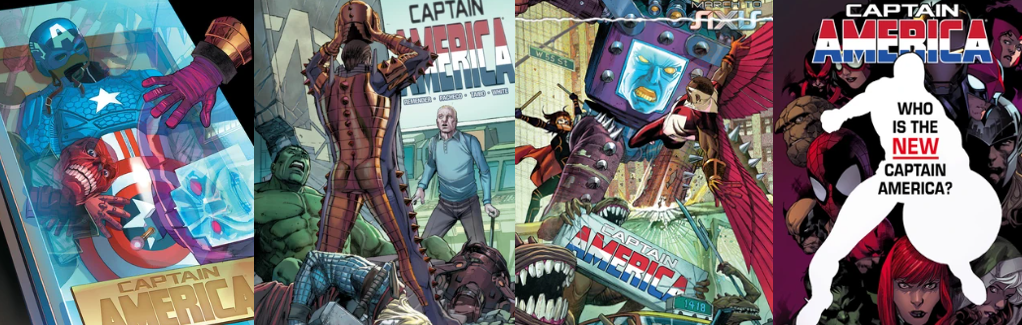
Back Issues: Captain America 22-25

Story Title: “The Tomorrow Soldier” (Part 1 to Conclusion)
Published: 2 July 2014 (cover-dated: September 2014) to 1 October 2014 (cover-dated: December 2014)
Writer: Rick Remender
Artists: Carlos Pacheco and Stuart Immonen

The Background:
By 1941, Nazi Germany had decimated Denmark and Norway and World War Two was fully underway and, after some initial resistance, the United States joined the War against the “Axis powers” of Germany, Japan, and Italy. Patriotism and national pride was high, especially in America, during those dark days, making it the perfect time for Joe Simon and the legendary Jack Kirby to debut Captain Steve Rogers/Captain America and his kid sidekick, James Buchanan Barnes/Bucky, to encourage support of the war effort. Once the War was over, superheroes saw a decline and Captain America’s solo publication was cancelled in 1954. However, Cap got a second chance when he joined the Avengers as a “man out of time”, battling iconic villains like Johann Shmidt/The Red Skull and even opposing his fellow superheroes during a “Civil War”. After surrendering to the authorities, Cap was seemingly killed and his troubled sidekick, better known as the Winter Soldier, took up the mantle until Steve’s inevitable resurrection. However, in 2014, cybernetic supervillain Arnim Zola’s machinations saw Cap drained of the super soldier serum and rapidly aged into an old man! Thus the battle was on the see who would become the new Star-Spangled Avenger, a battle eventually won by Cap’s long-time ally, Sam Wilson/The Falcon, to much undue controversy, Created by Stan Lee and Gene Colon in 1969, the Falcon was the first Black American superhero in mainstream comic books and was specifically created to challenge social perceptions. After a lengthy career as a bit-player in Marvel Comics, Sam made headlines with his promotion, a story arc that achieved mainstream recognition due to Anthony Mackie’s celebrated portrayal of the character in the Marvel Cinematic Universe.

The Review:
Sam Wilson’s assumption of the Captain America mantle didn’t come easy, nor without drama. In the leadup to this story, Cap was kidnapped by Arnim Zola and spirited away to Dimension Z, where the mad scientist plotted to drain his super soldier serum to create a race of genetic super-beings! Cap broke free but was trapped in Dimension Z for ten years, during which time he raised Zola’s son, Ian, as his own. Though Cap eventually escaped with Jet Zola/Jet Black, Zola’s daughter, both Ian and Cap’s lover, Agent 13/Sharon Carter, were lost. Cap then spent some time working with Sam to mould Jet Black into a hero but, in a battle with former Strategic Homeland Intervention, Enforcement, and Logistics Division (S.H.I.E.L.D.) agent-turned-madman, Ran Shen/Iron Nail, Cap’s super soldier serum was neutralised and he quickly aged into frail, infirm old man! Our story picks up with Steve sequestered at Avengers Mansion, stewing over sensationalist news reports demanding accountability for Captain America and S.H.I.E.L.D.’s dangerous and destructive antics. Steve’s offered council by S.H.I.E.L.D. director maria Hill and the decidedly Samuel L. Jackson-esque Nick Fury Jr., who assure him that he saved countless lives taking down Iron Nail. Unfortunately, his shield has been left too radioactive to be returned to him and Steve’s aghast when he’s told S.H.I.E.L.D. won’t be destroying Gungnir, the weaponised, Transformer-like Helicarrier Iron Nail hijacked and threatened the United States with. Steve is so angered that he starts to wonder if the reports of corruption within the government and S.H.I.E.L.D. aren’t valid, though Fury simply explains that contingencies such as Gungnir are vital to protect innocent civilians and keep the public from being overly reliant on costumed heroes, especial as the Avengers’ roster has dwindled lately.
When Armin Zola’s mutates invade, the Avengers gain an unlikely ally in Steve’s adopted son!

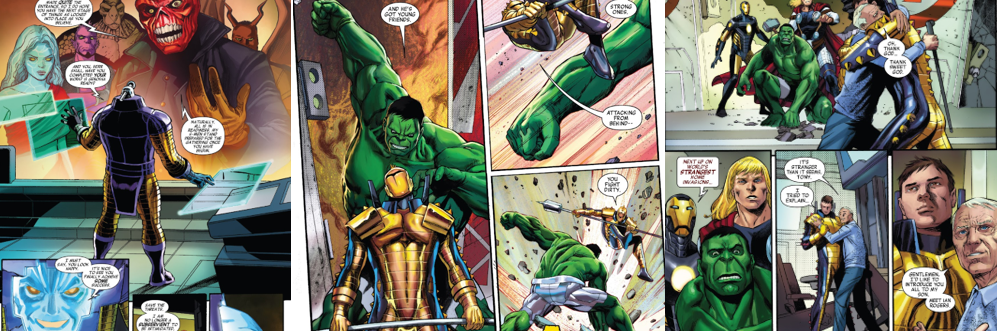
Over on the upper west side, Sam Wilson wakes up to a hell of a hangover and to find he spent the night with Jet Black! Though he’s not exactly thrilled at having crossed that line, he seems won over by her affections, but their tender moment (and the awkwardness) is interrupted when Jet spots a commotion outside. It turns out that her father, Armin Zola, is so eager for revenge that he rips open a hole in the fabric of reality and his monstrous, “hyperevolved mutates” come pouring into Central Park, followed closely by a mysterious man garbed in a spiked battle suit. Zola quickly contacts the Red Skull to co-ordinate their newest efforts in overthrowing the decadent West, asserting himself as a menacing force in his own right and seemingly earning the Red Skull’s respect with his army of mutates. While Anthony “Tony” Stark/Iron Man and Doctor Robert Bruce Banner/The Incredible Hulk work to find some way of restoring Steve’s superhuman condition, they (along with Thor Odinson and Steve himself) are alerted to the crisis via the mansion’s monitors. Steve immediately recognises the threat as Zola; Stark is incredulous but quickly convinced of the danger when the armoured mutate comes crashing through the wall. Luckily, the Hulk is around to face the stranger (with Banner having more control over the Hulk at this point). Naturally, Iron Man adopts a snarky “shoot first, ask questions later” philosophy, leading to an explosive confrontation as he and Thor try to keep the masked intruder from reaching Steve. However, the masked man easily avoids their attacks and even gets the better of Thor, running rings around them, only to be astonished by Steve’s frail condition. This distraction allows the Hulk needs to strike; ironically, though the stranger deftly evades the Green Goliath, Steve easily subdues the masked man. However, Steve is stunned when the intruder unmasks to reveal himself as Ian Ziola, now Ian Rogers, Steve’s adopted son, who was regenerated from death by one of Zola’s “bio-mass [tanks]”.
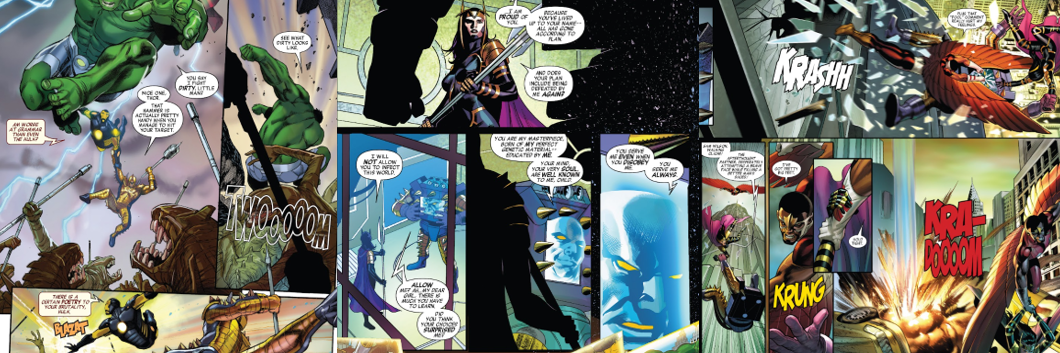
Zola manipulates events to coerce his daughter, whom the Falcon rushes to defend.

Overjoyed to see Ian alive and that he’s come to help, Steve proudly introduces him to his fellow Avengers but distraught to learn that Ian’s been fighting Zola alone for the last ten years. Steve then gets a call from the Falcon, who relays the extent of Zola’s attack: thanks to the city’s birds, Sam has seen the monsters rapidly spread throughout New York City. Jet Black then reveals she knows a way into her father’s fortified tower that may help them to stop the invasion and calls upon the Avengers to go along with her father’s plan, which is to face him head-on, to provide a suitable distraction. The Avengers readily accept, taking the fight to the ravenous, near-mindless hoards alongside their new ally, and are initially unimpressed by Zola’s forces. However, they’re soon confronted by Zola’s “hyper-mutates”, warped, monstrous copies of the Avengers that call themselves the “Unvengers”! Meanwhile, Jet Black and the Falcon easily infiltrate Zola’s tower, affirming that her allegiances lie anywhere but with her crazed father and insisting on using her position as the madman’s daughter to throw off his mutate guards. The plan works and they advance through the tower, only to find Sharon held hostage in a pitiful cell! After learning about Sharon’s predicament from Sam, Steve immediately asks Ian to leave the fight to the Avengers and go rescue her; though Sharon warns that such an act was all foreseen by Zola. When Jet confronts her father in his control room, he all-but guarantees the Red Skull that he can win her over to their side, claiming everything she’s done – even her betrayal – was also all part of his manipulative will. The Falcon breaks up the tense family reunion, tackling Zola out the window and sending him crashing to the streets below. Zola recovers near-instantly, however, his patience with his “perfect child” wearing thin, but the Falcon immediately intercepts him in mid-air.
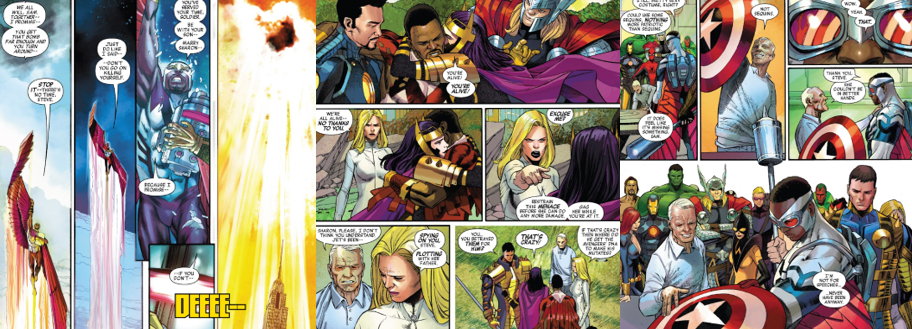
Though the Avengers turn on Jet, Sam survives to take up the Captain America mantle.

Raging at Zola for his ill treatment of Jet, the Falcon fights valiantly even as Zola smashes a bus onto the mis-matched hero. When Jet rushes to his aid and Zola sees how much she cares for the Falcon, Zola vows to murder him to rid her of such weaknesses all while hypocritically declaring his undying love for her! Thanks to Sharon, Steve warns the Falcon that Zola plans to blow up Avengers Tower, though Sam inadvertently kickstarts the detonation when he has Redwing remove Zola’s “telepathic broadcast doohickey”! When the Unvengers keep Iron Man from helping and Ian and Sharon are unable to disarm it, the Falcon bravely and selflessly grabs the bomb and flies high into the sky, bidding an emotional farewell to Steve and urging him and Sharon to enjoy their retirement with Ian before the bomb explodes in his arms. A horrified Steve thinks back to when he and Sam first met, the adversity he fought through, and how hard he worked to be a hero without any superpowers, fancy gadgets, or special serum as Iron Man sombrely retrieves the Falcon’s surprisingly intact body. Though Zola pleads with Jet Black to return to Dimension Z where she can be safe from the Red Skull’s looming threat, she angrily rebukes him. Sharon, Steve, and the Avengers gather in quiet mourning, only to be astonished when he comes to and reveals that Stark made him some Adamantium wings, which absorbed most of the blast! Though everyone’s overjoyed by this, Sharon blames Jet for Zola’s attack and accuses her of being a double agent. To Jet’s dismay, even Sam has his doubts and, when the Avengers try to restrain her to investigate, she angrily rushes to Zola’s tower, believing her father was right that her new allies couldn’t be trusted. One week later, seemingly every superhero around gathers at Avengers Mansion, where Steve announces his retirement from superheroics due to his condition (though he and Sharon plan to aid the Avengers with tactical support). He also reveals that Sam is the new Captain America and proudly hands him his shield, entrusting one of his oldest friends with his legacy, which Sam humbly accepts with a cry of “Avengers Assemble!

The Summary:
This was a difficult story to just jump into without context. A lot of modern comics are like that, with one series of mini arcs leading to the next, all of it part of a bigger picture. I get it and I accept it and I know there’s some onus on the reader to maybe get some background before diving in feet-first. However, since I’m mostly going on some background reading and what the “Previously…” recap is telling me, there were a few characters and events that I wasn’t very familiar with. Jet Black and Ian Rogers were two main examples; I knew Steve aged into an old man around this time, but I didn’t realise he took a son and a protégé as well. Consequently, Ian’s big reveal didn’t impact me as much as other, more invested readers but I think Rick Remender did a great job of conveying Steve’s shock and joy at seeing his son alive and well. I loved that Steve proudly introduced him to his surrogate family, the Avengers, and that Ian wasn’t some bitter, twisted soul looking to kill his adopted father. Instead, we got a young man who’s actually happy to see and fight alongside his father for a change, something very rare in comics. Ian meshes well with the Avengers, sporting a smart mouth and a capable agility despite his years of fighting against his maniacal father and living in a nightmarish alternate dimension. Similarly, I didn’t have much of a connection with Jet Black but I think the story did a good job of showing her as a character just trying to find her way. I liked her blossoming relationship with Sam (even if his reaction at waking up with her was a little odd) and that she willingly and selflessly opposes her father once he arrives. She does nothing except lash out against Zola, rebuking his offers and voicing her hatred of him even as he tries to win her over with his silver tongue. And, for all her efforts and hard work and personal turmoil, Jet is met with suspicion and accusations from even her own brother. Thus, she’s driven from her newfound allies and retreats back to Zola, devastated to learn that he was right and that she would never be accepted as one of them all because Sharon blew her lid and Sam barely even vouched for Jet’s trustworthiness.
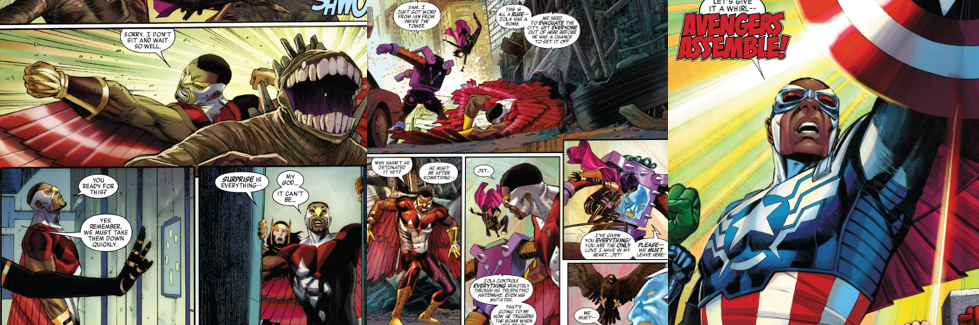
For a story meant to be Sam’s crowning moment, he was strangely portrayed throughout.

Indeed, I hope subsequent issues delved into Sam’s feelings regarding this. He barely says anything when Sharon accuses Jet and gets only one panel where he seems conflicted or upset by what he sees as a betrayal. It’s a weird way to end the conflict, especially considering everyone was just mourning Sam’s loss and celebrating his survival. Sam’s selfless actions and his commitment to justice despite lacking any superpowers are the qualities that make him suitable to take up the Captain America mantle, yet this feels somewhat tarnished since he didn’t showcase any loyalty to Jet or any conviction in defending her. He stood there, stunned, and let everyone run their mouths, which doesn’t scream “Captain America” to me. In fact, this is a bit of an odd story to introduce Sam as Cap in general, really. For most of the issues, he’s not really doing anything except flying around and reporting intel to the Avengers. Sure, this is useful from a tactical standpoint but the mutates were swarming everywhere; I’m pretty sure the Avengers would’ve spotted them without him. The Falcon does take the fight directly to Zola, infiltrating his tower with Jet Black, and he does valiantly fight the cybernetic madman despite clearly being outmatched. During this fight, the Falcon also sticks up for Jet in a way he fails to do once the conflict is resolved and his fighting spirit is certainly commendable, but I feel like any hero would’ve fought just as hard in his stead. The Falcon making the sacrifice play is a great shorthand for the mentality needed to be Captain America but, again, it feels a touch hollow. Like, Iron Man was just about to take care of the bomb before he got interrupted and Sam probably wouldn’t have had to make that call if he hadn’t yanked out Zola’s broadcast device. It just felt a bit rushed and out of nowhere to me and I can’t help but wonder if maybe it would’ve been better to play things a little closer to the ground. Like, have Zola threaten to kill a group of civilians and have Sam shield them with his wings and seemingly be beaten to death, or something like that. Just something a little less random and a bit more in-line with his status as a more grounded, “human” superhero.
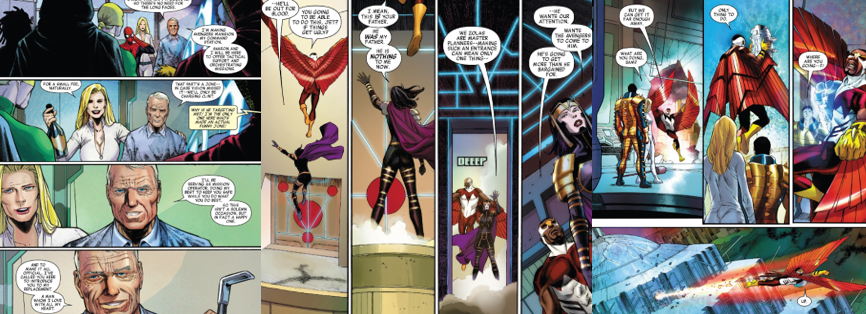
I liked that Steve passed on the mantle but the story felt oddly rushed at times.

On the plus side, Carlos Pacheco and Stuart Immonen do good artwork. I liked Iron Man’s darker armour and Ian’s totally nineties emo armour (I mistook him for Robbie Baldwin/Penance at first), though Jet Black felt a bit overdesigned. Similarly, while Sam’s Falcon outfit is a vast improvement over his debut costume, I can’t say I’m a big fan of his Falcon/Captain America hybrid suit. He reckons it’s “sexy” but it looks a bit of a mess to me, with miss-matching colours and a far too “busy” design. Maybe if his chest emblem was just the star, which was an extension of his weird-looking cowl, I’d like it more. I dunno, it just looks uncomfortable to wear and a pain in the ass to draw. I quite enjoyed the passing of the torch, though, in concept. I like seeing Steve rendering incapable of continuing as Captain America and retiring to a more sedentary life, though I do think Bucky is a better choice to take up the mantle. I get the idea that Captain America is a symbol of what a normal man can strive to be, but Steve was at least partially superhuman thanks to the super soldier serum. Then again, considering the Falcon survived having a bus dropped on his head, it’s safe to assume he’s more durably than Joe Public. I really like seeing all the other heroes immediately accept and endorse Sam; there was no question or objection, and he slipped into the role effortlessly. However, I feel he didn’t play a big enough role in this conflict. He fought Zola, sure, but to a standstill and didn’t defeat him; he just stopped his plan, and he lost his girl in the process. It’s a weirdly, tonally confused story for me and a strange way to usher in a new Captain America, though I was left curious to explore how Sam adapted to the role and the fallout from this adventure.

My Rating:

Rating: 3 out of 5.

Pretty Good

What did you think to Sam’s promotion to Captain America? Do you agree that this was a strange story to make that change or did you like the way it went down? What did you think to Sam’s suit, and do you like seeing him in the role? Were you disappointed that the Unvengers didn’t do more, and that Sam didn’t try harder to defend Jet Black? What are some of your favourite moments from Sam’s time as Captain America? Use the comment section below to share your thoughts and go read my other Marvel and Captain America content on the site.


Back Issues: Hulk #1-6

Writer: Jeph Loeb Artist: Ed McGuinness

Story Title: “Who is the Hulk?”
Published: 4 January 2008 (cover-dated: March 2008)

Story Title: “The Smoking Gun”
Published: 20 February 2008 (cover-dated: April 2008)

Story Title: “Creatures on the Loose”
Published: 23 April 2008 (cover-dated: June 2008)

Story Title: “Red Light, Green Light”
Published: 25 June 2008 (cover-dated: August 2008)

Story Title: “Rolling Thunder”
Published: 6 August 2008 (cover-dated: October 2008)

Story Title: “Blood Red”
Published: 24 September 2008 (cover-dated: November 2008)

The Background:
Created by legendary Marvel duo Stan Lee and Jack Kirby, the depiction of Doctor Robert Bruce Banner transforming into the monstrous Incredible Hulk was inspired by a story of a hysterical mother summoning superhuman strength to rescue her child and classic screen monsters Frankenstein’s Monster and Doctor Jekyll and Mister Hyde. Initially appearing as a stone-grey creature, the Hulk has appeared in many forms and at different levels of strength and intelligence over the years. We’ve seen an old, dictator-like Hulk, an intelligent gangster Hulk, a “Smart Hulk”, and even a “Devil Hulk” so why not a Red Hulk? The idea of a Red Hulk can be traced back to Kenny Johnson, producer of the popular and iconic Incredible Hulk television series (1977 to 1982), who lobbied for the colour change since red is commonly associated with rage, the Hulk’s defining characteristic, only to have his logic dismissed. However, a mere thirty-odd years later, then-Marvel editor-in-chief Joe Quesada officially introduced a red variant of the Green Goliath, one whose identity was kept a closely-guarded secret for about three years. A dangerous, intelligent, and tactically-savvy villain who grew hotter the angrier he got, the Red Hulk was eventually revealed to be Banner and the Hulk’s long-time enemy, General Thaddeus “Thunderbolt” Ross, a cantankerous military man who hounded both characters for decades. Naturally, General Ross appeared prominently in the Hulk’s ancillary media, appearing in cartoons and live-action many times, but the Red Hulk (or “Rulk” as he’s colloquially known) has not only been a card-carrying member of the Avengers but has also appeared in Hulk-centric cartoons and even unexpectedly appeared in the Marvel Cinematic Universe, courtesy of Harrison Ford.

The Review:
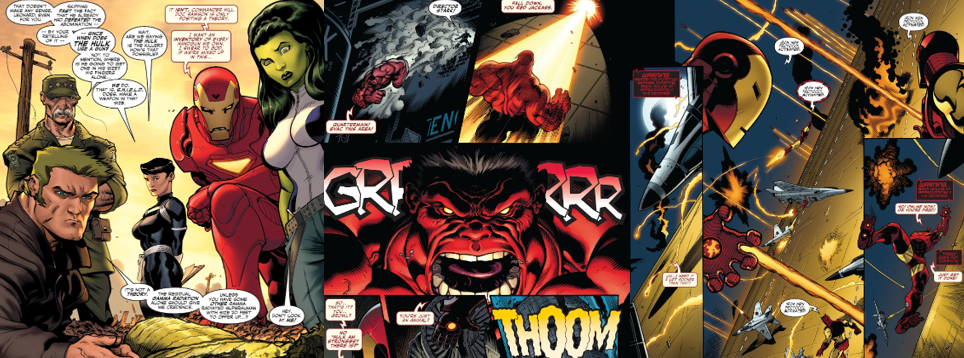
Our story begins in Russia, where Doctor Leonard Samson/Doc Samson and Jennifer Walters/She-Hulk investigate the sight of a fierce battle between the Hulk and his monstrous rival, Emil Blonsky/The Abomination. Begrudgingly, She-Hulk allows Samson to recreate the fight, deftly surmising and reenacting both character’s movements based on footprints and the surrounding devastation. It’s Doc Samson’s learned belief that the Hulk was unusually vicious, that he sought to beat the Abomination to death no matter what damage he caused in the process, and that, with his foe at his mercy, the Hulk drew a pistol and shot the creature at point-blank range. General Ross, Strategic Homeland Intervention, Enforcement, and Logistics Division (S.H.I.E.L.D.) commander Maria Hill, and S.H.I.E.L.D. director Anthony “Tony” Stark/Iron Man, who are also present, question the legitimacy of such an outrageous claim. However, when Hill reveals that S.H.I.E.L.D. does make a weapon big enough for the Hulk to fire and Doc Samson points out the residual Gamma radiation, the evidence, however unlikely, becomes difficult to ignore. She-Hulk and Samson also note that the Hulk is apparently emitting so much radiation that he’s scorching the earth with each footprint. The team’s squabbling and theorising is interrupted by Russia’s equivalent to the Avengers, the Winter Guard, led by Anton/The Red Guardian, who demand to take charge of the investigation. Despite being invited by the Russian government, the Red Guard have issue with their unauthorised personnel, like Samson, who reacts by starting a fight with the Red Guardian. Not to be outdone, Mikhail Ursus/Ursa Major, Boris Vadim/Crimson Dynamo, and Sasha Roerich/Darkstar join the fracas, with the bear-like Ursa clawing She-Hulk’s arm and Iron Man blasting the mech-armoured Crimson Dynamo right in the face. The battle is violent but short-lived as General Ross discovers a survivor, a traumatised boy who can only repeat the word “Красногоin” (or “red”) over and over.

A mysterious Red Hulk murders the Abomination and trashes the S.H.I.E.L.D. Helicarrier,

On the S.H.I.E.L.D. Helicarrier, Maria shows Stark a version of the gun used to kill Blonsky, a weapon he had no knowledge of. However, their discussion is interrupted when She-Hulk is suddenly attacked by a monstrous, Hulk-like figure. Though Stark barely glimpses the creature, he sees that it’s red, not green, and is stunned when the unconscious and badly beaten She-Hulk is dumped at his feet. Stark armours up and meets agent Clay Quartermain, who’s been injured by the monster but no less determined to bring him, and any and all Hulks, down. Iron Man’s orders are cut short when the Red Hulk suddenly tackles him through a wall. Noting the strange contradiction of a Hulk that growls like an animal but apparently wields a pistol and systematically targets a Helicarrier, Iron Man scrambles to fend off the brute’s vicious attack and deploy his spare armours to help stabilise the Helicarrier and catch the jets that tumble from it following the Red Hulk’s attack. Though his armour’s severely damaged, Iron Man is saved from a plummet by She-Hulk, who reveals that the Red Hulk wiped S.H.I.E.L.D.’s secure files with a sophisticated virus, and that the Red Hulk threatened her with an eloquence not shown to Stark. Despite Iron Man’s best efforts, the gold-plated Helicarrier crashes in a New Jersey field (with, surprisingly, no causalities). Iron Man’s attempts to formulate an effective counterattack are put on hold when Maria shows him video footage of General Ross and Doc Samson meeting with Bruce Banner, who’s held captive in the Gamma Base located in Death Valley, Nevada. The footage confirms that there is another Hulk out there, one very different from Banner’s mindless alter ego, and Banner suggests it’s someone who’s previously been exposed to high levels of Gamma radiation. However, Iron Man’s enraged when a crucial exchange between Banner and Ross is rendered unintelligible and orders Maria to clean up the recording. Later, Iron Man is brought to a meat packing plant where Agent Quartermain has been found dead alongside a severely torn, Gamma-irradiated coat belonging to Doc Samson, framing the superhuman psychiatrist as the Red Hulk.

The Red Hulk easily overpowers A-Bomb and even the rampaging Green Goliath!

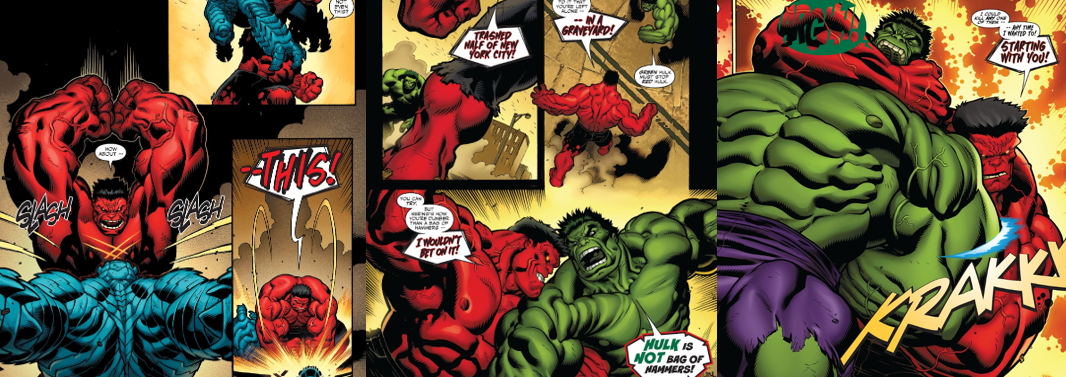
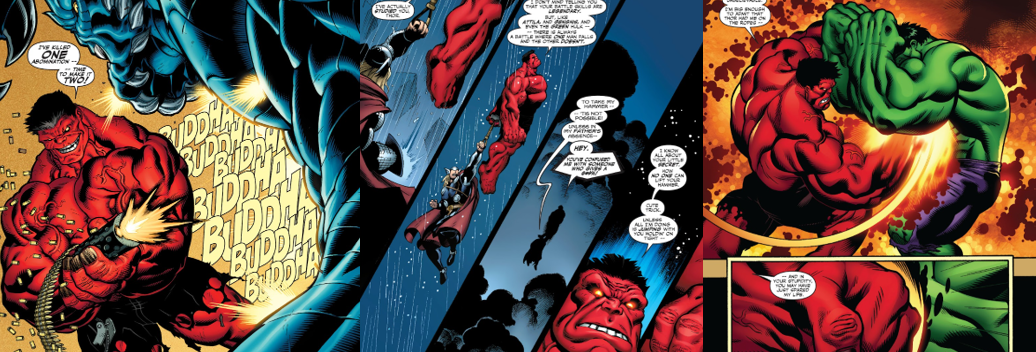
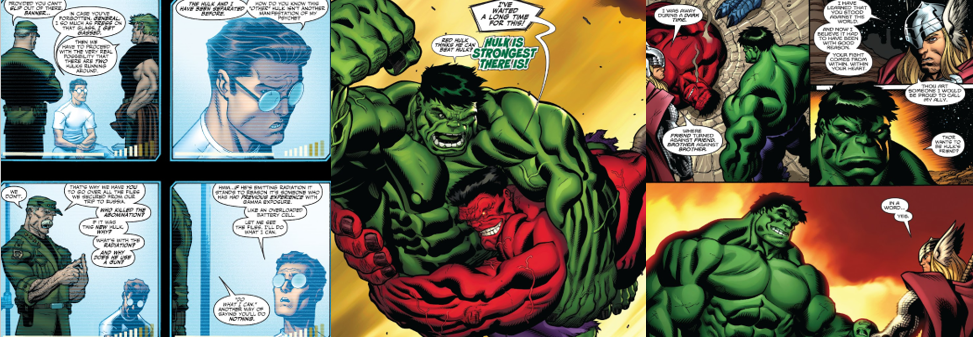
Elsewhere, the Red Hulk blindsides perennial sidekick Rick Jones outside Gamma Base, transforming him into his own Gamma monstrosity, the A-Bomb. It’s in this fight that we learn just how intelligent the Red Hulk is. While A-Bomb can only bark childish threats, the Red Hulk is goading, intelligent, and aware of his surroundings. Although Gamma Base recognises the Red Hulk as an authorised entrant, its defences fire on A-Bomb and Red Hulk takes advantage, swiping a massive cannon and taking great pleasure in riddling the armoured monster with bullets. When A-Bomb spits claims of his invulnerability, the Red Hulk gleefully tests his theory by pummelling him into the ground. The sheer force of the assault sends seismic shocks through the entire base and triggers Banner’s transformation into the Hulk when his cage attempts to gas him. As the battle rages, the base unleashes its Adamantium-taloned harpy robots (modelled after Banner’s long-time love, Doctor Betty Ross) to carry the two away. Unfortunately, the machines are no match for either monster’s strength, though the distraction separates them long enough for the Hulk to confront his red-skinned doppelgänger. Before the two can lock horns, however, the Red Hulk casually punches out Uatu the Watcher, who randomly popped up due to the significance of these two immensely powerful beings coming to blows (and, I guess, to show how tough this new Hulk is). After humbling the cosmic overseer, the Red Hulk finds the Hulk enraged by his appearance. The Hulk sees his red double an imitation and challenger to his title of “The Strongest One There Is”, a title he vehemently seeks to defend as aggressively as ever. Red Hulk, however, dives into the fight with relish, determined to make the Hulk pay for years of death and destruction, and for waging war against the entire planet after his return from Sakaar. Though the Hulk’s no longer as intelligent as his “World Breaker” persona, his strength only increases with his anger. However, the Red Hulk weathers the beating and easily grabs the Hulk’s wrist, breaking his arm and causing him to pass out.

Though he humbles Thor, the Red Hulk is outsmarted by the Hulk, his true identity left a mystery…

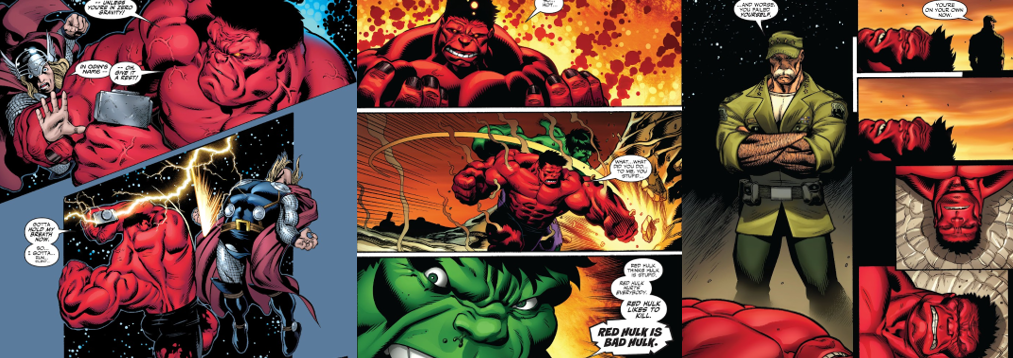
The Hulk awakens atop the Golden Gate Bridge and avoids a public execution by biting the Red Hulk’s gun. For his insolence, the Red Hulk decides to let his foe live with the knowledge that he’s not the strongest and knocks him into the bay, trigging the San Andreas fault. Thor Odinson then confronts the monster, only for the God of Thunder to be stunned when the Red Hulk shrugs off a blow from the mighty Mjöllnir. Savouring the chance to beat a God to death, the Red Hulk backs his words with blows powerful enough to draw blood and knock Thor flying. Thor fights back, not realising his foe is a different Hulk to the one he knows and is therefore left speechless when the intelligent Red Hulk gets around Mjöllnir’s enchantment by launching them out of Earth’s atmosphere. In zero gravity, the Red Hulk humbles Thor by beating him with his own hammer and dumping him on the Moon. After the Fantastic Four seemingly confirm that the Red Hulk is Doc Samson and A-Bomb pulls the Hulk from San Francisco Bay, Iron Man, She-Hulk, Ben Grimm/The Thing, Johnny Storm/The Human Torch, Prince Namor McKenzie/The Sub-Mariner, and Ares, the God of War, arrive to help save the city. While the Hulk initially rejects their assistance, he begrudgingly agrees to let them get San Francisco under control so he can confront the Red Hulk in Monument Valley. The Hulk’s efforts are aided by the returning Thor and A-Bomb, with the latter revealing the Red Hulk’s weakness (that he gets hotter the madder he gets) and restraining Thor so the Hulk can settle the score alone. Smartly, the Hulk absorbs the Red Hulk’s horrendous assault, causing the monster to overheat and grow weaker. The Hulk then asserts his dominance and knocks the Red Hulk out with a single punch. He then parts ways with Thor as friends before wandering into the desert, exhausted and reverting to Banner. However, when A-Bomb turns back into Rick and tries to reveal the Red Hulk’s identity, he’s shot in the back by Doc Samson. Both Samson and General Ross express disappointment with the Red Hulk, who they leave lying in the dirt as his eyes snap open…

The Summary:
First of all, I have to say that I love Ed McGuinness’s artwork. His work is always hyper-stylised and very bold and cartoonish, and he draws a wonderful Hulk and Hulk-like creatures, with them all being brutish monsters full of life and personality. You can tell so much about each of the Hulks in the way Ed McGuinness draws them: A-Bomb is constantly hunched over, as though weighed down by his armoured scales; the Hulk is always bulging and ready for a scrap; and the Red Hulk stands tall and confident, with a condescending smirk plastered to his face most of the time. The glue that holds this story together is the mystery of who the new Red Hulk is. At first, Doc Samson believes the Hulk is behind the Abomination’s murder. This is an odd hypothesis given he knows as well as General Ross that Bruce Banner is locked up in Gamma Base, but not one without merit; after all, Doc Samson himself once split Banner and the Hulk into separate beings. Naturally, given he was a bit of a dick around this time, Iron Man’s primary thought is to his culpability; he snaps and rages at Maria Hill about the Hulk-sized weapons S.H.I.E.L.D. developed and is desperate to ensure he can’t be held accountable for the murder. The evidence seems to ring true, but for the use of a gun and the scorched footprints, though She-Hulk remains unconvinced that her cousin was capable for such a cold-blooded act. Little moments throughout the story give some hints towards the Red Hulk’s identity, but there are numerous red herrings as well: Rick Jones, for example, seems tormented at the events, initially framing him as a suspect. We see that both Samson and Ross are authorised Gamma Base personnel, and that the base’s security recognises the Red Hulk’s iris. The garbled security footage seems to implicate Samson, as does his tattered coat, and the story even ends with the suggest that Doc Samson is the Red Hulk…until it’s revealed he’s not. But then again, General Ross is also seen standing over the Red Hulk’s unconscious body and he was right there when the Red Hulk attacked the Helicarrier, and he later turns out to be the Red Hulk! Indeed, the ending suggests more that Samson and Ross were in league with the Red Hulk, rather than being him, and I’d be interested to know or try and remember exactly how they explained how Ross and the Red Hulk could be in the same place at the same time (though it was probably a Life-Model Decoy).

The Red Hulk is an overpowered, egotistical, and incredibly dangerous Hulk.

As for the Red Hulk…well, this is a glorious showcase. Doc Samson’s intuitive nature reveals that the Red Hulk is a formidable foe, capable of beating even the super-tough Abomination into submission and fighting with a ferocity and power comparable to the Hulk. The Red Hulk is also seen to be tactically minded, launching an all-out assault against Iron Man’s fancy-pants gold Helicarrier and even wiping S.H.I.E.L.D.’s files. The Red Hulk’s intelligence is showcased in his eloquence; he delights in goading and taunting his foes as he fights them, displaying a familiarity with each and the defences of Gamma base. He repeatedly demonstrates a personal vendetta against the Hulk, first happy to frame him for murder and then delightedly besting him in a straight-up fight, even going so far as to break the Green Goliath’s arm and wish to publicly execute him. This, as he says, is payback for the Hulk’s years of death and destruction and more recent assault against the entire planet. The Red Hulk sees the Hulk as the true threat and is determined to stamp him out, but he’s also out to prove himself the superior being in mind and body. And what better way to do this than by not just beating the piss out of the Hulk and kicking him to the bottom of the San Francisco Bay, not just by punching out the Watcher, but by besting Thor in combat! Seriously, the Red Hulk is so massively overpowered it’s not even funny. Not only does he outmatch and humiliate Thor, even using insane logic to rob him of Mjöllnir, the Red Hulk completely disrespects and disregards the God of Thunder like he was nothing. A vindictive, calculating, ferocious opponent, the Red Hulk is so much than just another “Smart Hulk”. His blows have a purpose, striking at weak points and mixing pure power with tactical precision; he knows what he’s doing and enjoys doing it. His only weakness, one he doesn’t seem to realise, is that his body temperature rises exponentially when he gets mad, weakening him significantly. Well, it’s not his only weakness: he still needs to breathe, but that isn’t much of an issue considering he effortlessly trounced Thor while holding his breath.

The Hulk doesn’t care who his new foe is. He just wants to prove he’s the strongest!

The Red Hulk’s debut starts off as a showcase for the new Hulk on the block and a superpowered murder mystery. The investigation into the Abomination’s murder, the murder weapon, and the mystery of what’s happened to drive the Hulk to such an uncharacteristic action frames the first issue and a half. Once the Red Hulk makes his presence know, there’s some brief confusion as even Banner states that he’s been split in two and assumed different forms before, but then the crux of the story becomes trying to work out who this new Hulk is. Thus, everyone’s favourite Jade Giant doesn’t factor into the story for a few issues. Indeed, it’s up to the decidedly Hulk-like A-Bomb to carry the load when the Red Hulk targets him, but the action really ramps up when the two Hulks come to blows. I’m not sure what happened between Green Scar’s return to Earth and this story, but the Hulk has regressed to his mindless, child-like persona and is therefore at an initial disadvantage against his more tactile-minded doppelgänger. The Hulk’s driven to fight the Red Hulk out of a sense of pride (“Hulk is Hulk!”, after all) rather than to protect others, but his need to prove himself superior aligns with defending his few friends (such as A-Bomb) and allowing Iron Man and the others to save San Francisco. Thanks to Ed McGuiness, the Hulk-on-Hulk action is dynamic and interesting; it’s not just a senseless brawl as both Hulks weather their opponent’s onslaught to tire them out or strike when the opportunity presents itself. The Red Hulk, especially, stands out by using an enemy’s momentum against them and mixing brain with brawn, while the Hulk is naturally more savage and only tries a different tactic after seeing how dangerous his foe is. The art definitely makes his story a visually enjoyable experience and I did like the intrigue surrounding the Red Hulk. The red herrings and revelations are kind of odd knowing what I know now about the character, but it’s always nice seeing 2008-era Iron Man get his smug face smashed in and I loved that an intelligent Hulk proved to be such a threat. There’s definitely enough here to make me want to read up on what happened next with the Red Hulk and the lingering plot threat regarding Doc Samson, and the mixture of action and mystery were highly entertaining all-in-all.

My Rating:

Rating: 4 out of 5.

Great Stuff

Did you enjoy the Red Hulk’s explosive first appearance? Do you think the writers went a bit over the top in showcasing his threat, power, and intelligence? What did you think to the murder mystery sub-plot and who did you think the Red Hulk was? Were you impressed by the way the Hulk defeated his doppelgänger at the end? Which alternative version of the Hulk is your favourite? What are some of your favourite Red Hulk moments? Tell me your opinions on the Red Hulk in the comments and be sure to check out my other Marvel and Hulk content.

Screen Time [HulkaMAYnia]: She-Hulk: Attorney at Law


Since his explosive debut in May 1962, Stan Lee and Jack Kirby’s gamma-irradiated Jade Giant has been one of their most recognisable and successful characters thanks, in large part, to the Incredible Hulk television show (1977 to 1982) catapulting the Hulk into a mainstream, pop culture icon. The Hulk has been no slouch in the comics either, being a founding member of the Avengers and undergoing numerous changes that have made him one of their most versatile and enduring characters, so what better way to celebrate all things Big Green than by dedicating every Sunday in May to the Green Goliath?


Air Date: 17 August 2022 to 12 October 2022
Network: Disney+
Stars: Tatiana Maslany, Todd Phelps, Jameela Jamil, Josh Segarra, Ginger Gonzaga, Tim Roth, and Mark Ruffalo

The Background:
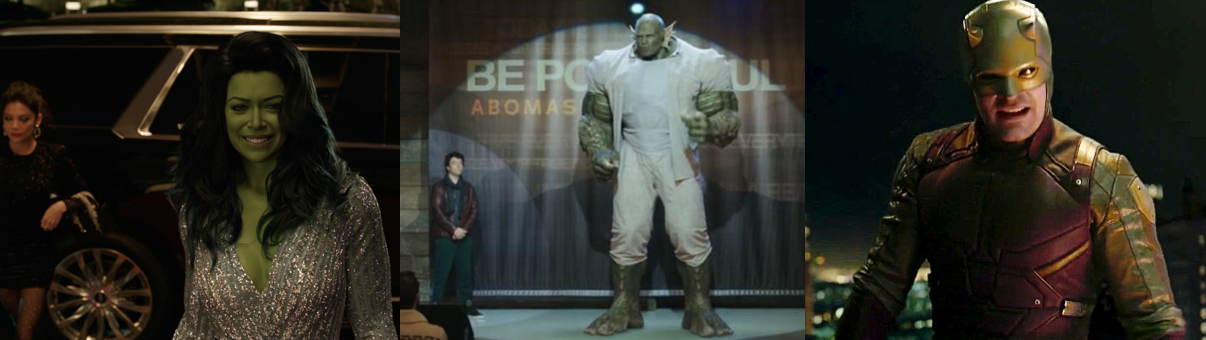
Following the incredible success of the Incredible Hulk television show, Marvel had Stan Lee create a female counterpart to the Green Goliath to beat Incredible Hulk producer Kenneth Johnson to the punch. A powerful feminist icon for Marvel who has been a member of the Avengers and the Fantastic Four, She-Hulk shared the spotlight with her cousin in the Incredible Hulk cartoon from the nineties and very nearly got her own live-action movie back then, too; Brigitte Nielsen was even cast to bring the character to life at the time. Decades later, Marvel Studios announced that She-Hulk would be joining the Marvel Cinematic Universe (MCU) with a nine-episode series streaming exclusively on Disney+, with Kat Coiro placed as the guiding hand behind the series and Tatiana Maslany cast in the dual role. She-Hulk’s visual effects were the work of multiple effects studios and initially caused some premature backlash, and the show promised not only to feature Mark Ruffalo as Doctor Bruce Banner/The Hulk in a mentor role but also the long-awaited return of Tim Roth as Emil Blonsky/The Abomination. After being delayed due to COVID-19, She-Hulk: Attorney at Law released to largely positive reviews; critics praised the performances and interpersonal slant towards a legal drama, and the comedic aspects were particularly lauded. Others, however, were not so impressed; some criticised the pacing, the CGI effects were a massive point of contention, and the show was slandered by online trolls throughout its run. Regardless, She-Hulk was also praised as an empowering series for female viewers that tackled the subject toxic masculinity and was highly regarded if only for returning a beloved, seemingly forgotten MCU character to the franchise. Finally, unlike other Disney+ MCU shows, Kevin Feige stated that She-Hulk had the potential to not only gain additional seasons but to also cross over into the MCU’s big-budget feature films.

The Plot:
After a car crash sees her blood contaminated with the Gamma-irradiated blood of her cousin, Bruce Banner, lawyer Jennifer Walters (Maslany) finds herself able to transform into a superpowered hulk. As she tries to adapt to her new situation, she tackles a series of unique superhero court cases and finds herself targeted by a slanderous online smear campaign.

The Review:
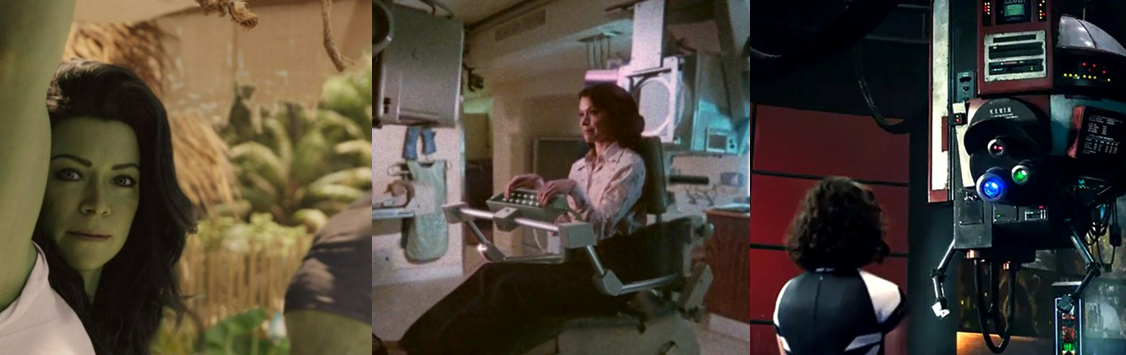
She-Hulk: Attorney at Law begins in medias res; Jen is already capable of becoming She-Hulk, her best friend and paralegal Nikki Ramos (Gonzaga) is aware of her abilities, and she immediately showcases her additional ability to address the audience to catch us up with her origin story. Jen was on a road trip with Bruce and the two of them were involved in a car crash caused by the sudden appearance of a Sakaaran spacecraft. While rescuing Bruce from the wreckage, some of his blood drips into her wound, instantly transforming her into a savage hulk in the first of many call-backs to the pilot episode of The Incredible Hulk. Disoriented and dishevelled, she’s unquestionably supported and fixed up by a gaggle of helpful women at a bar but is triggered by a group of pushy guys before being tackled by the Hulk and brought to his secluded island laboratory for testing and training. Jen is distraught at the idea of being handicapped by such a life-destroying condition and immediately annoyed and critical of the Hulk’s attempts to mentor her; this ends up going both ways, however, as the Hulk’s lifelong syllabus on controlling his rage is rendered mute by Jen’s natural ability to retain her personality and intelligence in her Hulk form since she’s so used to managing her emotions, both in public and at work, to avoid lashing out at every creep or being branded as inferior because of her gender, which allows her to willingly transform at will because, essentially, she’s always angry.

Jen’s transformation into a Hulk causes some major changes to her personal and professional life.

This presents the unique dichotomy of She-Hulk; while the Hulk strived for years to master his abilities and to reconcile his two warring halves, Jen immediately has full control of not only her strength but also her transformations; though she’s physically smaller and less savage than the Hulk, she showcases all of his abilities with the added benefit of greater physical control. However, despite the Hulk’s best efforts, Jen has no desire to abandon her life and her career to be a superhero; after a brawl, he reluctantly agrees to let her live her own life, but things quickly become complicated for the superpowered lawyer when, during a session in court, she’s forced to reveal her dual identity in front of the world when “superpowered influencer” Mary Macpherran/Titania (Jamil) literally crashes in and threatens lives. It takes Jen some time to embrace her superhero identity; she regularly distances herself from the She-Hulk name and constantly downplays the appeal and benefits of being a superhero, and her condition comes to negatively affect her when she’s fired and unable to find work at a conventional law firm. Holden Holliway (Steve Coulter) throws her a lifeline by offering her the chance to join a superhero law division at Goodman, Lieber, Kurtzberg & Holliway (GLK&H); though initially annoyed that she’s been hired to represent clients as She-Hulk and as more of a publicity stunt than for her legal skills, she’s won over by her new office and just being back at work. Unfortunately for Jen, her troubles only escalate; the press constantly hound her, reporting rumours as facts and often belittling her because of her gender, and she’s even forced to set aside her personal bias in order to represent Emil Blonsky/The Abomination (Roth) at his parole hearing. This all comes to a head when Titania releases a rage of beauty products using the She-Hulk name and sues her for misuse of the copyright, which ties into a central theme of the series, which revolves around Jen learning to embrace both sides of her personality, the meek and somewhat awkward Jen and the sexually confident and alluring She-Hulk; throughout the show, she takes great strides in reconciling both in the court room by embracing her moniker and even later donning a form-fitting superhero outfit to directly assist others.

Jen’s struggles at romance are compounded by an online group that targets and slanders She-Hulk.

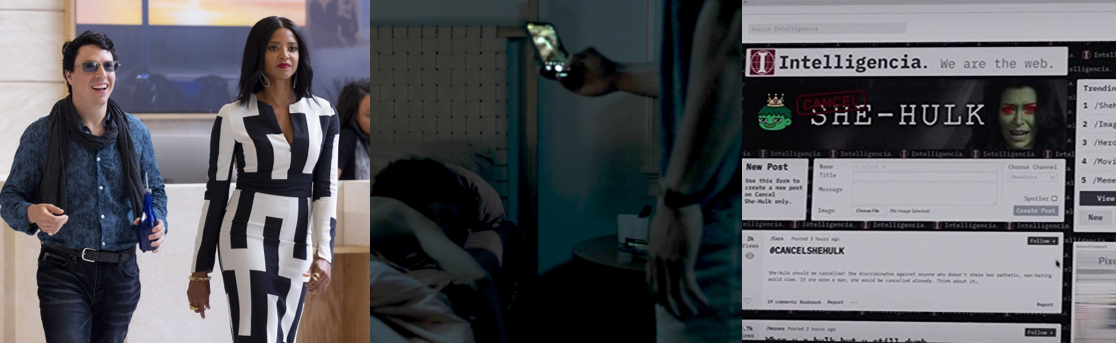
This character growth is full of little stumbles, however. Not only is she faced with an overbearing family who clearly care for her but can’t help but interfere and put her down, her love life is a bit of a shambles. Even after she reluctantly changes her online dating profile to a She-Hulk one, Jen is forced to endure a series of disastrous dates with self-obsessed, disrespectful, and down-right creepy men who either disregard her entirely or care only about comparing her to her more famous cousin, such as the uncomfortably obsessed Todd Phelps (Jon Bass), who later forms an entire online movement, Intelligencia, designed to hate on She-Hulk. Because of this, and Jen’s low self-esteem and desire for attention, it doesn’t take much for Arthur (Michel Curiel) to make an impression; he seems genuinely interested in her and actually engages her in conversation, however he has no interest in Jen and thus isn’t interested in pursuing a serious relationship with her. While attending the wedding of her high school friend, Lulu (Patti Harrison), Jen is surprised to make a connection with the charming Josh Miller (Trevor Salter), especially as she’s forced to stay in her human form so as not to steal Lulu’s spotlight. Josh appears to be the opposite of Arthur; he’s only interested in Jen and never really asks about She-Hulk and they actually take the time to date rather than jumping into bed right away. Unfortunately, after they do sleep together, he ghosts her, driving her to distraction; while she finds a measure of closure and self-respect thanks to some unlikely advice from Blonsky and the gaggle of misfit, rehabilitated supervillains at his retreat, she’s driven into an uncontrollable fury when Josh leaks her personal information, including photos and videos of her, to Intelligencia, resulting in her briefly losing the support of the public and being imprisoned.

Of all the guest stars to feature, Daredevil undeniably steals the show with his long-awaited return.

Thankfully, it’s not all bad news for Jen in the romance department. While he initially rubs her the wrong way by proving to be a competent lawyer, blind, flirtatiously charming Matt Murdock (Charlie Cox) proves to be a suitable confidante and partner after not only encouraging Jen to help others with her powers when the law fails them but also being unmasked as the superpowered vigilante Daredevil. Together, they’re able to rescue a mutual acquaintance, eccentric superhero fashion guru Luke Jacobson (Griffin Matthews), from wannabe superhero-turned-supervillain Eugene Patilio/Leap-Frog (Brandon Stanley) and, in the process, She-Hulk learns a little bit about what it means to be a superhero. The chemistry between them boils over following their fight and the series ends with the suggestion that they’re going to be a regular thing going forward since he joins her and her family for a meal. Although he steals the show in every scene, Daredevil isn’t the only guest star to feature in She-Hulk: Attorney at Law; Wong (Benedict Wong) shows up a few times, first to help with Blonsky’s appeal and then to ask for She-Hulk’s aid in barring disgraced sorcerer Donny Blaze (Rhys Coiro) from threatening the fabric of reality with his reckless magic. Similarly, the Hulk also plays an important role in the first episode; initially appearing as Bruce Banner thanks to a convenient inhibitor, he assumes his “Smart Hulk” form and puts Jen’s abilities to the test. He’s frustrated by her not taking his lessons seriously and tries to emphasise the burden and responsibility of being a Hulk, but ultimately trusts her to live her life her own way and disappears into space for his own side story, one that we’re not privy to but see the results of in the finale when he returns from Sakarr with his son, Skaar (Wil Deusner). We even get a couple of celebrity cameos as David Otunga and rapper Megan Thee Stallion feature in the series but the show’s breakout original character is clearly the brazen Madisynn King (Patty Guggenheim), a career party animal who makes a shady deal with a demonic goat and ends up forming an unlikely bond with Wong over their shared love of television.

While spending a lot of time in court, She-Hulk also explores her duality and self-esteem.

At its core, She-Hulk: Attorney at Law is a superhero comedy with a fair amount of courtroom drama serving as the focal point or backdrop of each episode. Whether it’s Jen trying to find a job in her field, Nikki and their co-workers Augustus “Pug” Pugliese (Segarra) and Mallory Book (Renée Elise Goldsberry) working cases involving shapeshifting elves or immortal cuckolds, rogue sorcerers or bumbling heroes, superhero law is naturally a large focus of the show. Conjecture, hearsay, trademarks, and faulty manufacturing are all elements that need to be addressed in a court of law, just like in normal life, but the superhero slant definitely makes these aspects more entertaining to watch. She-Hulk is often representing or even defending individuals who have wronged her in the past; she puts her neck on the line to vouch for the rehabilitated Blonsky, is called to speak to misogynistic Dennis Bukowski’s (Drew Matthews) stupidity, and is even forced to parade her former dates in order to prove that she identifies as She-Hulk. That’s not to say that the show is without any action scenes; Jen may prefer to use her legal skills more than her fists to resolve conflicts but she gets into a number of scraps throughout the show, often for comedic effect. Her first fight with Titania, for example, is over in a single punch and Jen forgets herself for a moment when she’s jumped by Wrecking Crew – Dirk Garthwaite/The Wrecker (Nick Gomez), Eliot Franklin/Thunderball (Justin Eaton), Henry Camp/Bulldozer (Tennison Barry), and Brian Calusky/Piledriver (Kyle Murillo) – when they try to steal her blood using Asgardian-powered construction tools, before easily dispatching them as She-Hulk. She-Hulk is specifically recruited by Wong to fend off the goblin demons Donny unwittingly summons, and she throws down with Titania again at Lulu’s wedding, much to the delight of the guests, but she chooses to leave the violence to Daredevil when confronting Leap-Frog and instead offers him legal counsel. Indeed, She-Hulk largely subverts a lot of the usual expectations when it comes to action sequences; she openly criticises Daredevil’s reliance on stealth and denies him another fight in a hallway and even finds herself really opening up to Blonsky and the oddball guests at his retreat since they can relate to her identity crisis.

Jen’s so annoyed at the derivative nature of her narrative that she forces the show to change tack for the finale.

She-Hulk’s true enemy here isn’t the monstrous Abomination, who’s now repentant and committed to offering emotional support and spiritual guidance, or even Titania, who’s strength makes her almost as formidable a foe as her spiteful nature. Instead, She-Hulk’s greatest foe throughout the series is toxic masculinity. We get our first taste of this moments into the first episode when Dennis undermines Jen’s abilities and suggests he’s a more capable lawyer than her; he continues to talk down to her even when addressing She-Hulk and, later, refuses to have her or Mallory represent him as he’d rather have a man. A shallow, arrogant little man, he refers to women as “hot chick” and “it” but it’s this delusional nature which ends up winning him the case against catfisher Runa (Peg O’Keef). Although a small-time annoyance, Dennis is just one example of the persecution Jen faces, both as herself and as She-Hulk; when the Wrecking Crew confront her, they accuse her of flaunting herself when she’s simply living her life and the press are constantly using derogatory terms to label her. Very few males treat her as an equal or with the respect she deserves, allowing the likes of Pug, Murdock, and even Blonsky to stand out as they actually engage with her and don’t condescend her or try to undermine her intelligence and abilities. Male chauvinism isn’t limited to just She-Hulk either; Craig Hollis/Mr. Immortal (David Pasquesi) lands himself in hot water after abandoning his many marriages by faking his death, leading to him not only earning Mallory and Nikki’s ire but also being forced to agree to a fair settlement tailored for each of his slighted partners. No male is more troublesome to She-Hulk’s stature than Todd, however; using the online alias “HulkKing”, Todd forms Intelligencia specifically to slander her and create a following of likeminded assholes to steal a sample of her blood so they can take the power they feel she doesn’t deserve. Still, luckily for Todd and his vile followers, Jen herself takes issue with the redundant nature of their plot and literally demands that the show try something a little more original, tailoring the ending into something a little less derivative and seeing that the HulkKing and his cohorts are exposed for the toxic, petty-minded jerks they are.

The Summary:  
There’s a real nasty environment that’s brewed online in the last few years where any product that even dares to try something new or feature a strong female lead, or include any kind of diversity, is immediately labelled as “woke”. Personally, I have no idea what this is supposed to mean and find it extremely degrading as it’s just some catch-all term mindless, anonymous idiots use to slander anything they don’t like. She-Hulk: Attorney at Law deals very heavily in this topic; although she largely ignores her online haters (primarily because she knows they wouldn’t dare say anything to her face), Jen is constantly besmirched and belittled both subtly and explicitly throughout the show. It’s small wonder, then, that she goes on a rampage, one eerily reminiscent of Carrie (De Palma, 1976), when Intelligencia publicly slut shame her at an award ceremony. This ceremony is perhaps the best example of the struggles Jen faces in her career; multiple women are named Female Lawyer of the Year and they’re paraded on stage like it’s a Miss Universe pageant, and Jen even foreshadows this when she quite rightly rants to her cousin about how difficult it is for a women to succeed as she’s slandered the moment she shows any weakness.

She-Hulk’s CGI is admittedly dodgy but other characters fare much better in this regard.

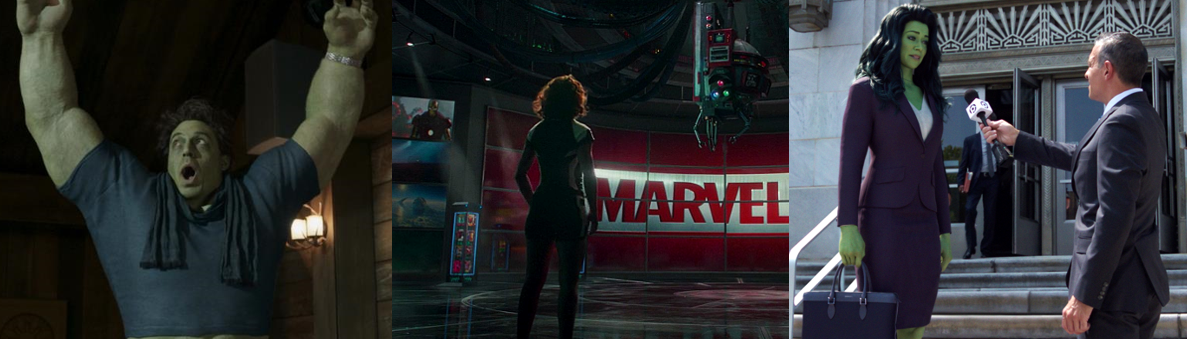
But I know what you want to hear me really talk about: the special effects. First of all, the Hulk looks fantastic; his CGI model is on point, which is to be expected as they pretty much perfected the look in Avengers: Endgame (Russo and Russo, 2019), but still surprising for a television show, especially as a Hulk-centric show seems to me to be one of the more costly MCU projects. Similarly, the Abomination looks really good; I’m really digging his more comic-accurate redesign and even enjoyed seeing him as this rational pacifist rather than some mindless monster, though I will admit that his face was a little off and his transformation was a little too “clean”. She-Hulk suffers from this a bit as well; she simply grows larger or smaller, her custom-made clothes expanding to accommodate her, so we’re largely beyond the days of dramatic transformation sequences for these characters. As for She-Hulk…she mostly looks perfectly fine, but it does vary wildly. Given that she’s not as monstrous as the Hulk, I do wonder if it might’ve been better to use her on-set stand-ins, Maliah Arrayah and Devon Lewis, to actually portray the character and enhance her with CGI, imposing Maslany’s face onto the larger doubles as a modern take on the 1970’s show (something the show does actually do when it lovingly recreates The Incredible Hulk’s iconic opening sequence). I think the things that bother me the most is her hair, which looks like a bad wig most of the time, and her eyes and face, which are a little lifeless and blank at times. It definitely works but it does stick out quite a bit and I can see why people would be distracted by it; low lighting definitely aids the presentation, but I admire how often Jen is seen in broad daylight as She-Hulk. Thankfully, Daredevil is here to again make up for some of these effects; now garbed in a yellow and red number, this is a fantastic return to form for the character, who seems much more jovial and far less bleak than in his Netflix show, allowing him to kick ass and be intimidating but also be a fun and attractive prospect for Jen. Hell, I even enjoyed the Leap-Frog suit and the inclusion of small-time, ridiculous villains like William Taurens/Man-Bull (Nathan Hurd), Alejandro Montoya/El Águila (Joseph Castillo-Midyett), Saracen (Terrence Clowe), and Alexander Gentry/Porcupine (Jordan Aaron Ford). I always enjoy it when live-action adaptations turn to the more obscure and ludicrous characters, and they really worked in the context of this show and played a surprisingly poignant part in shaping Jen’s acceptance of herself and her duality.

She-Hulk’s ability to break the fourth wall results in a unique metatextual humour.

Of course, one major aspect that separates She-Hulk from most comic book characters is her ability to break the fourth wall, which is present right from the start and, while characters occasionally react to this, it’s mostly just played for laughs and ignored. Jen habitually addresses the camera, generally asking us not to judge her, addressing the abundance of cameos throughout the show, and questioning the plot at certain points. This metatextual approach extends to the title sequence, which changes a number of times to reflect what’s happening (such as Jen being out of work, Titania’s lawsuit, and Jen being barred from transforming into She-Hulk). The aforementioned recreation of the 1970’s intro was my favourite instance of this but all this metatextual commentary comes to a head in the finale; after being forced to wear an inhibitor after her rampage, Jen is at her lowest point when Todd transforms into a Hulk-like creature and even Titania and the Hulk show up at the last minute in a chaotic attempt to have all her separate storylines converge. She’s so unsatisfied with the conclusion that she literally escapes to the Marvel Studios: Assembled (Baruh, 2021) documentary to confront She-Hulk’s staff, who are amusingly non-plussed at a fictional character gate-crashing their meeting and direct her to “Kevin”, who turns out not to be MCU executive producer Kevin Feige but an artificial intelligence which makes all of the decisions about the MCU. Somewhat reminiscent of the divisive finale to The Matrix Reloaded (Wachowskis, 2003), Knowledge Enhanced Visual Interconnectivity Nexus/K.E.V.I.N. (Brian T. Delaney) continues the metatextual narrative by asking that she transform back into Jen as she’s “very expensive” and the visual effects team has “moved on to another project” and explaining that it uses advanced algorithms to create “near perfect” products, the quality of which is left up to the internet. Using her legal skills, Jen’s able to argue for more originality in her show, criticising Todd’s plot and the entire finale and demanding that she get the ending she deserves rather than what’s expected. She then goes on to address many of the issues people have with the MCU and even asks about the X-Men before being denied such a boon in the future and left to enjoy her happy ending.

A fun show with some great humour, action, and an empowering message that nicely expands the MCU.

I honestly didn’t expect to enjoy She-Hulk: Attorney at Law as much as I did; like a lot of people, I was mainly watching it to witness the glorious official integration of Daredevil into the MCU but the whole show was really good from start to finish. At nine episodes, it’s longer than usual for a Marvel Disney+ show and there’s an argument that a couple of the episodes could’ve been trimmed down or had their plot points combined into other episodes, but I have no complaints about the length or the content. It was a great introduction to this fresh new Hulk character, one who’s fully capable of defending herself and having a successful career and yet as conflicted and full of doubts as anyone else. Jen’s ability to break the fourth wall helps her to stand out even more and enabled the show to have a fun, carefree vibe while still holding up a mirror to the online trolls and toxic masculinity that is so prevalent in this day and age. While they were only minor roles, I also enjoyed Jen’s supporting cast; her doting, if annoying, family, Nikki’s endless enthusiasm, and Pug’s awkwardness at being forced to integrate with Intelligencia all made for some compelling and entertaining side characters. The courtroom drama was also very enjoyable; I liked seeing She-Hulk coming up with legal loopholes, even if it meant embarrassing herself, to win cases and I’d like to see the second season spend a little more time in the courtroom with some of Marvel’s more colourful and obscure characters. Alterations to the Abomination and the continuation of the Hulk’s mini arc also landed well with me; it was great to see Blonsky back, and cast in a sympathetic light and elevated into something more than just a brutish solider/supervillain and I was left really intrigued to see what’s next for the Hulk family. Yes, She-Hulk’s special effects can be wonky but I fully expect to see this addressed in another season; they work and can be impressive but you will have to get over it to fully enjoy the show. Also, if you’re one of these “woke” crusaders it’s probably better you watch something else as She-Hulk: Attorney at Law is very much geared towards sending a positive message about rising above hate and valuing people based on their ability and merits rather than belittling them because a small-minded minority think of themselves as somehow “superior”.

My Rating:

Rating: 4 out of 5.

Great Stuff

What did you think about She-Hulk: Attorney at Law? Did the CGI used to bring She-Hulk to life put you off? What did you think to her ability to break the fourth wall? Were you a fan of the legal drama and comedy aspects? What did you think to the Abomination’s character growth and the reintroduction of Daredevil? Did you enjoy the attack on toxic masculinity or was it too “woke” for you? Where would you like to see the character go in the future and are there any She-Hulk storylines or characters you’d like to see included in future seasons? Whatever you think about the show, or She-Hulk in general, leave a comment below or on my social media and be sure to check out my other Hulk content!

Back Issues [HulkaMAYnia]: The Savage She-Hulk #1


Since his explosive debut in May 1962, Stan Lee and Jack Kirby’s gamma-irradiated Jade Giant has been one of their most recognisable and successful characters thanks, in large part, to the Incredible Hulk television show (1977 to 1982) catapulting the Hulk into a mainstream, pop culture icon. The Hulk has been no slouch in the comics either, being a founding member of the Avengers and undergoing numerous changes that have made him one of their most versatile and enduring characters, so what better way to celebrate all things Big Green than by dedicating every Sunday in May to the Green Goliath?


Story Title: “The She-Hulk Lives”
Published: 13 November 1979 (cover-dated February 1980)
Writer: Stan Lee
Artists: John Buscema and Chic Stone

The Background:
The Incredible Hulk (and his human alter ego, Doctor Robert Bruce Banner), was another creation of Marvel legends Stan Lee and Jack Kirby. Inspired by a story of a hysterical mother exhibiting superhuman strength to rescue her trapped child, as well as classic movie monsters Frankenstein’s Monster and Doctor Jekyll and Mister Hyde, Lee and Kirby’s allegory to the foils of war initially debuted as a stone-grey figure who emerged at the onset of night. Although The Incredible Hulk was cancelled only a year and a half in, the character returned to a position of prominence thanks to subsequent expansions of his lore and character and the popularity of the Incredible Hulk television show. The eighty episode series not only established the Green Goliath as a mainstream icon but also directly led to the creation of his female counterpart; fearing that Incredible Hulk producer Kenneth Johnson would create a female spin-off as he had with The Bionic Woman (1976 to 1978), Marvel had Lee dream up a She-Hulk first so that they would own the rights, and the character would be the last one Lee created for Marvel until the early nineties. Written as the alter ego of Banner’s cousin, Jennifer Walters, She-Hulk was intentionally cast as a lawyer to promote equality and her original self-titled run lasted 1982, after which she made guest appearances, joined the Avengers and the Fantastic Four, and became known for both breaking the fourth wall and being a strong feminist icon for Marvel. Although a live-action film never came to pass in the early nineties, She-Hulk shared the spotlight with her cousin in the Incredible Hulk cartoon from the mid-nineties and made her live-action debut in the Marvel Cinematic Universe at the tail-end of 2022.

The Review:
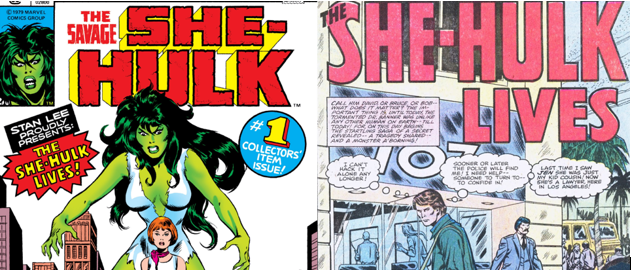
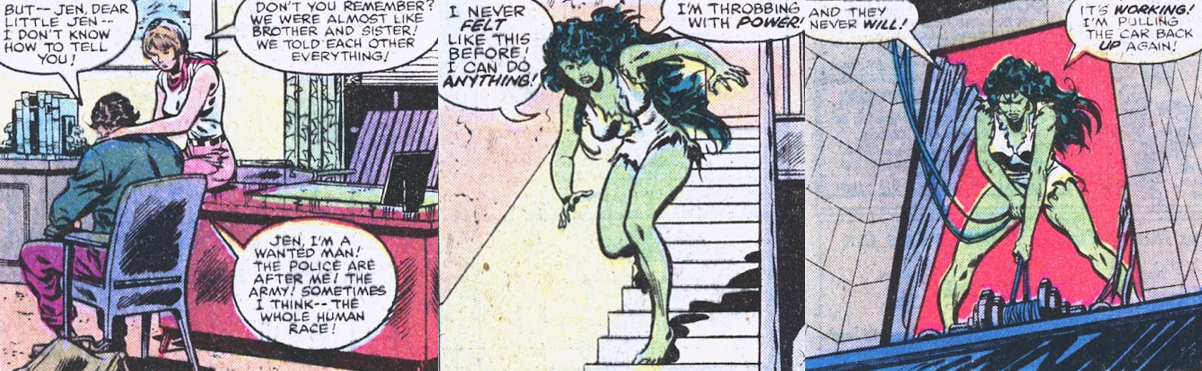
Our story begins with a dialogue box amusingly lamp shading Stan Lee’s tendency to get Banner’s first name wrong and finding the fugitive arriving in Los Angeles, California. After being on the run, hounded by the police and the military, ever since his first transformation into the Hulk, Banner has finally reached his limit and is in need of help, so he seeks out his kid cousin, Jennifer Walters, for some solace. I’m not entirely sure where his long-time friend, confidante, and on-and-off sidekick Rick Jones is or if the comics have ever mentioned Jennifer prior to this, but apparently they were extremely close as children, almost like brother and sister. Jennifer works as a successful criminal lawyer and affectionately refers to Banner as “Doc”, but also has absolutely no knowledge of his dual identity so you know what that means! Over the course of six panels and one page, Banner recounts the specifics of his origin and his curse to transform into a rampaging, near-mindless beast whenever angry or panicked thanks to a massive dose of Gamma radiation, and, despite her shock at this knowledge, Jennifer immediately insists that he come back to her home so that she can shelter and help him. Although he’s reluctant because of the inherent danger, she waves his concerns off since her profession means she’s used to living with danger; for example, she’s currently defending a low-level hoodlum named Monkton who’s been accused of murdering mobster Nick Trask’s bodyguard, which she believes is a frame-up.

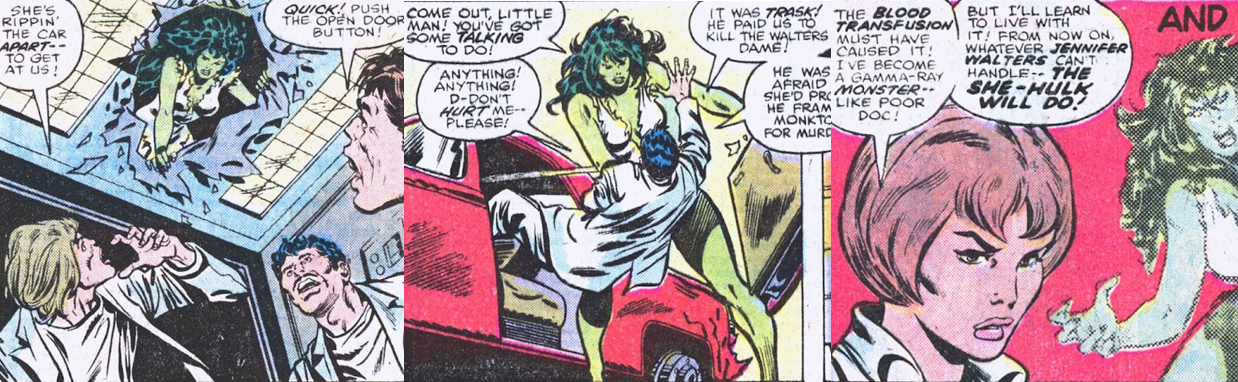
Banner’s forced to give Jennifer a blood transfusion, transforming her into the Savage She-Hulk!

While she’s confident of her ability and safety, Banner isn’t so sure, and his concerns immediately turn out to be correct as Trask’s hitmen follow them back to her house and put a bullet in her back. Banner’s able to keep calm long enough to fend the gunmen off with a simple garden house and they hit the road to avoid attracting any unwanted attention, leaving Banner to struggle with his rising emotions and to find some way of helping the injured Jennifer. With no time to wait for an ambulance, he carries her over to (and breaks into) a convenient nearby doctor’s surgery and does the only thing he can think of: a blood transfusion with his blood (which, also conveniently, is the exact same as Jennifer’s) which stabilises her long enough for him to call for an ambulance and the police. For some reason, the cops immediately peg Banner as a suspect, especially when he doesn’t have an identification or credit cards, and the stress finally reaches boiling point, causing him to Hulk-out and escape custody (though we only get the briefest glimpse of the Hulk). The next day, Banner is relieved to learn from the local tabloid that Jennifer is doing well and reluctantly makes plans to leave town to avoid his true identity being discovered. However, while recovering in the hospital, Jennifer feels a strange tingling sensation throughout her body but this, and her concerns over Banner’s welfare, are quickly set aside when Trask’s hitmen come in posing as doctors and looking to finish the job they started. As they pin her down and attempt to chloroform her, Jennifer suddenly undergoes her own startling transformation, tossing her attackers aside and looming over them as a huge, muscular, savage green-skinned beauty they dub “She-Hulk”.

She-Hulk’s abilities are more than enough to force a confession and empower her to right wrongs.

Unlike her brutish cousin, Jennifer retains her intelligence and personality when transformed, but the surge of power afforded to her (especially after feeling so helpless mere moments before), causes her to lash out and revel in her newfound abilities. She easily tosses a hospital bed at one of her would-be murderers (probably killing him…) and chases down the others, ripping open elevator doors and hauling the elevator cart up when they try to escape! Though terrified by their pursuer, the hitmen are able to elude her, and she inspires only further fear in the hospital staff and orderlies due to her savage appearance and ceaseless pursuit of her targets. “Throbbing with power” and revelling in her superhuman strength, She-Hulk’s rational mind is somewhat clouded by her absolute rage and, as they try to race away in their car, she easily cripples their vehicle with a well-timed throw of a nearby road sign. She then manhandles one of them until he confesses that Trask hired them to kill her and admitting that it was Trask himself who killed Monkton. This is apparently enough for the nearby cops to arrest the gunmen, and they ultimately let She-Hulk go since “there’s no law against green skin” (and, apparently, destruction of city property, causing an affray, grievous bodily harm, and harassment are all hunky-dory). As She-Hulk flees, her anger fades alongside her incredible strength with it. She successfully makes it back to her hospital room without being seen, returning to her normal, human state just in time, and consoles herself with the knowledge that her newfound monstrous alter ego will be able to handle any threat that comes her way in the future.

The Summary: 
I was expecting a little more from “The She-Hulk Lives”, if I’m being honest. Her bombastic debut issue really could’ve done with being a double-length feature so we would could learn a little bit more about Jennifer and Banner’s past and relationship beyond a couple of panels, and the story almost reads like it could’ve been condensed down a little and been included as a back-up feature in the regular Hulk book. Thankfully, the artwork, writing, and dialogue are much better than what we normally saw in the sixties; unlike many female characters, Jennifer isn’t written as some air-headed bimbo and is actually a pretty capable woman in her own right. She clearly went to law school, or a similar educational institute, and is successful enough to have her own office and to be working on a big case. She’s also incredibly compassionate and loyal to her cousin; she doesn’t judge him for his affliction and offers to help him without hesitation, viewing him as a brother and sure that the two of them can work something out. Finally, she’s pretty self-confident; although he’s usually overly paranoid, Banner immediately recognises that her case against Trask is considerably dangerous but she’s so sure of herself that she doesn’t even consider there being any reprisals against her. Naturally, this ends up biting her in the ass and she nearly dies from a gunshot wound and this (and her subsequent spell in hospital) is the only time Jennifer is portrayed as being weak and in need of help from others.

Although I’d to see more of Jennifer and Banner/Hulk, She-Hulk made a decent impression.

Banner is so panicked at the thought of losing her that he gives her his blood without thinking and, for all his science-smarts, without even considering the effect his Gamma-irradiated blood might have on her. Due to the risk of being exposed and causing unnecessary destruction, he doesn’t even check in on her afterwards and quietly leaves the story without us even properly seeing the Hulk, which is actually to allow the She-Hulk to take centre stage. It’s not explored in this story but it can be assumed that the transfusion was far less potent than Banner’s own Gamma exposure, accounting for She-Hulk’s retained personality and intelligence and less impressive strength, but she’s still a force to be reckoned with in her green state and overcome with anger due to her previous helplessness and the evil of Trask’s men (and, it can be inferred, all such men who seek to undermine and hurt women). I do feel, though, that the story might’ve benefitted from a confrontation between She-Hulk and the Hulk; maybe she could’ve battled him to a standstill and helped calm him down through their shared condition and showing him some compassion. I have no doubt that this probably did happen in a subsequent issue or encounter between the two, but it does mean that She-Hulk’s debut falls a little flat even compared to her cousin’s first appearance since she only exerts herself against a few regular hoodlums. While this opens itself up into a feminist reading about a woman exerting power and dominance over an oppressive patriarchy, I feel that’s more inferred than explicitly showcased in her debut issue and wouldn’t come to the forefront until she was a bit more established.

My Rating:

Rating: 2 out of 5.

Could Be Better

How did you find She-Hulk’s debut story? Did you read it when it was first published and, if so, did She-Hulk leave much of an impression on you or were you expecting something more? What did you think to the concept of a female Hulk and the idea that she is far more stable when transformed? Would you have liked to see her throw down with the Hulk here or were you happy with her rallying against common mobsters? What is your favourite She-Hulk story or moment and how are you celebrating the Hulk’s debut this month? Whatever your thoughts on She-Hulk, go ahead and share them below or leave a comment on my social media and be sure to check out my other Hulk content!