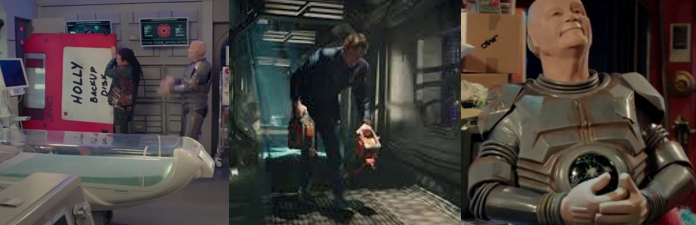
Screen Time [Gazpacho Soup Day]: Red Dwarf (Series Four)


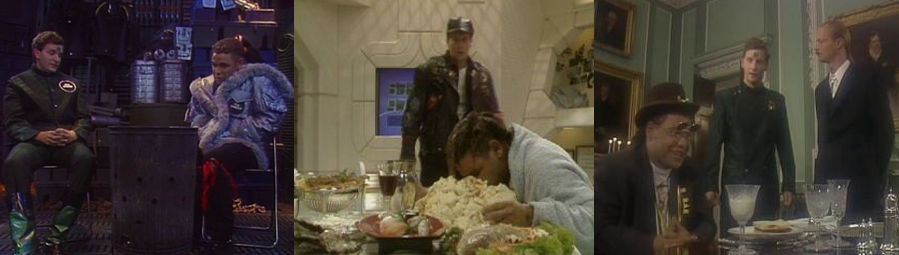
In the episode “Me2” (Bye, 1988) of the classic British science-fiction comedy show Red Dwarf (1988 to 2020), it is revealed the Arnold Rimmer’s (Chris Barrie) last words were “Gazpacho soup!” and that he celebrated November 25th as “Gazpacho Soup Day” after a traumatising visit to the Captain’s Table.


Series Four

Director: Ed Bye
Air Date: 14 February 1991 to 21 March 1991
Original Network: BBC2
Stars: Chris Barrie, Craig Charles, Danny John-Jules, Robert Llewellyn, and Hattie Hayridge

The Background:
Back in the eighties, Rob Grant and Doug Naylor, influenced by Dark Star (John Carpenter, 1974) and The Hitchhiker’s Guide to the Galaxy (Adams, 1978; Bell, 1981), created the sci-fi comedy Dave Hollins: Space Cadet for BBC Radio 4. This was the prototype for Red Dwarf, though the duo initially struggled to sell their vision despite prioritising character and comedy over genre. Once the show was picked up, impressionist Chris Barrie and Liverpudlian “punk poet” Craig Charles took the lead roles, and singer and dancer Danny John-Jules and sardonic stand-up comedian Norman Lovett rounded out the cast. Red Dwarf finally aired in 1988 and, despite viewing figures dropping in the first series, strong audience feedback saw the BBC approve a second series. Afforded a greater budget, Grant and Naylor expanded their premise and, now that Red Dwarf had established its audience, series two was more successful. Now firmly considered a cult hit, a greater budget saw a complete redesign of the sets for the third series, where Robert Llewellyn and Hattie Hayridge joined the cast. With series three widely regarded as one of the best of the show’s entire run, production shifted to Shepperton Studios, giving the cast time to rehearse and tweaking the series lore to better align with the books. Though never revamped with the same controversial digital overhaul as its predecessors, series four was also widely acclaimed, with “Dimension Jump” proving one of the best episodes, and Red Dwarf continued to be consistently popular even after Grant and Naylor parted ways.

The Plot:
Last human Third Technician Dave Lister (Charles), his hologrammatic supervisor, Second Technician Arnold Rimmer (Barrie), a humanoid cat (John-Jules), service mechanoid Kryten (Llewellyn), and neurotic computer Holly (Hayridge) are lost three million years into space. Their journey home sees them encounter a shape-shifting lifeform, endure trial by an automated space station, encounter Rimmer’s charismatic double, and visit a world populated by waxwork androids.

The Review:
While the first series was a shaky start for this classic sci-fi sitcom, Red Dwarf hit its stride with the second and third series, with the latter especially paving the way for this fourth series. Series four thus features the same introduction and sets, with Lister and Rimmer still bunking in the officers’ quarters and the crew still utilising the iconic ship-to-surface vehicle Starbug for most jaunts away from the ship. While Red Dwarf largely avoids aliens, man-made Genetically Engineered Lifeforms (GELFs) and killer mechanoids known as “simulants” are much more prominent here. Series four also dabbles in alternate timelines and time anomalies (which were equally important later on), space stations, and teleportation, expanding the lore while still focusing on character dynamics. While they still can’t stand each other, Lister and Rimmer are far more amicable now, with their antagonism shifting to Rimmer being unnecessarily boring, piteous, or down-right maniacal. While Rimmer bores Lister with stories of his Risk campaigns and either micromanages every situation or proves useless due to both cowardice and being an intangible hologram, Lister still tries to spare his feelings when Rimmer discovers them sneaking out to go fishing in “Dimension Jump”. Rimmer also objects to using the DNA modifier to turn Lister superhuman potentially as much out of concern for his safety as doubts about Holly’s capability to work the strange machine. Still, Rimmer jokes about leaving Lister as a chicken, mocks him about his petty criminal past in “Justice”, and criticises Lister’s mad plan to get drunk and play pool with planets in “White Hole” as a foolhardy disregard for Holly’s super genius calculations.
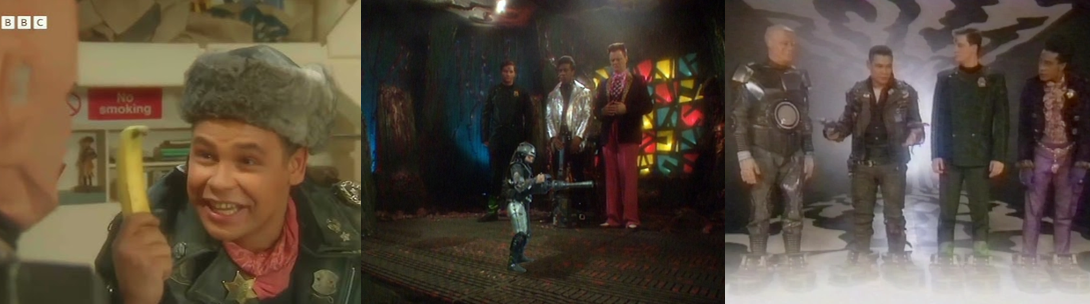
More of Lister’s background is revealed as he works to help Kryten and combat the crew’s new threats.

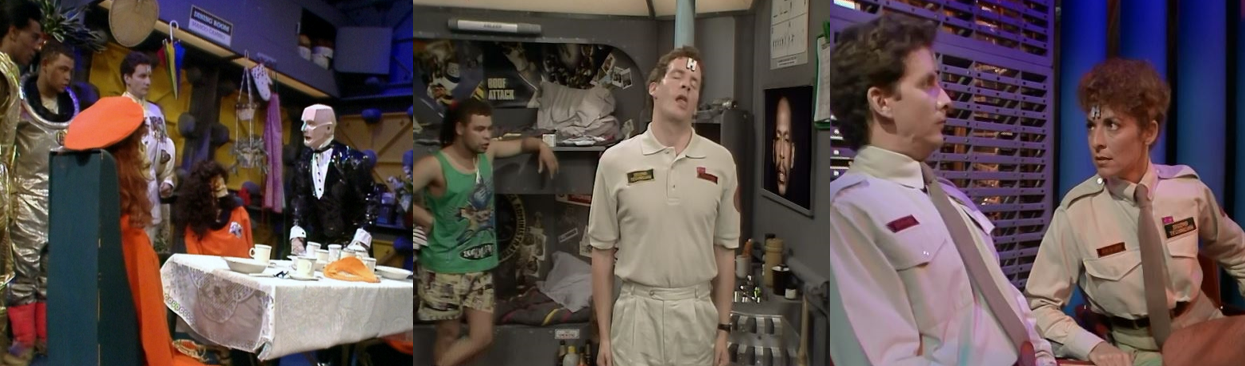
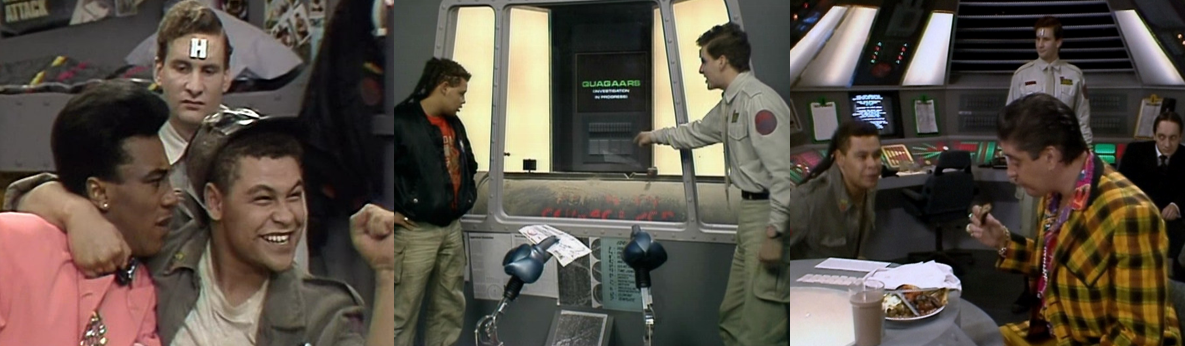
“Justice” tells us a bit more about Lister’s unruly childhood where he was coerced to steal cars and beds from hotels. Lister also relates how he went condom fishing in the canal and drastically alters established continuity as he now dated First Console Officer Kristine Kochanski (Clare Grogan) rather than lusting after her, with him being so cut up by their breakup that he envied a squirrel. When Lister meets Camille, he sees a mirror of him (Suzanne Rhatigan) that somewhat resembles Kochanski, according to the credits, but this isn’t mentioned in the episode. Still, Lister’s immediately eager to bed her and is frustrated to learn she’s a pleasure GELF who induces instant love. Lister later considers options to hide his “space mumps” to be more attractive for Barbra Bellini, only to again be robbed of any female companionship when a psychotic simulant (Nicholas Ball) emerges from her cryogenic pod. Eager to help Kryten to be independent, Lister continues to encourage him to break his programming, tutoring the mechanoid in how to lie and insult others. Similarly, Lister helps Kryten adjust to being a human when his DNA is transmogrified but, after being horrified by pictures of Kryten’s penis and his struggles with human anatomy, Lister eventually encourages his friend to embrace his true self. Lister’s very adamant about this, which is why he’s reluctant to become a vaguely familiar superhuman to battle the horrific vindaloo monster (Paul McGuinness). However, his belief that everyone should be true to themselves doesn’t extend to Talkie Toaster (David Ross), whose chirpy demeanour and obsession with toast drive Lister mad, and he’s disgusted when Rimmer leads the free-thinking wax-droids in “Meltdown”. Believing the wax-droids have developed a self-awareness that makes them “practically people”, Lister opposes Rimmer’s mad plot to live out real-life wargames but is ultimately helplessly as Rimmer causes all the wax-droids to be destroyed.
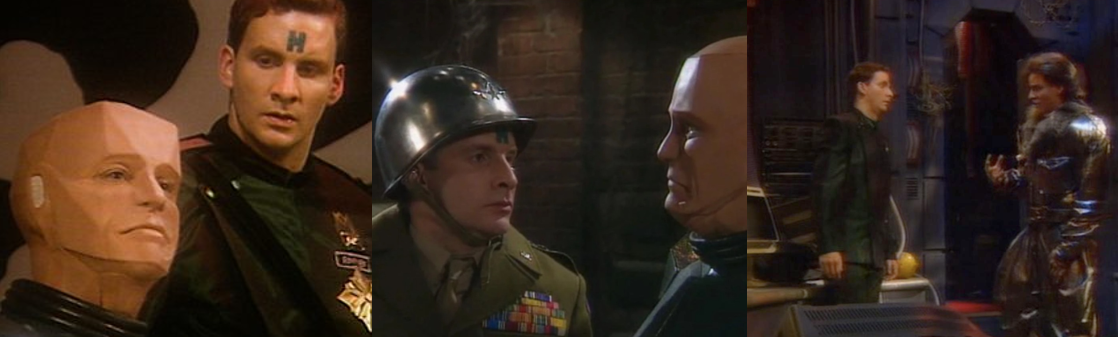
Rimmer’s all over the place here, though we do meet his charismatic counterpart.

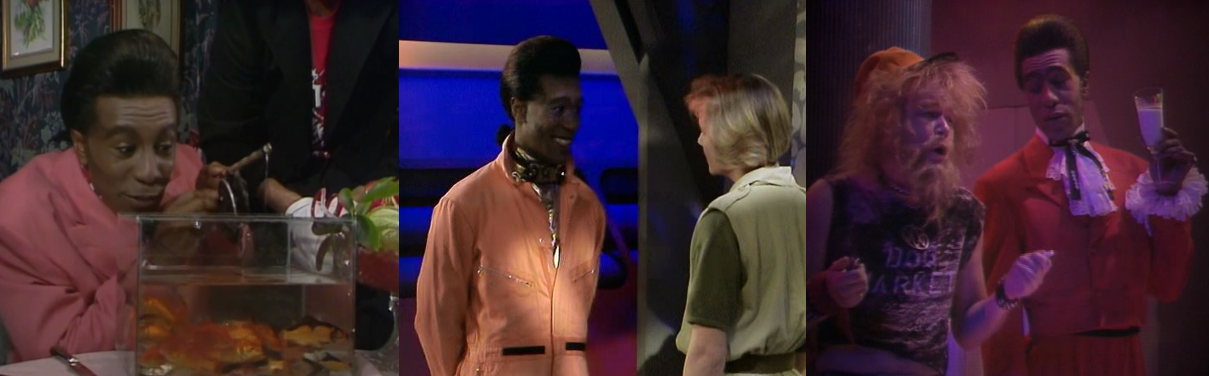
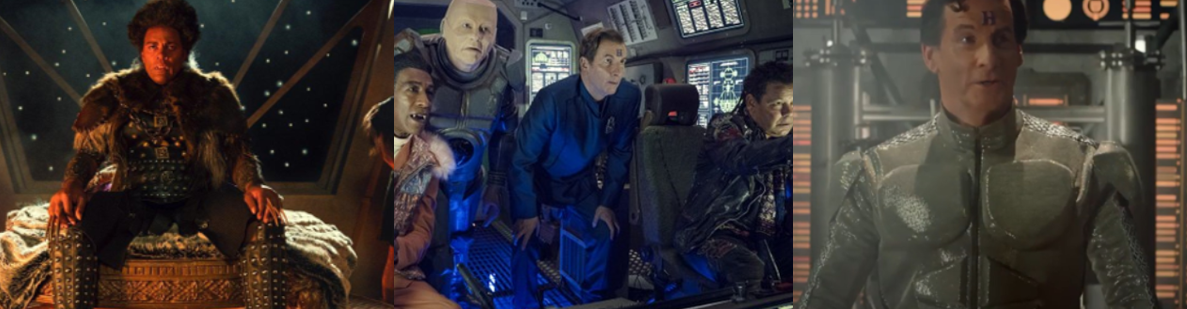
Rimmer gets a few spotlights this series, though his personality flip-lops quite unpredictably. In “Camille”, he’s the first to encourage Kryten to date the titular GELF (Judy Pascoe) despite her monstrous appearance, he successfully works with and directs the crew in docking with the presumably alien vessel in “D.N.A.”, and often showcases a take-charge attitude, even if he is overbearing. Yet, simultaneously, Rimmer mocks Lister’s criticisms of being human, refuses to be switched off to give Lister and the Cat a few more months to live, and goes insane when visiting Wax-World since it gives him the chance to live out his Risk days. When visiting the Justice World penal colony, Rimmer is stunned when he’s incarcerated for accidentally killing the Red Dwarf crew and equally insulted when Kryten’s defence plea paints him as a buffoon with delusions of grandeur who naturally shouldered the guilt since he took his lowly job so seriously. Series four also introduces Rimmer’s charismatic and awe-inspiring counterpart, “Ace” Rimmer, a hot-shot test pilot who’s everything Rimmer wishes he was. Consumed by petty jealousy, Rimmer makes a fool of himself accusing Ace of being gay and trying to pull pranks on him, bitter that Ace got the breaks he missed out on, only for it to be revealed that Ace was held back as a child and forced to toughen up. Ace and Rimmer couldn’t be more different as one is confident, complementary, and capable and the other is next to useless and so despised by his crew that they try to sneak off without him. Indeed, Ace is so disgusted by his counterpart that he alters his dimension hopping mission to try and find another version of himself that’s more pathetic, only for the ending crawl to reveal he failed in this endeavour.
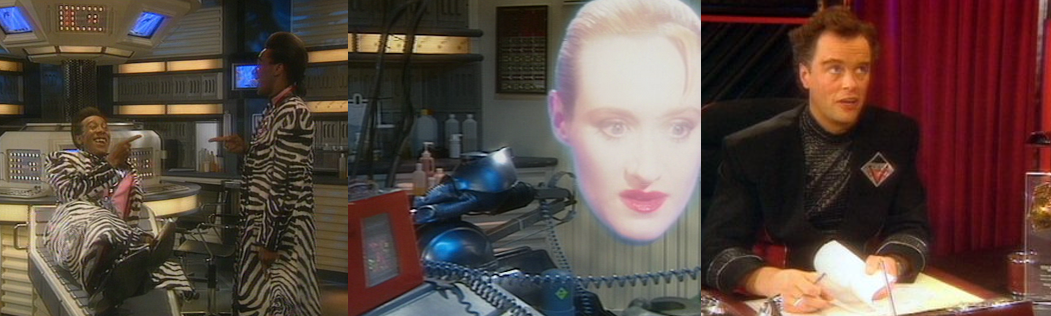
While the Cat doesn’t have much to do, Holly gets a fun spotlight and the actors are given more leeway.

While the Cat doesn’t get a spotlight episode and is again more of a third wheel, he often chips in insults towards Rimmer and gags regarding his grooming habits. The crew are frustrated when he keeps unplugging the console in “D.N.A.”, Lister is terrified when the Cat’s curiosity transmogrifies him into a chicken, and the Cat amuses when his broken leg sees him worry more about his colour co-ordination than his health. The Cat’s awareness of pop culture is far greater this series and he feels more integrated into the crew despite not having a dedicated plot. I loved that his perfect mate was himself and him encouraging Lister to power electrical appliances with a bicycle in “White Hole”, and his utter despair when faced with the gallows in “Meltdown”. While there’s less for Holly to do than ever thanks to Kryten largely acting as technobabble exposition, she still gets her time in the sun by swooning at the sight of Ace and questioning whether she has any desires as she didn’t see anything special when meeting Camille. “White Hole” is built around Kryten’s efforts to cure Holly’s computer senility, a bizarre computer virus that’s made Holly quirky, forgetful, and unreliable. Thanks to experiments with Talkie Toaster Kryten boosts Holly’s intelligence but a miscalculation dramatically reduces her lifespan to under four minutes. Holly’s brief delight at being a genius again is shattered by the aggravating toaster and this revelation, which sees her shut herself and all non-essential systems down, leading to curse exchanges between her and Rimmer as the crew try to figure out what’s happening and solve the problem of the white hole. The actors also get a chance to showcase different personalities in “Dimension Jump”, with Lister being a competent mechanic, the Cat a caring priest, Holly a horny receptionist, and Kryten recast as Ace’s equally horny commander, all of them as besotted by Ace as the regular crew are fed up with Rimmer.
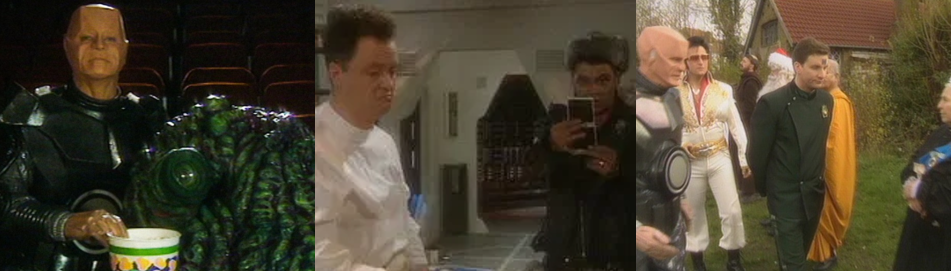
Kryten benefits from being the focus of many episodes and cements his place on the show.

Kryten gets the most spotlight here. We saw in series two that Lister hated the idea of the mechanoid being subservient and constantly pushed Kryten to follow his own dreams. Series four revisits this, with Lister encouraging him to lie and be insulting so he can be more human. While Kryten eventually succeeds, he stutters when insulting Rimmer but, by the end of “Camille”, has been so through the wringer of emotion that he can lie and offend at will. While he delights in unleashing a barrage of insults at Rimmer as time unravels in “White Hole”, this doesn’t represent much of a status quo change for Kryten as he’s still a courteous and respectful servant. Indeed, he’s largely powerless to stop Rimmer in “Meltdown” and even obeys his orders due to his programming. However, Kryten does showcase more independence, piloting Starbug and explaining the white hole when Holly’s offline. Kryten also takes the spotlight in “D.N.A.” as he unexpectedly becomes human. At first, he’s elated to be living his dream but quickly finds he doesn’t understand his limited senses. Desperate to remain optimistic, he insults his “second class” origins and spare body parts, experiencing wild mood swings as he struggles to adapt, ultimately realising he was happier as a mechanoid. While Camille fakes being in love with others, she seems to genuinely fall for Kryten, to the point where she wants to abandon her “husband”, Hector (Rupert Bates), to be with him and only agrees to leave when she sees that Kryten is doing what’s best for her, even if it causes him pain. Kryten proves indispensable in “Justice”, compiling a case that, while insulting to Rimmer, exonerates the hologram of any true guilt, and showcases some medical proficiency (though he still needs Ace’s help with the Cat’s broken leg). Equally, Kryten cobbles together the matter transporter after discovering it in the ship’s research laboratories, quickly figuring it out and encouraging its use. Moments like these largely explain Holly’s diminished role as Kryten is much better suited to delivering exposition while also being physically integrated into the crew, and I really enjoying his struggles to apply Lister’s teachings here.
The Summary:
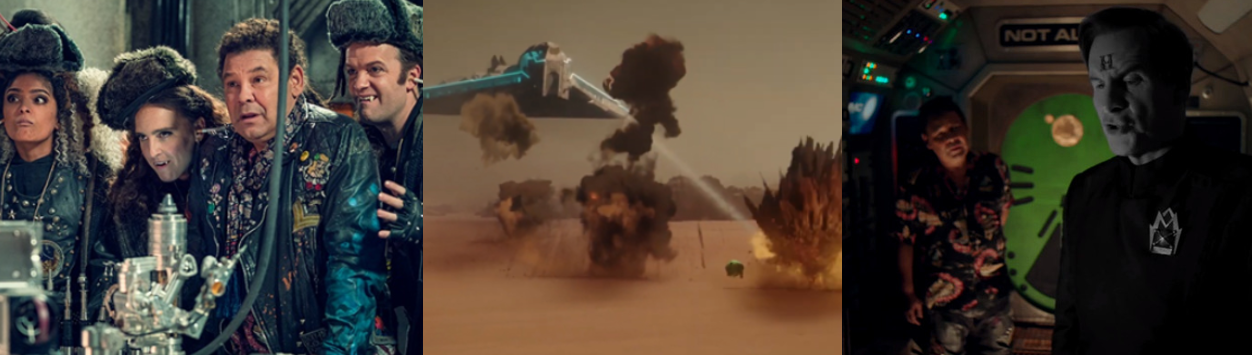
On paper, series four has a lot going for it. It matches series three’s visuals (even recycling Starbug footage as much as Red Dwarf model shots) and continues many themes of previous episodes, mainly involving Kryten and his independence. The crew venture to new or redesigned areas of the ship, such as the science lab, medical bay, and space dock, with each giving off a dark, industrial aesthetic. While the crew only visit alien worlds once (twice, if you count the crashlanding in “Dimension Jump”), Wax-World is painfully restricted. As if recycling grainy footage from Gappa: The Triphibian Monster (Noguchi, 1967) wasn’t bad enough (though it is referenced as a joke in the episode), many events happen offscreen (sure, it’s funny hearing Winnie-the-Pooh get executed but it might’ve been nice to see it) and it always looks like they’re shooting in someone’s back garden and on quiet country lanes. Many episodes also have disappointing endings. “Camille” sets a high standard with its emotional parody of Casablanca (Curtiz, 1942), though things quickly go downhill from there. “D.N.A.” isn’t bad, I guess, with the miniature RoboLister enjoying the remains of the vindaloo monster, but “Justice” ends with a bizarre rant from Lister about free will and the nature of justice and “Dimension Jump” has a weird coda where Rimmer plays Hammon organ music. This really wasn’t necessary as the ending text explaining how pathetic Rimmer is in the wider multiverse was enough and it feels like the writers just couldn’t decide how these episodes should end. I did like seeing the time anomaly fade out behind the crew in “White Hole” and Kryten taking advantage of the opportunity to roast Rimmer, but it does make me wonder why the crew didn’t continue their intelligence experiment upon the timeline being reset.  
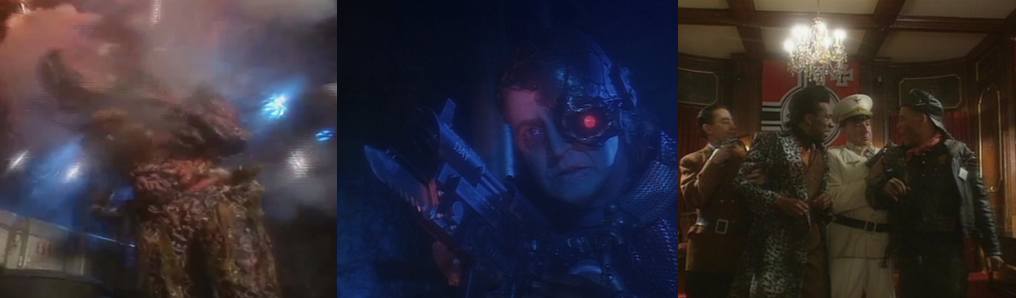
The series leans into monster-of-the-week territory to present some fun new villains.

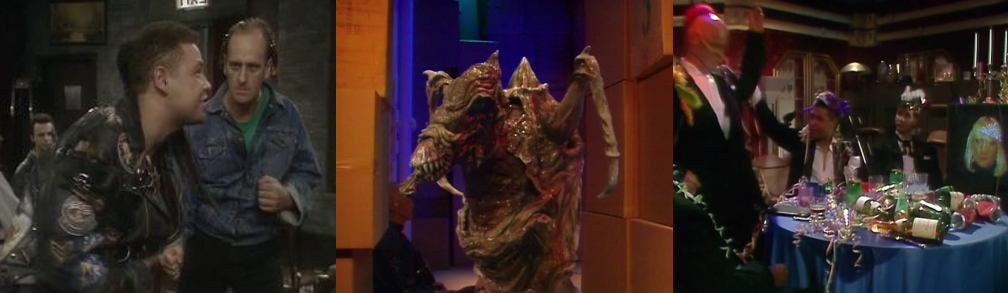
Series four leans more into “monster-of-the-week” territory than ever. The show’s still not using aliens (though the DNA ship is initially thought to be alien and certainly looks it, with its bio-organic interior and multilingual DNA modifier) but happily evoke them through the hideous, blob-like GELF Camille. Although she looks grotesque and causes some emotional turmoil, Camille can’t help that she becomes the object of a person’s desire. She seems to genuinely connect with Kryten but sees that he’s right that she belongs with Hector, who could potentially cure their condition. “D.N.A.” leans into horror with a ghastly three-headed corpse and the rampaging vindaloo monster, which shrugs off bazookoid fire and is only stopped by a vindaloo’s natural enemy: larger! The crew’s guilt is turned against them in “Justice” as the Justice Computer (James Smillie) scans them for any criminal acts and judges them accordingly. Justice World is a fascinating environment that uses robotic boots to ferry visitors around and includes a nigh-magical “Justice Zone”, where criminal acts are inflicted upon perpetrators. Lister learns this the hard way when he tries to commit arson but later uses it to his advantage to fight the simulant, who’s shot, stabbed, and eventually choked to death when he tries to kill Lister and the strange karma field inflicts the damage on him. The simulant makes for a memorable villain, taking the potential shown by the psychotic Hudzen-10 (Gordon Kennedy) and ramping it up to eleven with his devious nature and sadistic demeanour. Artificial lifeforms also pose a significant threat in “Meltdown”, with history’s most feared and ruthless evildoers waging war against celebrities, pacifists, and intellectuals to utilise their wax. Adolf Hitler (Kenneth Hadley) and Emperor Gaius Caesar Augustus Germanicus/Caligula (Tony Hawks) lead the charge in this campaign, mercilessly melting the resistance’s best fighters and punishing Lister when the Cat’s insolence denies them knowledge of the matter transponder.
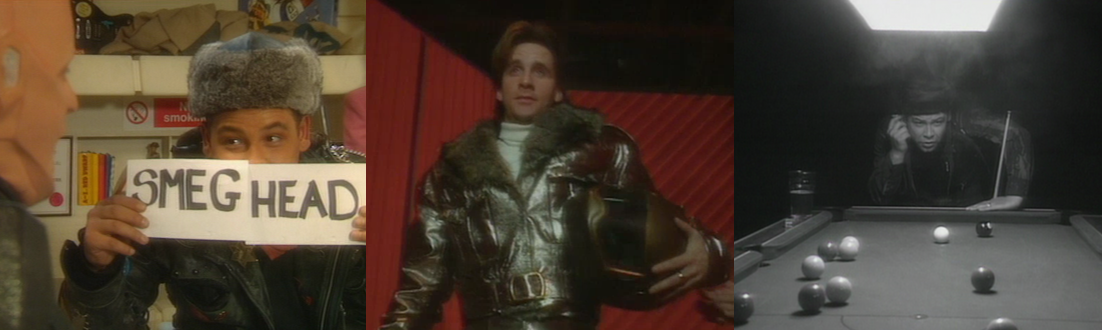
Despite some memorable moments and characters, I’ve always found series four lacking.

Despite its awful ending, “Dimension Jump” is my favourite episode of this series. It showcases some new model work and environments and introduces the alluring Ace Rimmer, a charming and awe-inspiring version of Rimmer who’s so attractive, brave, and kind-hearted that everyone swoons at his feet. Despite this, he remains humble and affable, reading to sick children and giving props to the engineers who give him the means to be the best. Even with a broken arm, Ace doesn’t hesitate to help the scuttled crew, braving a raging storm to fix Starbug’s engine alongside “Skipper”, though even he cannot stomach how disappointing and pathetic his counterpart is. I also really enjoyed “White Hole”, which starts with some fun antics with Talkie Toaster, shifts gears to a survival situation after Holly’s forced offline, and then explores temporal anomalies and has Lister launching a thermo-nuclear device for a one-in-a-million shot! “Camille” and “D.N.A.” were great showcases for Kryten, establishing some changes to his programming and allowing him to explore new emotions, though this is largely distilled into a “lie mode” going forward. It’s a shame there wasn’t more for the Cat to do and that Holly’s role is further lessened, but I enjoyed a lot of the extra depth given to the characters and their relationships. They’ve clearly become a dysfunctional surrogate family, enduring each other most of the time, genuinely connecting on rare occasions, but often winding each other up. When the chips are down, though, the crew come together to help each other, even if reluctantly, defending Rimmer despite his aggravating nature and Lister even betraying his morals if it means killing a vindaloo monster. However, I still feel something’s lacking here even if there are still a lot of laughs. Maybe it was the lack of visual variety in the locations, maybe the abrupt endings or bizarre narrative choices (the space mumps thing really doesn’t add much), but series four always feels like a small step back from series three and that’s a shame as there are a lot of good moments to be found.

My Rating:

Rating: 3 out of 5.

Pretty Good

Do you think I’m being too harsh on series four of Red Dwarf? Did you enjoy seeing Kryten take the spotlight and the exploration of his emotions? Which of the threats featured in this series was your favourite? Were you a fan of Ace Rimmer? Which episode of this series was your favourite? How are you celebrated Gazpacho Soup Day today? Drop your thoughts on this series of Red Dwarf in the comments, go check out my other Red Dwarf content, and donate to my Ko-Fi to support more reviews like this.

Screen Time [Gazpacho Soup Day]: Red Dwarf (Series Three)


In the episode “Me2” (Bye, 1988) of the classic British science-fiction comedy show Red Dwarf (1988 to 2020), it is revealed the Arnold Rimmer’s (Chris Barrie) last words were “Gazpacho soup!” and that he made a point to celebrate November 25th as “Gazpacho Soup Day” after a particularly traumatising visit to the Captain’s Table.


Series Three

Air Date: 14 November 1989 to 19 December 1989
Director: Ed Bye
Original Network: BBC2
Stars: Chris Barrie, Craig Charles, Danny John-Jules, Robert Llewellyn, and Hattie Hayridge

The Background:
In the mid-1980s, Rob Grant and Doug Naylor created Dave Hollins: Space Cadet, a BBC Radio 4 sci-fi comedy show influenced by classics of the genre like Dark Star (John Carpenter, 1974) and The Hitchhiker’s Guide to the Galaxy (Adams, 1978; Bell, 1981). Dave Hollins was also the prototype for Red Dwarf, a concept the duo struggled to sell despite emphasising character and comedy over genre. After casting impressionist Chris Barrie and Liverpudlian “punk poet” Craig Charles in the lead roles of Second Technician Arnold J. Rimmer and Third Technician Dave Lister, respectively, the cast was rounded out by singer and dancer Danny John-Jules and sardonic stand-up comedian Norman Lovett. Red Dwarf was eventually aired in early-1988 and, while viewing figures dropped during the first six-episode series, audience feedback was so strong that the BBC greenlit a second series. Granted a bigger budget, Grant and Naylor expanded the premise and, thanks to Red Dwarf now having an established audience, series two was more favourably received. The show was now a cult hit and afforded an even bigger budget for the third series, which saw a complete redesign of the sets and the introduction of a new model, and service mechanoid Kryten joining the crew (albeit now played by Robert Llewellyn). Widely regarded as one of the best sets of episodes throughout the show’s entire run, Grant and Naylor enhanced series three seasons with additional digital effects some ten years later, to some criticism. Since then, Red Dwarf continued to be consistently popular even after Grant and Naylor parted ways, returning from a lengthy absence with a series of specials and revivals that arguably struggled to match the quality of this season.

The Plot:
The mining ship Red Dwarf drifts through deep space three million years into the future, crewed by the last human being alive, Dave Lister, Arnold Rimmer, a hologram of his deceased superior officer, a humanoid cat (John-Jules), service mechanoid Kryten, and the ship’s neurotic computer, Holly (Hayridge). Their journey sees them visit a version of Earth where times runs backwards, dabble in time travel, swap bodies with each other, and the imminent arrival of Kryten’s ultra-modern replacement.

The Review:
Series three is really when Red Dwarf hit its stride, in many ways; at least, it is for me. Gone is the slow, strangely ominous opening sequence, replaced with a rockin’ cover of the main theme that plays over clips from the series to give a sense of the zany action viewers can expect. The first episode, “Backwards”, also starts with an amusing parody of the traditional Star Wars (Various, 1977 to present) opening scroll that flies past in the blink of an eye. Eagle-eyed viewers or those who slow down the footage will learn about how Lister returned his twins to the female-dominated parallel universe where they were conceived, how the ship’s computer, Holly, assumed the guise of his counterpart from that same reality after falling in love with her, and how service mechanoid Kryten suffered a horrific accident that saw him rebuilt by Lister to now join the crew. Additionally, Lister and Rimmer have now moved to the far more luxurious officer’s quarters, gaining bigger bunks, an en suite shower, and a far more comfortable and eye-catching space for them to socialize and bicker. Enough time has passed between Kryten’s offscreen repairs for the overly polite and submission mechanoid to have fully ingratiated into ship life, with him anxiously taking his pilot’s exam in the first episode as a way of introducing the show’s newest and most iconic ship-to-surface vehicle, the appropriately named Starbug. Even the ship’s corridors and layout have undergone a dramatic change, switching from the dull grey paintjob to a more ominous and dramatic hallways. Rather than recycle the sets from the first two series, series three introduces new areas, such as a dark room (where Kryten rocks out while developing photos), a club where the crew celebrate what’s believed to be Kryten’s final night before he’s forcibly replaced, and the science lab. The vending machines have a new design, we visit a claustrophobic cargo bay, and more episodes take place off-ship, with Rimmer and Lister literally being marooned on a frigid world at one point and the crew indulging in a bit of fun, if limited, time travel.

Lister and Rimmer’s relationship deepens, with the two sharing as much as they clash.

Lister and Rimmer’s contentious relationship remains a focal point of the series but has evolved to the point where Rimmer simply despairs of his slovenly roommate and Lister openly criticizes Rimmer’s boneheaded decisions. When Rimmer and Kryten prove a smash hit on the backwards version of Earth, Lister lists the many reasons why staying on such a bizarre world make little sense and openly challenges Rimmer’s tenuous authority when his fear is removed by the gruesome polymorph. The two are force to co-exist and we see a deeper representation of their dynamic in “Marooned”. Stuck with only each other for company, Lister must practically beg Rimmer to keep his mind off his seemingly inevitable slow death from either extreme cold or hunger and we explicitly see why Rimmer was chosen to keep Lister company after the ship’s crew were wiped out. Rimmer represents a smug, authoritarian antagonist Lister can focus his despair and loneliness onto and Rimmer fulfils this role admirably, chastising Lister’s short-focused greediness and trying to impress upon him the need to ration himself and make personal sacrifices to stay warm. Of course, Rimmer’s awe at Lister burning his beloved guitar soon turns to rage when he realises the devious slob has actually desecrated Rimmer’s prized camphorwood chest. Their relationship is further tested in “Bodyswap” when Rimmer sees a chance to experience the thrill of being alive once more. After failing to convince Lister to swap minds and bodies, Rimmer forces him to undergo the transfer and immediately indulges his every vice. Trapped in a hologrammatic body and powerless to prevent Rimmer from gorging himself, Lister is horrified when Rimmer hijacks his body and almost dies fleeing from reprisals in Starbug. Finally, the two clash in their attempts to alter the timeline using mutated developing fluid; discovering a limited means to travel to the past, they each vie to create the strangely popular “Tension Sheet” before the other. This gives a glimpse into Lister’s past as an ambitious but untalented musician and into an alternative life where he’s a successful rock star with a giant mansion and an obnoxious attitude. While Rimmer’s motivations for resetting the status quo are purely selfish for he wishes to have that life for himself, it also comes from a deep-seated desire to not be left alone on Red Dwarf, a fate worse than being trapped with people he barely tolerates let alone likes.

Kryten fits right in with the misfit crew and adds an extreme layer of dry comedic value.

While still a flamboyant, self-serving, egotistical narcissist, the Cat is far more well-rounded here. An accomplished pilot in his own right, he’s often partnered with Lister as a far more amicable, if not less self-absorbed, alternative to Rimmer. The Cat and Lister regularly engage in game night, playing various tabletop and physical games to occupy themselves, and the Cat seems genuinely hurt when the despondent Lister refuses to play and lashes out in frustration at being stuck in deep space as the last man alive. While the Cat is seemingly nonplussed when Rimmer and Kryten disappear in “Backwards”, he’s so distraught at Lister’s own disappearance in “Marooned” that he doesn’t “buff his shoes for three days” and reacts with elation upon spotting the crashed Starbug. Additionally, when a sugar-high Rimmer takes Lister’s body hostage and goes for a joyride, the Cat immediately volunteers to pursue him in Blue Midget (though mainly to avoid giving Lister possession of his body) and joins the crew in celebrating Kryten’s life in “The Last Day”. Kryten adds a lot to the ship dynamic, being a logical and deadpan presence amidst such bombastic characters. Though his inclusion makes Holly superfluous since he has a physical presence and isn’t suffering from computer senility, Kryten makes a great impression by performing parlour tricks for the Backworld inhabitants with Rimmer, overseeing the mind swap procedure, and in his surprisingly emotional reaction to the crew risking their lives when Hudzen-10 (Gordon Kennedy) arrives to replace him. Indeed, while Kryten is happy to accept his replacement and inevitable shutdown, Lister rallies against it, openly criticising Kryten’s belief that he’ll be rewarded for a lifetime of servitude in “Silicon Heaven”. Surprisingly, it’s Rimmer who’s the voice of reason here; though also sad, in his own way, he chastises Lister for mocking Kryten’s beliefs, however illogical and unfair they seem. Of course, Kryten really steals the show in “Polymorph”, where we see his various groinal attachments at work, witness him desperately and suggestively remove Lister’s shrinking underpants, and get a taste of his occasional semi-rebellious attitude when the titular monster removes his guilt and he’s suddenly insulting his friends and happy to sacrifice them to the polymorph to save his own hide.

It’s not an exaggeration to say every episode of the series is an absolutely classic.

Indeed, in a series full of standout episodes, “Polymorph” is one of the best. In keeping with series tradition, the titular creature (which is totally not a Xenomorph) isn’t an alien, but a genetically engineered lifeform (GELF) bred to remove its victim’s emotions. Beginning as a comical slug-like creature, the polymorph changes shape to lure in its prey and grows larger and more monstrous the more it feeds. It even feeds on artificial emotions, removing Rimmer’s anger and Kryten’s guilt, turning the former into a peace-loving hippy and the latter into an outspoken rogue. The Cat, normally the most stylish and confident of the crew, is reduced to a whiskey swilling vagrant happy to throw away his life when the creature removes his vanity and Lister becomes an angry, trigger happy brute eager to tackle the creature even if it means “sacrificing his life in some stupid, pointless way”. With only Holly on hand as the voice of reason, the dramatically compromised crew only succeed through pure luck and, even then, the ending suggests that a second polymorph is lurking in the background. “Backwards” is also a favourite of mine; though Lister’s initially amazed to finally be back home, he soon realises that he cannot exist in a world where time runs in reverse. Kryten and Rimmer, however, find a niche as the “Sensational Reverse Brothers” and are prepared to stay before a “barroom tidy” sees them fired as pub entertainers. Finally, “Timeslides” is a fun episode that starts off exploring Lister’s loneliness and anger and evolves into a game of one-upmanship not unlike “Stasis Leak” (Bye, 1988) where Lister and Rimmer desperately travel to different snapshots of their pasts to try and invent a simple but profitable stress reliever and change their fates. When Lister convinces his past self (Emile Charles) to patent the Tension Sheet, he, Cat, and Kryten disappear from the timeline, leaving Rimmer alone with Holly. Refusing to accept this, Rimmer first tries to convince the now wealthy and successful Lister to rejoin the crew and then travels to an earlier point in time to beat him to the punch. While his younger self (Simon Gaffney) fails to follow his instructions, Rimmer inadvertently restores the timeline…and himself to life. However, his elation is short-lived as he accidentally blows himself up, completely restoring the status quo.

The Summary:
As with the previous two series, I generally watch the Remastered version of Red Dwarf’s third season (1998), which replaces all model shots with CGI models and a new opening sequence. Series three includes some additional changes, most notably in “Polymorph” where new CGI first-person shots of the slug-like polymorph’s travels were added alongside a text epilogue to the episode that states the polymorph died in Lister’s underpants drawer, and a bizarre redubbing of Rimmer’s mother (Kalli Greenwood). It’s also worth nothing that the DVD release of the series allows you to watch “Backwards” in reverse, meaning all the Backworld dialogue is now understandable and reveals that the pub manager’s (Arthur Smith) tirade at Rimmer and Kryten is simply the actor mocking the efforts of people to understand his dialogue! Rimmer debuts perhaps his most iconic look here and has become a foil for the entire crew, rather than just Lister. He despairs of Kryten’s constant subservient demeanour but doesn’t hesitate to take advantage of it when it suits him, is more than happy to gorge himself in Lister’s slovenly body, and bemoans Holly’s incompetence when she’s unable to tell the difference between specks of grit and black holes. Lister occasionally shows a surprising emotional maturity this season, desperate to convince Rimmer and Kryten to leave Backworld, revealing much of his chirpy disposition is covering a depressing pain at being the last man alive, and raging at the idea that Kryten could be so easily replaced. Both Lister and Rimmer reveal more about their pasts, such as their sexual experiences and childhoods, adding additional dimensions to their characters even as they try to compromise the other into burning their beloved possessions or change their fates. It’s great seeing their roles literally reversed in “Bodyswap”, where Lister’s powerless to keep Rimmer from ruining his body with cigars and food and Rimmer becomes addicted to the rush of being alive, a euphoria that no doubt informs his short-lived celebration at the conclusion of “Time Slides”.    

The series expands on the characters’ personalities through humour and pathos.

Jokes in series three are absolutely top notch; all the characters feel far more familiar and the actors much more comfortable with each other so their rapport is even more natural. Even Kryten fits in like a glove, with Robert Llewellyn easily taking up the mantle from David Ross and making the character his own. Kryten’s interactions with Lister and Rimmer in episodes like “Polymorph” and “Body Swap” showcase how hilarious this group can be, with Kryten forced to obey every command “no matter how insane” and performing menial tasks by plugging appliances into his groin. I also enjoyed Lister repurposing medical supplies for his meal and scuffling with Adolf Hitler and Nuremberg, and that series three gives the actors a chance to explore different sides to their characters. “Polymorph” is the most obvious example as they all undergo extreme personality changes and are rendered even more inept as a result. “Timeslides” also shows us a version of Lister without his shady moral compass, and his naïve but charismatic younger self, while Rimmer develops a carefree and increasingly insane attitude when he hijacks Lister’s body. Kryten is also faced with his far more efficient, imposing replacement in “The Last Day”, a surprisingly emotional episode in which Lister first refuses to accept and then is determined to celebrate Kryten’s impending shutdown. The drunk crew share some emotional scenes that soon lead to accusations about Lister’s parentage and, though desperately hungover, resolve to defend Kryten from the maniacal Hudzen-10 even though they’re physically outmatched. Similarly, the crew are faced with their pending destruction when Lister accidentally activates the ship’s self-destruct sequence in “Body Swap”, a desperate situation masterfully subverted when it’s revealed Holly disposed of the bomb and never told the crew since they didn’t ask! Additionally, Lister faces his own impending demise in “Marooned” where he’s forced not only to rely on Rimmer for emotional support but also to choke down dog food and Pot Noodles. This is an equally torturous situation for Rimmer not just because he faces the very real possibility of watching the closest thing he has to a friend die before his eyes, but also because Lister burns Rimmer’s prized possessions to stay alive. Interestingly, Rimmer seems to connect with the younger Lister, though his enthusiasm for the “Om” song could easily be interpreted as sarcasm. Still, his impassioned plea to the time-altered Lister seems genuine, though born from his fears of loneliness.

Series three was peak Red Dwarf and established a new standard for the show.

As much as I enjoyed series two, series three of Red Dwarf is where the show really started to land with me. Every episode is a gold mine of comedic situations and memorable moments. While many of these are in “Polymorph” (still one of the best episodes of the entire show), each episode shines as the writers explore the boundaries of the show’s unique sci-fi setting. Kryten was a welcome presence, adding additional comedy by playing the logical but still awkward straight man to his more volatile crewmates. It was fun seeing the crew bumble about on Backworld, riding and driving backwards without really realising it and performing simple tasks to the amazement of their audience, with the reverse brawl being an obvious highlight. I enjoyed exploring Rimmer and Lister’s relationship in “Marooned”, how they genuinely seemed to connect and yet Lister couldn’t help but sabotage Rimmer’s beloved family heirloom to safeguard his guitar. “Polymorph” explored extreme opposites of their personalities, showing that this ragtag crew may be dysfunctional but support each other well despite being very different personalities. “Body Swap” explored these personalities in a fun new way, with Lister left disapproving of Rimmer’s outrageous antics and getting a taste of how helpless Rimmer often feels as a hologram. While there are some logic gaps in “Timeslides”, the time travel shenanigans were fun and I enjoyed exploring a world where Lister never got marooned in deep space yet was still a slob, despite his great wealth. “The Last Day” is a great character showcase for Kryten, showing how much the crew care for him (Lister especially) to the point where they willingly defend him even though Hudzen-10 deems them all “viable targets” for termination. The resolution to this is as ingenious as it is hilarious: the menacing mechanoid is forced into a “metaphysical dichotomy” when Kryten lies about the existence of Silicon Heaven, cementing his place in the crew. Series three is easily the best of the classic era of Red Dwarf and a must-watch for anyone looking to get into the show. It’s sci-fi sit-com at its finest and showcases some of the best and most amusing moments for the crew and remains as appealing today as it was all those years ago.

My Rating:

Rating: 5 out of 5.

Fantastic

Is series three of Red Dwarf your favourite of the show’s run? What did you think to Kryten becoming a full-time member of the crew? Did you enjoy the exploration of Lister and Rimmer’s relationship and their constant one-upmanship? What did you think to the depiction of time travel and solidarity the crew showed towards Kryten? Which episode was your favourite and how are you celebrated Gazpacho Soup Day today? Feel free to share your thoughts and memories of Red Dwarf down in the comments and be sure to check out my other Red Dwarf content on the site.

Screen Time [Gazpacho Soup Day]: Red Dwarf (Series Two)


In the episode “Me2” (Bye, 1988) of the classic British science-fiction comedy show Red Dwarf (1988 to 2020), it is revealed the Arnold Rimmer’s (Chris Barrie) last words were “Gazpacho soup!” and that he made a point to celebrate November 25th as “Gazpacho Soup Day” after a particularly traumatising visit to the Captain’s Table.


Series Two

Air Date: 6 September 1988 to 11 October 1988
Director: Ed Bye
Original Network: BBC2
Stars: Chris Barrie, Craig Charles, Danny John-Jules, Norman Lovett, David Ross, and Charles Augins

The Background:
Back in the mid-1980s, creative duo Rob Grant and Doug Naylor created Dave Hollins: Space Cadet, a sci-fi comedy show for BBC Radio 4 influenced by sci-fi classics like Dark Star (John Carpenter, 1974) and The Hitchhiker’s Guide to the Galaxy (Adams, 1978; Bell, 1981) and which laid the foundation for what would become Red Dwarf. Their concept of a comedy set in space was initially a hard sell due to its sci-fi trappings, despite the duo emphasising character and comedy over genre. With impressionist Chris Barrie and Liverpudlian “punk poet” Craig Charles cast as bickering duo Second Technician Arnold J. Rimmer and Third Technician Dave Lister, respectively, and joined by tardy singer and dancer Danny John-Jules and sardonic stand-up comedian Norman Lovett, Red Dwarf eventually came to TV screens in early-1988. Despite viewing figures dropping throughout the six-episode first series, five million viewers tuned in for the pilot episode and audience feedback was so strong that the BBC greenlit a second series, which was really where the show hit its stride. Afforded greater influence, and a bigger budget, Grant and Naylor took the chance to expand the show’s setting, even moving out of their comfort zone to introduce a mechanical character who would later join the main cast. Having established their audience, the second series was received far more favourably and was on its way to becoming a cult hit. Some ten years later, Grant and Naylor enhanced the first three seasons with additional digital effects, replacing model shots with CGI and even revising lines and jokes, which resulted in these Remastered episodes being largely criticised. Nevertheless, Red Dwarf proved consistently popular even after the duo parted ways; after a lengthy absence, Red Dwarf returned with a three-episode special in a questionable revival that arguably struggled to match the quality of its earliest seasons.

The Plot:
Deep space mining ship Red Dwarf drifts aimless in space three million years into the future, crewed only by Dave Lister, the last human being alive, Arnold Rimmer, a hologram of his deceased superior officer, a humanoid cat (John-Jules), and the ship’s neurotic computer, Holly (Lovett). Their long journey back to Earth is side-tracked by a distress call from confused android Kryten (Ross), an addictive virtual reality game, a leak in the fabric of space and time, and a journey to a parallel dimension where women are the dominant gender.

The Review:
Red Dwarf was a popular show in my house when I was a kid. I was too young to remember the first series, however, and our VHS collection of the show started here, with series two, presumably because my dad either didn’t have the means to record the first series when it first aired or never thought to do so. Re-runs of the first series wouldn’t come around until much later, so I grew up watching the second to fifth series with considerable regularity. When I finally did watch the first series, I wasn’t very impressed; there was something lifeless and stilted about the presentation and the jokes that was decidedly at odds with the presentation of later seasons, but even the second series, which aired later in the same year as the first (something I still find astounding; I would’ve expected it to come the following year), has improved dramatically in every way save for that oddly ominous, lengthy, and out of place introductory sequence that would thankfully be ditched for something more upbeat in the third series. Still, you can see how far the series has come just from Holly’s brief recap of the plot that accompanies each episode’s title sequence; not only is Holly rendered in a more aesthetically pleasing way, but his jokes land a lot better, with his quip about having to life at the bleakness of existence and his collection of singing potatoes being just two examples.

Lister finds some new distractions to help vary his long days in deep space.

When we catch up with the Red Dwarf crew, things aren’t too far off from where we left them in the last series; although it seemed Lister and Rimmer came to an understanding and were prepared to show each other mutual respect, that’s not quite the case as Lister openly mocks Rimmer’s desperate attempts to learn Esperanto, proudly piles up his mail (despite it all being junk mail and useless mail order items) and winds Rimmer up about his $£8,500 debt to the “Outland Revenue”, and openly reads his diary (even narrating select sections to the Cat). Yet, their relationship is notably less antagonistic now; Lister bakes a spanner-shaped cake for Rimmer’s death day and not only seems genuinely happy to celebrate the occasion but also tries to help Rimmer’s intoxication with a triple fried egg sandwich with chilli sauce and chutney. Similarly, Rimmer, despite the fact that he can’t stand Lister, is dismayed that he would throw away their relationship in favour of three weeks of happiness with Kristine Kochanski (C. P. Grogan). Lister’s still the same cheerful slob; excited at making contact with another ship, he makes the effort shine his boots, toss on his cleanest t-shirt (“with only two curry stains on it”), and hammer his wretched socks to make himself somewhat presentable despite emphasising that they’re “not on the pull!” and Lister’s staunch refusal to refer to Rimmer as “Ace” leads to Rimmer encouraging him to wear his day-glow orange moonboots, which stink so badly that even the uptight hologram is reduced to tears by their rancid odour. What little emotion Lister showed at being the last man alive is mostly disregarded as he’s settled into his new, bizarre life, however he still craves happiness with Kochanski, to the point where he’s willing to die alongside her after discovering a stasis leak to the past, and is so distraught to find she’s already married that he launches into a great broken-hearted soliloquy about how women always leave him for “total smegheads”, nice guys they can rely on and who aren’t complete slobs. “Stasis Leak” (Bye, 1989) also sees Lister so elated to be reunited with Olaf Petersen (Mark Williams) that he embarrasses him in front of two ladies, and expressing excitement at seeing his long-dead friends again and a brief flash of regret at having taken them for granted. This episode also ends with the revelation that Lister will one day travel to the past and marry Kochanski, a plot point never revisited in future episodes (which is probably for the best as, while this Future-Lister is an arrogant jerk).

The series explores themes of slavery, friendship, and gender equality with a comedic, sci-fi flair.

Much of Lister’s characterisation shifts towards advocating for equality, both for machines and women, whom Rimmer treats with equal measures of indifference, disrespect, and misogynistic apathy. The series introduces the concept of humanoid androids (or “mechanoids”) whose only function is to serve their human masters like butlers; Lister finds Kryten’s life of servitude particularly grating, seeing it as a form of slavery, and actively encourages him to think of himself, work towards his dreams of having a garden somewhere, and exposes him to the works of James Dean and Marlon Brando to try and break his programming and make him more independent. Rimmer is far less respectful and mindful, referred to Kryten as “it” and giving him a ridiculously long list of tasks, including painting a grandiose portrait of him. Lister also vouches for the Skutters (now referred to as Pinky and Perky and depicted as being obsessed with John Wayne and playing cowboys and Indians), reasoning that they only do what they’re told to do and cannot be expected to understand complex instructions or be pro-active, though he does later quip that he “wouldn’t trust them to open a can of beans” when Rimmer suggests they can perform a caesarean. When Holly endangers the crew in “Queeg” (Bye, 1989), drawing the ire of Rimmer and even the Cat, a new authoritarian artificial intelligence, Queeg 5000 (Augins), replaces Holly (accusing him of having an IQ of six, relying on the Junior Encyclopaedia of Space, and sending them in circles for over a year), reducing him to a nightwatchman and enforces far stricter rules. While Rimmer is initially impressed by Queeg’s regime, Lister is dismayed and hurt on Holly’s behalf; while Rimmer demonstrates a lack of empathy towards machines, Lister shares a half-baked story about a pair of shoes with artificial intelligence (or “souls”) and feels bad for Holly being replaced like he was expendable. Similarly, Lister attacks Rimmer’s reliance on cheap tricks, lines, and even hypnosis to deceive women, emphasising that they’re people who deserve respect rather than trickery or contempt. Lister is excited to explore a parallel universe, where females dominate, but Rimmer is disgusted and insulted by Arlene Rimmer’s (Suzanne Bertish), perverse magazines that depict “hugely deformed” male models draped themselves over sports cars and her attempts to hypnotise him and use the same tactics he was previously so proud of to try and seduce him. Since holograms can touch each other, he comes to fear Arlene’s aggressively sexual advances and refuses to acknowledge that she’s simply treating him with the same disrespect and fetishisation he showed women. Arlene even goes so far as to challenge Rimmer, accusing him of being a “boring masculinist”, which runs parallel to Deb Lister’s (Angela Bruce) descriptions of how males fought for equality in this universe.

The series delves deeper into Rimmer’s background and neuroses to flesh out his grating quirks.

Like Lister, Rimmer has largely become accustomed to his newfound life (or, in his case, death). Lister still accuses him of using his condition as an excuse to fail in “Better Than Life” (Bye, 1989), where Rimmer becomes despondent by his reliance on the Skutters since they’re so stupid that they cause more harm than good; he later gets his revenge, and demonstrates his adaptability (or, more accurately, cunning) by simply waiting for a Skutter to return to its duties so he can win a game of draughts by default. This series really expands on Rimmer’s fascination with aliens; mockery from Lister relates that Rimmer equates any strange happenings, however minor, to extraterresital lifeforms. His first guess when the crew wake up to find they’ve lost four days overnight in “Thanks for the Memory” (ibid) is aliens and he attempts to piece together evidence that they were abducted and had their memories erased in an elaborate attempt to communicate. We also learn much about Rimmer’s childhood, which goes a long way to explaining his neurotic and antagonistic character; he’s shaken when he receives a letter informing him of his father’s (John Abineri) death, something he was obviously aware of given they’ve been lost in space for three million years but which still rattles him. However, his turmoil comes not from sadness, as Lister assumes, but out of complex mixture of hatred and respect for his father, an abusive and judgemental patriarch who was so fixated on his sons getting into the Space Corps that he’d withhold food if they couldn’t answer astronavigation questions (resulting in Rimmer almost dying from malnutrition) and stretch them on a traction machine. Still, Rimmer desperately wanted his father’s approval and attempts to find some solace in Better Than Life; although initially ecstatic to get the autograph of his “all-time favourite fascist dictator”, Napoléon Bonaparte (Reece Clarke) (using his “bad hand”, no less), promoting himself Admiral, and even signing a copy of his memoirs, he’s denied hearing his father’s approval thanks to the Cat’s selfishness and the game’s more malevolent side soon comes through. Rimmer revels in rekindling his fling with Yvonne McGruder (Judy Hawkins) but is soon a desperate a despondent husband and father to seven unruly children; Rimmer’s brain cannot handle nice things happening to him, reducing him to an unkempt alcoholic in the blink of an eye and leaving the crew awaiting a slow and painful death by killer ants, earning him only further contempt from his ship mates because of his diseased mind.

The Cat’s attempts to indulge his selfish sexual desires are constantly thwarted throughout the series.

The Cat also noticeably grows as a character; while he’s still obsessed with food, fashion, and sex and largely self-absorbed, he often accompanies Lister on his jaunts around the ship and jumps at the chance to indulge himself in Better Than Life. He delights in ordering a tank of live goldish, seasoning them and singing a fun song as he toys with them, dreams up a wardrobe so big that it crosses an international time zone, and insists that he’s a pro at golf despite his strategy being to avoid hitting his “egg” in favour of hurling his club across the green. The Cat’s imagination also extends to a catchy dance number, “Tongue Tied”, that he views on the dream recorder. Although the Cat lacks the empathy to cheer Rimmer up after he’s shaken by his mother’s note, and actively scuppers Rimmer’s fantasy, he debuts his “wise old cat saying” gag to share his unique cat wisdom, and also disagrees with Kryten’s servant status (though more because he finds the idea of following orders ludicrous), and later admonishes Lister for screwing with Rimmer’s memory with a love affair with Lisa Yates (Sabra Williams). The Cat also showcases more of his love for fashion; he’s aghast at having to hide his colourful clothes in “Stasis Leak”, is distraught when Queeg forces him to work for food and ruins his hands, and even creates a garish customised gold spacesuit and needs to be literally dragged away form his own reflection! The Cat’s constant horniness comes up throughout the series; in “Better Than Life”, he dates both a mermaid, Miranda (Debbie King), whose top half is a fish in an amusing sight gag, and Marilyn Monroe (Debbie Ash), whose attentions eventually annoy him. The Cat is so excited to rescue the Nova 5’s crew that he spends a whole day getting ready and doesn’t seem bothered when they turn out to be dressed up skeletons. When he’s actually around women in “Stasis Leak”, however, he’s driven into such a frenzy that his usual cool is lost and he’s denied the chance to act on his libido. Rimmer later hypocritically scolds the Cat for only thinking about sex rather than a long-term commitment, though the Cat asserts that he’s willing to settle down with the seven or eight perfect girls. The Cat is ultimately disappointed and disgusted to find that his counterpart in the parallel universe isn’t a female cat, but a scruffy and overly enthusiastic dog (Matthew Devitt). Appalled by the Dog’s appearance and stench, the Cat actively avoids his counterpart, who eagerly tries to engage with the Cat and impress him with his dance moves.

Not only is he more versatile, Holly pulls an elaborate prank to teach the crew a lesson in appreciation.

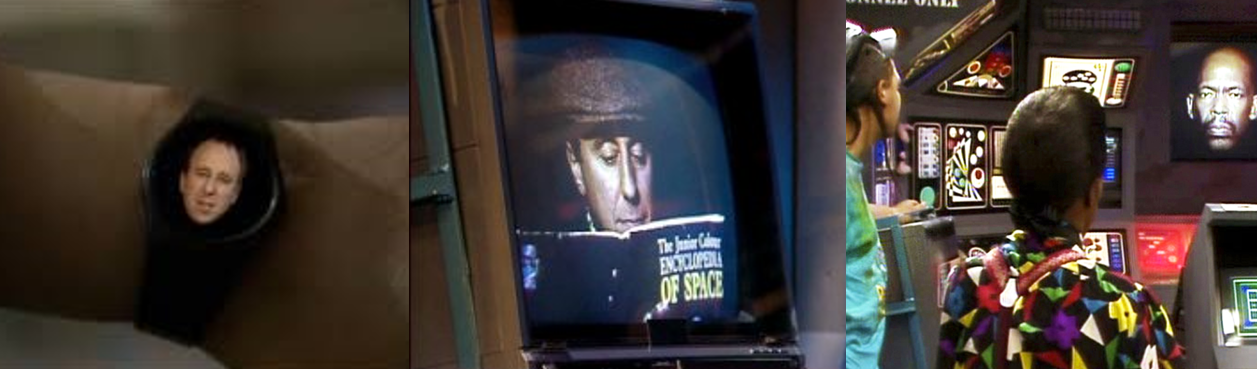
Holly is just as clueless as ever; still half-assing his duties at keeping Red Dwarf on track, he spends his time “totally [revolutionising] music” by decimalising it and inventing new notes, though this results in a completely impractical redesigning of traditional musical instruments that even Lister isn’t impressed by. Still, Holly is more interested in sharing this bizarre idea than in relating distress signals, would rather have the crew guess what his announcements are about even though they have no way of knowing what’s happened, and is even slow to warn of a meteor strike, resulting in them chastising his uselessness. Holly’s absent-mindedness makes him slow to tell Lister that Red Dwarf ran out of cow’s milk “yonks ago” and has been supplemented it with dog’s milk, but he’s still switched on enough to suggest hunting down the black box in “Thanks for the Memory” and to leave a pre-recorded message on the device warning the crew from watching it. Despite Holly’s animosity towards the postal service, he has been playing postal chess with Gordon (Gordon Salkilld), an eleventh-generation computer with an IQ of 8000 who proves to be as quirky and off his rocker as Holly, and even ends up joining the crew in their adventures either using a clunky mobile television unit or on Lister’s wristwatch. The crew’s despair at Holly’s unreliability means they’re understandably sceptical of his dimension-crossing “Holly Hop Drive”; although it doesn’t work as Holly intended, it does shunt them into the “fifth dimension”. Since this isn’t the first time Holly has “flamingo’d up”, it’s surprising when he’s able to explain how parallel dimensions work, especially as he wasn’t able to explain what a stasis leak was. Like the others, Holly also has a female counterpart, Hilly (Hattie Hayridge), who’s equally scatter-brained; unlike his doomed love affair with a Sinclair ZX-81, this relationship goes well for Holly, with Holly not even need a wig to impress Hilly. Series two spotlights Holly tremendously in “Queeg”; the crew loses their patience when Holly endangers them, with Rimmer in particular exasperated when damage to the hologram simulation suite causes him to glitch out (allowing Chris Barrie to showcase his impressions as he imitates Lister, the Cat, and Holly). Holly is initially resentful of them for not sticking up for him but is won over when Lister’s easily convinced of his capability even after witnessing him consult his book. Reinvigorated by the crew’s faith, Holly challenges Queeg for control; despite suggesting any other game, Holly’s forced to take his rival on in a game of chess and is resoundingly defeated, much to the despair of the crew. However, Holly delights in revealing that the totalitarian Queeg was an elaborate hoax to teach the crew to appreciate him, flaws and all.

The series is bolstered by an expanded supporting cast, including standout future stars like Kryten.

Series two is also bolstered by some guest stars; some, like Petersen, Kochanski, and Captain Hollister (Mac McDonald) return from the last series thanks to the stasis leak and a flashback to prior to the accident that wiped out the crew. Things are kept interesting by the likes of the “Groovy Channel 27” presenter (Tina Jenkins) and a number of celebrity look-a-likes and other roles showcased in “Better Than Life”, the first time the show was filmed on location, but Kryten is easily the most memorable guest star. Kryten is an overly polite and affable mechanoid whose sole function is to serve; in fact, Rob Grant and Doug Naylor’s later novelisations revealed that Kryten’s overbearing cleanliness made him directly responsible for the Nova 5’s crash and the death of its crew (something alluded to in series seven). When he’s not serving humans without question, he enjoys watching Androids (an amusing parody of Australian soap opera Neighbours (1985 to 2022)) and dreams of a life tending to a garden. Kryten is a little different to how he’s portrayed in later episodes; slightly more effeminate and dressed up in a glossy penguin suit, he fusses over every little thing and admonishes his dead crew for their dishevelled appearances and unsociable eating habits (with the exception of the “absolutely perfect” Ms. Tracey). Because of his programming, and centuries of isolation, Kryten carries his duties out to the fullest extent and doesn’t seem to realise that the three are dead; when the Dwarfers force him to face the truth, though, it’s heavily implied that he was simply living in a state of intense denial. While it seems like Lister’s efforts to break his programming have gone to waste, Kryten eventually rebels in spectacular fashion, painting Rimmer sitting on a toilet and bombarding him with insults before heading out for a jaunt on Lister’s space bike. Lister finds a kindred spirit in his female counterpart, Deb, with them enjoying drinking contests and delighting in the two Rimmer’s awkwardness. They actually find common ground and hold a normal conversation, which is more than can be said of the Rimmers, who struggle to make small talk when Arlene’s not treating him like a sex object and being uncomfortably rapey in her advances, branding him “frigid” when he doesn’t put out and raising concerns over Rimmer’s treatment of women. Despite this, Lister isn’t impressed by Deb’s drinking and love for curries, criticising aspects of her that define his own character while simultaneously chastising Rimmer for not realising that Arlene reflects his despicable attitude towards women, and ending up being used and impregnated by his female counterpart to again raise some questions about our main character’s attitudes towards and treatment of women.

The Summary:  
Even though it aired later in the same year as the first series, Red Dwarf’s second season definitely has a far more interesting and engaging visual presentation. It’s possible the creators were afforded a bigger budget as we’re no longer subjected to the same drab, boring ocean grey (or is it military grey…?) corridors of the titular ship; Red Dwarf’s corridors are darker, moodier, and sport arcade machines and grates to make them far more interesting to look at. We get to see more of the ship; although the general appearance of Lister and Rimmer’s quarters is basically the same, the overall presentation seems far livelier this time around. Similarly, the drive room has been completely redesigned; rather than being a largely lifeless and empty grey room with a simple bank of monitors, it’s now a bustling, colourful hub of activity with a distinctly 1960s sci-fi flair. Series two debuts the observation dome (where Lister shares his memories of Lisa Yates and his father’s death), the hologram simulation suite (where footage of previous episodes represents Rimmer’s dreams and memories (alongside him singing Frank Sinatra’s “Someone to Watch Over Me” sans trousers), and the introduction of other ships, such as the Nova 5 and the show’s first additional spacecraft, Blue Midget, an insect-like shuttle that allows the crew to venture off-ship; it’s not as iconic as its successor, Starbug, but it adds some visual variety and it’s fun seeing the cockpit all decked out like a trucker’s cab. Some of these additional effects are better than others; the transitions to Better Than Life and the visual effect of the multiple monitors in the hologram simulation suite is poorly implemented but some clever camera techniques allow the crew to celebrate Rimmer’s death on a small habitable moon (though Rimmer’s holographic projection cage wouldn’t appear again, and rightfully so as it doesn’t even make sense in this series as he was able to travel to the Nova 5 without issue). The Remastered version of the show adds some additional effects, such as all-CGI ships replacing the traditional models, a glitch effect being spliced onto Rimmer in “Queeg”, and removing the admittedly odd looking mermaid shot.

Despite some odd plot choices, series two is full of hilarious moments and surprisingly tight on continuity.

The writing was much tighter and more enjoyable overall this time around; the characters were given much more depth and more to do and interact with, which really helped the comedy. Some standouts include the revelation that Lister attended Art college but dropped out after ninety-seven minutes because of the unreasonable timetable, Kryten’s reaction to the unmistakable reality of his crew’s fate (resulting in one of the best reactions in the entire series, “My God! I was only away two minutes!”), and Rimmer flipping out over his Outland Revenue debt despite being three-million years into deep space and the human race being extinct. Other favourites of mine include a news report about a missing page from the Bible proving it to be fictious, the revelation that Rimmer’s only had sex once and his subsequent reaction to remembering this admission, the description of Rimmer’s psychedelic, hallucinogenic trip on “Freaky Fungus” that saw him attack two senior officers after mistaking them for armed giraffes, and Rimmer’s story about being betrayed by his childhood friend Porky Roebuck while in the Space Scouts. Surprisingly, considering how lax Red Dwarf became with its continuity, there are many references and ties to the first series: we get to see the dream recorder this time, Rimmer’s outfit is exactly the same and he wears his dress suit and medals again, and “Parallel Universe” finally answers how they got two babies without a woman onboard, though the idea of Lister taking a pill or having an abortion never comes up after he inexplicably falls pregnant. Similarly, “Stasis Leak” offers the first of many questionable plot threads; the visual effect allows the crew to travel to the past (but conveniently not bring anything back through, despite the crew being unaffected by the return trip), and ludicrously suggests that a space ship five miles long only has two stasis booths. Furthermore, Lister and Rimmer end up competing to try and rescue Kochanski and Rimmer’s past self, respectively (Rimmer’s even oddly excited at the idea of two versions of him being on the ship despite how badly it went in series one), rather than simply hijacking a Blue Midget and escaping (or staying on Ganymede) before the accident occurs; they even could’ve loaded others onto the ship as well, but this wouldn’t be the last time the show ignored a solution like this.

By expanding the visuals, cast, and personalities, series two was a big step up from its predecessor.

Still, series two is packed with great episodes; “Better Than Life” is probably the best episode of the series and was clearly a favourite of the show’s creators as it formed the basis for their second Red Dwarf novelisation, albeit in a far more sinister context. In the show, the “total-immersion videogame” Better Than Life is a relatively harmless virtual reality simulation that grants the players anything they desire, only for Rimmer’s deep-rooted neuroses and self-deprecation to ruin the experience; in the books, it traps the crew in their own personal haven, wasting their bodies away and causing them a great deal of pain and heartache. I also enjoy “Kryten”, though I wonder if it might’ve been better placed as a later episode in the series given how the character was promoted to the main cast going forward; I love Rimmer’s macho bravado somewhat akin to his later alter ego, “Ace” Rimmer, a façade that falters when Kryten flusters him with fluent Esperanto, and Kryten’s redecorating of their quarters, which sees him throw out a cup of mould that Lister was specifically breeding just to annoy Rimmer. “Thanks for the Memory” explores Lister and Rimmer’s changing relationship; Lister not only offers Rimmer practical advice, he’s genuinely motivated to help Rimmer experience true love when he implants Lisa Yates into his memory. This not only improves Rimmer’s mood and self-confidence but also amusingly creates a strange period of his life where he went on an eight-week bender living Lister’s life, remembers being an orphan despite his parents being alive, and had his appendix removed twice. Although Lister stresses that Rimmer’s love and appreciation for Lisa were stronger and more real than his own, Rimmer demands to literally erase and bury his humiliation. I also really enjoy “Queeg”, especially as a wake-up call for the crew and as an exploration of their dysfunctional friendship, and “Parallel Universe” was ahead of its time in many ways with its frank deconstruction of the male/female dynamic. Overall, Red Dwarf’s second series is a vast improvement over the first; the writing, jokes, and visuals and character dynamics make every episode a riot. From Holly’s praise for the benefits of dog’s milk and “blind spot” for sevens, the fantastically bleak elevator safety video (complete with cyanide pills), to Rimmer attacking the captain, the multiple character variants showcased by the confusion of time travel, to the idea that men routinely give birth in an alternative dimension, series two is better in almost every way compared to its predecessor. The ship is far livelier, the crew have more to do and toys to play with, and series two absolutely set the standard for subsequent seasons…until Doug Naylor randomly went back to the dullness of the first series for the eighth series.

My Rating:

Rating: 4 out of 5.

Great Stuff

What did you think series two of Red Dwarf? Do you agree that it’s an improvement over the first series? Which of the jokes was your favourite? What did you think to the changes in the relationship dynamic between Lister and Rimmer, the exploration of Holly’s character, and the Cat’s development? Were you a fan of Kryten and Queeg? Which episode of series two was your favourite? Why do you think the crew didn’t just stay in the past? Would you like to see more seasons and specials, maybe one that finally closes the book on the Red Dwarf story, or do you think it’s best to leave it be for now? How are you celebrating Gazpacho Soup Day today? No matter what you think, feel free to leave a comment about Red Dwarf down in the comments and on my social media.

Screen Time [Gazpacho Soup Day]: Red Dwarf (Series One)


In the episode “Me2” (Bye, 1988) of the classic British science-fiction comedy show Red Dwarf (1988 to 2020), it is revealed the Arnold Rimmer’s (Chris Barrie) last words were “Gazpacho soup!” and that he made a point to celebrate November 25th as “Gazpacho Soup Day” after a particularly traumatising visit to the Captain’s Table. While this is the perfect date to celebrate the long-running cult series, it clashed with another celebration this year so I’m a day late, but better late than never…


Series One

Air Date: 15 February 1988 to 21 March 1988
Director: Ed Bye
Original Network: BBC2
Stars: Chris Barrie, Craig Charles, Danny John-Jules, Norman Lovett, C. P. Grogan, and Mac McDonald

The Background:
In the mid-1980s, creative duo Rob Grant and Doug Naylor created a sci-fi comedy show for BBC Radio 4, Dave Hollins: Space Cadet; this, along with influences from sci-fi classics like Dark Star (John Carpenter, 1974) and The Hitchhiker’s Guide to the Galaxy (Adams, 1978; Bell, 1981), served as the basis for what would become Red Dwarf. Putting character and comedy before genre, their concept of a comedy set in space featuring dysfunctional characters in an extraordinary setting was initially a hard sell due to its sci-fi trappings. Originally, Alfred Molina was cast in the role of Second Technician Arnold J. Rimmer but, when he dropped out due to difficulties with the character and concept, impressionist Chris Barrie (who’d previously worked with Grant and Naylor) stepped into the role. Liverpudlian “punk poet” Craig Charles was cast as Third Technician Dave Lister and, despite being an hour late to his appointment, singer and dancer Danny John-Jules was cast as “The Cat”, with the actors tackling their roles as being larger-than-life caricatures of themselves. Sardonic stand-up comedian Norman Lovett was cast the the ship’s neutronic computer, Holly, and gained a bit of a reputation, insisting on appearing on camera rather than merely a voice over and refusing to work unless his confiscated football was returned to him. Against all the odds and despite a tight budget, Red Dwarf finally made it to TV screens; however, while five million viewers tuned in to watch “The End” (Bye, 1988), those numbers dropped over the course of the series. Nevertheless, audience feedback was so strong that the BBC commissioned a second series, where the show really hit its stride and became a cult hit. About ten years later, Grant and Naylor revisited the first three seasons and enhanced them with additional digital effects, replacing many model shots and even excising some lines and jokes, which resulted in these Remastered episodes being largely criticised. Still, following this first series, Red Dwarf proved consistently popular even as the duo experimented with more outlandish concepts. After they parted ways and Red Dwarf disappearing altogether, the show returned with a three-episode special, which led to a questionable revival that focused on the far more jaded principal cast members.

The Plot:
When the crew of deep space mining ship Red Dwarf are all killed following a radiation leak, the ship drifts aimless in space for three million years. When the background radiation dies down the ship’s computer, Holly, releases slovenly technician Dave Lister from his incarceration in suspended animation and he’s left alone in the endless void with only the hologramatic recreation of his overbearing superior and bunk mate, Arnold Rimmer, and a creature who evolved from the ship’s cat for company.

The Review:
I grew up watching Red Dwarf, but perhaps not in the way you’d expect. My dad was a big fan of the series and had taped each episode as they aired so we could easily just go to the shelf and shove in a VHS tape to watch it whenever we wanted, but our collection originally started from series two (Bye, 1988). In fact, I’m pretty sure that we were up to series four (ibid/Paul Jackson, 1991) or five (Various, 1992) before I had even seen the first series. This was because, back in the early nineties, re-runs didn’t really work the way they do now; we didn’t have catch-up TV or streaming services, VHS tapes were extortionately expensive and often only contained two or three episodes, and there weren’t any channels like Gold or Dave that constantly showed repeats. I remember being stupidly excited when the first series was announced to be returning to BBC2 in anticipation of the latest series, only to find that the first series was very different to what I have experienced so far, even from the technically similar second series. Of all the classic series’ of Red Dwarf, series one is easily my least favourite and, even now, I rarely choose to watch it over the second or third (Bye, 1989); while I can understand that the show was establishing itself and finding its footing, many of the episodes drag and aren’t very visually interesting to look at. You can tell from the live audience’s reactions that this sentiment was shared as many of the jokes fall a bit flat and the audience seems confused about the premise. This wouldn’t be an issue in the next series and wouldn’t reoccur until Grant and Naylor stopped working together and the show took a noticeable nosedive, but it’s unmistakable here and does somewhat stunt my enjoyment of the first series despite there being a few standout moments and episodes.

The show’s premise is surprisingly dark, with the human race extinct except for one slob.

The show begins with the titular mining vessel fully crewed and out in the depths of space. According to Officer Frank Todhunter (Robert Bathurst), the ship houses 169 crew members, from dosgbody technicians like Rimmer and Lister to officers and the ship’s captain, Frank Hollister (McDonald). The dynamic between Lister and Rimmer is established in the very first sequence of the first episode; Lister, a lowly Third Technician, is a lifelong slacker and career slob who is endlessly bored by their mundane duties, which include unclogging food dispensing machines. To amuse himself, Lister likes to wind Rimmer up with singing, humming, and other annoying habits, which has earned him no less than 247 complaints from his superior and bunk-mate. Truth be told, Rimmer is equally as unsatisfied with his job, which isn’t assigned to the ship’s service robots (known as “Skutters”) simply because the machines have a better union. However, Rimmer, believes wholeheartedly in the importance of their essential routine maintenance in keeping the ship and her crew safe on their long journey and is a stickler for the rules and professionalism even though it’s earned him a reputation as a “Smeghead”. This is the primary reason why Lister is so insubordinate towards Rimmer; he can’t stand Rimmer’s stuck up, kiss-ass attitude and would much prefer he got the rod out of his ass, but Rimmer is determined to impress and advance his career to get the respect he feels he deserves. Although Rimmer believes Lister is content to simply slob around with no ambition, Lister actually has a few dreams; his first love is music and he’s an enthusiastic (if terrible) guitar player; he also plans to buy a farm on Fiji where he can breed horses and own a sheep and a cow. He believes he’ll achieve this goal since he saves money by not buying deodorant, socks, and soap and because the prices on Fiji are ridiculously low thanks to a volcanic eruption leaving most of the land three feet below sea level. While Rimmer mocks this plan, Lister is determined to make it work, ideally, with Navigation Officer Kristine Kochanski (Grogan) by his side. Unlike in later series’, Kochanski is Lister’s dream girl who he has been working on plucking up the courage to ask out rather than a former flame who he longed to get back with, and he always makes sure to flirt with her during his many trips to the captain’s office.

Lister’s slovenly ways grate on Rimmer and conflicts with his status as the Cat’s “God”.

While Lister’s insubordinate attitude sees him getting numerous write-ups and reprimands, it’s his housing of an illegal animal that ends up with him being sentenced to the stasis booth for breaking the ship’s quarantine procedures. Refusing to give up his pregnant cat, Frankenstein, Lister is released to find that the entire crew has been wiped out by a radiation leak thanks to Rimmer’s sloppy work. Unlike in the novelisations, where Lister falls into a deep and self-destructive depression following the revelation that everyone he knows (literally everyone) is dead, Lister takes this news surprisingly well; he’s gutted that Kochanski’s dead and that his plan will never come to fruition but still coherent enough to crack jokes about overdue library books. “Balance of Power” (Bye, 1988) offers a glimpse into Lister’s despair as he sits alone in the bar, remembering the fun times with his friends; before the accident, Lister was surrounded by the equally slovenly Petersen (Mark Williams), Chen (Paul Bradley), and Selby (David Gillespie) and the three of them delighted in mocking Rimmer whenever possible, drinking, smoking, and slacking off together at every opportunity. He feels their loss deeply, but is largely ruled by his regret at never making a move on Kochanski, and his pining for her is a recurring theme throughout the series as he tries, and fails, to convince Rimmer to allow him to spend some time with her hologram. Unlike Rimmer, who believes wholeheartedly in the existence of aliens, Lister is of the belief that humanity is alone in the vast universe, but jumps at the chance to pull a prank on Rimmer when he mistakenly believes a garbage pod contains the remains of the fictional “Quagaar” race. Lister does suffer a crisis of conscience, however, when he learns that, during this three million year sleep, the cats evolved into a humanoid species, Felix sapiens, that worshipped him as a God, “Cloister the Stupid”, who would lead them to the promised land of “Fuchal”. The extent of this thread is explored in “Waiting for God” (Bye, 1988), where Lister learns from smell reading the Cat’s books and bible that the cats engaged in violent wars over differing interpretations of Lister’s dreams of opening a hot dog and doughnut diner on Fiji. Lister is distraught at having been “misquoted” but gains a modicum of catharsis when he’s able to pose as his holy self and help bring some peace to a blind, disillusioned, and dying elderly an elderly cat priest (Noel Coleman).

The neurotic Rimmer’s insistence on barking orders often leads to his humiliation.

A huge part of the series is the love/hate relationship between Lister and Rimmer, with both despising the other’s annoying habits and accusing them of holding them back. While Lister doesn’t really care all that much what people think of him, Rimmer is obsessed by it, constantly trying to impress his superiors and pass his engineer’s exam, only to be met with a series of embarrassing failures, including writing “I am a fish” four-hundred times. So desperate is Rimmer to pass his exams and become an officer that he often resorts to cheating (either using illegal “learning drugs” or writing the answers on his arms and legs as an “aid to memory”), but it’s also stated that his tendency to self-sabotage is just as to blame for his failures as his lack of capability as he wastes weeks creating revision schedules rather than actually revising. Lister is constantly frustrated by Rimmer’s neurotic ways and insistence on following rules and procedures, but Holly explains that he brought Rimmer back as a hologram rather than one of Lister’s friends since he was statistically the best person to keep him sane. Rimmer’s newfound intangibility and sudden death only adds to his neuroses; the first thing he does upon seeing Lister is blame him for choosing the save Frankenstein and thus not being able to help replace the drive plate, before whining that any dreams he had of advancing his career or having a sex life have been forever lost thanks to him now being dead. Rimmer finds solace in maintaining his officious and aggravating personality; he goes out of his way to insult and bring down Lister for being a lazy slob, and throws his weight around as the ship’s highest ranking officer to order Holly to perform menial tasks for him and give him access to the crew’s confidential files, which always results in Rimmer being embarrassed in some way. Interestingly, while Rimmer is later personified by his abject cowardice, he actually tries to attack the Cat when they’re properly introduced and shows so co-dependency on his slovenly bunk mate; he’s distraught at the idea of being turned off when Lister plans to go back into stasis and constantly denies Lister access to Kochanski’s hologram disc simply out of fear of whatever little life he has left being snuffed out completely.

The vain and self-obsessed Cat is more concerned with his appearance than helping others.

Rimmer also has little time or patience for the Cat, a suave, sharply-dressed, hyperactive humanoid with a propensity for dancing, traversing the ship via the air ducts, stopping to admire himself, and claiming everything he sees as his. Though he exhibits knowledge of his species’ reverence for Cloister/Lister, he’s not really a true believer and is more interested in sex, food, and looking good and disparagingly refers to Lister as a “monkey”. His curiosity often causes problems for Rimmer, who has restricted Lister’s access to his vices (mostly cigarettes and booze) to try and coerce him into co-operating with menial tasks; Rimmer’s horrified when the Cat finds Lister’s cigarettes and claims them for himself since they’re so shiny and manages to convince him to return the fags in exchange for being taught how to use the vending machines. This backfires on Rimmer and the Cat, however; not only does the Cat betray him, costing him some leverage in trying to talk Lister out of taking the chef’s exam and thus becoming his superior officer, the Cat gorges himself on fish and ends up suffers from stomach pains. The Cat is largely used as a comedic break; he wanders the corridors “investigating” and looking for food and showing off his “shiny thing”, a yo-yo that fascinates and excites him in its simplicity, much to Rimmer’s disgust and irritation. In “Confidence and Paranoia” (Bye, 1988), the Cat momentarily expresses concern when he spies Lister’s unconscious body but quickly moves on, more concerned with finding something to have sex with and then showing no interest in helping when Rimmer tries begging him for assistance since he’s more focused on playing with his Chicken Marengo. Later, when Lister recovers, the Cat does try to cheer him up with “presents” but ends up stealing his pillow and blanket and trying to take a nap, and even seems genuinely hurt when Rimmer snaps at him. The Cat plays a large role in the series, however, despite his comparative lack on screen time; not only is Lister deeply shaken by his influence over the Cat’s society, he’s determined to keep the Cat from losing a tooth in “Future Echoes” (Bye, 1988) in order to prevent his own inevitable and violent death. Though he’s unsuccessful, and the Cat is largely incredulous to the drama between Lister and Rimmer throughout the series, the Cat does end up socialising with Lister on a few occasions and has some fun moments, such as becoming paranoid about the presence of a dog, taking a crap in Rimmer’s boots, and roller-skating around with a megaphone and large bouquet of flowers trying to court any lady cats.

Driven senile from isolation, Holly is more capable of pulling pranks than running the ship.

Finally, there’s the ship’s computer, Holly, who boasts that he has an IQ of six-thousand (“the same IQ as six-thousand PE teachers”). Before the accident, Holly was merely a glorified announcement system, but three million years of isolation have driven him “a bit peculiar” and resulted in him dropping any formalities and indulging in decidedly un-computer-like conduct. Despite his high IQ, Holly has quite a few limitations; he can only sustain one hologram at a time, he can’t observe or communicate with anyone or anything in the cargo hold, and he’s frequently forgetful, meaning that he’s initially overwhelmed when he has to figure out the precise calculations needed to navigate the ship when it exceeds the speed of light following three million years of constant acceleration. To properly marshal his efforts, he even sets up an answering machine to keep people from bothering him, and he’s ill equipped to handle the lightspeed trip, which overwhelms him once it occurs (as he puts it, “me bottle’s gone!”) Rimmer also makes constant menial demands of him, demanding haircuts and answers to problems happening on the ship without consideration for Holly’s feelings or duties. As a result, Holly enjoys pulling pranks on Rimmer almost as much as Lister does, messing about with his hair and image file to give him Peterson’s arm and keeping the truth of the garbage pod from him for “a laugh”. Holly’s propensity for jokes and pulling pranks also extends to Lister, however; he later tries to stave off his boredom in “Me2” with an early April Fool’s joke where he claims that Norweb have dispatched fighters to claim debts owed by Lister. He also constantly interrupts Lister’s attempts to enjoy a heart-breaking film in “Confidence and Paranoia” when he finds himself at a loose end after reading every book ever written. Frustrated at the constant interruptions, Lister agrees to erase Holly’s knowledge of Agatha Christie in lieu of the computer’s inability to create a lifelike replica of a woman, only to be exasperated when Holly has no idea of what’s happened!

The Summary:  
One of the first things to note about series one of Red Dwarf is how long and boring the opening title sequence is; sadly, it wouldn’t be until the third series that things would get a bit more interesting and exciting in this regard, and every episode opens with a slow, dramatic, even ominous series of shots showcasing the vastness of the titular mining vessel against the endless black of outer space. It’s not particularly thrilling or engaging, and the presentation (like much of the series’ music) veers oddly towards the ominous rather than the comical. Thankfully, every episode after the first also begins with Holly providing either a bit of context to life onboard the ship, catching people up with the show’s general premise, and dropping a few jokes here and there, almost as a warm-up act to the remainder of the episode. The series also lacks a real appealing visual identity; every corridor looks the same, drab grey (there’s even a joke about this in “Me2” when Rimmer insists on repainting the walls from ocean grey to military grey) and boring grey labels cover all the food and drink throughout the series as well. Even the cigarette packets are unappealing to look at, as are the crew’s uniforms, though this does help Lister, the Cat, and the show’s other colourful guest stars to pop out a bit more with their wild attire. The show’s technology and sci-fi elements are primarily introduced in the first episode and recur in easy to digest ways throughout the series; robotic Skutters glide about the place performing menial tasks (they later showcase some amusing personality quirks, like begging Lister not to leave them with Rimmer, enjoying a movie, and flipping Rimmer off behind his back) and the ship is outfitted with dispensing machines that frequently malfunction. The stasis booth is the focus of the first couple of episodes and essentially functions as a brig for insubordinate crew members, but also allows Lister to survive the radiation leak, but the most prominent technology is Holly’s ability to “resurrect” dead crew members as holograms. We’re introduced to the concept through Flight Coordinator George McIntyre (Robert McCulley) but much of Rimmer’s neurotic behaviour boils down to him being recreated almost perfectly except for the large H on his forehead and the fact that he cannot lift or touch anything and is, essentially, a digital ghost.

The conflict between Lister and Rimmer is at the forefront of the series.

Perhaps more so than any other series of Red Dwarf, series one hinges on the chaotic relationship between Lister and Rimmer. The two cannot stand each other and are constantly finding ways to either put the other down or wind each other up and, while every episode explores their relationship in some way, “Balance of Power” (Bye, 1988) goes all-in with showing just how frustrated Lister is by Rimmer’s oppressive and borderline insane hang-ups. Rimmer despairs of Lister’s hygiene, his taste in music, his lack of ambition, and his slobby nature but is also paranoid about losing his fragile existence in favour of Kochanski. To that end, Rimmer arranges to hide the hologram discs from Lister and refuses to entertain even a short switch off, so Lister resolves to force him to listen to him by passing his chef’s exam. This shakes Rimmer, not just because he believes a chef is a “white-hatted ponce” rather than a real officer, but also because of the very real fear that Lister could actually succeed, especially given that Lister showcases flashes of intelligence and capability throughout the show and he actually tries to revise rather than making excuses like Rimmer. When his attempts at reasoning with Lister fail, he assumes Kochanski’s form and tries to talk Lister out of his efforts; however, while initially crushed by her rejection, Lister quickly sees through Rimmer’s charade, exposing him with ease. Their issues finally come to a head in the final two episodes; interestingly, Rimmer shows genuine concern when Lister’s pneumonia causes physical manifestations of Lister’s Confidence (Craig Ferguson) and Paranoia (Lee Cornes) to appear. In a flash of uncharacteristic concern, and despite how similar Paranoia is to him, Rimmer sees them as dangerous and symptomatic of Lister’s illness since, as long as they exist, Lister can’t recover. Rimmer even tries to distract Paranoia so a Skutter can sneak up on him to sedate him but is unsuccessful, but his concerns are largely out of his selfish desire not to be left alone with just Holly and the Cat for company. In the end, he’s proven to be right, and then gets the last laugh by swapping Kochanski’s disc with his own, creating two Rimmers. At first, both Rimmers and Lister are happy to be rid of each other; Lister delights in being free from Rimmer’s rules and irritations and the Rimmers deck their quarters out with everything they need to motivate (procrastinate) and succeed (self-aggrandise), much to Lister’s amusement.

The series eventually delves deeply into Rimmer’s issues and introduces some fun technology.

However, conflict soon grows between the Rimmers; one is noticeably more driven, more focused, and more demanding than the other and they eventually verbally attack each other and descend into childish squabbling. Lister is able to use this to his advantage, however, to learn the secret of Rimmer’s last words (“Gazpacho soup”). When Rimmer 1 shows up for his erasure in his finest attire and showing off his long service medals, he relates how he embarrassed himself at the Captain’s Table by sending back a bowl of gazpacho soup since he didn’t know it was meant to be served cold. Haunted by the experience, he blamed his ignorance for his subsequent lack of confidence and stunted career, raging at the injustice of such a simple mistake costing him his aspirations. When Lister wipes the other Rimmer, the series seems to end with them finally reaching a level of mutual respect…only for Lister to make a “soup-er” pun to keep their relationship decidedly antagonistic. Gags such as this are commonplace throughout the series, which primarily focuses its dialogue and jokes on grounded, relatable subjects rather than resorting to incomprehensible space jargon. This does happen a few times, however, and mostly lands quite well, but it’s just as amusing seeing Lister accidentally put shaving cream under his armpits, the crew’s interactions with the chirpy Talky the Toaster (John Lenahan), and making topical references about the French and Germans. Probably the best episode of this series is “Future Echoes” for its hilarious use of double takes and time dilations that see Lister have one-sided, out of synch conversations with Rimmer, frantically trying to prevent his death, and him and Rimmer puzzled at how they manage to get two babies on the ship without a woman.

The potential is definitely there but the show would quickly exceed the efforts of its first series.

Primarily, the show is focused on the four main characters; some fun personalities appear in the first episode before being reduced to ashy powder and the memories of them haunt both Lister and Rimmer alike throughout the series. The crew are joined by a couple of additional cast members in the form of Lister’s Confidence (a loud, outspoken, encouraging, and enthusiastic individual who compliments everything about Lister, however slovenly and unappealing) and Paranoia (a twisted little man who criticises everything about Lister and seeks to question him, bring him down, and attack every decision he makes). Frustrated by Rimmer’s overbearing nature, Lister jumps at the chance to spend time with Confidence, who’s won over by his musical “talent” and is so admiring of his “King” that he even keeps Lister’s discarded cigarette butts. Although Lister is a little uncomfortable by Confidence’s blinkered belief in him, he’s inspired by him to search for the hidden personality discs so he can finally be reunited with Kochanski. Lister’s resolve falters when Confidence reveals that he not only destroyed the medical unit but also killed Paranoia to keep them together and he’s distraught when Confidence takes his helmet off in the vacuum of space to bolster his confidence and instantly explodes as a result. Even despite some of its genuinely amusing moments and the pull of nostalgia, I still have to admit that series one is one of my least favourite of the show’s many seasons; everything’s a bit dull and lacking in visual variety and the characters and concepts would be fleshed out far better in even the following series. Even watching the Remastered version of the series doesn’t help as some of the CGI shots, additions, and changes made actually throw off the original jokes. In the end, there’s a lot of potential here; the dynamic between Lister and Rimmer is at the forefront and helps to carry series one to some funny moments, usually at Rimmer’s expense or at Lister’s slovenly ways, but the show definitely found its footing in later series and improved upon the foundations laid down by this first enjoyable, if somewhat awkward, season.

My Rating:

Rating: 2 out of 5.

Could Be Better

What did you think to series one of Red Dwarf? Were you a fan of the show and the concept when it first aired? Did the jokes and gags work for you? What did you think to the chaotic relationship between Lister and Rimmer? Were you a fan of the Cat and his surprisingly dark history? Which episode of series one was your favourite? When did you first discover Red Dwarf and which character, season, and ship is your favourite and why? Would you like to see more seasons and specials, maybe one that finally closes the book on the Red Dwarf story, or do you think it’s best to leave it be for now? How are you celebrating Gazpacho Soup Day today? No matter what you think, feel free to leave a comment about Red Dwarf down in the comments and on my social media.

Screen Time [Gazpacho Soup Day]: Red Dwarf: The Promised Land


In the episode “Me2” (Bye, 1988) of the classic British science-fiction comedy show Red Dwarf (1988 to 2020), it is revealed the Arnold Rimmer’s (Chris Barrie) last words were “Gazpacho soup!” and that he made a point to celebrate November 25th as “Gazpacho Soup Day” after a particularly traumatising visit to the Captain’s Table. Accordingly, this seems like the perfect date to celebrate the long-running cult phenomenon.


The Promised Land

Air Date: 9 April 2020
Director: Doug Naylor
Network: Dave
Stars: Chris Barrie, Craig Charles, Danny John-Jules, Robert Llewellyn, Norman Lovett, Lucy Pearman, Mandeep Dhillon, Tom Bennett, and Ray Fearon

The Background:
Red Dwarf was the brainchild of creators Rob Grant and Doug Naylor, who originally produced a similar show, Dave Hollins: Space Cadet for BBC Radio 4 in 1984. Influenced by sci-fi classics such as Dark Star (John Carpenter, 1974) and The Hitchhiker’s Guide to the Galaxy (Adams, 1978; Bell, 1981), the duo’s concept of a comedy set in space featuring relatively ordinary characters in an extraordinary setting was initially a hard sell but quickly became a cult hit among audiences. The show remained consistently popular and the duo became experimenting with more outlandish sci-fi concepts up until the seventh season, when the two parted ways, before disappearing from broadcast altogether following the eighth season. In 2008, the show was revived in a three-episode special that aired on Dave, which led to the commission of three more seasons that returned the four principal cast members, now understandably much older and far more jaded. After years of rumours, a feature-length instalment of the series finally saw the light of day in 2020 ahead of a comprehensive retrospective on the popular series. As a life-time fan of the show who had noticed an unmistakable dip in quality since the eighth season, I wasn’t too surprised to find that Red Dwarf: The Promised Land was met with mixed reviews as I remember being mostly unimpressed with it at the time of airing but let’s take another look back and see if it holds up on a repeat viewing.

The Plot:
While exploring Red Dwarf’s cargo bay, Dave Lister (Charles) is able to finally reboot Holly (Lovett), the ship’s computer, who promptly forces the crew to flee for their lives. In the process, Arnold Rimmer (Barrie) discovers technology to upgrade his hologramatic form and the crew stumble upon remnants of the Cat’s (Jules) race of felis sapiens, who worship Lister as  God and are being relentlessly hounded by the ruthless Rodon (Fearon).

The Review:
The Promised Land finally delivers on a concept the Red Dwarf creators had been kicking about years ago by returning to a long-forgotten plot point of the series revolving around the felis sapiens race; in all the length of the series history and the many bizarre plots and characters Red Dwarf has employed, the show never delved into this aspect beyond the first series despite the fact that it would have been pretty easy to have the cat race be recurring antagonists or characters. Instead, all we really know about felis sapiens comes from the Cat (who has little to no interest in the religious teachings of his race and is more obsessed with himself and fashion), an elderly priest (Noel Coleman), and the rough translation of the Cat Bible in the episode “Waiting For God” (Bye, 1988). It goes without saying that the focus of Red Dwarf has shifted quite drastically from the identity crisis Lister suffered in that episode, and which was peppered throughout the first series, and his status as the Cat’s God and saviour of his race was downplayed to the point of nonexistence in favour of him being a slobby, reluctant hero and developing a far more equal friendship with the Cat. The Promised Land, though, finally comes full circle back to these long-forgotten threads and shows that the felis sapiens race (or, at least, part of it) roams the universe on a fleet of warships under the command of Rodon. Rodon is unimpressed that three of his crew, Brother Sol (Bennett), Sister Luna (Dhillon), and Sister Peanut (Pearman), refuse to submit to his rule and, instead, prefer to embrace the antiquated teachings of “Cloister”.

The crew are forced to abandon Red Dwarf, allowing Rimmer to upgrade totemporary diamond-light.

These three outcasts dress like Lister (at least, they dress like he did in the first two seasons) and believe wholeheartedly in the teachings of the Cat Bible; when they meet Lister, they bombard him with the big questions of life (male genitals, the agony of child birth, why people smell. You know, the usual) and are resolute in their belief that Lister is capable of working miracles since Peanut wondrously regains the ability to speak upon meeting her idol. Lister, meanwhile, has taken to hording junk, eating and drinking more than usual, and seems more distracted and slobby than normal, to the concern of Kryten (Llewellyn), who believes that Lister is having something of a mid-life crisis due to the pressure of being the last man alive. Eager for Lister to procreate and thereby ensure the survival of his species and give him something to focus on, Kryten suggests that the Cat undergoes a sex-change operation, much to their horror. This discussion is interrupted when Rimmer orders Kryten to investigated an unidentified object that appears to be on a collision course with the ship; when the object turns out to be the cats’ ship in need of aid, Rimmer decides that they’re all too old and too past it to go gallivanting off on some rescue mission and so has Kryten erase his memory of the entire event. This exchange goes on for some time before Lister and the Cat reveal that they found Holly’s back-up disk. However, upon rebooting Holly, they find that he’s returned to his factory settings and no longer recognises or remembers the crew or their many misadventures; believing them to be a group of stowaways and criminals, Holly decides to decommission Red Dwarf and drives the crew from the ship. Fleeing in Starbug, the crew plan to catch-up to the ship Rimmer picked up earlier, the Iron Star, and stumble upon advanced hologram technology; Rimmer, excited at the prospect of his form being vastly upgraded, decides to overrule Kryten’s concerns and (after cycling through his various costumes from previous series’) is granted a new “diamond-light” form and transformed into a veritable superhero. Sporting a glistening new uniform, Rimmer is now able to manipulate the density of objects around him, phasing through matter while still retaining his hard-light invulnerability, and even transforming into pure light energy at will…for about two minutes as his Light Bee is drained by the resulting energy surge.

There’s some surprisingly heartfelt moments amidst the cat drama and sci-fi action.

While exploring the Iron Star, the crew stumble upon the cat escapees, who are immediately in awe at meeting their idol; as in “Waiting For God”, Lister is reluctant and uncomfortable at being worshipped as a God and insists that he’s simple a normal, unremarkable man. While he wants to tell them the truth, as he did with the Cat, Kryten and Rimmer discourage him from destroying their faith and he begrudgingly decides to play along while also vowing to protect them from Rodon’s pursuit. Rodon is unimpressed to find that their God is actually real as is concerned only with the rebels and the Anubis Stone they possess; he’s easily able to acquire the stone thanks, largely, to Lister not actually being the all-powerful deity the clerics believe him to be and orders his lackeys to throw them all out of an airlock as a message to those that would defy his authority. Thanks to Rodon’s impatience to destroy the Iron Star, the crew are able to elude their captors and make a harrowing escape in Starbug, though Lister impulsively jettisons the ship’s engines when they catch fire, sending them into an uncontrollable death dive to a desert moon. Thankfully, the hitherto-unknown Starbug owner’s manual reveals that the ship possesses emergency parachutes (as well as being a hybrid and having a hovercraft mode) and, while the Cat fashioned himself a jacket and mittens out of one, the back-up parachute is deployed, and the crew makes a successful crash-landing. Marooned on the moon with no food, water, fuel, or hope of escape, the crew are driven into a sandstorm when Rodon attacks and Lister begins to question the decision to keep the truth from the cats in their midst. Similar to when he worked to help Kryten break his programming, he is uncomfortable with the cats being so dependant upon him rather than thinking and acting for themselves and ultimately decides to break the truth of to them. When Kryten is unable to speak a bad word against Lister, Cat volunteers to do the deed but is quickly (and amusingly) reminded of everything Lister has done for him and briefly joins them in their worship of Lister, so Rimmer steps up to the task. Unfortunately, while he relishes the opportunity to tell them the awful truth about Lister, he is interrupted by a crashed piece of debris that may hold the key to their escape; in order to catch up to the piece of debris, Kryten is forced to conserves all available power, reducing Rimmer to low power mode. Thanks to being in mono and greyscale, and Cat’s goading, Rimmer begins to question his relevance and existence as he faces both his impending end and questions his identity. This does, however, give Lister an opportunity to show just how much he’s grown over the years; at one time, it would have been him criticising Rimmer and tearing him down but, instead Lister snaps at Cat for harassing Rimmer and is ultimately able to convince his long-time frenemy that he is a relevant and appreciated member of the crew with a heartfelt analogy comparing Rimmer to moonlight.

Rimmer ultimately saves the day and then reluctantly gives up his superpowers to save Kryten.

After being buried by the sandstorm, and with little options available to them, Rimmer comes up with the crazy idea to have Kryten establish contact with Red Dwarf and convinces Holly to load up his last save file, thus restoring his memories to the full. However, now suffering from three million years’ worth of computer senility, Holly’s only suggestion is to use one of Red Dwarf’s thermonuclear torpedoes to dislodge Starbug, a tactic which succeeds…but also destroys the entire moon in the process! However, Rodon and his fellow ferals managed to beat them back to Red Dwarf and, when he takes Luna hostage, Lister is forced to admit the truth about who he is, much to the disappointment and heartbreak of his devoted followers. Disgusted by these revelations, Rodon is satisfied to order Red Dwarf’s destruction with a time bomb; it’s also randomly revealed that Rodon is the Cat’s older brother and that the cats purposely left him behind for being “uncool”, thus spurring him to devote his life to being fashionably cool. Facing certain death, Lister performs one last miracle by revealing that the seemingly useless Anubis Stone in fact houses an incredible power source. He then uses this to power Rimmer back up to his diamond-light form, which allows Rimmer to save the ship from destruction by flying the bomb out into space. After a brief fake out where Rimmer appears to die (it’s already been established that his hard-light form is invulnerable to harm so it’s pretty obvious his diamond-light would be equally impenetrable), the crew fly head-first towards Rodon’s ship and Rimmer projects a beam of light into the bridge, turning Rodon’s crew against him and forcing them to crash into a nearby asteroid. Rimmer then reluctantly sacrifices his superpowered form to repower Kryten with the Anubis Stone (though he isn’t shy about rubbing this act in Kryten’s face) and the cats are returned to their people, their faith reaffirmed but now placed in Rimmer after witnessing his heroic actions.

The Summary:
Being a lifelong fan of Red Dwarf, I’m always excited to see the guys back on screen and getting up to all kinds of wacky hijinks and, ever since series eight, I’ve been continuously disappointed. You can really feel the absence of Rob Grant; ever since he left, the show hasn’t been the same and slowly, but surely, fell back on recycling the same old jokes and situations whilst sweeping all of the character progression under the rug. Thus, by the time the series came back on Dave, the Cat was right back to being a shallow, self-obsessed egomaniac rather than an independent and strong-willed character; Lister went right back to being a slobby layabout; Kryten regressed into a neurotic wreck; and Rimmer acted more like his season one incarnation than the developed and fleshed out character he was by season seven. To make matters worse, what little interest in continuity the show had was completely thrown out of the window, with sets, models, and outfits continuously changing with each of Dave’s productions and the show constantly dodging the unresolved cliffhanger of season eight in favour of random wacky shenanigans in space.

It’s great to see the characters back in action but a lot of the old magic is noticeably lacking.

Sadly, Red Dwarf: The Promised Land is no different in this regard; the only character who appears to have grown a little bit is Lister, who is now much more sympathetic and understanding to Rimmer and far more pragmatic and capable in tight situations thanks to his years of experience in dire scenarios. Yet this is never fully capitalised on and is massively downplayed in favour of random gags like Kryten’s sex change suggestion and laborious exposition and call-backs to previous episodes. Even the chemistry between the returning cast members is notably awkward; there’s a number of obvious pauses after they deliver lines where they wait for the laugh track or for the next line, which really interrupts the flow of their conversations and the few moments of genuine humour in the feature. The Promised Land puts a lot of its eggs in one basket, that being the depicting of the cat race. Accordingly, Rodon’s fleet resembles a cat’s face, the door to his private chambers is a cat flap, he and his minions all have exaggerate cat mannerisms similar to the Cat in the first series, and they’re all easily distracted by moving lights. Unfortunately, this all quickly outlives its charm; it’s one thing for one character, the Cat, to act this way but even he dropped the more annoying aspects of his personality by the second series and seeing a whole bunch of new characters take on the worst aspects of his character gets old very quickly. Equally, I found the call-backs to previous episodes and events more aggravating than anything else; Lister sings the Om Song, the crew run through a very truncated version of their past misadventures when bringing Holly up to speed, and Cat even drops a mention of the backwards world at one point and all this does is make me wish I were watching one of the earlier, far superior episodes of the show.

Some of the gags land and the feature has a lot of untapped potential in its premise.

It’s not all bad, to be fair. There are a couple of funny gags, such as Holly’s back-up disc being a gigantic floppy disc, Rimmer’s deep and overly dramatic voice when in his diamond-light form, Rimmer racing around with extension cords to prolong his lifespan, and Cat joining in with the cats’ “Listey-Listey” song. There’s also a definite sense that the crew are older and more world-weary (maybe “space-weary” is a better word) now: Kryten’s suit (which looks the worst and fakest it’s ever been) is all cracked and patched up; Lister’s rant about not finding the Cat attractive alludes to the possibility of him being impotent; and Rimmer asserts that they’re all too long in the tooth for any elaborate hijinks. Yet, once they are in the heat of their latest misadventure, the crew are still able to get by on the last few remnants of that old spark they had in season six, surviving through a combination of dumb luck, the stupidity of their enemies, and a modicum of competency on their part. Unfortunately, though, it’s just not enough to really capture the old magic of when Red Dwarf was at its peak. I was really excited when Red Dwarf first came back on Dave and was hoping for one last event to tie up all the loose ends and bring the story to a close. Instead, it feels as though Dave put the show on life support and has been dragging it out ever since. I would have much preferred to see maybe three one-hour specials that brought the story full circle, maybe even bringing the crew back to Earth or using time travel shenanigans to bring their story to a close. Instead, we keep milking the same gags and treading the same ground in a series of self-contained, meaningless episodes that, rather than celebrating the long-running cult show, merely serve as a bleak reminder of how great it used to be.

My Rating:

Rating: 1 out of 5.

Terrible

What did you think to Red Dwarf: The Promised Land? Did the jokes and gags work for you? What did you think to the inclusion of the cat race and Rimmer’s new diamond-light form? Are you a fan of the Dave era of Red Dwarf? Do you agree that it lost a lot of its magic after Rob Grant left or have you enjoyed the show regardless of the obvious dip in writing quality? Which character, season, and ship is your favourite and why? Would you like to see another feature-length special, maybe one that finally closes the book on the Red Dwarf story, or do you think it’s best to leave it be for now? How are you celebrating Gazpacho Soup Day today? No matter what you think, feel free to leave a comment about Red Dwarf: The Promised Land, or Red Dwarf in general, down in the comments.