Although February 2014 was dubbed “Green Lantern Day” (because, by the American calendar, the date read as “2814”, the sector of space assigned to Earth in DC Comics), the significance of this date has passed as the years have changed. Instead, as perhaps the most popular iteration of the character, Hal Jordan, first appeared in October of 1959, I’m choosing to dedicate every Sunday of October to the Green Lantern Corps!

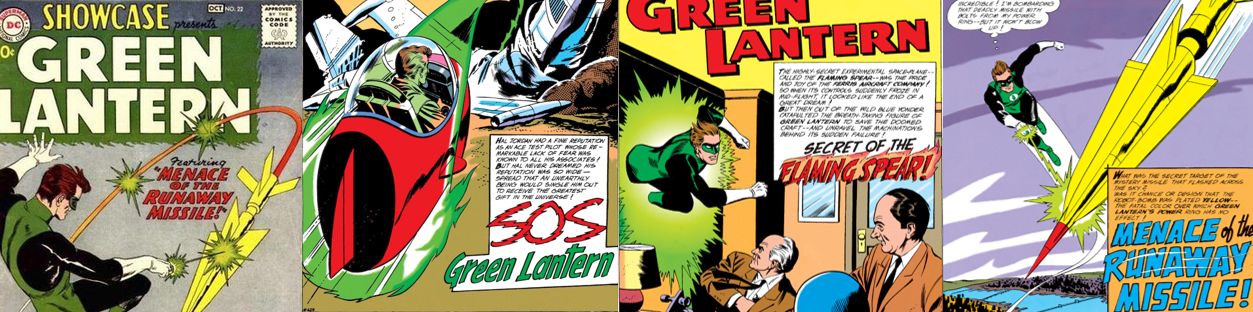
Story Titles: “S.O.S. Green Lantern”, “Secret of the Flaming Spear”, and “Menace of the Runaway Missile”
Published: October 1959
Writer: John Broome
Artist: Gil Kane
The Background:
In July 1940, Martin Nodell and Bill Finger introduced readers of All-American Comics to Alan Scott, the very first Green Lantern. Far from an intergalactic lawman, Alan was a magically empowered railroad engineer who became a regular fixture of the title and DC Comics’ first super team, the Justice Society of America (JSA). However, after Gardner Fox, Harry Lampert, and Julius Schwartz successfully reinvented the Flash in 1956, a new green-hued superhero began operating under the codename Green Lantern in 1956. Re-envisioned as fighter pilot Harold “Hal” Jordan, the Green Lantern concept was drastically reimagined to incorporate a science-fiction slant, and Hal later became he de facto Green Lantern after the universe-shattering Crisis on Infinite Earths (Wolfman, et al, 1985 to 1986) saw Alan Scott and his teammates briefly banished from DC continuity. A hotshot pilot with an eye for the ladies, Hal fully represented the Green Lantern Corps. He opposed tyranny in all its forms, even making an enemy of his tyrannical mentor, Thaal Sinestro, helped found the Justice League of America, and even formed an unlikely partnership with liberal spokesman Oliver Queen/Green Arrow. Widely regarded as the greatest Green Lantern of all time, Hal isn’t without his flaws; his despair at seeing his hometown obliterated by Hank Henshaw/Cyborg-Superman, saw him infested by the malevolent entity Parallax and briefly become a genocidal madman before being redeemed and retaking his place as the premier Green Lantern. This reputation means that Hal is popularly the go-to character whenever Green Lantern appears outside of comics. He’s appeared in numerous videogames and cartoons, even if just to characterise other Green Lanterns, and was the main character of the much maligned live-action adaptation.
The Review:
If there’s one thing Hal Jordan is known for in his role as the greatest Green Lantern, it’s his ability to overcome great fear and this is emphasised on the first page of his first-ever story, when we’re introduced to “ace test pilot” Jordan who has a reputation for his “remarkable lack of fear”. It’s this quality that fatally wounded Green Lantern Abin Sur seeks after his spacecraft crash-lands in “Southwest U.S.A.”. Summoning the remains of his strength, the dying alien wills his Battery of Power – the titular green lantern – to seek out a worthy successor, one who is without fear, and sends an emerald-hued energy beam across the globe in search of the perfect candidate. Over at the Ferris Aircraft Company, hotshot test pilot Hal Jordan is tinkering with a “flightless trainer” (presumably some kind of simulator to train space pilots) when he and the craft and bathed in a green glow and, to his astonishment, blasted away at high speed to Abin’s crash site. There, Hal is momentarily stunned to behold the purple-skinned alien, who telepathically welcomes him and begs that he listen to his instructions for the green lantern, which is a weapon against injustice utilised by space-patrolmen across the galaxy. Although Hal is eager to help Abin and save his life, the alien waves off his concerns, accepting the inevitability of his death, and confirms that the lantern chose a worthy successor.
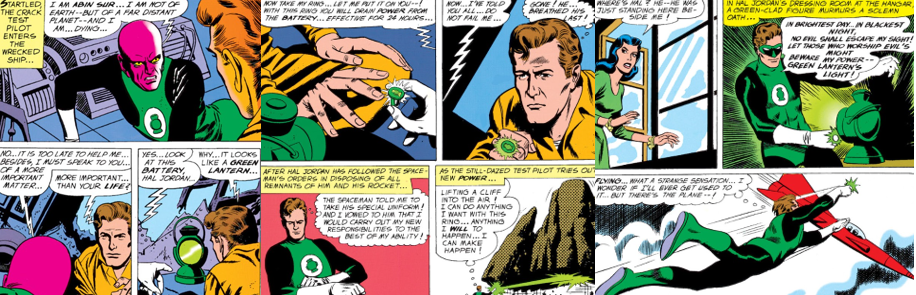
Abin then uses what little time he has left to share how his ship was unexpectedly battered by Earth’s radiation bands and he was momentarily blinded and left powerless by the flashing yellow lights. He goes on to relate that, for all the green lantern’s great power, it contains an “impurity” that renders it useless against anything tinted yellow, and that the power ring that channels the green lantern’s awesome might must be charged every twenty-four hours. Abin then hands Hal his ring, begs him to carry on the good fight, and promptly dies, much to Hal’s sorrow. On Abin’s instruction, Hal takes the alien’s slick, form-fitting uniform, tests the ring’s power by wiling a nearby cliff into the air, and vows to oppose evil in all its forms as Green Lantern. The issue’s next story, “Secret of the Flaming Spear”, introduces us to Carol Ferris, daughter of Carl Ferris, and Hal’s boss. Although she doesn’t approve of Hal’s tardiness, she’s more than wiling to go on a date with him, but their intimacy is cut short when pilot Frank Nichols suddenly calls in an S.O.S. when the controls of his experimental plane, the titular Flaming Spear, seize up on him. Feeling partially responsible since Frank’s only up there due to him being unavailable, and realising he has the power to intervene, Hal ditches Carol and utters a sacred oath before the green lantern: “In brightest day, in blackest night, no evil shall escape my sight. Let those who worship evil’s might beware my power… Green Lantern’s light!” Fully empowered, Hal takes to the skies as Green Lantern through sheer fore of will (noting how strange it is to fly without a plane) and easily guides Frank to safety using a burst of energy from his power ring.
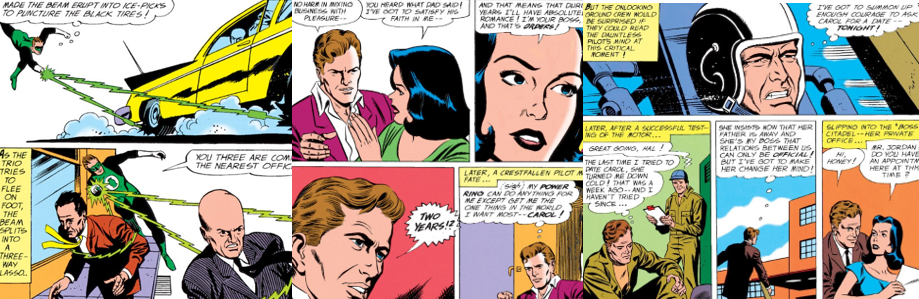
However, on closer inspection of the Flaming Spear, Green Lantern realises that the incident was no accident. Radiation caused the controls to freeze, so Green Lantern uses his ring to follow the lingering radiation to its source, a group of saboteurs holed up in a house not far off. Like his predecessor, Green Lantern phases through the wall of their hideout and confronts them, intercepting their bullets in mid-air but being briefly knocked out when the lead saboteur tosses a yellow lamp at his face. His pride hurt more than his body, Green Lantern recovers and chases after them, only to find they’re making a getaway in a yellow car. Although Green Lantern can’t affect the car directly, he does burst the tyres by conjuring hard-light ice picks with his power ring, wrangling the saboteurs with energy lassos so they can be apprehended by the authorities. When Hal returns to Ferris Aircraft, he finds Carl and Carol delighted at Green Lantern’s actions and that Carl is planning to take a two year leave of absence to go travelling, during which time he officially names Carol as his worthy successor. Carol takes the promotion very seriously, immediately shutting down any romantic involvement with Hal and leaving him to ponder the quandary that his ring can perform any miracle…except win the heart of his love interest. This irony continues in the final story, “Menace of the Runaway Missile”, where Hal wows his colleagues with his fearless testing of a rocket-sled. While Hal has the bravery to endure the intense speed and g-force of the sled, he struggles to find the courage to ask Carol out, especially after she knocked him back. He decides the best way to win her over is to invade her personal space, call her “Honey”, and be overly pushy in asking her out to dinner. Carol maintains her cold demeanour, however, and not only rejects him but also states she has a more pressing appointment at the charity ball, an event with an exclusive guest list that doesn’t include a nobody like Hal.
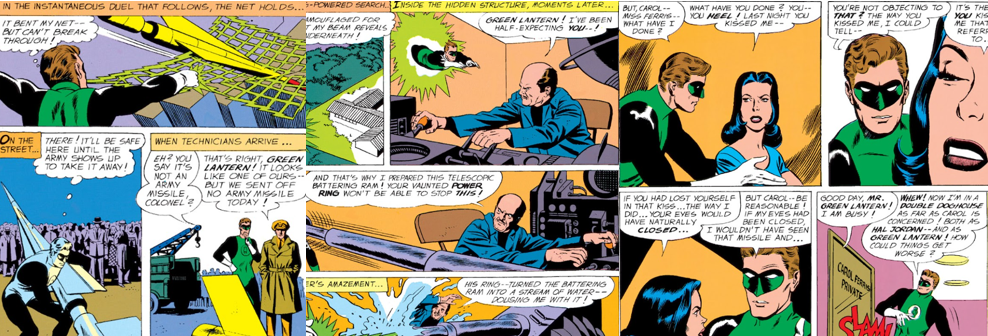
However, Carol lets slip that the mysterious Green Lantern is invited to the ball, so Hal decides that Carol is going to go on a date with him whether she’s aware of it or not. He attends the ball as Green Lantern and spends the whole night dancing with Carol, much to her excitement. Ironically, Carol’s thoughts reveal that she did harbour feelings for Hal and thought they would end up together, but the masked enigma has got her heart skipping a beat and, when Green Lantern leans in for a kiss, she responds eagerly, completely smitten. Unfortunately, at that exact moment, a yellow-hued missile comes baring down on Coast City, catching Green Lantern’s eye and forcing him to abandon Carol mid-kiss, much to her outrage. Upon inspecting the titular runaway missile, Green Lantern discovers it’s armed with an atomic warhead, but he’s unable to stop it because his ring is powerless against yellow. Conveniently, however, the missile’s tip is red, so Green Lantern constructs an elaborate net to catch the missile, which an Army Colonel informs him is not U.S. Army property nor does it contain the deadly payload Hal suspected. The two deduce that the missile’s true target was a hydrogen facility, so Green Lantern questions local aircraft spotters to find the source of the attack, an elaborate facility concealed by a forest. Phasing inside, Green Lantern confronts the man responsible, the maniacal Doctor Parris, who’s amazed when the Ring-slinger turns his high-powered battering ram into water and collars him without breaking a sweat. A lengthy interrogation from the Colonel reveals that Dr. Parris allowed ambition to overpower his reason. Desperate to harness the secret of “H-Power” first, he sought to eliminate his competition, only to now be faced with a lengthy jail sentence. Green Lantern’s victory is short lived, however, as Carol spurns him for not “losing himself” to their kiss, accusing him of not being as into the moment as she was, meaning both Hal’s identities are left in the doghouse by the issue’s end!
The Summary:
Showcase #22 doesn’t waste any time when it comes to telling Hal’s origin. Alan Scott’s origin story was longer than Hal’s, the bulk of which is taken up by exposition from Abin Sur as he delivers a soliloquy about the green lantern, its limitations, and his expectations for his successor. Unlike later revisions of Hal’s origin, there is no lengthy montage of Hal training with the Green Lantern Corps to be found here. Indeed, there’s barely a mention of the peacekeeping space cops to be found here, and Hal’s place in the grand scheme of the universe is largely cast aside the moment Abin Sur dies as Hal commits to defend Earth from evil, rather than the universe. It’s interesting, then, that John Broome and Gil Kane chose to so radically alter the nature of the Green Lantern for this revision. They lean more towards the science-fiction aspects of the character, but don’t commit to it, meaning we get no space-faring action here and everything is very grounded, which is a shame as I think one of these stories could’ve explored that. Thus, it’s fitting that I compared Hal to Alan in their shared methods of entering buildings with their phasing ability as Showcase #22 is essentially a retelling of Alan’s origin but expanded upon and tweaked here and there. Rather than the Green Flame informing Alan of his abilities, it’s Abin Sur telepathically giving Hal a crash course on the lantern; both channel the lantern’s power through a ring, the lantern comes from space, and the power is fuelled by both willpower and a twenty-four-hour charge limit. Hal also tests the ring’s abilities in similar ways, flying and phasing at will, but expands upon this by conjuring hard-light constructs, immediately demonstrating his greater degree of creativity compared to Alan, though Hal also has an equally arbitrary and ridiculous weakness. At least Showcase #22 makes a partial effort to explain the yellow impurity as an inherent flaw in the power battery. This would, of course, be elaborated upon to a dramatic degree decades later, but it’s just as illogical a weakness as Alan’s vulnerability to wood and leads to absurd scenarios where this all-powerful space cop is felled by a lamp or powerless against anything remotely yellow, which I guess is supposed to say something about the infallibility of even great cosmic power and the ingenuity of the Green Lanterns, but it just looks a bit silly, especially here.
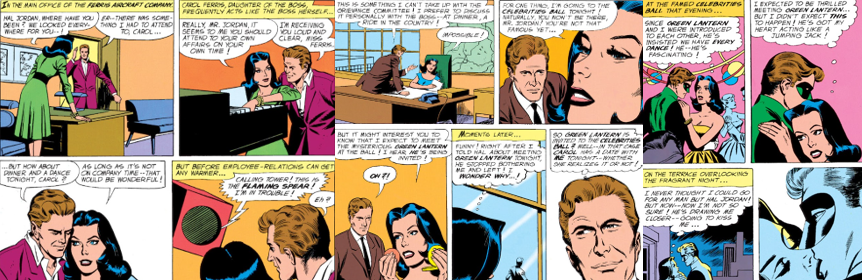
Although Showcase #22 doesn’t include any supervillains, or even Hal’s mentor-turned-villain Sinestro, and little in the way of a physical challenge for Hal, it does introduce many elements that became synonymous with the character. Chief among these are his reputation for being fearless, his vaulted skill as a test pilot and the arrogance and unreliability that comes with this, and his love interest, Carol Ferris. An independent and strong-willed woman, Carol doesn’t make life easy for Hal. She makes him work for her affections, expecting better from him at work and as a man, but immediately puts an end to any inappropriate flirtations once she’s promoted. Hal’s pursuit of Carol seems a bit undercooked here; his interest in her seems purely based on her looks and appeal as an authority figure since he never mentions anything he likes about her personality. Carol seems equally shallow in her reluctant attraction towards him, basically being interested purely because there’s no one better around, especially at work. Just as I was beginning to admire Carol’s no-nonsense attitude, she does a complete turnaround into full lovelorn Lois Lane the moment she’s face-to-face with Green Lantern. Excited by the masked man’s mystery, she melts into his arms and gives in to the allure, only to turn on him because his eyes weren’t closed during their kiss! The romance between the two, and the shaky attempt at a love triangle, feels tacked on and cheap. I definitely think it would’ve been better if Hal simply admired Carol for her strong will, feistiness, and no-nonsense attitude, with him only developing feelings for her during the ball and Carol’s inner monologue revealing that she secretly does want Hal, but is torn between her duty to her father and her heart, and is feeling conflicted since Green Lantern is so enigmatic.
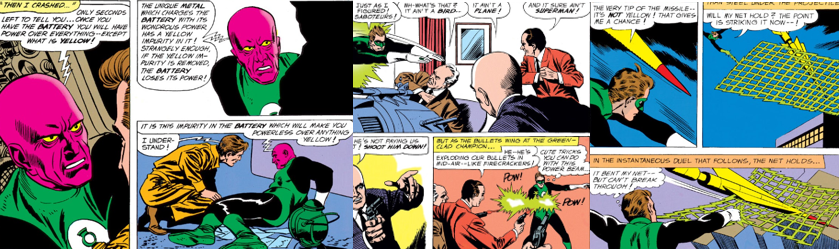
As I mentioned, it’s a bit of a shame that Showcase #22 doesn’t do more with its revised concept for Green Lantern. The origin is different, now firmly rooted in space and including aliens, the costume is way better (even with the useless domino mask), and we of course get the iconic Green Lantern oath and more creativity with the ring’s abilities, but it all feels a bit wasted as the stories are stuck on Earth. Hal isn’t facing anything more challenging than saboteurs and jealous scientists, who only cause him troubles because they just happen to utilise yellow in their schemes. If the lamp, car, and missile had been any other colour, Green Lantern would’ve neutralised these threats even faster, meaning the yellow impurity is simply a contrivance that honestly makes Hal look like an idiot as much as it showcases his adaptability. Hal definitely has to think a little outside the box on two occasions to stop the saboteurs getting away and halt the runaway missile, but apprehending Dr. Parris is a cakewalk for him since there’s no yellow involved, meaning Hal’s greatest obstacles in these stories come from his civilian life and his pursuit of Carol. This could be an intriguing aspect, showing that this all-powerful superhero is powerless in matters of the heart, were it not for how down-right creepy Hal acts towards Carol in “Menace of the Runaway Missile”. He’s a pushy, insistent, misogynist who won’t take “no” for an answer, and even plots to mislead Carol into going on a date with him by wooing her as Green Lantern. The worst part is that this works, completely ruining Carol’s formally forth-right character and turning her into another Lois Lane, and really doesn’t make Hal a very appealing protagonist as he’s just so brash and arrogant whenever he puts the “moves” on Carol. I was very surprised by this, and it did spoil the remainder of the issue, which features some bright, colourful art and makes Green Lantern immediately more visually interesting than his predecessor. I’ve never been a fan of Hal Jordan, though, and his debut issue didn’t do much to change that, casting him as a fearless flyboy whose questionable pursuit of Carol clashes with his righteous battle against evil, which was as disappointing to see as the lack of space-based action.
My Rating:
Could Be Better
Have you ever read Hal Jordan’s debut issue? What did you think to the revisions made to the Green Lantern mythos? Were you surprised by how pushy Hal was towards Carol? Would you have liked to see at least one of these stories be set in space? What are some of your favourite Hal Jordan stories and where does he rank for you in the Green Lantern hierarchy? How are you celebrating Green Lantern this month? Whatever you think about Hal Jordan, and the Green Lantern Corps, leave them down below and be sure to check out my other Green Lantern content.




 Dr. K's Waiting Room
You must be logged in to post a comment.