Although February 2014 was dubbed “Green Lantern Day” (because, by the American calendar, the date read as “2814”, the sector of space assigned to Earth in DC Comics), the significance of this date has passed as the years have changed. Instead, as perhaps the most popular iteration of the character, Hal Jordan, first appeared in October of 1959, I’ve been dedicating every Sunday of October to the Green Lantern Corps!

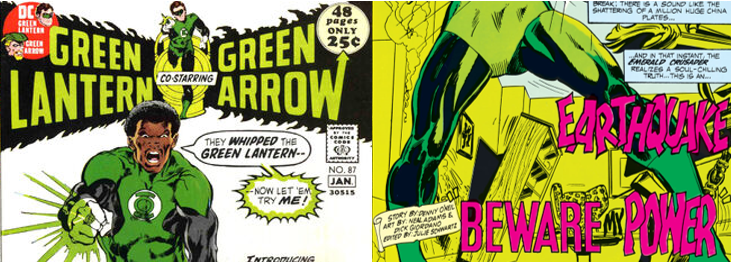
Story Title: “Beware My Power!”
Published: January 1972
Writer: Dennis O’Neil
Artist: Neal Adams
The Background:
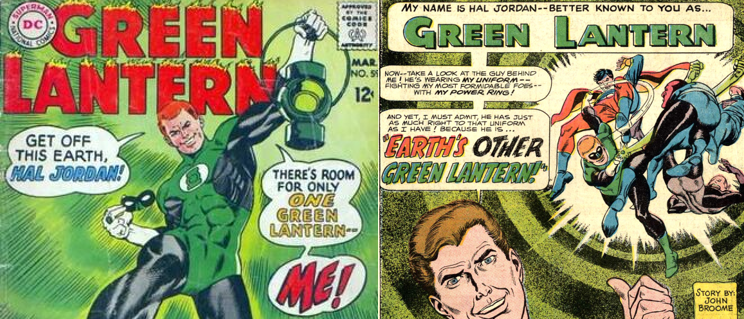
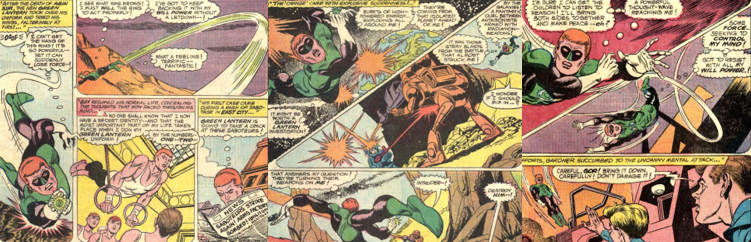
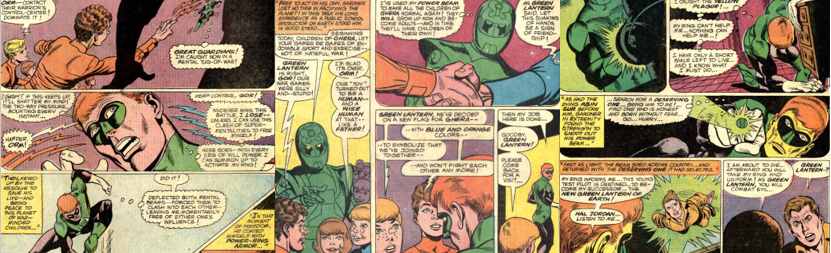
Initially presented as magically empowered railroad engineer Alan Scott, Martin Nodell and Bill Finger’s colourful Green Lantern was significantly reinvented by writer John Broome and artist Gil Kane in 1959, becoming a more science-fiction-oriented superhero. Almost ten years later, Groome and Kane planted the seeds for a diverse peacekeeping force, a Green Lantern Corps, with the introduction of Guy Gardner, a volatile individual who acted as a backup to Harold “Hal” Jordan, popularly known as the greatest Green Lantern of all time. Arguably, however, many fans are more familiar with military-minded John Stewart as Earth’s go-to Green Lantern, particularly after his inclusion in the popular Justice League cartoons (2001 to 2004; 2004 to 2006). Created by Neal Adams, who favoured shelving Guy Gardner for an African-American Green Lantern, John was originally depicted as a belligerent architect whose methods and sensibilities clashed widely with Hal’s, and famously refused to hide his identity. John was later retconned to be a former United States Marine, a change that would come to define his character, and became burdened by guilt after accidentally committing genocide. In addition to serving on the Justice League, John became the first mortal Guardian of the Universe, was one of the rare male members of the Star Sapphires, and has prominently featured in DC adaptations, appearing as a skin for Green Lantern in multiple videogames and very nearly making it to live-action on more than one occasion.
The Review:
Things get off to a dramatic start here as an earthquake rocks Southern California just as Hal Jordan is charging up his ring. Although the tremors are brief and have cause only minor damage, Green Lantern swoops over the city to help out where he can, do-gooder that he is. And he’s not the only one; outside the city, the quake has wrecked a bridge and sees little Suzie teetering over a fatal drop. Luckily, Guy Gardner is on hand to help talk her down, but the poor girl’s so terrified that she’s rooted to the spot. With the remains of the bridge unstable and a plummet into the canyon awaiting them both, Guy makes a desperate run for the girl just as Green Lantern arrives to help. Hal shows up just in time to see Guy get smashed by a bus(!) as the section collapses, rescuing them both from the fall but grieved to see that Guy was critically injured from the impact. When doctors at a local hospital inform Green Lantern that Guy should fully recover in six months’ time, Hal is left dejected. Since Guy has been pegged as his successor, Hal has been relying on him taking over if his personal issues become too overwhelming. Luckily, one of the enigmatic and all-power Guardians of the Universe senses Hal’s anxiety and, aware of the situation, suggests that a new substitute be picked in case the worst should happen. Hal agrees and the Guardian takes him to meet his new replacement in the last place Hal expected to go: an urban ghetto.
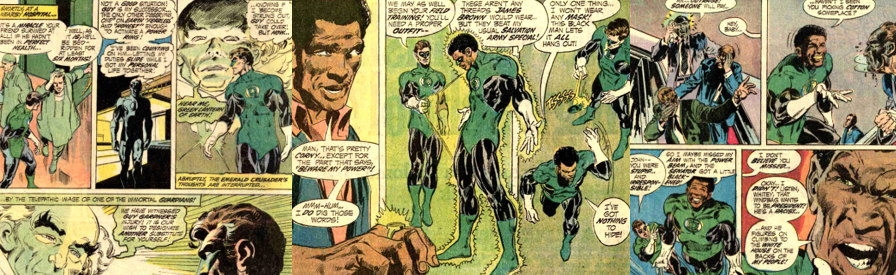
There, we’re introduced to John Stewart in a way that perfectly encapsulates his alternative sensibilities. When a police officer threatens two Black youths with disciplinary action for playing dominoes on the pavement, John intervenes, questioning his authority and calling the cop out on his obvious racism. Hal, however, is unimpressed (though not, as the Guardian suggests, because he’s equally prejudiced) by John’s apparent ego. Though he disagrees with the choice, Hal agrees to approach John as Green Lantern and offer him the position as his backup and John, who’s struggled to find work as an architect because of his race, readily agrees to the opportunity to shake off his reputation as a “square” as a superhero, jokingly suggesting he change his name to “Black Lantern”. Thus, Green Lantern (who doesn’t reveal his true identity to John) begins teaching John about the powers and limitations of the power battery and the ring. Hal teaches John the Green Lantern oath (which he finds “corny”), reminds him to charge his ring every twenty-four hours, and temporarily empowers John with his own Green Lantern uniform so they can begin field training, John, however, refuses to hide his identity behind a mask. He also takes to his training like a natural, mastering the ring easier than avoiding muggers and bigots, and is quickly given the chance to put his skills to the test when they spot an out of control fuel tanker heading towards a crowd at the airport. Although they succeed, Hal is enraged when John purposely causes Senator Jeremiah Clutcher to receive a face full of oil, giving John the chance to insult him with a racist quip. John, however, justifies his actions since Clutcher is a known racist who openly oppresses John’s people in his bid to become President of the United States.
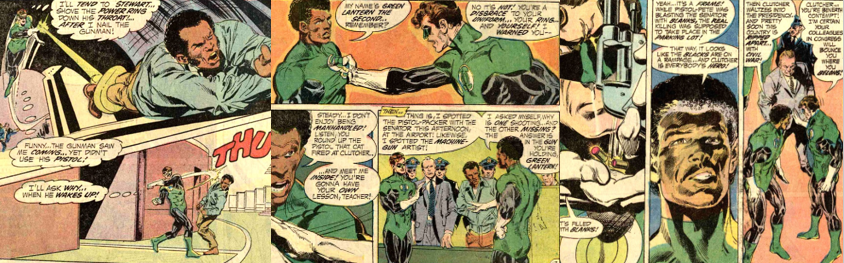
Hal chastises John and, to teach him a lesson, orders him to guard Clutcher from reprisals; he also objects to being called “Whitey”, especially considering John’s so pent-up about racism. Later, Clutcher makes an impassioned speech to his supporters, openly mocking “The Darkies” and accusing them of being of lesser intelligence, which only further raises John’s ire. Although Hal doesn’t approve of Clutcher’s insensitive attitudes, he’s so strait-laced that he believes the senator has the God-given right to free speech, meaning he leaps into action when a Black man suddenly shoots at Clutcher during his tirade while John refuses to get involved. Hal quickly tackles the gunmen, noting that the assassin never tried to put up a fight, while John subdues a White gunman outside the stadium. Hal reprimands John for his prejudice, accusing him of bringing disgrace to his uniform, but John simply shrugs him off and teaches Hal a lesson of his own: he spotted both gunmen at the airport and was suspicious to note that one was shooting and the other was missing. Hal’s stunned to learn that the Black man’s gun was filled with blanks as part of an elaborate frame. The Black man was a patsy, setup to make it look like the “Blacks are on a rampage” and winning Clutcher the Presidency at the cost of an all-out civil war. Hal condemns the senator’s actions and is impressed by John’s deductive reasoning. Hal still has apprehensions about John’s methods and style, but the content architect simply brushes it off and the two seem to finish the story with a mutual respect for each other.
The Summary:
First and foremost, I have to praise the stunning artwork of the late, great Neal Adams. Adams first came to my attention when I read Batman annuals as a kid and I’ve always loved his bold, kinetic, square-jawed depictions of DC’s superheroes. He brings Hal and John to life in such a dynamic way, depicting them as lean, muscular heroes and giving a fluidity to their actions, and it’s always a joy to see his art on the page. Sadly, the scans I’m reading don’t do the art justice. The colours are muted, messy, and robbed of their “pop”, though this does give “Beware My Power” a bit of a dark edge to it that is reflected in the nature of the plot. Next, I have to comment on Guy Gardner. While he tries to help a girl endangered by the earthquake, he’s unceremoniously taken out when a bus smashes into him, leaving him bedridden like a chump. This element was so random, so unnecessarily over the top, that it may as well have killed Guy (and, realistically, should’ve) since it was a pretty extreme and unintentionally hilarious way to put him on the shelf. It was also weird that Hal’s concern was less for Guy’s welfare and more for his own. His entire concern is on what will happen to him and the Green Lantern mantle if he’s unable to perform his duties and less on how the injuries will impact Guy’s future. It’s pretty selfish, if I’m honest, and does as little to endear me towards the “greatest Green Lantern” as his unwavering commitment to the concepts such as authority and free speech.
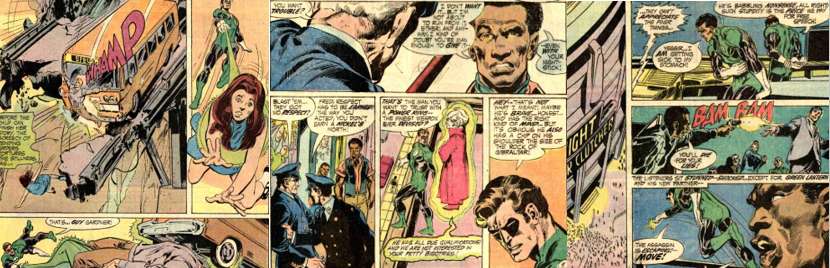
This means he naturally clashes with John Stewart. While John admittedly has a chip on his shoulder and is overly suspicious of authority figures, he has every right to be since he’s an out of work Black man struggling to make a living in the ghetto and facing unfair persecution wherever he goes simply for the colour of his skin. His attitude might be confrontational, and he might ruffle Hal’s feathers with his cavalier nature, but John’s entirely justified since the story depicts a cop persecuting young Blacks for no justifiable reason and then paints Senator Clutcher as such an exaggerated racist bastard that it’s almost comical. Of course, this is probably truer to reality at the time than we realise. The segregation and public dismissal of Blacks was commonplace and African-Americans had every right to take issue with it. Unlike many of them, John is given the power to affect real change when he agrees to become Hal’s backup Green Lantern. He easily masters the ring (potentially because of his creativity as an architect but also because of the strong sense of injustice he feels) and immediately clashes with Hal in his approach towards using his power. While Hal obviously doesn’t agree with racism, he’s a stickler for the rules and believes everyone should have basic human rights, even dirty scum like Clutcher, so he constantly reprimands John, who frankly doesn’t give a shit about Hal’s opinion. Being a product of the 1970s, the story naturally infuses John’s dialect with a bit too cliché “Jive talk” for my tastes, but it instantly gives him more personality than Guy; as does his refusal to wear a mask, his confrontational behaviour, and his unique look. Consequently, I’d definitely say John makes a better first impression than Guy, Hal, or even Alan. While they were all quite bland and cookie cutter in the debuts, John is bold and outspoken. He might be a bit of a hypocrite at times (he exhibits the same prejudices towards Whites as he receives from them) and in need of some seasoning, but his introduction was the shake-up the book needed at the time and I’d go as far as to say that both Guy and Hal should’ve been taken out by that bus so the Guardian could’ve empowered John to take over the comic!
My Rating:
Pretty Good
Did you enjoy John Stewart’s debut story? What did you think to his characterisation and the personality clash between him and Hal? Were you as unimpressed by Guy’s accident as I was? What did you think to the racism angle threaded throughout this story? Do you think John was justified in his actions or do you think he needed tempering a little to approach things more diplomatically? Where does John rank in the Green Lantern hierarchy for you and what are some of your favourite stories and moments of his? How are you celebrating Green Lantern this month? I’d love to hear your thoughts on John Stewart so leave them below, and go check out my other Green Lantern content across the site!


 Dr. K's Waiting Room
You must be logged in to post a comment.