Screen Time [Doctor Who Day]: The Day of the Doctor


On this day, the 23rd of November, in 1963, the longest-running and most successful science-fiction television series ever, Doctor Who, first aired on BBC One in the United Kingdom. Since then, the rogue Time Lord has gone through numerous incarnations and is widely celebrated as one of the most iconic and recognisable mainstream cultural icons in the world.


50th Anniversary Special:
The Day of the Doctor

Air Date: 23 November 2013
UK Network: BBC One
Stars: Matt Smith, David Tennant, John Hurt, Jenna Coleman, Jemma Redgrave, Ingrid Oliver, and Billie Piper

The Background:
In 1963, the BBC’s Head of Drama, Sydney Newman, commissioned a show that would appeal to be children and adults alike to fill a gap in the BBC’s schedule, one eventually outlined by writer Cecil Webber. The result was Doctor Who, a long-running science-fiction franchise in which a time travelling alien delighted audiences with historical hijinks, battles against terrifying cybernetic aliens, and emotionally charged morality tales. Save for a hiatus in the 1990s, Doctor Who has been a BBC staple for decades, with various actors stepping into the role thanks to the character’s unique ability to “regenerate” when dying. While debates rage about who is the best Doctor, two names often top the rankings: Tom Baker and David Tennent. After five years as the popular Tenth Doctor, Tennent finally passed the torch to Matt Smith, who won over audiences with his youthful exuberance. However, in the style of his predecessors, Tennent returned to the role for this 50th anniversary, reuniting with co-star Billie Piper (though in a dramatically different role). Tennent and Smith joined legendary actor John Hurt, who readily agreed to join the show and had been previously teased as a forgotten incarnation of the Doctor earlier that year. Accompanied by a short cinema release and two short tie-in episodes, The Day of the Doctor was simultaneously broadcasted in 94 countries to avoid plot leaks and met with critical acclaim. Reviews loved the chemistry between the three Doctors and its celebration of the show’s rich history, though the Zygon sub-plot and the handling of the War Doctor was criticised.

The Plot:
A Zygon plot to destroy London sees the Eleventh (Smith) and Tenth (Tennant) Doctors crossing paths with their former renegade incarnation (Hurt). Together, they reconcile their past by revisiting the last days of the Time War between the Time Lords and the Daleks.

The Review:
The Day of the Doctor takes place during a pretty tumultuous time in the Eleventh Doctor’s life. Most of Matt Smith’s run focused on the Doctor’s ultimate end, a seemingly unavoidable fate that would one day see him buried within his own embiggened TARDIS on the barren wasteland known as Trenzalore. Despite being fully aware of the finality of this inevitability, the Eleventh Doctor continues to be his usual energetic self, a quality I really came to enjoy about Matt Smith’s portrayal and one that juxtaposed his youthful appearance and childlike enthusiasm with a haunted, sombre, aged demeanour at times, both aspects of his personality that are exhibited in this 50th anniversary special. Indeed, the Eleventh Doctor is excited to be heading to the National Gallery with one of his most beautiful and charismatic companions, Clara Oswald (Coleman). He is summoned there by the Unified Intelligence Taskforce (UNIT) and meeting with Kate Lethbridge-Stewart (Redgrave), daughter of the Doctor’s old military correspondent Brigadier Alistair Lethbridge-Stewart (Nicholas Courtney, represented through archival pictures). The Eleventh Doctor relishes his impromptu helicopter ride over London and showing off his status amongst the UNIT personnel to Clara (who, despite having wandered through all of the Doctor’s lives, had no knowledge of his past ties to UNIT). Kate shows the Doctor a mysterious painting he knows all-too-well, a graphical depiction of the last day of the Time War; specifically, the fall of Arcadia and the day the Doctor, in a previous, hitherto unknown incarnation, personally ended the conflict. Since Doctor Who returned in 2005, the mystery of the Time War and the impact it had on the Doctor had been hanging over the show, and his demeanour, like a dark cloud. Burdened by guilt and scarred by the atrocities of war, many of which he perpetrated, the Doctor has effectively been running from his past for years now, but The Day of the Doctor forces him to confront in ways he never imagined.

A middling Zygon invasion proves the catalyst for a cathartic multi-Doctor adventure.

The main plot of the special revolves around, of all things, the Zygons. These monstrous shapeshifters try to conquer the Earth by subduing and replacing key figures in human history. One of their earliest efforts occurs back in 1562, when a Zygon attempted to replace Queen Elizabeth I (Joanna Page). Luckily, Queen Elizabeth was swept up in a whirlwind romance with the Tenth Doctor at the time, though even his cobbled together technology, intuition, and previous experience with the Zygons proves largely incapable of detected the Zygon threat. Time and again, both he and his successor fail to spot who’s a Zygon and who isn’t, leading to the Tenth Doctor putting his foot in it when he accuses the real Queen Elizabeth of being a bad fake. Luckily for him, he’s a dishy time traveller and she’s more amused by his incompetence than annoyed by his accusations. She also proves more capable than he is, fooling the other Zygons with her own impersonation skills (though, to be fair, he was distracted by his other incarnations). In the Eleventh Doctor’s time, the Zygons impersonate Kate and UNIT staff like Petronella Osgood (Oliver) to access the “Black Archive”, a super-secret vault deep within the TARDIS-proofed Tower of London that provides the Zygons with the means to take over London. Of all the threats to bring three incarnations of the Doctor together, the Zygons are disappointingly weak. They’re clunky, awkward creatures and this B-plot merely serves to unite the bickering Doctors and provide them the inspiration for saving their people. The Zygons have been using Time Lord technology to freeze themselves in paintings and covertly invade other worlds, technology that the Doctors use to briefly revisit the Time War and to travel back to the present day to force the humans and Zygons into an amicable truce rather than mutual destruction. They’re not a very compelling enemy (the Sontarans would’ve been much better), though they are defeated in an interesting way (the Doctors force both groups to temporarily forget which species they are). Naturally, the Daleks do appear, but merely as a cameo and purely in sequences depicting the chaotic Time War, where their power was at their mightiest and their thirst of victory was matched by the Time Lords.

The forgotten War Doctor sees how his decisions will shape the men he will become.

The Day of the Doctor firmly explains that, during the Time War, the Doctor took on a new face and forsook his name and title. Dubbed “The War Doctor”, this new incarnation fought a ruthless battle against his mortal foe for untold generations. The very nature of the Time War meant it existed in perpetuity, with victories, loss, deaths, and resurrections all happening at once. Finally, after an age of nonstop violence, the War Doctor decided he had had enough. Now aged to an old, battle-weary warrior, he took it upon himself to end the bloody conflict the only way he knew how. Thus, he broke into Gallifrey’s weapons facility and stole a doomsday weapon so destructive even their military General (Ken Bones) was afraid of it. A strangely archaic cube of cogs, the “Moment” can wipe out entire universes and is powered by a sentient artificial intelligence. Taking the form of a figure it knows is (or will be) important to the Doctor, the “Bad Wolf” (Piper), it questions the War Doctor’s motivation and, in a bid to show him what wiping out every single man, woman, child, and Dalek, will do to him, conjures a time vortex to show him his future selves. Honestly, I was never a fan of the War Doctor concept; I would’ve much preferred Paul McGann or Christopher Eccleston returned to portray this role rather than retroactively bump up the Doctor’s incarnations. However, you can’t go wrong with John Hurt and he portrays this forgotten, reviled incarnation with gusto. Despite being beaten down by war and technically being younger than his counterparts, the War Doctor is a cantankerous, grandfatherly figure who initially admonishes his successors’ buffoonery. He’s stunned that they don’t seem to take anything seriously or treat their equipment with respect and, much like the First Doctor (William Hartnell) in the first multi-Doctor special, is portrayed as the more authoritarian and sensible of the three despite being at least 400 years younger than them.
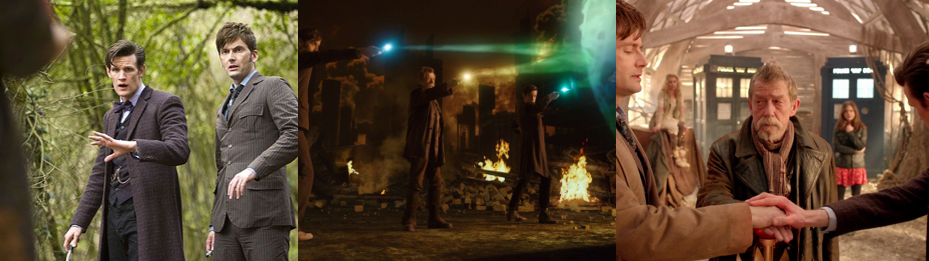
The Tenth and Eleventh Doctors are forced to confront, and embrace, their violent past.

The Tenth and Eleventh Doctor are horrified to see their renegade incarnation, treating him as a dangerous, almost bogeyman-like figure from their past that they’ve buried deep at the back of their minds. Prompted by the Moment, the War Doctor asks pertinent questions to understand how committing genocide will affect him and learns that the Tenth Doctor was haunted by the decision and the Eleventh has tried to move on and forget about it. The Tenth is outraged at such a suggestion, stunned to find his future self has gotten over the worst decision they ever made, but it’s clear that the Tenth Doctor is still tormented by his past and simply trying to find a productive way forward. While they take an instant dislike to each other (the Tenth Doctor hates his successor’s new TARDIS interior, as is tradition), the Tenth and the Eleventh Doctor have a lot in common. Both favour spectacles, suits, and being more flamboyant with their sonic screwdrivers, eschewing the War Doctor’s more practical and scientific approach for a dramatic flair. The Eleventh Doctor is largely critical of his predecessor’s more theatrical approach, especially his way with women, while the Tenth Doctor criticises his successor’s dress sense (particularly the fez). The two bicker here and there but mostly engage in a game of one-upmanship, comparing their sonic screwdrivers and competing to see who can solve problems faster, with both being trumped by the War Doctor’s more measured approach. Hardened by their past experiences and desperate to keep Kate from making the same mistakes, the two intervene to reach a more amicable solution and the War Doctor sees that his decision, while horrendous, will save countless lives since his future incarnations try to atone for their past. Their adventure together sees the Tenth and Eleventh Doctor embrace their forgotten counterpart and, in a bid to help the War Doctor face his decision, they willingly join him in activating the machine, only for Clara’s distraught reaction to show them they can come up with a better solution.

The Doctors’ desperate plan sees Gallifrey saved and their pain eased as a result.

Inspired by their solution to have their sonic screwdrivers calculate a formula to vaporise a door (a plan amusingly foiled when Clara reveals their cell was never locked!), the Doctors use their TARDISes to collude with all twelve thirteen of their other incarnations to utilise the Zygon picture-hopping technique and shift Gallifrey to, essentially, a pocket dimension, destroying the Daleks in the process. While the General initially resists since it would mean the Time Lords are trapped in another dimension, he relents since it means the survival of their race and the Thirteen Doctors co-ordinate their TARDISes to execute the plan, sparing Gallifrey and undoing the Doctor’s darkest moment. Unfortunately, due to the unstable timelines, none of the three will remember this and the War Doctor resigns himself to having to live thinking he committed genocide, knowing he’s earned his title once more and that he’ll be succeeded by such fine men and welcoming his regeneration into the Ninth Doctor (Christopher Eccleston). The Tenth Doctor also urges the Eleventh Doctor to find a solution to their impending demise at Trenzalore, reasoning that their actions in this adventure prove they can always find some way out. Left to ruminate over the depiction of Gallifrey’s last stand, the Eleventh Doctor is visited by a strangely familiar curator (Tom Baker), who hints both that he’s a future incarnation and that the Doctor’s next journey will see him trying to recover his lost people. Of course, The Day of the Doctor was also accompanied by two short tie-ins. While “The Last Day” (Stone, 2013) isn’t that great and weirdly depicts a first-person account of the Daleks’ invasion of Arcadia, “The Night of the Doctor” (Hayes, 2013) saw the long-awaited return of perhaps the most underappreciated Doctor, the Eighth (Paul McGann), and showed how he regenerated into the War Doctor. After failing to save a doomed pilot since the Time Lords are as reviled as the Daleks, the Eighth Doctor is offered a chance to regenerate into a warrior by Ohila (Clare Higgins) of the Sisterhood of Karn, forsaking his name and passive ways in favour of a new form more fitting for a violent war.
The Summary:
As you’d expect from a 50th anniversary special, The Day of the Doctor contains a fair few Easter Eggs and references for long-time series fans. The opening, for example, is basically a shot-for-shot remake of the first-ever episode, An Unearthly Child (Hussein, 1963); Clara teaches at Coal Hill School; the Tenth Doctor echoes the Second Doctor (Patrick Troughton) with his “I don’t like it line”, and the General echoes the Brigadier when multiple Doctors show up. The Black Vault is full of gadgets and callbacks to previous adventures, including photos of previous companions and incidents, and much of the special refers back to the Tenth Doctor’s era. Perhaps the most exciting inclusion was the brief appearance of Peter Capaldi as the upcoming Twelfth Doctor, which was a fun tease that hadn’t been done before. All the Doctors (at that point in time, anyway) cameo in the finale thanks to archival footage and some rather disconcerting digital stand-ins, but it’s Tom Baker’s heartwarming reappearance as a possible future incarnation that steals the show at the end. Honestly, I’m surprised by the restraint, really. There could’ve been loads more lore and cameos and references stuffed in here but, instead, The Day of the Doctor wisely focuses on exploring this unknown chapter of the Doctor’s life and tying into what viewers saw with the Tenth and were currently experiencing with the Eleventh. The special is thus a story of grief, mourning, and dealing with difficult decisions. The Tenth and the Eleventh Doctor are haunted by their actions and the War Doctor is hesitant to activate the Moment but comes to see that the deaths of billions will safeguard innumerable other lives. The relief he feels when his counterparts suggest a wild, outrageous third option is palpable and all three get a sense of catharsis from undoing this one heinous act that scarred them for so many years.
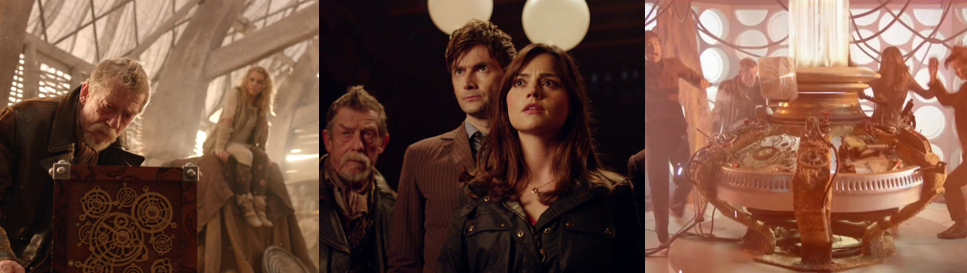
A forgotten era of the Doctor’s life is explored and his character examined in new ways.

While I’m no fan of Billy Piper and never liked her portrayal of Rose Tyler, it was nice to see her here as the Moment, an advisory, sentient AI only the War Doctor can see and hear. Through her, he meets his successors and sees that, while his actions will be traumatic for him, he’ll eventually grow beyond it and also put his lives to good use saving others as recompense. I’m not sure where the Tenth Doctor is being pulled from in his time stream but he’s a little more haggard and broken than what we usually see. He’s still cracking wise and masking his pain behind a bombastic façade, but it’s clear he’s being written to still be very raw over his actions in the Time War. In comparison, the Eleventh Doctor is just as haunted but has found more productive ways to cope. He attacks life with a youthful exuberance and delights in every adventure, determined to help whenever he can so that his dreadful actions can have some positive meaning in the universe. This makes Clara’s intervention when the three prepare to activate the Moment all the more poignant, since she never pictured “her” Doctor’s face as being responsible for so many deaths. Her presence has a positive impact on the War Doctor, too. It’s clear he hasn’t had a companion for some time and is struggling with the blood on his hands and the path that lies before him, but I enjoyed how he was this gruff old man who whipped his younger/older selves into shape. Again, I still would’ve preferred seeing the Eighth or Ninth incarnation fulfil this role just to make things less messy but the mystery surrounding the War Doctor is intriguing and I like how his counterparts are equal parts ashamed, afraid, and disgusted by him. Yet, in spending time with him and finally confronting this dark and oppressed part of their lives, they come to accept that the War Doctor was and still is a part of them and acknowledge him as a necessary evil in their long lives.

Cameos, references, and a heartfelt celebration of the series make for an enjoyable special.

The War Doctor, in turn, comes to feel vindicated and accepted for the first time in ages. Having forsaken his name and pacifist values and committed himself to war for so long, the pride he feels in being known as the Doctor once more shines through and allows him to regenerate with dignity rather than in infamy. While the Zygon subplot isn’t all that interesting and largely detracts from these more interesting narrative beats, I did like how it brought the three together. I just wonder if, maybe, looping in some kind of Dalek plot wouldn’t have been better. Like, maybe Davros (Julian Bleach) or an Emperor Dalek could’ve used the magic picture technology to escape the Time War and threaten to unravel it, spilling it into the universe once more. Sure, we wouldn’t have had the doppelgänger plot or the creative resolution to the Zygon invasion, but it might’ve been more visually and thematically interesting for the three Doctors to team up against their mortal enemy in a more explicit way for the 50th anniversary special. Still, the main selling point here is the exploration of the Time War and the War Doctor’s part in it and delving into how badly his violent actions affected him over the years. This was a constant and recurring thread in the revival series (and even cropped up in later years, especially after Gallifrey was wiped out once again!) and formed a central part of the Doctor’s character from 2005. The Day of the Doctor aims to bring him some catharsis, sewing the seeds in the Tenth Doctor to move past his actions ahead of regenerating into the Eleventh and, in this regard, it succeeds admirably. Throw in some fun cameos, entertaining interactions between the three incarnations, and a solid, emotional narrative core and you have an extremely enjoyable celebration of the long-running franchise.

My Rating:

Rating: 4 out of 5.

Great Stuff

What did you think to The Day of the Doctor? Are you a fan of multi-Doctor adventures or do you find that they’re confusing and lacklustre affairs? Is the Tenth Doctor one of your favourites? What did you think to his interactions with his counterparts? Were you disappointed that a new, unknown incarnation was created, or did you enjoy seeing John Hurt take on the role? Would you like to see more multi-Doctor adventures featuring the modern cast? How are you celebrating Doctor Who Day today? Let me know your thoughts on Doctor Who and its 50th anniversary special down in the comments and go check out my other Doctor Who reviews.

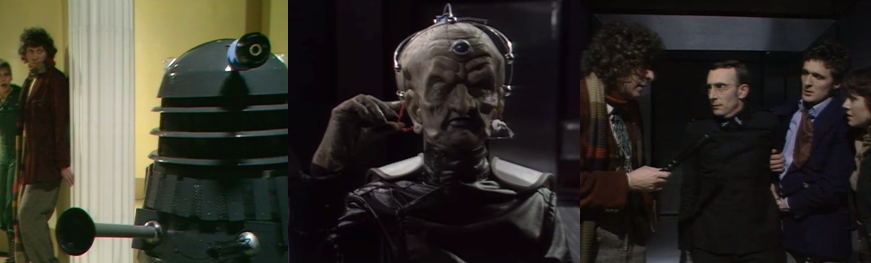
Screen Time [Doctor Who Day]: Genesis of the Daleks


On this day, the 23rd of November, in 1963, the longest-running and most successful science-fiction television series ever, Doctor Who, first aired on BBC One in the United Kingdom. Since then, the rogue Time Lord has gone through numerous incarnations, travelled throughout the entirety of the past, present, and the future, and is widely celebrated as one of the most iconic and recognisable mainstream cultural icons in the world.


Season Twelve, Serial Four: “Genesis of the Daleks”

Air Date: 8 March 1975 to 12 April 1975
UK Network: BBC One
Stars: Tom Baker, Elisabeth Sladen, Ian Marter, Michael Wisher, Peter Miles, James Garbutt, and Roy Skelton

The Background:
In 1963, Sydney Newman, the Head of Drama at the BBC, commissioned a show that would appeal to children and adults alike to fill a gap in the BBC’s schedule. Following writer Cecil Webber’s initial outline and its debut episode, a collaborative effort saw Doctor Who terrify audiences with the introduction of the Time Lord’s long-running and iconic antagonists, the Daleks. Created by Terry Nation and designed by Raymond Cusick, the Daleks went through numerous designs and were specifically created to evoke fears regarding the dangers of war and nuclear fallout, and immediately became as synonymous to the series as the Doctor as younger viewers cowered in fear behind their sofas. By 1975, the Doctor’s various incarnations had battled the genocidal pepper pots on eleven separate occasions and the show was hitting its stride thanks to the mainstream popularity of the iconic Fourth Doctor, Tom Baker. Genesis of the Daleks was Nation’s return to the series after a brief hiatus; although script editor Robert Holmes preferred to develop new monsters for the show, Nation was encouraged to explore the tyrannical race’s origin, having worked on a Dalek comic book serial in the interim. Crucially, Nation introduced the character of Davros (Wisher), creator and mastermind of the Dalek race, whom he infused with fascist ideologies to tie into producer Philip Hinchcliffe’s desire for a more atmospheric and mature production than its more juvenile predecessors. Although Genesis of the Daleks caused some controversy for its violence and darker moments, the serial has been widely lauded as one of the finest of its era, and in the entire run of the show; Davros, especially, went on to become one of the Doctor’s most iconic and persistent antagonists, and the serial galvanised the Daleks as his most fearsome foes.

The Plot:
Foreseeing a time when the malevolent Daleks (Skelton) destroy the entire universe, the Time Lords task the Doctor (Baker) to travel to the planet Skaro at the time of the Daleks’ creation. There, he and his companions find themselves in the midst of a war between the Thals and the Kaleds, led by maniacal scientist Davros, the progenitor of the Daleks and whom the Doctor must overcome.

The Review:
Genesis of the Daleks may very well be the quintessential Dalek story, and the most iconic of all the classic Doctor Who serials, not least because it stars perhaps the most famous incarnation of the Doctor, the Fourth Doctor, masterfully portrayed with maniacal glee by Tom Baker. Baker’s madcap performance, infectious grin and enthusiasm, and bonkers outfit is one of the most memorable versions of the Doctor and, for many – including myself – still the first person you think of when thinking of Doctor Who. When I was a kid, Doctor Who wasn’t on television, so my primary exposure was through the various novelisations, a handful of videogames and other adaptations, and the few brief snippets featured in documentaries and such. Strangely, my first true Doctor was the Third Doctor (Jon Pertwee), though I can’t remember exactly how or why; still, I had the novelisation and cassette version of Genesis of the Daleks and the old Dalek Attack videogame (Alternative Software, 1992) on the Amiga drew heavily from this and other Dalek serials to cement the genocidal pepper pots, and this wacky version of the Doctor, as unforgettable elements of the sci-fi series. Genesis of the Daleks takes place after the Doctor was exiled to Earth; ever the renegade, his Time Lord superiors eventually grew tired of his rebellious ways and stranded him on Earth in the 20th century in the guise of the Third Doctor, stripping him of the secrets of his craft, Time and Relative Dimension in Space (TARDIS), but this ban was lifted after the events of The Three Doctors (Mayne, 1972 to 1973), so the Doctor is understandably annoyed when he’s abducted by a Time Lord (John Franklyn-Robbins) following his adventures in The Sontaran Experiment (Bennett, 1975). The Doctor’s annoyance turns to intrigue, however, when the Time Lord tasks him with destroying (or otherwise pacifying) his most persistent enemy, the Daleks, before they can threaten all of time and space, a mission that the Doctor willingly undertakes not just to cripple his most lethal enemy but also to get the officious overlords off his back once and for all. 

The Doctor is determined to discover, and prevent, the creation of the Daleks.

Although the Doctor accepts the mission, he’s still aggravated to find that the Time Lords have taken the liberty of transporting him and his companions, Sarah Jane Smith (Sladen) and Doctor Harry Sullivan (Marter), to the Dalek home world, Skaro, a war-torn planet ravaged by conflict between the Kaleds and the Thals that has made it largely inhospitable, thus subjecting himself and his friends to considerable danger from the ongoing conflict and the lingering radiation in the air. All too soon, the Doctor and Harry are separated from Sarah Jane and imprisoned by the warmongering Kaleds, who take shelter from the toxic atmosphere in technologically advanced domes created by their horrifically crippled, but no less genius, lead scientist, Davros. Time quickly becomes the Doctor’s enemy as Davros not only prepares a coup d’état to overthrow the Kaled government and roll out his plans to irrevocably change Skaro by forcing his species to mutate into ghastly, mutant creatures that are dependent on his heavily-armed Mark III travel machine but also seizes the Doctor’s Time Ring, his only means of returning to the TARDIS once his mission is complete. The Doctor is horrified to see that the Mark III is, in fact, a prototype Dalek and to learn that Davros’s plan is already well underway, meaning he’s forced to charm the Kaled elite into opposing Davros to buy him some time. Having encountered the Daleks on numerous occasions before, the Doctor is well aware of the threat they pose but finds himself in a unique position where the Daleks have yet to become a nigh-unstoppable army, are largely confined to a laboratory, and where Davros has yet to technically commit the crime he’s being judged for. Although the Doctor threatens Davros with death, commandeering his life support functions to coerce him into destroying the Daleks, this can be interpreted as an empty threat since the Doctor’s morality is such a strong aspect of his character. This is further emphasised when the Doctor prepares to destroy the fledgling Daleks and hesitates, considering the ramifications of his actions not just because the Daleks are “innocent” but also because generations of people will be united to oppose them in the future, meaning that the Daleks, for all their evil, can inspire progress and co-operation simply through their malevolent existence. 

Unlike unremarkable Harry, Sarah inspires a revolution and encourages the Doctor to destroy the Daleks.

The Doctor and Harry are separated from Sarah for the majority of the serial; while the two are held captive in the Kaled dome, Sarah is captured by the Thals alongside Sevrin (Stephen Yardley), a “Muto” (though, aside from being dishevelled and dirty, I’m not sure what Sevrin’s mutation is supposed to be) unique among his kind as he expresses kindness and sympathy towards even the “Norms” who have long ostracised his people. Sarah, Sevrin, and the other prisoners are put to work loaded deadly munitions onto the Thal’s rocket, their trump card against the Kaleds, and find that their captors are just as ruthless and harsh as the Kaleds. Ever the proactive optimist, Sarah inspires the prisoners to make a break for it while they still have the strength, a campaign that leaves several of them dead and her and Sevrin back in Thal custody. It’s also Sarah, rather than Harry, who argues in favour of destroying the Daleks when the Doctor suffers a crisis of conscience; she pragmatically argues for genocide since that’s not only their mission but also the only way to truly stop the Daleks from spreading death and destruction across the galaxy. This exchange, perhaps one of the most memorable and character defining moments of the entire series, goes almost entirely without comment from Harry, who’s more concerned with making a decision quickly before they’re discovered. Indeed, although he acquits himself well by saving the Doctor from a landmine and holding various Kaleds hostage, and echoes the Doctor’s snarky attitude towards his captors, Harry really doesn’t do much of anything except be someone for the Doctor to talk to (which he doesn’t really need considering he’s of vital interest to the Kaleds) and spout the occasional witty remark.

Despite Davros’s commanding presence, the Doctor finds allies in each of Skaro’s warring races.

The Doctor finds other allies amongst the three warring races of Skaro; in the Kaled dome, he finds his first sympathiser in Senior Researcher Ronson (Garbutt), a man of science who is so intrigued by the existence of extraterrestrials that he saves the Doctor from certain death. Ronson is just one of many Kaleds who question Davros’s increasingly insane orders; Gharman (Dennis Chinnery) and Kavell (Tom Georgeson) are two key components of the revolution against Davros after becoming disillusioned by his orders to strip the eventual Kaled mutates of all conscience and morality. Although Kavell is reluctant to assist in opposing Davros after the mad scientist has Ronson killed as a patsy for the devastating Thal attack, he joins Gharman in leading a (mostly) bloodless revolution. Interestingly, Gharman is surprisingly reasonable; rather than seeking to assassinate Davros, he’s willing to work alongside him to rebuild their race but with an eye on morality, rather than merciless slaughter. Sadly, Gharman is all-too-trusting; when Davros’s right-hand man, Security Commander Nyder (Miles), feigns sympathy to his cause, Gharman and his other supporters first face a painful lobotomy and then are out-right executed by Davros, who takes a pitiless approach to betrayal. This is just one of many ironic and hypocritical stances for Davros since it was he who secretly colluded with the Thals to provide them with the chemical formula necessary to destroy the Kaled dome, thus obliterating much of his opposition in the Kaled council and bringing his race to the desperation of near extinction. Davros’s actions also lead to him being celebrated as a hero to the Thals since their missile strike effectively ends the thousand-year war of attrition; victory sees the Thals promise to be far more benevolent but blinds them to Davros’s obvious betrayal, leading to many of them being slaughtered by the Daleks. Still, thanks to the Doctor’s warnings, Thal soldier Bettan (Harriet Philpin) organises a small resistance comprised of both Thals and Mutos who covertly enter the Kaled bunker and seal it off in the serial’s conclusion, suggesting the promise of unification between the two races.

The Dalek threat looms over the serial, with them asserting themselves by the finale.

Although still in the prototype phase of their existence, the Daleks remain very much a threat throughout this serial; the entire plot revolves around preventing them from not only rising to power but also threatening all of time and space in the future, something the Time Lords – and the Doctor – believe is inevitable given the Daleks’ lust for power and conquest. Thus, their threat looms over Genesis of the Daleks like a black shadow; when Davros demonstrates his Mark III travel machine, the Kaleds are intrigued and have no idea of danger the machine poses, with even Ronson thinking the Doctor is mad for his horrified reactions and the likes of Gharman recognising the machines as their ultimate fate due to radiation exposure. Davros regards the Daleks as his greatest creation; he’s convinced that the Kaleds need to forcibly evolve – mutate – to achieve total victory over their enemies, shedding the confines of a conventional emotional and physical form to become pragmatic, aggressive conquerors. His experiments have already resulted in some of the first Daleks, which are horrific creatures that attack the Doctor when he tries to blow them up, yet Davros is fully prepared to sacrifice what little humanity remains in the Kaleds in favour of these abominations if it means achieving total victory. Davros refuses to cease his plot (and couldn’t even if he wanted to as his workshops are now fully automated) or to consider that his mutates are evil, fully believing that Dalek supremacy will bring about universal peace, but reveals the extent of his megalomania by admitting that he is thrilled by the virtual God-like power afforded to him by the Daleks. Naturally, this hubris becomes his downfall; while he scoffed at the notion of programming concepts of “pity” and “mercy” into the Daleks, he ends up pleading for his life when they become independent enough to turn against him and begin their own path of conquest.

Megalomaniacal schemer Davros proves an intellectual challenge for the Doctor.

Before Genesis of the Daleks, the Dalek hierarchy was denoted by the colouration of the warmongering aliens; generally, the black, red, or gold variants were seen to be “in charge” but all Daleks operated in a unified thirst for knowledge, power, and conquest. Genesis of the Daleks shows that they were the brainchild of one man, a crazy Victor Frankenstein-like invalid whose physical handicaps seem to have only augmented his vaulted intellect into insanity. Davros is largely seen to be a cold, composed, pragmatic scientist; he offers solutions and platitudes to the Kaled elite to pacify them and lull them into a false sense of security, but openly lords his intellectual superiority over any who dare question him. Confined to a Dalek-like wheelchair, Davros is brains rather than brawn, relying on the sadistic Nyder and those loyal to his cause, dependencies he hopes to replace with the Daleks, whose firepower and capabilities are beyond those of any man. Davros is perfectly characterised as a highly intelligence, focused, manipulative megalomanic; he swears fealty and allegiance to Councillor Mogran (Ivor Roberts) while plotting his death, presents himself as the ultimate Kaled patriot while betraying their secrets to the Thals, and concocts elaborate deceptions that confuse and frustrate even Nyder in order to get all his enemies together in one place and eliminate them. Davros is intrigued by the Doctor, not least because he matches his intellect but also because of his knowledge of the future; while Davros has remained unchallenged on Skaro, meaning all his observations and scientific proclamations are taken as gospel, the Doctor offers proof of life beyond Skaro and things outside of Davros’s expertise. Determined to ensure that the Daleks run unopposed throughout the galaxy for centuries, Davros subjects the Doctor to torture, forcing him to detail his previous encounters with the Daleks so that Davros can prepare them for any potential weaknesses and failures, adding an additional objective to the Doctor’s mission as he scrambles to destroy the recording and keep the Daleks from benefitting from his future knowledge.  

The Summary:
Genesis of the Daleks really leans into the parallels between the Kaleds (and the Daleks) and the Nazis; as if their xenophobic hatred towards the Thals and the Mutos wasn’t enough, with the likes of the surprisingly complex General Ravon (Guy Siner) taking perverse pleasure in torturing and executing both races, the Kaled’s uniforms, salutes, and discriminatory brutality make these comparisons openly explicit. Davros himself is clearly modelled after Adolf Hitler, being both a charming and affluent leader who has saved as many lives as he has taken, but also a malicious and cruel despot who seeks to conquer and destroy – even sacrificing his own people, if necessary – all to prove his intellectual superiority. This has led to a thousand-year war of attrition where both sides started with high-tech weaponry and are now reduced to trench warfare, archaic weapons, and conserving resources. Skaro’s nigh-inhospitable environment and the inevitability of genetic mutation leads Davros to construct a heavily-armed travel machine that stands as the pinnacle of his species’ “evolution”, a creature that will stamp out weakness and imperfection wherever it goes, yet his obsession with this goal blinds him to the fact that the Daleks lack the morality to recognise allies or see him as their leader since he’s physically inferior. One thing I enjoyed about Genesis of the Daleks was the complexities of the characters; there’s dissension within Kaled society, with the scientific community butting heads with the military and governmental arms, and even Ravon and Nyder have a rivalry, with them only stomaching each other’s methods because Davros wills it and Davros’s word is law. The Doctor delights in stirring the pot in his favour; he bamboozles his Kaled captors with gobbledegook, sows the seeds of doubt and conflict, and even pleads with Davros to give up his mad schemes and put his intellect towards good deeds, though this latter gamble doesn’t pay off as well as the others and even his charismatic scheming almost leads to Harry and Sarah being killed in the Thal’s missile strike.

Despite the atrocities of war perpetuated by the Daleks, the Doctor hesitates to commit genocide.

The Doctor is placed in a unique position in Genesis of the Daleks; his mission is to stop or otherwise interfere with the creation of the Daleks, with the implication being that he’s been authorised to commit genocide, but he hesitates to go through with this when he considers the morality of his actions and the good that comes from the Daleks (specifically the alliances between different races and planets to oppose them). Ultimately, this decision is taken out of his hands when a Dalek causes the explosion, but the Doctor still placed the explosives in the laboratory, making him partially responsible, but the serial takes pains to further absolve the Doctor of having too much blood on his hands by stating that he’s merely delayed their rise to power but approximately a thousand years. The Daleks are presented in a unique light here as well, initially being not just subservient to Davros but outright controlled by him, either directly or through his orders. For the most part, they obey without question, gunning down targets with a flash of strobe lighting and idling along with a quiet (if awkward) menace. Many Kaleds are in awe of the machines and forget about the wretched abominations controlling them; these squealing, inhuman beasts are the result of Davros’s experiments (many of his earliest, more unstable creations stalk the sewers, with a particularly laughable Styrofoam clam attacking Harry at one point) and represent, in his eyes, the pinnacle of Kaled evolution. Genetically designed to more remorseless and adaptable, Davros designs the Daleks too well; after all his bluster advertising the ruthlessness and ambition of his creations, it’s amusing how surprised Davros is when they inevitably turn on him. While he had once scoffed at the suggestion of placating the Daleks, he ends up begging – screaming – for mercy when they gun down his loyalists and turn their weapons on him, with his (seemingly) last act being to reach for the button that would destroy his automated production lines. This is, however, the greatest example of hypocrisy on Davros’s part and he paid the ultimate price for his reach exceeding his grasp, but we’d later discover that he would survive this assassination attempt and it can be argued that his influence changed the Daleks for the worst. His later appearances show that the Daleks being reliant upon Davros or descended into civil war rather than being a dominating, unified force like before, simply because the Doctor’s presence and interactions with Davros saw him take efforts to ensure his survival.

In addition to adding to the Daleks’ mystique, the serial put an instantly-iconic face behind their creation.

As always with classic Doctor Who, the biggest problem with Genesis of the Daleks is the budget; exteriors are simple redressed quarry pits and countrysides adorned with fog and limited explosions, and the interiors are rather drab and grey, though this actually works here since the Kaleds and the Thals put all their resources into military and scientific might rather than aesthetics. The sewers and cave systems are as laughable as the puppet effects, but I’m okay with that as they has a whimsical, tangible charm that’s often lost in today’s CGI-heavy productions. The Daleks themselves steal the show, as ever; there’s only a handful of them but the exude a great sense of menace, primarily due to the Doctor’s reaction to and warnings about them, and in their efficiency at causing the serial’s actors to writhe around in exaggerated pain when blasted by their death rays. Genesis of the Daleks dives deeper into their origins than ever before, showing that the Daleks never really had a chance to be anything but amoral monsters as they were specifically engineered to be that way, but also demonstrating that they were once analogous to humans. Many Kaleds, while loyal and indebted to Davros, vehemently oppose stripping themselves of all morality and humanity, and there’s a definite suggestion that both the Kaleds and the Thals simply want the war to end. Both are unscrupulous, xenophobic, and destructive races but a thousand-year war will probably do that to you; with neither side willing to concede, the only option for peace is to eradicate the other, and once each side believes they’ve achieved this victory they’re more than willing to try and rebuild a more functional and less destructive society. There’s a reason Genesis of the Daleks is so beloved and, while it has some flaws, it remains a timeless Doctor Who story. The Doctor shines through it all, bringing energy, a contemplative curiosity, and a desperate plea for reason and his interactions with Davros were as much a highlight of the serial as seeing the Daleks slowly usurp their creator and the over-the-top performances of characters like Nyder. Putting a more human face behind the Daleks, one that could converse and show emotion and offer an intellectual challenge to the Doctor, was a great idea and the serial remains one of my favourites simply for its depiction of the Daleks, who cast a shadow over every episode as a looming threat before vowing to realise their potential as the supreme beings in the universe.

My Rating:

Rating: 4 out of 5.

Great Stuff

Is Genesis of the Daleks your favourite classic Dalek serial? Was the Fourth Doctor your favourite incarnation? What did you think to this exploration of the Dalek’s origins, and do you like the concept of Davros? Do you think the Doctor was right to question committing genocide or do you think the ends would’ve justified the means? Were you disappointed that Harry didn’t have more to do? How are you celebrating Doctor Who Day today? Let me know your thoughts on Doctor Who and this classic Dalek story in the comments or leave a reply on my social media.