
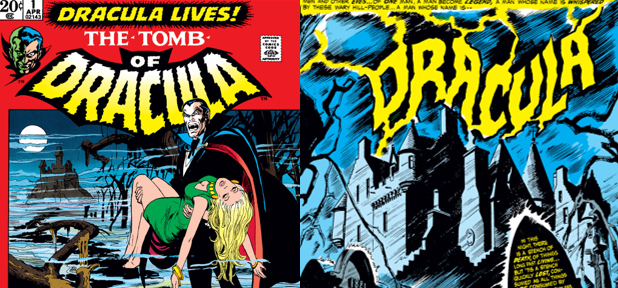
Story Title: “Dracula”
Published: 16 November 1971 (cover dated: April 1972)
Writer: Gerry Conway
Artist: Gene Colan
The Background:
Inspired by famous butchers like Vlad II/Vlad Dracula/Vlad the Impaler, Count Dracula first appeared all the way back in 1897 courtesy of author Bram Stoker’s classic Gothic novel, which became the great-great-grandfather of what we now know as the vampire mythology. An instant classic, Dracula was adapted many times over the years as plays, movies, videogames, and even comic books. Indeed, when publishers like Marvel Comics were finally allowed to print stories involving vampires and other supernatural creatures, writers like Gerry Conway and artist gene Colon selected the infamous Count to spearhead the Tomb of Dracula series. Heavily inspired by classic Hammer Horror films, The Tomb of Dracula saw numerous writers and artists come and go as it struggled to find its identity and is perhaps best known for introducing Eric Brooks/Blade to Marvel readers. Still, Dracula went on to clash with many Marvel heroes, especially those who were involved with the supernatural. Dracula worked alongside the Avengers to fend off the Dread Dormammu, spawned a Nazi vampire, established a vampire colony on the Moon, and even matched wits with various cosmic beings. Perhaps surprisingly, Dracula also appeared in many Marvel cartoons but was most infamously brought to life by Dominic Purcell in the much-maligned Blade: Trinity (Goyer, 2004).
The Review:
Marvel’s version of the enigmatic Count was first introduced, fittingly enough, against the backdrop of a storm swept Transylvania, where Count Dracula’s mighty, gothic castle stands ominously on a hilltop. Despite the torrential weather and poor visibility, Frank Drake and his girlfriend, Jeanie Ovington, brave the storm alongside Clifton Graves, Frank’s cantankerous long-time friend who chastises Drake’s decision to fly from London just to sell the castle, which he recently inherited. While the three lament their misfortunes, hopelessly lost, residents of the nearby village discuss Frank’s impending arrival. While Fritz Burgeister predicts only sorrow will come from continuing to mess with the long-abandoned castle, a local barmaid hopes that Frank will bring some much-needed tourism and revenue to their sleepy Romani town. Just then, the three stumble into the Baron’s Inn seeking transportation to Castle Dracula from Fritz. However, Fritz refuses to take them to the castle and is adamant that none of the townsfolk would volunteer to replace him. While Clifton scoffs that the locals believe the wild tales spun by Bram Stoker, one of the patrons, Otto, volunteers to take them…for a small fee. Naturally, this is by horse and carriage and, on the way, Otto shares tales of how Dracula’s legend is debatable for, while such a man possibly existed, none can be sure if he were actually a vampire as Stoker claimed. Regardless, fear of the Count and his kin drives many of the locals to bar their windows, leave wolf’s-bane at their doors, and wear crucifixes to ward off any evil spirits. While Otto claims to be an exception in this regard, he’s no fool and refuses to take them right to the castle door, forcing the three to walk the rest of the way and costing Clifton his last ten bucks for the pleasure.
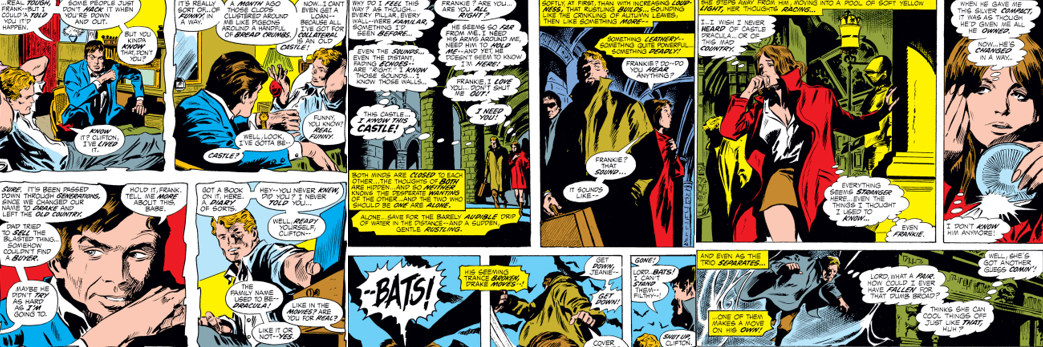
While Frank’s distracted by the grandeur of Castle Dracula, Clifton tries to put the moves on Jeanie. However, while they used to be a thing, she ended it months ago and is sick of his refusal to accept that she’s moved on. Frank, however, is lost in memories of how he stupidly blew his father’s fortune, how Jeanie stuck by him despite his money woes, and him being refused financial aid from banks and friends alike. While sharing his woes with Clifton, Frank mentions how all he has left is an old castle, one passed down through his family line and which his family has struggled to sell. This is where we learn that Frank is a descendant of Dracula’s and that it was actually Clifton’s idea to capitalise on his lineage by turning the castle into a tourist attraction. While reading through a family journal (strongly implied to be Stoker’s novel, reinterpreted as a historical document), Frank felt the stirring of “some ancestral memory” and was captivated by the descriptions of Dracula. The book also told of his ancestor’s shame and fear of being associated with the Count and of how Abraham van Helsing (referred to as “van Helfing”) seemingly destroyed the vampire lord by driving a wooden stake through his heart. Haunted by the text, Frank nevertheless agreed to head to Transylvania with Clifton and Jeanie in hopes of turning the castle into a museum though, as he stands in the shadow of the gothic structure, Frank can’t help but be unnerved by the strange feelings of home and destiny exuded by the dark building. As they tour the interior, Frank’s odd behaviour worries Jeanie, who’s startled when a cloud of bats suddenly swarms them. Although Frank fends them off, Jeanie’s left traumatised and wanting to leave, noting that Frank’s changed and is no longer the sweet man who gifted her a silver compact mirror.
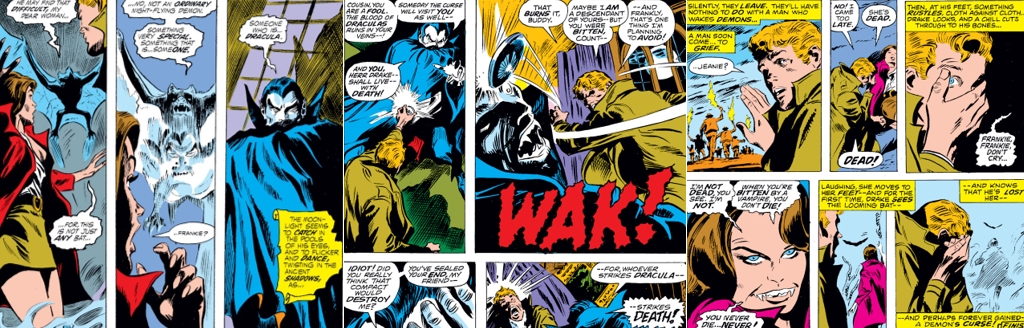
Determined to force Jeanie back into his arms and screw his friend over, Clifton takes off and ends up tumbling into a dungeon. There, he discovers a narrow stone stairway leading to an ancient tomb, where Dracula’s coffin rests. Seeing only dollar signs, Clifton draws a gun and arrogantly opens the crypt, discovering the skeletal corpse of Dracula, stake and all, lying within. Excited, Clifton removes the stake and sets out to kill Frank so he can reap all the rewards, unaware that this act causes Dracula to reconstitute and rise again! Weary and famished from his long slumber, the eloquent Count pounces upon Clifton, shrugging off his gun shot and tossing him into a deeper dungeon for safekeeping. Entranced by the sound of others, especially a woman, Dracula heads to the upper floors in his bat form, frightening Jeanie and then horrifying both her and Frank when he reveals his true self. Thanks to his silver tongue and hypnotic eyes, Dracula easily sways Jeanie to leave Frank’s side, so he knocks her out with a right hook to keep her safe (!) and sends Dracula fleeing by flashing her silver compact. As Frank rushes Jeanie upstairs (since she’s somehow “close to dying!”), Dracula flies to the village and feeds upon the barmaid, turning the locals into an angry mob when they rightly assume that Frank and the others disturbed the legendary vampire. Returning to his castle, Dracula spies on the unconscious Jeanie and, though tempted by her purity and innocence, is again denied another meal by the glittering crucifix around her neck. Frank takes credit for this and confronts his ancestor, warding the vampire off with the compact’s mirror, enraging Dracula and casing him to strike his cousin, knocking him out. Although Dracula compels Jeanie to remove her crucifix, the angry mob sets the castle alight and Frank recovers in time to flash the compact once more, forcing Dracula to flee. Unfortunately, Frank was too late to stop Jeanie being bitten and she awakens as a vampire, mocking his grief and fleeing into the misty night.
The Summary:
This had a bit of potential, but didn’t fully deliver on its premise. I quite like the idea that Dracula is treated as folklore, a retelling of factual events whose veracity is disputed. For the Transylvanian locals, Castle Dracula is all-too real and the fear of the vampire lord within is strong enough to stir up superstitions and debate between them. While none of them dispute that Dracula did exist, some aren’t convinced he was a vampire and yet many take precautions nevertheless because…why tempt fate? Fritz takes these concerns very seriously, presumptuously speaking for his fellow villagers and claiming that no one will help Frank and the others. This isn’t quite true as Otto’s assistance can be bought, though even he’ll only go so far despite boasting of his disbelief of such superstitious nonsense. Whether they believe it or not, Castle Dracula stands as an ominous monument. Its very presence evokes fear and it’s become a symbol of all their superstitions, though ironically may hold the key to bring some much-needed revenue to the struggling villagers as it could lure in tourists. The ill-fated barmaid is almost as excited by this prospect as the opportunistic Clifton, who maliciously manipulates Frank into buying into his family’s account of the Count and profiting off his inheritance, with no understanding of what truly lurks within Castle Dracula. He’s perfectly happy to use his friend, openly complaining and criticising him and gaslighting Frank into believing the troubles they’ve suffered from the trip are his fault, all with the aim of profiting both financial and by regaining Jeanie’s affections. While she has no time for Clifton (and even Frank quickly loses patience), Clifton refuses to take no for an answer and is even prepared to off Frank just so that he can weasel his way back into Jeanie’s bed, a selfish ambition that blinds him and makes him easy prey for the rejuvenated vampire lord.
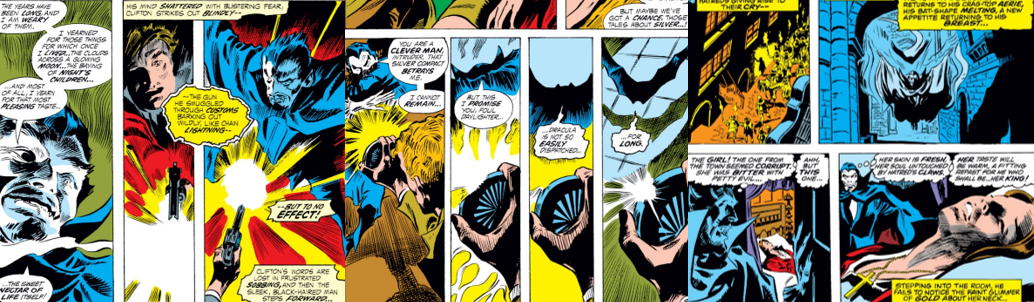
Yes, Dracula is very real here. Clearly modelled after Christopher Lee’s iconic portrayal from Dracula: Prince of Darkness (Fisher, 1966), the Count is a tall, alluring figure with hypnotic eyes and even more hypnotic voice. A gothic figure of ancient legend, he’s ripped straight from Bram Stoker’s novel and sports many of the same tropes and weaknesses. He can transform into a bat, mesmerise his prey, feeds on their blood, and is warded off by wolf’s-bane, silver, crucifixes, and mirrors. The Drake journal reveals that their bloodline largely distanced themselves from Dracula out of fear and tells how an old vampire hunter finally slayed the creature, revealing that Dracula can be killed with a wooden stake (though this doesn’t come into play, except to revitalise the fiend). Immune to Clifton’s bullets, Dracula’s scared off by Jeanie’s convenient silver combat mirror and heads into town to feed, though seems displeased by the barmaid’s blood and desires purer, sweeter blood. Thus, he targets Jeanie, a caring spouse who worries about Frank’s distracted state and fends off Clifton’s advances, though she crumbles like paper whenever bats appear, much less Dracula. Dracula seems a bit weak here, which is understandable since he just woke up, but it’s weird that his strike didn’t kill Frank. The story’s also incomprehensible at times; Frank seems to think Jeanie’s in danger of dying after simply passing out and she gets bitten between panels, which wasn’t very clear. In the end, this was an alright story with some unique visuals. I like the gothic depiction of Castle Dracula and the torrential rain, and Dracula’s very Lee-esque appearance and unique, haunting way of talking. However, it was quite a repetitive story (Frank relied on that silver compact way too much) that didn’t fully deliver on all its plot threads (Clifton being a prime example). I can only hope that future issues of The Tomb of Dracula characterised the titular Count as less of a weakling as this wasn’t a great showing for him here, even if he did get the last laugh by turning Jeanie.
My Rating:
Could Be Better
What did you think to Count Dracula’s debut story? Were you disappointed by how weak he was depicted? What did you think to Frank Drake and the depiction of Dracula’s legend? Did you ever read The Tomb of Dracula books and, if so, did you enjoy them? What are some of your favourite Dracula moments from Marvel Comics? Have you ever read Stoker’s novel, and what are some of your favourite vampire stories? No matter what you think, good or bad, feel free to share your thoughts below, show me some love on Ko-Fi, and check out my other Dracula content.

 Dr. K's Waiting Room