
In the decades since his first dramatic appearance in the pages of Detective Comics, Bruce Wayne/Batman has become a mainstream, worldwide, pop culture icon. The brainchild of writer Bob Kane, Batman was brought to life by artist Bill Finger and has been a popular staple of DC Comics and countless movies, videogames, and cartoons over the years. “Batman Day” falls on September 16 this year and I figured this was a perfect excuse to spend every Saturday celebrating comic’s grim and broody vigilante.

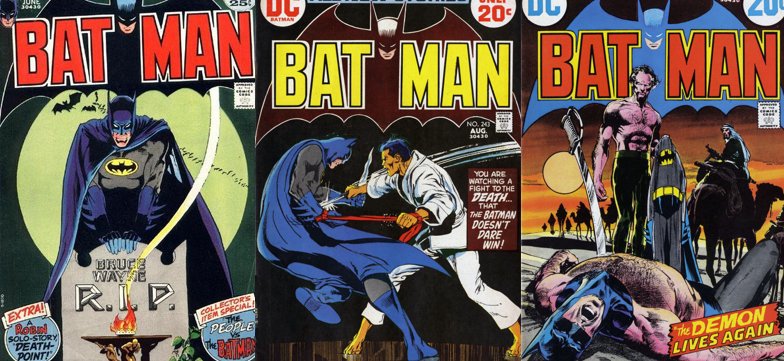
Story Title: “Bruce Wayne — Rest in Peace!”
Published: June 1972
Writer: Dennis O’Neil
Artist: Irv Novick and Dick Giordano
Story Title: “The Lazarus Pit!”
Published: August 1972
Writer: Dennis O’Neil
Artist: Neal Adams
Story Title: “The Demon Lives Again!”
Published: September 1972
Writer: Dennis O’Neil
Artist: Neal Adams
The Background:
Following their success with Clark Kent/Superman, National Comics Publications tasked Bob Kane with creating another masked crimefighter to add to their repertoire. Thanks to the invaluable and long-suppressed talent of artist Bill Finger, the “Bat-Man” quickly became one of DC Comics’ most popular characters and a mainstream cultural icon. Over the years, the Batman defended Gotham City from many costumed supervillains, but perhaps his most captivating and intriguing villain is “The Demon’s Head”, Rā’s al Ghūl. Created by editor Julius Schwartz, writer Dennis O’Neil, and artist Neal Adams during DC Comics’ reinvention of the Batman to downplay the camp trappings of the sixties, Rā’s al Ghūl was an enigmatic criminal mastermind not unlike a James Bond villain. His expansive criminal empire, lofty goal of ending worldwide conflict by any means necessary, and international flavour made him a dark counterpart to the Dark Knight. Following his first appearance, Rā’s al Ghūl continually plagued Batman thanks to the rejuvenating properties of his “Lazarus Pits”, which were introduced in these three issues and restored him from death at the cost of his keen intellect. Rā’s was a pivotal figure in DC Comics thanks to his daughter, Talia, who birthed Batman’s volatile son, and numerous appearances outside of comics. He was excellently brought to life by the eloquent David Warner, Matthew Nable, Alexander Siddig, and Liam Neeson. These issues also inspired some of these interpretations of Rā’s, with the story and visual of the two (or a Batman proxy) battling bare-chested and/or with swords being evoked in the DC Animated Universe, Batman Begins (Nolan, 2005), and Arrow (2012 to 2020).
The Review:
This three-part story kicks off with quite the sensational headline: “Bruce Wayne Vanishes!” In Commissioner James “Jim” Gordon’s office, the world-weary commissioner discusses the millionaire’s presumed death with the Caped Crusader, obviously oblivious that the Batman is Bruce Wayne. Both men lament Wayne’s assumed death before the Batman leaves, informing Gordon that he’ll be out of the country for some time. As the Batman swings through the city, we learn that he faked his alter ego’s death as a mysterious villain apparently knows of his dual identity and the Batman doesn’t want to risk endangering those closest to him. Begrudgingly, the Batman realises he needs help combating this threat and thus swoops into a downtown café to chat with crime boss “Matches” Malone. However, Malone sics his goons on the Batman and flees into the café’s kitchen. Cornered, Malone opens fire and apparently shoots Batman dead! Thus, the story follows Malone (whose gimmick, who may have guessed, is repeatedly lighting matches with his thumb) as he follows Doctor Harris Blaine through the Gotham Arms Hotel. When Dr. Blaine is attacked by an unknown assailant, Malone repays the favour and carries the unconscious doctor to a nearby building to meet the Batman, alive and well and grimly revealing that Rā’s al Ghūl – the seemingly immortal head of the worldwide criminal organisation the League of Assassins – has targeted Dr. Blaine due to his as-yet-unknown research. Dr. Blaine’s attacker, Lo Ling, interrupts the meeting and spontaneously reveals some of his backstory (he was saved by Rā’s and thus owes him his servitude) and that Rā’s’ daughter, Talia, disagrees with his vendetta against the Batman, all before tossing a knife right into the Dark Knight’s chest! Malone is so enraged by this that he accidentally topples over the projector Batman was using to show Dr. Blaine slides, temporarily blinding Dr. Blaine and allowing Lo Ling to vanish…along with the Batman’s corpse!
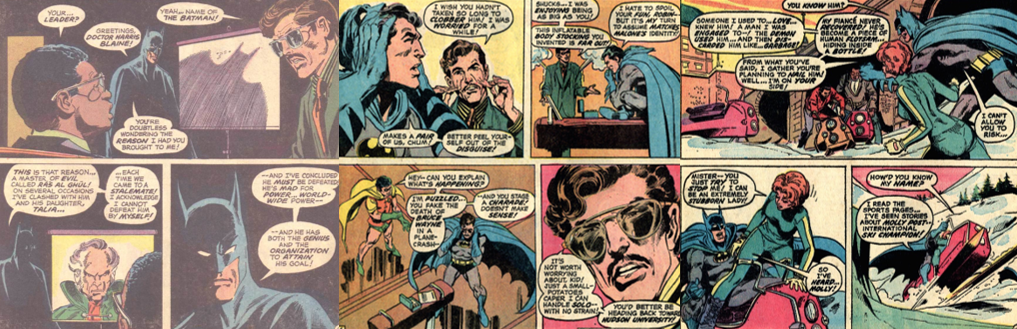
Malone orders Dr. Blaine to the lobby and then races after Lo Ling. With Dr. Blaine out of sight, Malone removes his clever disguise and reveals that he was the Batman all along, the Dark Knight assuming the mobster’s identity after he accidentally killed himself and setting up a dummy for his meeting with Dr. Blaine. Lo Ling is so shocked to see the Caped Crusader alive that he slips from the rooftop, though the Dark Knight catches him mid-fall by racing to a lower-floor window. Now owing his life to the Batman as much as Rā’s al Ghūl, Lo Ling is drafted into Batman’s crusade, though insists on fighting him in respectful combat first. This time, Dick Grayson/Robin assumes Malone’s identity as the two battle, with Batman abandoning his blade and overpowering Lo Ling with his superior judo skills and earning Lo Ling’s eternal servitude. Despite needing allies for his war with Rā’s al Ghūl, the Batman sends Robin back to Hudson University to avoid endangering the Teen Wonder and to ensure that the Batman’s legacy can continue if he falls. Dr. Blaine and Lo Ling then meet with Malone (who’s Batman in disguise, keep up!) at a private airfield and take a plane to the Swiss alps, where it’s rumoured Rā’s al Ghūl is located. Upon landing, Lo Ling randomly spots Talia al Ghūl and rushes to capture her, eager to please his new master, only to be knocked out by Talia’s hulking bodyguard, Ubu. The Batman intervenes and quickly takes the brute down, only to be blasted by international ski champion Molly Post, who misread the situation and thought Batman was attacking Talia. This allows Ubu to kick the shit out of Batman, but Talia calls him off since she’s still got the hots for the Masked Manhunter.
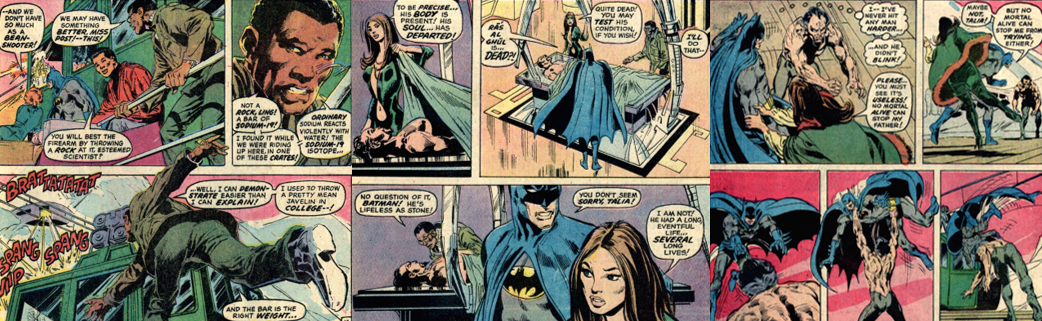
After apologising for her blunder, Molly insists on accompanying the three in hunting Rā’s al Ghūl since the Demon’s Head manipulated her fiancé so badly that he turned to alcoholism. Upon reaching Rā’s al Ghūl’s private cable car, Batman and Lo Ling KO two guards (much to Dr. Blaine’s chagrin) and have Molly and Dr. Blaine assume their identities, while Batman and Lo Ling cling to the outside of the cable car, to bypass the inept snipers. As swift as the Dark Knight and his ally are, however, the goons open fire, causing the group to be pinned down by machine gun fire from a nearby World War Two bunker that serves as Rā’s al Ghūl’s Swiss headquarters. Despite claiming to be a pacifist, Dr. Blaine resolves the situation by hurling a bar of Sodium-19 (which was being transported in the cable car) into the bunker, causing a massive explosion that the doctor is strangely confident their attackers will have survived. Eager to discover what Rā’s is planning for the Sodium-19, the Batman leads the group onwards, lamenting that he must endanger such brave and feisty lives, easily breaking into Rā’s’ stronghold and taking Ubu down with a flying kick. Although Molly tackles Talia, believe her to be a threat, Talia not only reaffirms her love for the Batman but also reveals that Rā’s is dead. Dr. Blaine confirms it by examining the body and Batman offers his condolences. Although Talia dismisses Batman’s sympathies and agrees to be arrested, the group miss that she activates a hidden switch that lowers Rā’s al Ghūl’s corpse into a bubbling, putrid green liquid – the Lazarus Pit. True to its name, the mysterious liquid reanimates Rā’s, returning him to life with the strength of ten men and the madness of an animal! Accordingly, the crazed, half-naked Rā’s races into the frigid cold to confront the group, laying Lo Ling out with a single punch and shrugging off the Batman’s most powerful blow! Refusing to back down even in the face of such a mighty madman, the Batman is easily manhandled and tossed into the cable car.
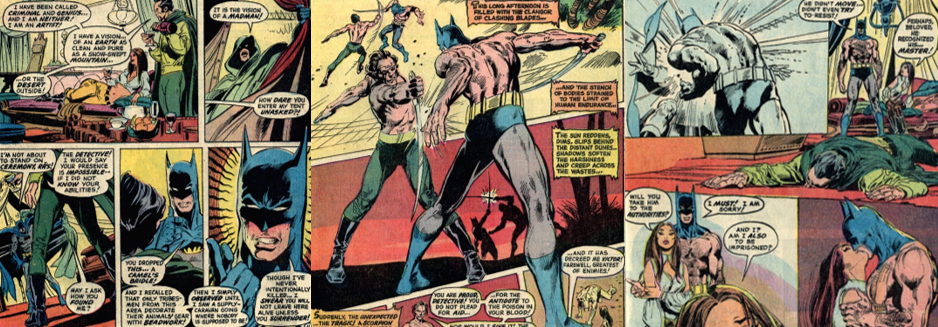
After Dr. Blaine wrecks the cable car’s controls, Talia talks some sense into her father and flees with him to their hovercraft, leaving Batman to shake off his injuries and Dr. Blaine insisting they get the wounded Lo Ling to a hospital. Upon seeing Rā’s al Ghūl’s futuristic hovercraft blast away, the Batman is stunned when Molly gives chase on her skis, forcing him to follow to protect her. Though astonished by her recklessness, the Batman can’t help but admire her skill and bravery, and he’s even more impressed when Molly hurls one of her skis into the hovercraft’s propeller, forcing a crash landing, though she’s wounded from debris. This is all the distraction the al Ghūl’s need to flee and, after getting Molly to safety, the Batman returns during the night to inspect the downed hovercraft and discovers a camel’s bridle. With all his allies on the shelf, Batman heads to the desert of an unspecified nation to confront Rā’s, whose regained his senses and determined to rebuild his empire. Determined to stop Rā’s, Batman agrees to a duel to the death and the two face each other, topless and armed with swords, in the sweltering desert. As a weeping Talia watches her lover and her father clash, Batman and Rā’s battle long into the afternoon but the fight unexpectedly ends when Batman is stung by a scorpion. Declaring himself the victor, Rā’s abandons his foe to his fate, though a kiss from Talia revitalises Batman and counteracts the poison. Driven by rage and instinct, the Batman stalks to Rā’s’ tent and lays him out with a single punch, with Rā’s too humble and horrified to offer any resistance. Although the Batman carries Rā’s al Ghūl off to be the authorities, he lets his emotions get the better of him and spares Talia, leaving her with a final kiss.
The Summary:
These three stories (generally referred to as “The Demon Lives Again!”) have become iconic moments in the Batman’s long and storied career mainly due to the visual of the bare-chested Dark Knight duelling with the Demon’s Head in the arid desert. For me, this is peak classic Batman since I grew up with the writing and art of Dennis O’Neil and Neal Adams, which portrayed him as a well-rounded, intelligent, and stable individual more focused on crime solving than bashing heads or being a paranoid control freak. While the Batman loathes asking for help and putting others in danger to track down Rā’s al Ghūl, he feels compelled to do so to protect those he cares about (such as Robin and, assumedly, his mentor and father figure, Alfred Pennyworth). While the Batman is clearly rattled to have his civilian identity be targeted, to the point where he fakes Bruce Wayne’s death to operate autonomously as the Batman, it’s not clear what Rā’s al Ghūl’s goal is in this story arc. He targets Dr. Blaine for unspecified reasons and is stockpiling Sodium-19, but it’s not revealed why or what the endgame is beyond Rā’s wishing to strengthen his already powerful criminal empire. The assumption is that whatever Rā’s al Ghūl is planning can’t be good since he’s essentially a threat to the entire world by default, but it might’ve been nice to get some idea about what the stakes were beyond this vague threat. It’s also not revealed how and when Rā’s al Ghūl died. The Batman doesn’t seem to have known about this, so I doubt it happened in a previous story, and it raises questions regarding Talia. While she’s clearly conflicted between her loyalty to her father and her love for the Batman, it’s heavily implied that she’s begrudgingly carrying out his posthumous orders and is therefore the true threat of the story arc.
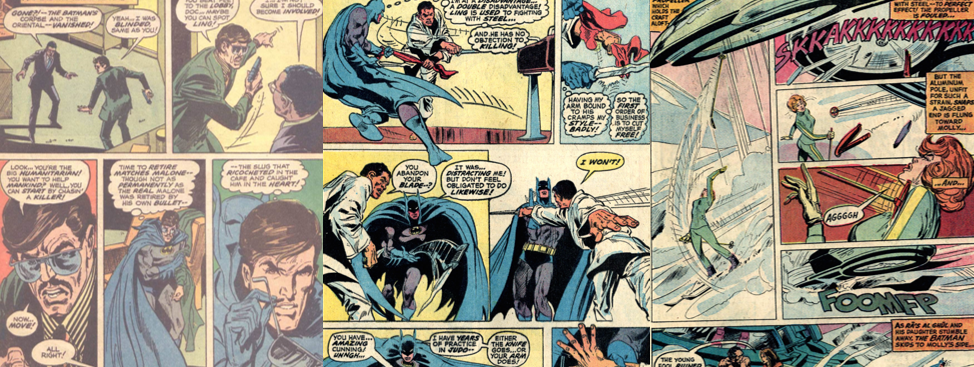
Naturally, she hides it well, talking down Ubu, kissing the Dark Knight, weeping at the iconic clash between the two, and making no explicit moves against him, but Talia clearly can’t be trusted and carries out her father’s orders, willingly or not. The Batman’s plan is to assemble a team to hunt the Demon’s Head, though I’m not entirely sure what the benefit of assuming “Matches” Malone’s identity was since his underworld ties didn’t have any impact on their journey. I guess it helped to distract Lo Ling, who was fooled by the dummy Batman, but Malone didn’t seem necessary to the plot to me. It would’ve made more sense for “Bruce Wayne — Rest in Peace!” to revolve entirely around Batman masquerading as Malone to figure out who Rā’s al Ghūl is planning to target and then abandoning the disguise once Dr. Blaine was saved. I quite liked Lo Ling; he seemed like a tortured soul torn between his loyalties, like Talia, and was a useful ally in combat. It definitely would’ve made more sense for him to toss that Sodium-19 bar and for that to have killed Rā’s’ men, bringing some conflict between Lo Long’s methods and the Batman’s. It also would’ve made more sense for Lo Ling to guide Batman through the Swiss alps; he should know the location of Rā’s al Ghūl’s base, after all, meaning the inclusion of Molly Post also a questionable one. I liked that she impressed Batman time again, how resourceful, determined, and fearless she was, and that he was obviously taken by her, but I fail to see how she added anything to the story. Lo Ling and the Batman could’ve easily filled her role and it’s not like Molly and Batman become an item by the end. Additionally, Lo Ling and Molly are both grievously wounded in the final issue, which also takes Dr. Blaine out of the picture since he needs to see to her, meaning Batman faces Rā’s al Ghūl alone in the end…which was the exact opposite of his plan!
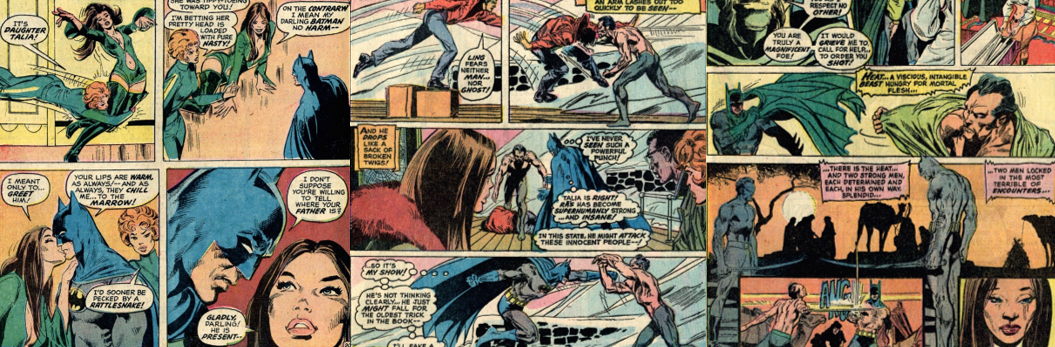
Therefore, the primary focus of this story arc (tracking down and stopping Rā’s al Ghūl’s mysterious plot) is a bit flimsy for me. However, these issues still stand as a landmark moment in the Dark Knight’s history simply because of how alluring and nuanced Rā’s al Ghūl and Talia are. Rā’s al Ghūl poses a significant threat to both the world and the Batman because of his resources and knowledge of Bruce Wayne’s identity, while Talia represents seductive temptation. Both the al Ghūl’s deeply respect and admire the Batman and wish him to join their cause, though they refuse to alter their methods to appeal to him and even Talia only defies her father so much. These issues not only reintroduce Rā’s al Ghūl but also introduce the concept of the Lazarus Pit, a mysterious, ancient substance that not only restores the dead to life but briefly bestows them with superhuman strength, though at the temporary loss of their sanity. When he rises from the dead, Rā’s al Ghūl is a mindless, animalistic force who easily fells Lo Ling and overpowers the Batman, only coming to his senses when confronted by his daughter. By the time the Batman intercepts them in Egypt Afghanistan whatever desert they flee to, Rā’s al Ghūl has fully regained his composure and is ready to battle to the death to settle his differences with the Dark Knight. While the Batman outright refuses to kill Rā’s al Ghūl, he also refuses to leave without the Demon’s Head in custody and accepts the challenge, providing the arc’s most powerful and sexually charged imagery. The actual sword fight, however, is surprisingly disappointing; neither competent draws blood, there’s no back and forth between the two, and it randomly ends when a scorpion stings Batman. Rā’s is incredibly pleased by this victory, claiming that nature itself has willed him as the victor, but so startled to see his foe fully recovered that he offers no resistance when the enraged Batman comes for him. In the end, these are decent enough stories, but I feel it could’ve been cut down to a two-part tale by removing some unnecessary characters and moments. This might’ve freed some panels to better explore Batman’s relationship with Talia and Rā’s al Ghūl’s plan, but there’s no denying the appeal of their sword fight and the juxtaposition between the Dark Knight and the Demon’s Head.
My Rating:
Pretty Good
What did you think of Rā’s al Ghūl’s rematch with the Dark Knight? Do you agree that the additional characters bogged down the narrative or were you a fan of Lo Ling and the “Matches” Malone identity? Did you enjoy the bare-chested sword fight between the two? What are some of your favourite Rā’s al Ghūl stories? Which interpretation of the Rā’s al Ghūl, whether animated, pixelated, or live-action, is your favourite? Whatever you think about the Rā’s al Ghūl, share your thoughts below, support me on Ko-Fi, and check out my other Batman content!

 Dr. K's Waiting Room
One thought on “Back Issues [Bat-Month]: Batman #242-244”