
Easily Marvel Comic’s most recognisable superhero, unsuspecting teenage nerd Peter Parker was bitten by a radioactive spider and learned the meaning of power and responsibility in August 1962. Since then, the Amazing Spider-Man has featured in cartoons, movies, videogames, and countless comic books. To coincide with his day of celebration, I’m dedicating every Monday of August to everyone’s favourite web-head!

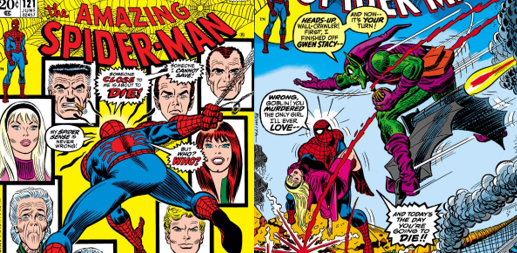
Story Title: “The Night Gwen Stacy Died”
Published: 13 March 1973 (cover-dated: June 1973)
Story Title: “The Goblin’s Last Stand!”
Published: 10 April 1973 (cover-dated: July 1973)
The Background:
In 1962, Marvel Comics editor and head writer Stan Lee followed up his success with the Fantastic Four with Spider-Man. The wall-crawler’s debut in Amazing Fantasy #15 proved one of Marvel’s best selling titles and Spider-Man’s popularity led to him getting his own solo title within a year. Very quickly, Spider-Man amassed one of the most colourful and memorable rogues galleries, though Norman Osborn/Green Goblin proved to be one of his most dangerous foes. A central figure in many prominent Spider-Man stories, the Green Goblin cemented his status as Spidey’s archenemy with these two issues, where Osborn contributed to the death of Peter’s long-time love interest, Gwendolyne “Gwen” Stacy. Created by Stan Lee and Steve Ditko and debuting in The Amazing Spider-Man #31, Gwen was the daughter of police captain George Stacy and first met Peter when they were students at Empire State University. Designed to be Peter’s one true love, Gwen and Peter had a rocky relationship, especially after she blamed Spider-Man for her father’s death and Lee was said to be adamantly against killing her off. Writer Gerry Conway and editor Roy Thomas disagreed, however, and wished to do away with the beautiful blonde in favour of the more rambunctious Mary Jane Watson/M.J. Said to have marked the end of the more innocent “Silver Age” of comics, Gwen’s death haunted Spider-Man for decades both literally (thanks to her clones and some abysmal retcons) and figuratively, as seen in his subsequent relationship with M.J. and his guilt over sharing the blame for Gwen’s death. This dramatic moment also came to be adapted into live-action, being echoed in the 1990’s cartoon and Spider-Man (Raimi, 2002), with M.J. (Saratoga Ballantine/Kirsten Dunst) as a substitute, and served as a heart-wrenching finale to The Amazing Spider-Man 2 (Webb, 2014) that Peter (Andrew Garfield) atoned for some ten years later. While alternative versions of Gwen have since gained popularity, “The Night Gwen Stacy Died” remains one of the most pivotal and iconic stories in Spider-Man’s long history.
The Review:
This classic two-part tale begins with Peter’s best friend, Norman’s son, Harry Osborn, suffering from an LSD-infused fever. By Norman’s request, Harry is cared for by his family doctor in his own home, with his friends Gwen and M.J. by his side, though the doctor grimly states that Harry’s repeated drug abuse has caused the onset of schizophrenia! Peering from the window, Spider-Man laments not being there for his friend and changes to Peter, slipping in through the rooftop to pay a visit. However, Peter’s intercepted by Norman, who angrily demands that he leave, blaming him for Harry’s condition and barking in his face. This exchange sees Peter reflect on Norman’s former dual life as the Green Goblin and their shared knowledge of each other’s identity, knowledge that Norman has forgotten thanks to a bout of amnesia but which apparently still lingers and informs his hatred of Peter. Norman then extends this to Gwen and M.J. and tosses the three out, leaving them dejected and concerned for Harry’s welfare. As if that wasn’t bad enough, Peter finds himself suffering from the flu; since he can barely bring his latest photos of Spider-Man to the Daily Bugle, the worse for wear hero heads home to rest. Things continue to get worse for Norman, who receives a phone call informing him that his company stock is continuing to plummet and, when Harry collapses in his arms, finds his thoughts descending into angry paranoia at his son’s “friends” and his perceived enemies. The stress culminates in Norman being attacked by a vision of Spider-Man and bombarded by memories, compelling him to race to an abandoned brownstone that contains his long-forgotten equipment and, with manic glee, the Green Goblin lives once more! Immediately recalling his hatred of Peter Parker and Spider-Man, the Green Goblin hops on his goblin glider and races to Peter’s apartment, where Gwen is waiting for Peter to discuss their friend and what they can do to help him.
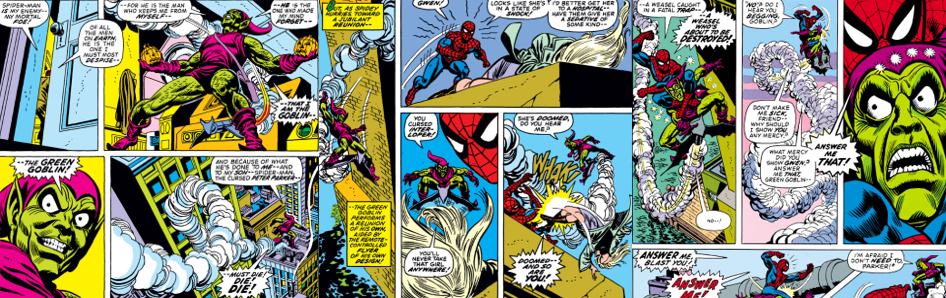
Spider-Man’s journey home is delayed by his illness, meaning he arrives too late to help and finds only Gwen’s handbag and one of the Green Goblin’s pumpkin bombs. Intuiting that Osborn’s returned to his violent alter ego and concerned for Gwen’s safety, Spider-Man follows his spider-sense to the George Washington Bridge. There, he finds the Green Goblin perched an archway with Gwen’s presumably unconscious body at his feet. The Green Goblin threatens to kill Gwen unless Spider-Man indulges in a final confrontation, to the death (naturally), and, angered at his girlfriend being targeted, Spidey readily agrees. Thrown by his flu, Spidey barely dodges a pumpkin bomb and is bashed by the raving Green Goblin’s glider. Luckily, Spider-Man snags his foe with his webbing and lands a huge left hook that sends the Green Goblin plummeting. Confident that his enemy is subdued for the time being, Spidey races to his unconscious lover, assuming she’s in shock, and is horrified when the Green Goblin makes a sudden recovery and spitefully knocks Gwen from the bridge! Desperate to save her, Spider-Man shoots a web line and is so elated when it snags on Gwen’s ankle that he misses the small Snap! at her neck… Congratulating himself, Spidey pulls Gwen up and embraces her, still clinging to denial, only to find Gwen doesn’t respond and is, in fact, dead despite his best efforts. Spotting the Green Goblin hovering nearby, Spidey sets Gwen safely on the ground and vows to make Osborn pay with his life for crossing the line. Attacking with a self-righteous fury, Spider-Man violently beats his foe, doubling down when the Green Goblin seemingly begs for mercy.
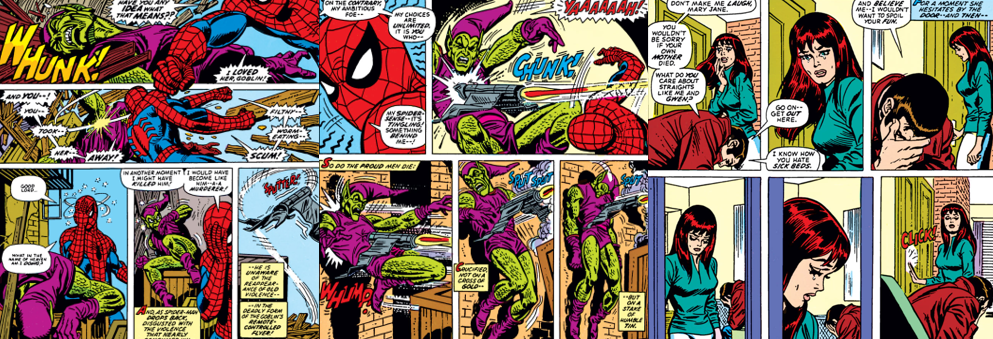
Unfortunately, Spider-Man’s anger gets the better of him and sees him knocked from the glider, allowing the Green Goblin to escape. When the police come to check on Gwen, Spidey leaps to her defence, unconcerned about his reputation. Thankfully, one cop sees the anguish in Spider-Man, who’s tormented by memories of happier times with Gwen, the guilt of letting down her father, and the inescapable knowledge that Spider-Man not only drove a wedge between them but also caused her death. When the ambulance arrives, Spider-Man mournfully hands over Gwen’s body and takes responsibility for her death, lashing out when the cops try to arrest him and fleeing. Swinging to the Osborn house, Spidey switches back to Peter to talk to the paranoid and feverish Harry. However, seeing his delusional friend’s no state help, Peter decides settling the score with the Green Goblin trumps caring for his friend. Seeking a lead on the Green Goblin, Spidey heads to the Daily Bugle to talk to editor Joseph “Robbie” Robertson, who’s also reeling from Gwen’s death and points him to one of Osborn’s warehouses. Norman gleefully leaps to engage with Spider-Man, keeping the vengeful wall-crawler at bay with his finger blasts. The Green Goblin further enrages Spidey by insulting Gwen, causing Spidey to brutally pummel his crazed foe. However, Spider-Man comes to his senses at the last minute, disgusted by how close he came to being just like Osborn. Of course, the Green Goblin refuses to go quietly and activates his glider, intending to skewer his foe through the back. However, Spidey’s spider-sense sees him deftly duck, causing Norman to be impaled by his own glider! Finding no comfort in his hated enemy’s end, just further emptiness and misery, Spider-Man stalks off, unaware that someone’s watching him from the shadows. When he gets home, Peter finds M.J. waiting for him and lashes out at her, chastising her for being a selfish, party-loving airhead who couldn’t understand his pain. Despite being hurt by Peter’s words, M.J. sees his heartache and chooses to stay and comfort her friend in his grief.
The Summary:
There’s a lot happening in these two issues, as is common for Spider-Man stories. The toxic influence of Norman Osborn stretches far, infecting not just Peter’s life but the mindset of his best friend, Harry. After years of feeling insignificant next to his powerhouse businessman father, Harry turned to LSD for some relief and, despite his best efforts, has relapsed into drug use once more. Since he has no memory of his past as the Green Goblin and refuses to take responsibility for his actions, Norman turns his anger at the situation to Harry’s friends, particularly Peter, and insists that Harry be treated at home in a desperate attempt to show he’s a caring father. Every time we see Norman, he’s as drenched with sweat as his son, though Norman’s stress is caused not just by his son’s state and his work issues, but also the resurfacing of his Green Goblin persona. When his memories return, Norman immediately regresses to a raving lunatic, one whose soul purpose is to protect Norman and make his enemies pay. Despite Norman’s outburst, Peter, Gwen, and M.J. truly care for Harry but find themselves powerless to help him. They each carry guilt for missing the signs of Harry’s degeneration sooner and not intervening before he returned to drugs, and each feels powerless to help him. When he returns to Harry to get a lead on Norman, Peter uncharacteristically rejects his friend, deciding to focus on his enemy rather than his suffering friend and causing Harry to further question his sanity. However, there’s a reason these two stories (generally collectively referred to as “The Night Gwen Stacy Died”) are so iconic and pivotal. They changed not only Spider-Man’s status quo but dramatically changed the landscape of all comicdom. Suddenly, significant supporting characters could die and that death would not only change the title character, but be a permanent fixture.
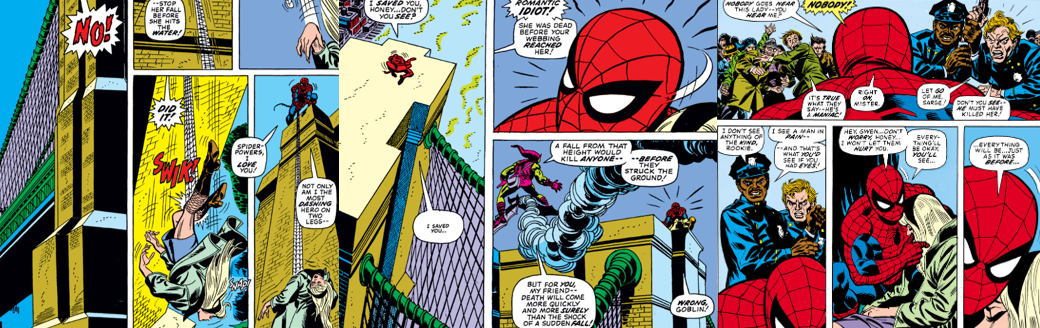
I’ve always been more a fan of Mary Jane since she was Peter’s love interest when I started reading comics and therefore have always found Gwen to be a very shallow and one-note character. She was pretty and nice enough, sure, but there wasn’t much to her, even after her father died and we got that dramatic dichotomy where she hated Spider-Man but loved Peter. While I would’ve preferred to see Aunt May die and for her death to be permanent, killing Gwen is totally out of left field and has so much more weight to it. Readers have seen Peter struggle with his dual identity, which drove a wedge between him and his many girlfriends, so it was very cathartic for him to finally find happiness with Gwen, a girl who accepted Peter for who he was and asked for nothing but his loyalty. When Peter realises that his actions as Spider-Man have led his most dangerous foe to target his girlfriend, Spider-Man wastes no time tracking down his foe and flies into a frenzy to make Osborn pay, incensed that the Green Goblin would make their rivalry even more personal. It’s so interesting reading their battle knowing how it’s going to end because it really makes you question whether Gwen was already dead to begin with. The Green Goblin claims that the “shock” of the fall would’ve instantly killed Gwen before she hit the ground, that little Snap! sound effect implies the sudden stop from Spidey’s web broke Gwen’s neck, and the fact she’s unconscious the entire time suggests Osborn might’ve killed her between panels. It’s fantastically ambiguous but, in the end, it’s inconsequential. The Green Goblin spitefully boasts of causing her death, which is true, and Spider-Man sees himself as responsible since Gwen was only put in danger because of him, which is also true. It’s heart-wrenching seeing Spidey clouded by denial, patting himself on the back for his innovation and heroics and desperately trying to wake Gwen up despite her clearly being dead. Spider-Man is then bombarded by memories and guilt and desperate to keep strangers from messing with her body but eventually comes to accept that his love is not only dead, but that he is to blame for it. This consumes him with a grief so powerful that he lashes out at cops and bystanders alike, no longer caring to try and defend his reputation.
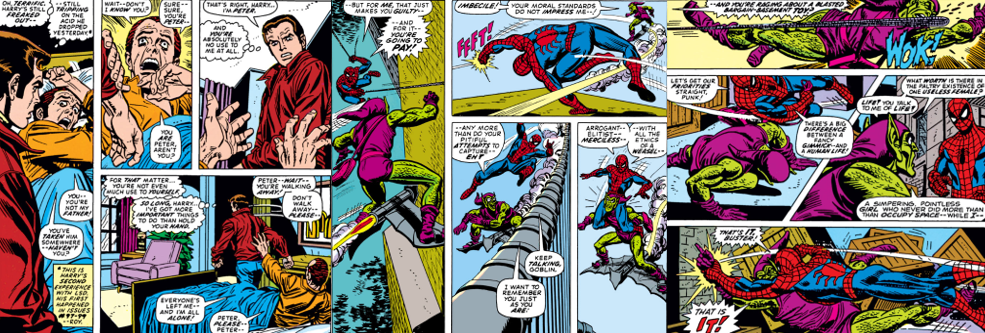
Peter’s grief causes him to fly into an uncharacteristic rage. It’s widely said that Spider-Man means business when he drops the inane quips and, indeed, Peter adopts a more violent approach when tracking down and confronting the maniacal Green Goblin. He shuns his best friend, shuts down the petulant J. Jonah Jameson’s, and races to the Green Goblin’s location with murder on his mind. The resulting rematch is an aggressive affair where Spidey eschews all sympathy for his crazed foe and berates his spiteful, vindictive nature. When Spider-Man damages the glider, the Green Goblin enrages the wall-crawler by showing more concern for his toys than a human life and, true to his word, Spider-Man seems ready to beat the Green Goblin to death. However, logic and reason hit Spider-Man like a brick wall and, disgusted by his actions, he pulls back at the last second. This hesitation is seen by the Green Goblin as a weakness but it’s the fundamental difference between the two rivals: one is a murderous lunatic who gleefully tortures and kills and the other is a righteous hero, who sacrifices his own personal needs to protect others. The Green Goblin’s stubborn and wicked nature ultimately prove his undoing as he’s impaled by his glider in a surprisingly harrowing death scene, especially for the time. The moment is framed as sudden and hollow, with Spider-Man getting no pleasure or closure in the deed and only being further convinced that “an eye for an eye” is the furthest thing from justice. For me, this was the perfect way to kill off Norman Osborn and I’ve been salty for decades that he inexplicably survived. It was thematically fitting for Harry to take up the Green Goblin mantle and be similarly undone, and we had plenty of look-a-likes and Hobgoblins running around so I could’ve done with leaving the Osborns in the grave. However, that doesn’t diminish the impact of his death as presented here, or of these two issues. Gwen’s death rocked Spider-Man and haunted him for years; it raised the stakes faced by all comic book characters and changed the industry forever. The ambiguity of the event and the way it weighs on Spider-Man’s conscience are disturbing and I do think the right decision as made since Gwen couldn’t compete with M.J. Subsequent stories have also constantly reinforced that Gwen was his first true love, ensuring a legacy that’s far more potent than if she’d been left alive.
My Rating:
Great Stuff
Where were you on the night Gwen Stacy died? Did you enjoy the story or were you annoyed that Gwen was killed off? What do you think killed Gwen, or do you believe she was dead to begin with? What did you think to Spider-Man assuming the blame and looking to kill the Green Goblin? Do you agree that Norman Osborn should’ve stayed dead or were you glad when he came back? What are some of your favourite Gwen Stacy stories? Whatever you thought to this classic Spider-Man story, share your thoughts below, support me on Ko-Fi, and be sure to check out my other Spider-Man content.

 Dr. K's Waiting Room
2 thoughts on “Back Issues [Spidey Month]: The Amazing Spider-Man #121/122”