

Story Title: “Act 1: The Suit”
Published: 19 July 2000 (cover-dated: September 2000)
Story Title: “Act 2: The Unicorn”
Published: 16 August 2000 (cover-dated: October 2000)
Story Title: “Act 3: The Photograph”
Published: 20 September 2000 (cover-dated: November 2000)
Story Title: “Act 4: The Conspiracy”
Published: 18 October 2000 (cover-dated: December 2000)
Story Title: “Act 5: The Betrayal”
Published: 15 November 2000 (cover-dated: January 2001)
Story Title: “The Truth”
Published: 31 January 2001 (cover-dated: February 2001)
The Background:
Debuting in 1938, Clark Kent/Kal-El/Superman wasn’t just an immediate hit with readers, he was also the first-ever costumed superhero, inspiring every single colourful crimefighter that came after him. Oddly, despite co-creating and bringing to life some of the industry’s most recognisable and beloved characters, Marvel Comics legend Stan Lee struggled to emulate the success of the Man of Steel. Over the years, many Marvel characters have been positioned as the company’s parallel to Superman, with none really making much of an impact. Robert “Bob” Reynolds/The Sentry, however, is perhaps the closest Marvel came to this endeavour. First conceived of by Paul Jenkins and Rick Veitch back in the late-1990s, the Sentry was pitched as an over-the-hill superhero struggling with addiction and was cleverly positioned as a “forgotten” hero from Marvel history. Easily one of Marvel’s most overpowered heroes, the Sentry was also a figurehead for mental illness thanks to his drug addiction and psychotic split personality, though this often led to him being seen an aggravating and inconsistent character. Despite some bad-ass moments and turning the tide in many conflicts due to his awesome power and unpredictable nature, Marvel’s insistence of reverting to the status quo meant the character has had more downs than ups over the years, to the point of fading from the spotlight. Indeed, as of this writing the Sentry has only ever appeared in supporting roles in Marvel videogames, with no animated appearances to his name, though the character did make the jump to the Marvel Cinematic Universe, courtesy of Lewis Pullman, in 2025.
The Review:
We first meet Bob Reynolds when he’s awoken by a lightning storm that triggers memories of an aggressive alien menace known as “The Void”. After reassuring his wife, Lindy Lee-Reynolds, Bob retrieves a bottle of liquid and is haunted by scattered memories that emulate the art style of the legendary Jack Kirby. Through them, we learn that a young, naïve Bob stumbled upon the mysterious “Professor’s” secret serum and drank it, fashioning a golden costume and blue cape and fighting both crime and supervillains as “The Sentry”. As Bob struggles to reconcile these memories, torn between them being fanciful delusions made from a comic book and real-life recollections of his battles against the Void alongside the Avengers, he remembers dispelling the Void with “the power of a million exploding suns” and the shadowy villain’s vow to return one day. Plagued by self-doubt, Bob’s memories shift to a decidedly darker, more Frank Miller-esque style as the Professor runs down his strengths and weaknesses. The serum supercharged his molecules, causing each atom to be slightly out of shift with time, granting him a “hyperstate of consciousness” and rendering him functionally immortal thanks to the power of the Sun. His only weakness was that his powers were tied to the serum, though the Sentry ignored the Professor’s warnings of him becoming addicted to the drug in favour of saving the galaxy from the Void. Desperate to regain a more coherent sense of himself and to be “vigilant” once more, Bob swigs from the serum and is immediately wracked by pain and spasms. Visions of the Void see Bob branded a common junkie and lectured about the emptiness of life so, when Lindy discovers him delirious and with an empty botte nearby, she naturally assumes he’s fallen off the wagon. Refusing to see her lover destroy himself before her eyes, Lindy walks out, leaving Bob to fool himself into thinking he’s slipping back into his costume and answering “the Sentry Signal” when, in reality, he’s simply put on a jacket with a crude cape pegged to the back! Still, he can fly, at the very least, so he heads to New York City (vaguely remembering when the Void reduced Manhattan to a smouldering crater) and is confronted by Doctor Reed Richards/Mister Fantastic. Though Bob speaks to Mr. Fantastic as an old friend, Reed has no idea who he is, though the word “unicorn” triggers something in the curious adventurer.
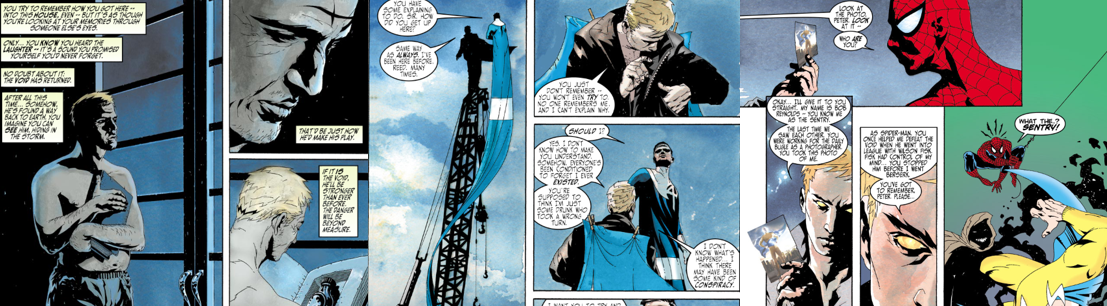
While Bob remembers Lindy accepting his superhero life right before their wedding, Mr. Fantastic talks the incident over with his family, perturbed by the sudden appearance of a golden unicorn that Bob gifted to Reed, who was his best friend. Disturbed and curious, Reed discovers a VHS tape in the unicorn that contains a warning from himself about the Void, but the tape explodes before the Fantastic Four learn anything tangible. Meanwhile, Bob (who “becomes” the Sentry the more he recalls his fragmented past, with his rudimentary costume even being revitalised) visits Doctor Robert Bruce Banner/The Hulk. Unlike the others, the Hulk remembers “Golden Man” as his “best amigo”, though Bob is disturbed to find the Green Goliath hasn’t evolved past his savage, childlike demeanour. Bob shares his concerns regarding a conspiracy surrounding him and convinces the Hulk to stand by him when the Void returns. Bob then meets Peter Parker/Spider-Man, who doesn’t remember Bob, sees only a blank piece of paper when Bob shows him a photograph he once took of the Sentry, and brands Bob a “fruitcake”. However, as he goes to leave, Bob begs Spidey to investigate further. As the world is thrown into turmoil, Peter’s memory is jogged after he confirms that multiple publications have been excised from public record. Additionally, Doctor Stephen Strange confirms the Void’s threat to Reed and, though he refuses to elaborate, he does magically conjure a memory of the Fantastic Four and Dr. Strange erasing everyone’s memories of the Sentry and Reed forcing Dr. Strange to keep that information hidden. Bob has a psychic parlay with Professor Charles Xavier/Professor X, causing Professor X’s memories resurface, and the X-Men to be put on alert. Similarly, Anthony “Tony” Stark/Iron Man remembers the Sentry, leading Bob to fly into a tirade about how he inspired all the world’s superheroes and was simply forgotten. Bob remembers that the Avengers staged an intervention regarding his overreliance on the serum and the lingering threat of the Void, with all begrudgingly agreeing that the Sentry, despite his many good deeds, should disappear. Since Tony stood up for him, Bob begs him to get the others onboard before flying to a desolate area of the city, his impressive super suit finally reformed. He returns to his long-forgotten fortress, the Watchtower, while his scarred and disabled former sidekick, Billy Turner/Scout, awakens from a disturbing nightmare.
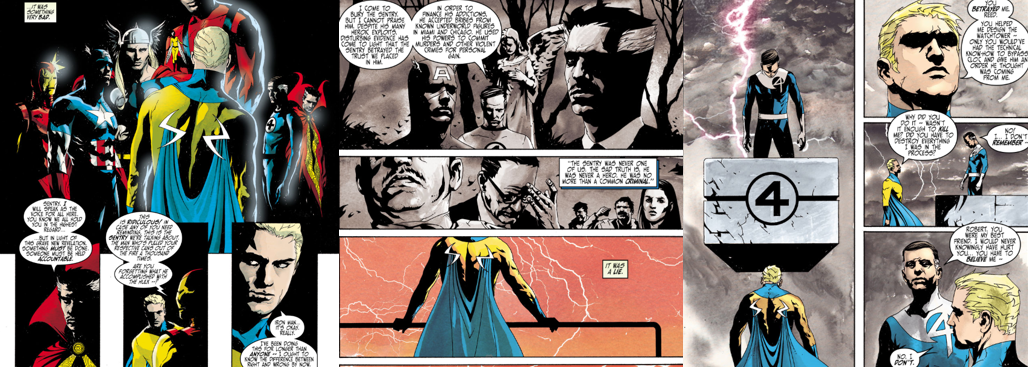
Inside the Watchtower, the Sentry reunites with its Centrally Located Organic Computer/C.L.O.C. to investigate a subliminal message being transmitted around the world by a small, bug-like transmitter that’s powered by the same serum that gives the Sentry his incredible abilities. Thanks to a “self-modifying loop virus”, C.L.O.C. cannot directly aid the Sentry without being destroyed, so the Sentry disables the crude device himself. This leads to a brief and near imperceptible shift in the fabric of reality and, suddenly, kids discover their Sentry memorabilia, Billy finds his old costume, and people are filled first with relief at remembering their hero…and then horror as they also remember the Void. They also remember the Sentry dying in battle (at least, as far as the public were concerned), marking the end of a “Golden Age” of heroes. This event also sees the Sentry remembering Reed condemn him as a traitor and a criminal, claiming that Bob accepted bribes from the criminal underworld to fund his addictions and then mislead the public into thinking he was a hero while also profiting from his violent impulses. Angered at this betrayal and slander, the Sentry reconciles with a remorseful Lindy, only for her to be attacked and threatened by the Void. Gleefully, the Void spitefully monologues about his scheme to bathe the world in darkness and devour every living soul in the universe, saving his hated foe until last just to make him suffer. With that, the Void tosses Lindy aside and conjures an alarming and devastating hurricane out at sea that threatens the mainland. The Sentry makes a quick public address to announce his return, protest his innocence, and warn that the storm signals the return of the Void. After calling for a mass evacuation, the Sentry pleads with his superpowered cohorts to stand by his side once more against the threat on Liberty Island. Though he’s uncharacteristically afraid, the Hulk is the first to arrive out of gratitude for all the support the Sentry once showed him. Spider-Man, the X-Men, the Avengers, and all the city’s costumed protectors then arrive soon after, alongside Billy Turner. When Mr. Fantastic arrives, the Sentry berates him for his betrayal, though Reed’s still got some gaps in his memory and is adamant that he’d never betray his best friend like that.
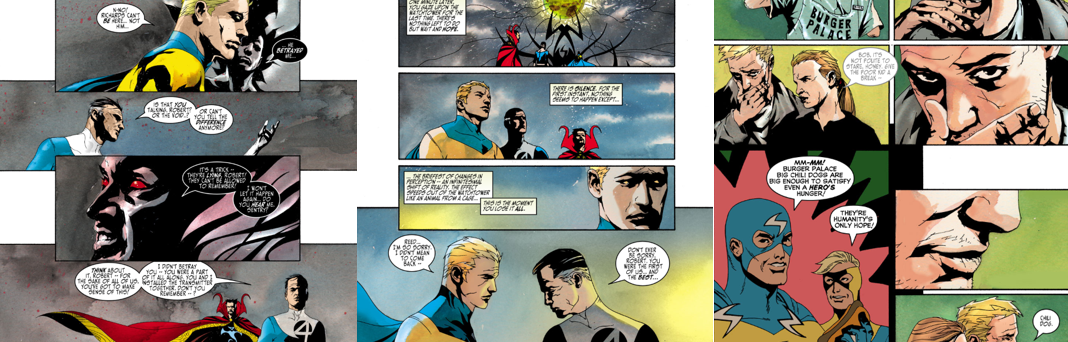
Faced with the Void’s pending arrival and the potential end of the world, the Sentry steels himself, with friends and foes at his back, for the assault. The Void attacks with “infinitendrils” that sap even the Sentry’s abilities and confidence. The trinkets the Sentry gifted to his allies barely keep them from succumbing to the Void’s influence and unnamed heroes and untold civilians die as the Void’s attack decimates the city. During the chaos. Dr. Strange prompts Reed to remember when the Void attacked Manhattan in the past, causing catastrophic damage and leaving a pile of slaughtered bodies in his wake, only for Susan Storm/The Invisible Woman to discover the Void and the Sentry were one and the same! In the face of the Void’s destructive power, which left a million people dead, and faced with a man they’d known and respected and could clearly see was suffering a psychotic episode that manifested in a separate personality, Reed and Bob came up with a plan. After Bob shared his concerns about himself and admitted to his addiction, the two constructed the hypnotic transmitters to ensure that no one, not even Bob, would remember the Sentry, thus keeping the Void at bay. Thus, at Bob’s insistence, the Sentry’s death was faked, his funeral staged, and his reputation tarnished to ensure that the people who loved and admired him so much would submit to the hypnosis. In the present, the physical and existential battle between the Sentry and the Void rages, breaking even the Hulk’s super-tough body, until Reed intervenes. Although the Void whispers poison in Bob’s ear, fuelling his confusion and anger, Reed triggers Bob’s memories, much to the Void’s anger. Desperate to live and to wreak havoc, the Void threatens to take full control of Bob’s body, so the Sentry rushes back to C.LO.C. alongside his allies. After a moment’s hesitation, the Sentry orders C.L.O.C to reactivate the transmitter and Bob gets a brief moment to reconcile with his best friend before their memories are wiped. In the aftermath, the devastation is blamed on a “temporal anomaly” and Bob returns to his mundane life with Lindy. However, when they stop for a bite and are served by Billy, a flash of a memory suggests the Sentry may not be completely forgotten…
The Summary:
This was my first time reading the Sentry’s debut story arc and I was quite excited to get into it. I don’t know much about the Sentry, but I remember his debut being quite a big deal and have seen it being talked about, and seen him pop up in a few crossover events and such, so I was eager to get into this and see if it lived up to the hype. Unfortunately, I really don’t think it did and I was left a bit disappointed. For starters, it bugged me that the story wasn’t contained in a five or six-issue arc. Instead, we have five issues laying the foundation for the Sentry and the Void, a couple of team-up stories that take between #5 and The Sentry vs. The Void #1, and that standalone resolution to the arc. This was a story clearly written for trade collections, which is fine on paper as that’s my preferred way to read comics, but it’s pretty damn arrogant of Marvel Comics to assume that people are going to be this heavily invested in their brand-new superhero right off the bat. Luckily, the central concept has a lot of legs to it, and I did enjoy the story as a very different, more cerebral superhero tale. It’s always engaging and interesting when comic books are more than just big superhero fights or cosmic events, and the Sentry’s debut definitely delves more into the psychological thriller genre as Bob, Reed, and the reader try to piece together the truth about this strange and apparently forgotten character. The mystery of the Void was equally well done and I liked that he was perceived as a world (well, universe) ending threat and the sense of desperation behind him. The idea that someone or something was so dangerous to all life that even the Avengers and the Fantastic Four blurred their morals to erase the minds of everyone in the world is very powerful and still holds up now, even knowing the truth about the two.
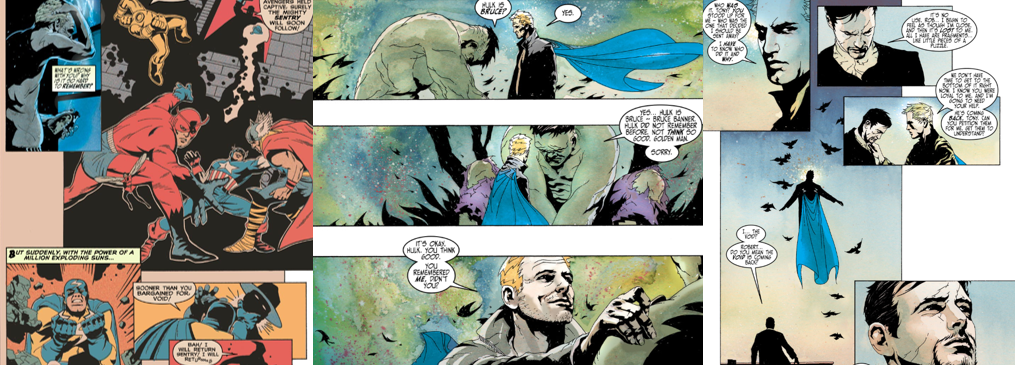
I liked that Bob is presented as an out of shape everyman. He’s a nobody whose wife barely seems to tolerate him and who’s haunted by nightmares and faded memories that could just as easily be comic books he read as a kid. When something (it’s not clear what) triggers the revival of the Void, Bob’s ordinary life is turned upside down and his body undergoes a slow and dramatic change upon drinking the mysterious serum that makes him an all-powerful demigod. I’m not sure how this transforms his costume or why a simple potion can give him such incredible power, but Bob’s memories, personality, and sense of self worth return the more he indulges in the serum and the more he meets with his old allies. Even his physical appearance changes, returning him to the superman physique he enjoyed in his prime, and his trip down memory lane changes many preconceptions of existing Marvel heroes. The Sentry is said to be the “first” costumed superhero, the one who inspired all the others, and his deeds were almost incalculable. He tamed the Hulk, was best friends with Reed Richards, scored Peter Parker his first Pulitzer Prize, and saved the world countless times. Indeed, this debut story goes out of its way to really hammer home that the Sentry was the bastion of all that’s good in the world, that no one could compare to him, and that he was the example others lived by. He had an elaborate headquarters in the heart of New York City, a kid sidekick, and all kinds of gadgets, making him very much a child’s perfect amalgamation of what makes a good superhero. It’s a bit grating, to be honest, primarily because we don’t really get to see any of the Sentry’s past deeds. We simply hear people talk about them and how great he is, with little evidence to back it up since even Bob barely remembers fact from fiction. Equally, we never get to see any of the Sentry’s incredible and much-touted powers beyond a few brief glimpses. Sure, he can fly and take a hit, but I’m not sure what “the power of a million exploding suns” means or how it scales with, say, the Hulk or Thor Odinson.
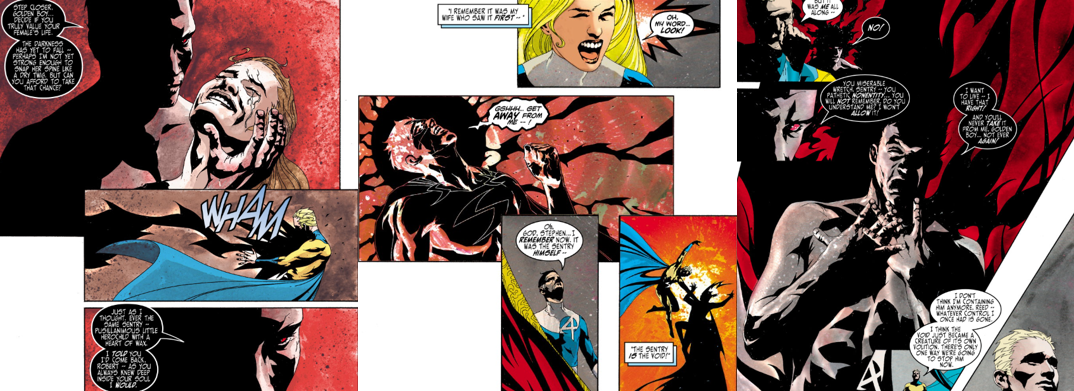
I really enjoyed the panels that reflected other artists and key eras in comic book history. They went a long way to keeping up the ruse that the Sentry was a long-forgotten hero from Marvel’s glory days, dusted off and reinserted into mainstream continuity. In fact, I’d go as far as to say that we should’ve gotten more of these. They could’ve helped flesh out Bob’s backstory and past exploits, his relationship with Billy, and maybe retroactively insert him into key moments in Marvel history. Instead, they’re just fun panels that don’t live up to their potential, which is a shame. While you could argue that the mystery surrounding the Void, how stubbornly cagy Dr. Strange was and how fragmented records were, hinted towards the final reveal as much as Bob’s obvious unstable mental state, I think it landed really well. There’s a degree of responsibility on the reader’s part to understand that things aren’t quite what they seem. When the heroes assemble to help repel the Void in the finale, they’re not necessarily standing with the Sentry against the oncoming storm. Instead, they’re observing him violently lashing out as the Void reasserts control. While I would’ve liked more panels devoted to the destruction, it’s painted as the greatest threat the world has ever seen and one that the heroes are unable to stop through conventional means. It’s only by appealing to the man they once knew that the heroes manage to contain the Void once more, convincing Bob to make the ultimate sacrifice one more time since his powers and mentality are too unstable to be trusted. It’s a very unusual and dramatic end to a superhero story and paints the Sentry as a very fragile and complex character, one who would continue to suffer from his mental health issues and addictions in subsequent appearances. Unfortunately, I do feel the execution was a bit lacking and the story didn’t quite live up to its full potential. This seems par for the course with the Sentry, who doesn’t seem all that relevant these days, which is also a shame as I really think there’s something here and that it’s a very unique way to introduce a new superhero and supervillain.
My Rating:
Pretty Good
What did you think to the Sentry’s debut story, and the character in general? Were you surprised and excited by the unusual depiction of the character? Did you guess that the Sentry and the Void were the same person or was it a surprise for you? What did you think to the Sentry being retroactively inserted into Marvel continuity? Do you agree that the story fell a little flat in the end or were you intrigued to see more? What are some of your favourite moments involving the Sentry? Which of Marvel’s Superman knock-offs is your favourite? Whatever your thoughts on the Sentry, leave a comment below, support me on Ko-Fi, and check out my other Marvel content on the site.

 Dr. K's Waiting Room
One thought on “Back Issues: The Sentry #1-5 / The Sentry vs. The Void #1”