
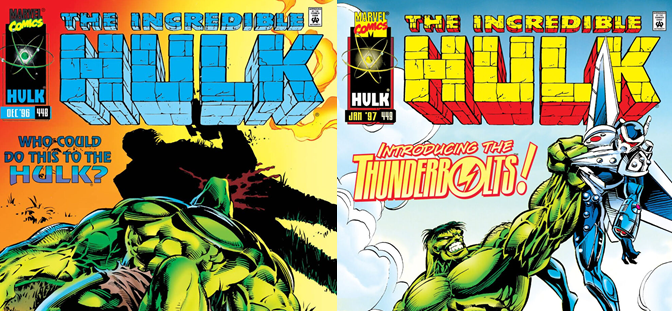
Story Title: “Line in the Sand”
Published: 16 October 1996 (cover-dated: December 1997)
Story Title: “Brakoow”
Published: 20 November 1996 (cover-dated: January 1997)
The Background:
The creation of Stan Lee and Jack Kirby, Doctor Robert Bruce Banner and his monstrous alter ego, the Incredible Hulk, was inspired by stories of incredible strength and classic screen monsters. While the Hulk’s publication history got off to a rocky start, he found his footing and a place in the mainstream lexicon thanks to a popular live-action series, and soon he was facing all manner of monstrous foes and battling his complex inner demons. Easily one of the most influential figures in crafting the Hulk’s stories was Peter David, who not only redefined the relationship between Banner and the Hulk but also pitted him against a tyrannical future version of himself! Back in the mid-to-late nineties, Marvel Comics was in a bit of a state, both financially and in its publications after the horrific events of the long-running “Onslaught Saga”. This saw some of Marvel’s most popular characters presumed dead for a time and, to fill the void, Peter David created an all-new superhero team, the Thunderbolts, who debuted in these two issues. Initially presented as heroes of the typical nineties ilk, the Thunderbolts were later revealed to be the villainous Masters of Evil in disguise though, in a double twist, many would find redemption through their heroic actions. The Thunderbolts continued to operate as a heroic (or, at least, anti-heroic) team, battling the likes of the Skrulls, recasting them as the “Dark Avengers”, and even encountering Mephisto! The Thunderbolts have also appeared outside ethe comics, popping up in a few Marvel cartoons and videogames, and a heavily altered version of the team was even assembled for a live-action venture in the Marvel Cinematic Universe.
The Review:
Those who are familiar with the Hulk’s time travelling jaunt into one of Marvel’s many possible, dystopian futures may recognise Janis Jones, granddaughter of perennial sidekick Rick Jones, accompanying the Hulk throughout this two-part story. After being aided by the Hulk in the past (well…the future…), Janis popped back in time to recruit the Hulk’s help a second time, only to find him regressed to a more savage and child-like personality. Unfortunately, Janis couldn’t use Doctor Victor Von Doom’s time portal, so she’s stuck in the past thanks to her grandad’s tech being unreliable. Even worse, the Hulk refuses to help her, though this doesn’t stop her hanging around in the hopes of changing his mind. Meanwhile, over at the Pentagon, Colonel Cary St. Lawrence butts heads with the government, who are once again preparing to track down and subdue the Hulk due to his unpredictable and aggressive personality, and she has to fight to be part of the team. As if her frustration and suspicion of some kind of cover up weren’t enough, Cary is accosted by Major William “Matt” Talbot, nephew of the Hulk’s long-time nemesis Major Glenn Talbot, who warns her to give up her crusade against the Hulk lest it destroy her as it did his uncle and General Thaddeus “Thunderbolt” Ross. After giving Talbot the cold shoulder, Cary returns home, only to find the shady Nathan Taylor/Paris of the Pantheon, a super-powered group descended from the legendary Agamemnon who have their own sights set on the Green Goliath. Though unimpressed, Cary watches as Paris shows her a video feed of his cohorts – Ajax, Atlanta, Cassiopeia/Cassie, Hector, and Jason – launch a surprise attack on the Hulk and Janis Jones.
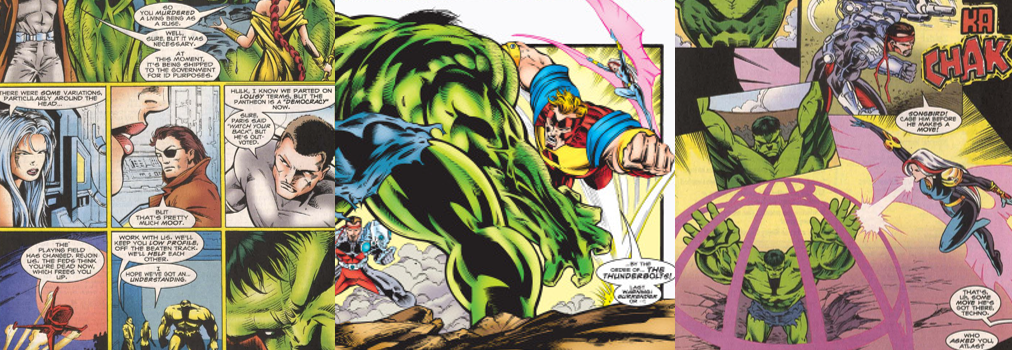
Though the Hulk easily tanks Cassie’s “stellar blasts”, Janis is stunned when Ajax shrugs off a blast from her rod. When a supersonic clap from the Hulk sends his teammates flying, the thick-headed Ajax rushes the creature, determined to prove himself the Hulk’s physical (if not intellectual) superior. Unfortunately, we and Cary are denied seeing the skirmish as the video feed suddenly cuts out. When it returns, Cary is shocked to see the Hulk has been taken down by three bullets right to the head courtesy of the sharpshooting Jason. Amazed, but no less unnerved by Paris’s demeanour, Cary rushes to inform the Pentagon. However, it’s quickly revealed that the Pantheon engineered a clever ruse by executing a mindless clone of the Hulk all to try and gain the brute’s allegiance once more. Just as Cary’s convincing the Pentagon that the Hulk’s been put down for good, the Jade Giant arrives right on their doorstep alongside Janis. The two deliver the military an ultimatum: attack the Hulk and he’ll counter-attack by trashing a major American city, all while making it clear that he was provoked by the United States government. After delivering their threat, the two are shot down over Arizona when the Hulk collides face-first with a missile! Stuck in freefall with a nasty end awaiting her, Janis is rescued by Abner Jenkins/Mach-1, an armour-clad soldier who believes she’s in danger from the Hulk. Janis quickly blasts him away, only for the Hulk to be approached by Mach-1’s cohorts – Erik Josten/Atlas, Karla Sofen/Meteorite, Melissa Gold/Songbird, and Norbert Ebersol/Techno, collectively known as the Thunderbolts – to whom the Green Goliath unexpectedly surrenders! Naturally cautious, the group takes no chances: Techno covers the Hulk with his massive back cannon and Songbird cages the Hulk inside a prison of pure sound waves. Disturbed by the Hulk’s strange behaviour, Meteorite asks for back-up, causing Mach-1 to abandon his fight with Janis and the time traveller to give chase.
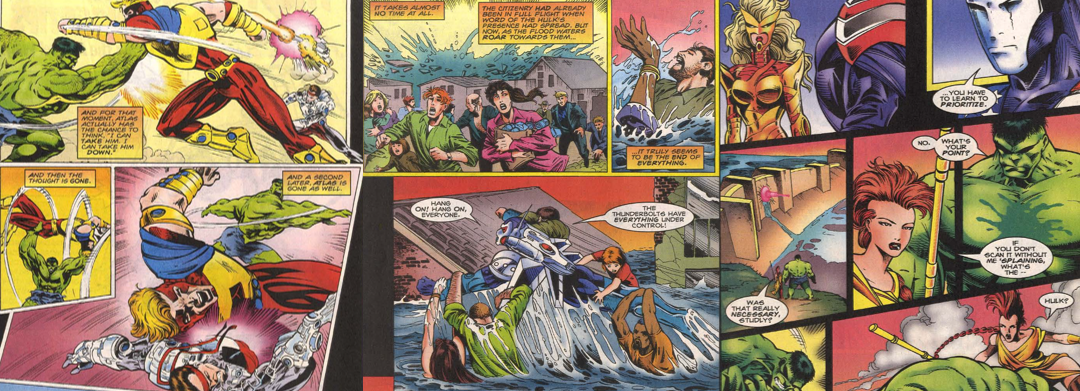
Mach-1 joins his comrades alongside their mysterious leader, Citizen V (later revealed to be Baron Helmut Zemo), a stars-and-stripes patriot who demands to know what the Hulk is up to. Gleefully, the Hulk reveals he was waiting for them all to gather in one place and easily dispels Songbird’s sound barrier with a clap of his hands. In retaliation, Mach-1 and Techno fire missiles and concussive blasts at the Emerald Giant, knocking the Hulk from the sky as he tries leaping to safety. Unnerved to find the blast not only hurt but caused him the bleed, the Hulk is saved by Janis from a two-pronged attack from Mach-1 and Meteorite. When the Hulk sees his friend assaulted by psionic daggers courtesy of Meteorite, he flies into a rage, easily overpowering the hyper muscular Atlas and tossing him at his teammates. Determined to keep the Hulk from hurting innocent people, the remaining Thunderbolts circle him and the Hulk has a brief flash of familiarity with Meteorite (he recognises her voice, but not her face, from past encounters with her supervillain persona, Moonstone). The Hulk then decides to put their conviction to the test and launches himself at a nearby dam, endangering the neighbouring town and forcing the Thunderbolts to abandon the conflict to save their lives. After Songbird plugs the hole, Citizen V orders Techno to help deescalate the damage and lectures Meteorite on getting her priorities straight since she’s fuming at being denied the chance to continue her vendetta against the Hulk. When questioning the Hulk’s motives, Janis’s shock at his inhuman actions turns to panic when he suddenly keels over in pain. For those wondering, the Hulk continued feeling incredible pain and a longing for power and respect, despite being stronger than ever, which drove him to revisit the site of his birth, ponder the Maestro’s skull, and to inexplicably take Duck Island hostage, christening it “Hulk Island”. Naturally, this leads to an alternative Hulk showing up to beat some sense into the Hulk, whose traumatic past has been exacerbated by recent encounters with the malevolent Onslaught, eventually leading the Hulk to isolate himself in a frigid wasteland.
The Summary:
If you’re looking for a classic Hulk tale of an ostracised man-monster lashing out at those who hate and fear him, you’ve come to the wrong place. The Hulk is surprisingly morose in this two-part tale and stuck in a strange place, apparently due to the influence of Onslaught. This was a turbulent time in Marvel Comics because of that God-like supervillain, the psionic amalgamation of Erik “Magnus” Lehnsherr/Magneto and Professor Charles Xavier/Professor X. Many of Marvel’s heroes were killed or missing, trapped in a “pocket dimension”, and the being’s incredible power seems to have scarred the Hulk in more ways than one. Previously a more intelligent and stable combination of Banner and the Hulk, the Hulk is now lethargic, spiteful, and brooding, outright threatening to attack major cities and even endangering countless lives by breaching a dam! Despite wanting no part in Janis’s mission to save her future, the Hulk doesn’t seem to mind her tagging along with him, perhaps out of some vague recollection of their past encounter. Indeed, the events of “Future Imperfect” (David, et al, 1992) directly inform these issues, which act as a continuation of sorts. The Hulk doesn’t entirely remember that adventure, but his instincts tell him Janis is an ally and he later showcases some distant memory of the Maestro’s end. The next few issues show the Hulk uncharacteristically taking control of a town and forcing them to praise him as their harsh (but fair) saviour, something that’s very Maestro-esque, and the Hulk is crippled by bouts of pain and a desperate need to attain something more, something beyond solitude or conflict. This seems to make the Hulk more unpredictable than ever; even Cary is torn regarding him since he seemed to be an ally until recently. The Hulk’s return to a more mindless and aggressive persona upsets the Pentagon and turns the military against him once more, setting the stage for the bouts that pepper these issues and the Hulk’s decision to issue an ultimatum that’ll see him retaliate with deadly force if provoked!
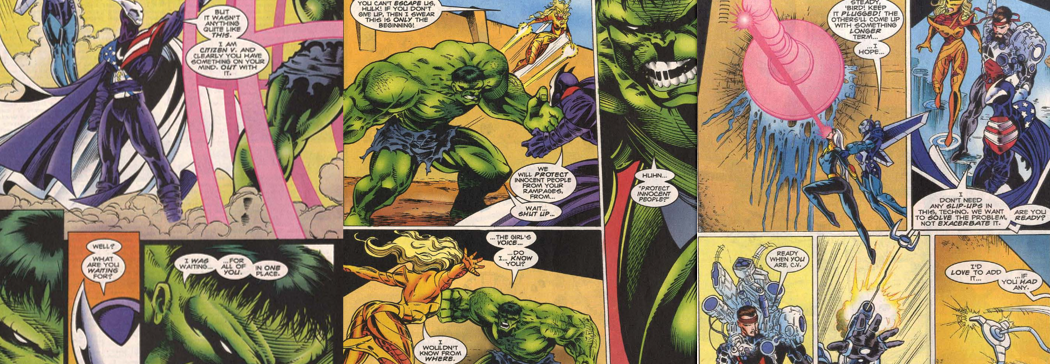
These issues were honestly quite the learning curve for me. A fair bit of back reading is required to understand the Hulk’s beef with the Pantheon, who claim to want him dead but actually want to recruit him. It seems like the Hulk is tempted by the offer and that input from the Pantheon leads to him threatening the military, but they disappear after issue #448 and have no impact on the next few issues. Instead, they’re replaced by an all-new team: the Thunderbolts. On the surface, the Thunderbolts are largely indistinguishable from the Pantheon: there’s a super-strong muscleman, a psionic female, and a more intellectual mastermind on both teams, for example. The battles between the Hulk (and Janis) and both teams are also largely similar and lacklustre. While both the Pantheon and the Thunderbolts have the numbers and some power, it’s not enough to stand against the Hulk’s unbridled rage. Indeed, the Thunderbolts seem less cohesive as a team since they’re easily tossed into each other by the Hulk and seemingly incapable of making big, independent decisions without Citizen V’s presence. While the Pantheon’s motives may be shady and questionable, with Paris seemingly playing both sides, the Thunderbolts are presented as misguided but purely altruistic. They seem genuinely determined to put a stop to the Hulk’s rampages and save innocent lives and immediately leap into action when he breaks a dam and endangers civilians. Of course, this is all revealed to be a ruse later down the line, as it turns out that they’re notable supervillains posing as heroes in the Avengers’ absence, but none of that is a factor here. Sure, there’s an odd moment where the Hulk recognises Meteorite’s voice and Citizen V acts a bit suspicious, but there’s no reason to think these are anything other than the latest crop of poorly designed, mid-nineties superheroes trying to rub shoulders with more popular and iconic characters. Frankly, I expected more and was left disappointed by how brief the Thunderbolts’ appearance is. Judging by ads in subsequent issues, their appearance here was simply to sow the seeds of their ongoing title and begin a six-month storyline where they’re positioned as the newest heroes before being revealed to be the Masters of Evil in disguise.
My Rating:
Could Be Better
Were you impressed by the first appearance of the Thunderbolts? Did you think the team was a good substitute for the Avengers? What did you think of the Hulk’s unstable personality at this time? Did you also find the Pantheon and the Thunderbolts to be largely indistinguishable? What did you think of the later reveal of the team’s true identity? If you have any thoughts on the Thunderbolts, drop them below, support me on Ko-Fi, and be sure to check out my other Marvel content.

 Dr. K's Waiting Room
One thought on “Back Issues: The Incredible Hulk #448-449”