On this day, the 23rd of November, in 1963, the longest-running and most successful science-fiction television series ever, Doctor Who, first aired on BBC One in the United Kingdom. Since then, the rogue Time Lord has gone through numerous incarnations and is widely celebrated as one of the most iconic and recognisable mainstream cultural icons in the world.


“The Day of the Doctor”
Air Date: 23 November 2013
UK Network: BBC One
Stars: Matt Smith, David Tennant, John Hurt, Jenna Coleman, Jemma Redgrave, Ingrid Oliver, and Billie Piper
The Background:
In 1963, the BBC’s Head of Drama, Sydney Newman, commissioned a show that would appeal to be children and adults alike to fill a gap in the BBC’s schedule, one eventually outlined by writer Cecil Webber. The result was Doctor Who, a long-running science-fiction franchise in which a time travelling alien delighted audiences with historical hijinks, battles against terrifying cybernetic aliens, and emotionally charged morality tales. Save for a hiatus in the 1990s, Doctor Who has been a BBC staple for decades, with various actors stepping into the role thanks to the character’s unique ability to “regenerate” when dying. While debates rage about who is the best Doctor, two names often top the rankings: Tom Baker and David Tennent. After five years as the popular Tenth Doctor, Tennent finally passed the torch to Matt Smith, who won over audiences with his youthful exuberance. However, in the style of his predecessors, Tennent returned to the role for this 50th anniversary, reuniting with co-star Billie Piper (though in a dramatically different role). Tennent and Smith joined legendary actor John Hurt, who readily agreed to join the show and had been previously teased as a forgotten incarnation of the Doctor earlier that year. Accompanied by a short cinema release and two short tie-in episodes, The Day of the Doctor was simultaneously broadcasted in 94 countries to avoid plot leaks and met with critical acclaim. Reviews loved the chemistry between the three Doctors and its celebration of the show’s rich history, though the Zygon sub-plot and the handling of the War Doctor was criticised.
The Plot:
A Zygon plot to destroy London sees the Eleventh (Smith) and Tenth (Tennant) Doctors crossing paths with their former renegade incarnation (Hurt). Together, they reconcile their past by revisiting the last days of the Time War between the Time Lords and the Daleks.
The Review:
The Day of the Doctor takes place during a pretty tumultuous time in the Eleventh Doctor’s life. Most of Matt Smith’s run focused on the Doctor’s ultimate end, a seemingly unavoidable fate that would one day see him buried within his own embiggened TARDIS on the barren wasteland known as Trenzalore. Despite being fully aware of the finality of this inevitability, the Eleventh Doctor continues to be his usual energetic self, a quality I really came to enjoy about Matt Smith’s portrayal and one that juxtaposed his youthful appearance and childlike enthusiasm with a haunted, sombre, aged demeanour at times, both aspects of his personality that are exhibited in this 50th anniversary special. Indeed, the Eleventh Doctor is excited to be heading to the National Gallery with one of his most beautiful and charismatic companions, Clara Oswald (Coleman). He is summoned there by the Unified Intelligence Taskforce (UNIT) and meeting with Kate Lethbridge-Stewart (Redgrave), daughter of the Doctor’s old military correspondent Brigadier Alistair Lethbridge-Stewart (Nicholas Courtney, represented through archival pictures). The Eleventh Doctor relishes his impromptu helicopter ride over London and showing off his status amongst the UNIT personnel to Clara (who, despite having wandered through all of the Doctor’s lives, had no knowledge of his past ties to UNIT). Kate shows the Doctor a mysterious painting he knows all-too-well, a graphical depiction of the last day of the Time War; specifically, the fall of Arcadia and the day the Doctor, in a previous, hitherto unknown incarnation, personally ended the conflict. Since Doctor Who returned in 2005, the mystery of the Time War and the impact it had on the Doctor had been hanging over the show, and his demeanour, like a dark cloud. Burdened by guilt and scarred by the atrocities of war, many of which he perpetrated, the Doctor has effectively been running from his past for years now, but The Day of the Doctor forces him to confront in ways he never imagined.

The main plot of the special revolves around, of all things, the Zygons. These monstrous shapeshifters try to conquer the Earth by subduing and replacing key figures in human history. One of their earliest efforts occurs back in 1562, when a Zygon attempted to replace Queen Elizabeth I (Joanna Page). Luckily, Queen Elizabeth was swept up in a whirlwind romance with the Tenth Doctor at the time, though even his cobbled together technology, intuition, and previous experience with the Zygons proves largely incapable of detected the Zygon threat. Time and again, both he and his successor fail to spot who’s a Zygon and who isn’t, leading to the Tenth Doctor putting his foot in it when he accuses the real Queen Elizabeth of being a bad fake. Luckily for him, he’s a dishy time traveller and she’s more amused by his incompetence than annoyed by his accusations. She also proves more capable than he is, fooling the other Zygons with her own impersonation skills (though, to be fair, he was distracted by his other incarnations). In the Eleventh Doctor’s time, the Zygons impersonate Kate and UNIT staff like Petronella Osgood (Oliver) to access the “Black Archive”, a super-secret vault deep within the TARDIS-proofed Tower of London that provides the Zygons with the means to take over London. Of all the threats to bring three incarnations of the Doctor together, the Zygons are disappointingly weak. They’re clunky, awkward creatures and this B-plot merely serves to unite the bickering Doctors and provide them the inspiration for saving their people. The Zygons have been using Time Lord technology to freeze themselves in paintings and covertly invade other worlds, technology that the Doctors use to briefly revisit the Time War and to travel back to the present day to force the humans and Zygons into an amicable truce rather than mutual destruction. They’re not a very compelling enemy (the Sontarans would’ve been much better), though they are defeated in an interesting way (the Doctors force both groups to temporarily forget which species they are). Naturally, the Daleks do appear, but merely as a cameo and purely in sequences depicting the chaotic Time War, where their power was at their mightiest and their thirst of victory was matched by the Time Lords.

The Day of the Doctor firmly explains that, during the Time War, the Doctor took on a new face and forsook his name and title. Dubbed “The War Doctor”, this new incarnation fought a ruthless battle against his mortal foe for untold generations. The very nature of the Time War meant it existed in perpetuity, with victories, loss, deaths, and resurrections all happening at once. Finally, after an age of nonstop violence, the War Doctor decided he had had enough. Now aged to an old, battle-weary warrior, he took it upon himself to end the bloody conflict the only way he knew how. Thus, he broke into Gallifrey’s weapons facility and stole a doomsday weapon so destructive even their military General (Ken Bones) was afraid of it. A strangely archaic cube of cogs, the “Moment” can wipe out entire universes and is powered by a sentient artificial intelligence. Taking the form of a figure it knows is (or will be) important to the Doctor, the “Bad Wolf” (Piper), it questions the War Doctor’s motivation and, in a bid to show him what wiping out every single man, woman, child, and Dalek, will do to him, conjures a time vortex to show him his future selves. Honestly, I was never a fan of the War Doctor concept; I would’ve much preferred Paul McGann or Christopher Eccleston returned to portray this role rather than retroactively bump up the Doctor’s incarnations. However, you can’t go wrong with John Hurt and he portrays this forgotten, reviled incarnation with gusto. Despite being beaten down by war and technically being younger than his counterparts, the War Doctor is a cantankerous, grandfatherly figure who initially admonishes his successors’ buffoonery. He’s stunned that they don’t seem to take anything seriously or treat their equipment with respect and, much like the First Doctor (William Hartnell) in the first multi-Doctor special, is portrayed as the more authoritarian and sensible of the three despite being at least 400 years younger than them.
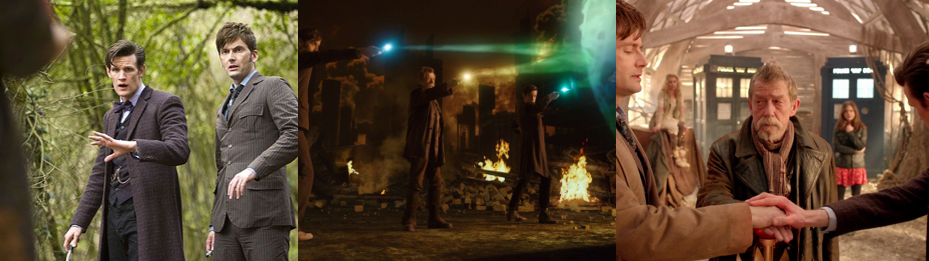
The Tenth and Eleventh Doctor are horrified to see their renegade incarnation, treating him as a dangerous, almost bogeyman-like figure from their past that they’ve buried deep at the back of their minds. Prompted by the Moment, the War Doctor asks pertinent questions to understand how committing genocide will affect him and learns that the Tenth Doctor was haunted by the decision and the Eleventh has tried to move on and forget about it. The Tenth is outraged at such a suggestion, stunned to find his future self has gotten over the worst decision they ever made, but it’s clear that the Tenth Doctor is still tormented by his past and simply trying to find a productive way forward. While they take an instant dislike to each other (the Tenth Doctor hates his successor’s new TARDIS interior, as is tradition), the Tenth and the Eleventh Doctor have a lot in common. Both favour spectacles, suits, and being more flamboyant with their sonic screwdrivers, eschewing the War Doctor’s more practical and scientific approach for a dramatic flair. The Eleventh Doctor is largely critical of his predecessor’s more theatrical approach, especially his way with women, while the Tenth Doctor criticises his successor’s dress sense (particularly the fez). The two bicker here and there but mostly engage in a game of one-upmanship, comparing their sonic screwdrivers and competing to see who can solve problems faster, with both being trumped by the War Doctor’s more measured approach. Hardened by their past experiences and desperate to keep Kate from making the same mistakes, the two intervene to reach a more amicable solution and the War Doctor sees that his decision, while horrendous, will save countless lives since his future incarnations try to atone for their past. Their adventure together sees the Tenth and Eleventh Doctor embrace their forgotten counterpart and, in a bid to help the War Doctor face his decision, they willingly join him in activating the machine, only for Clara’s distraught reaction to show them they can come up with a better solution.

Inspired by their solution to have their sonic screwdrivers calculate a formula to vaporise a door (a plan amusingly foiled when Clara reveals their cell was never locked!), the Doctors use their TARDISes to collude with all twelve thirteen of their other incarnations to utilise the Zygon picture-hopping technique and shift Gallifrey to, essentially, a pocket dimension, destroying the Daleks in the process. While the General initially resists since it would mean the Time Lords are trapped in another dimension, he relents since it means the survival of their race and the Thirteen Doctors co-ordinate their TARDISes to execute the plan, sparing Gallifrey and undoing the Doctor’s darkest moment. Unfortunately, due to the unstable timelines, none of the three will remember this and the War Doctor resigns himself to having to live thinking he committed genocide, knowing he’s earned his title once more and that he’ll be succeeded by such fine men and welcoming his regeneration into the Ninth Doctor (Christopher Eccleston). The Tenth Doctor also urges the Eleventh Doctor to find a solution to their impending demise at Trenzalore, reasoning that their actions in this adventure prove they can always find some way out. Left to ruminate over the depiction of Gallifrey’s last stand, the Eleventh Doctor is visited by a strangely familiar curator (Tom Baker), who hints both that he’s a future incarnation and that the Doctor’s next journey will see him trying to recover his lost people. Of course, The Day of the Doctor was also accompanied by two short tie-ins. While “The Last Day” (Stone, 2013) isn’t that great and weirdly depicts a first-person account of the Daleks’ invasion of Arcadia, “The Night of the Doctor” (Hayes, 2013) saw the long-awaited return of perhaps the most underappreciated Doctor, the Eighth (Paul McGann), and showed how he regenerated into the War Doctor. After failing to save a doomed pilot since the Time Lords are as reviled as the Daleks, the Eighth Doctor is offered a chance to regenerate into a warrior by Ohila (Clare Higgins) of the Sisterhood of Karn, forsaking his name and passive ways in favour of a new form more fitting for a violent war.
The Summary:
As you’d expect from a 50th anniversary special, The Day of the Doctor contains a fair few Easter Eggs and references for long-time series fans. The opening, for example, is basically a shot-for-shot remake of the first-ever episode, An Unearthly Child (Hussein, 1963); Clara teaches at Coal Hill School; the Tenth Doctor echoes the Second Doctor (Patrick Troughton) with his “I don’t like it line”, and the General echoes the Brigadier when multiple Doctors show up. The Black Vault is full of gadgets and callbacks to previous adventures, including photos of previous companions and incidents, and much of the special refers back to the Tenth Doctor’s era. Perhaps the most exciting inclusion was the brief appearance of Peter Capaldi as the upcoming Twelfth Doctor, which was a fun tease that hadn’t been done before. All the Doctors (at that point in time, anyway) cameo in the finale thanks to archival footage and some rather disconcerting digital stand-ins, but it’s Tom Baker’s heartwarming reappearance as a possible future incarnation that steals the show at the end. Honestly, I’m surprised by the restraint, really. There could’ve been loads more lore and cameos and references stuffed in here but, instead, The Day of the Doctor wisely focuses on exploring this unknown chapter of the Doctor’s life and tying into what viewers saw with the Tenth and were currently experiencing with the Eleventh. The special is thus a story of grief, mourning, and dealing with difficult decisions. The Tenth and the Eleventh Doctor are haunted by their actions and the War Doctor is hesitant to activate the Moment but comes to see that the deaths of billions will safeguard innumerable other lives. The relief he feels when his counterparts suggest a wild, outrageous third option is palpable and all three get a sense of catharsis from undoing this one heinous act that scarred them for so many years.
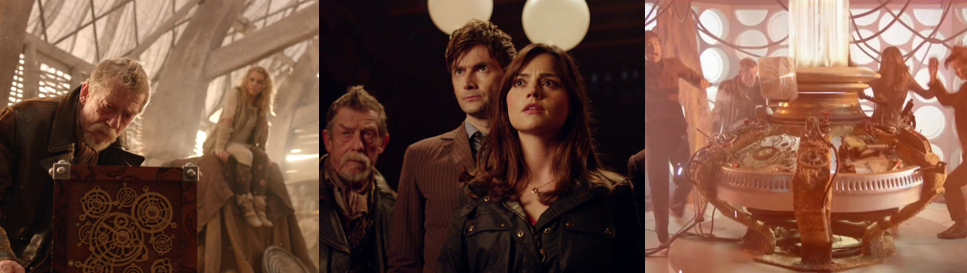
While I’m no fan of Billy Piper and never liked her portrayal of Rose Tyler, it was nice to see her here as the Moment, an advisory, sentient AI only the War Doctor can see and hear. Through her, he meets his successors and sees that, while his actions will be traumatic for him, he’ll eventually grow beyond it and also put his lives to good use saving others as recompense. I’m not sure where the Tenth Doctor is being pulled from in his time stream but he’s a little more haggard and broken than what we usually see. He’s still cracking wise and masking his pain behind a bombastic façade, but it’s clear he’s being written to still be very raw over his actions in the Time War. In comparison, the Eleventh Doctor is just as haunted but has found more productive ways to cope. He attacks life with a youthful exuberance and delights in every adventure, determined to help whenever he can so that his dreadful actions can have some positive meaning in the universe. This makes Clara’s intervention when the three prepare to activate the Moment all the more poignant, since she never pictured “her” Doctor’s face as being responsible for so many deaths. Her presence has a positive impact on the War Doctor, too. It’s clear he hasn’t had a companion for some time and is struggling with the blood on his hands and the path that lies before him, but I enjoyed how he was this gruff old man who whipped his younger/older selves into shape. Again, I still would’ve preferred seeing the Eighth or Ninth incarnation fulfil this role just to make things less messy but the mystery surrounding the War Doctor is intriguing and I like how his counterparts are equal parts ashamed, afraid, and disgusted by him. Yet, in spending time with him and finally confronting this dark and oppressed part of their lives, they come to accept that the War Doctor was and still is a part of them and acknowledge him as a necessary evil in their long lives.

The War Doctor, in turn, comes to feel vindicated and accepted for the first time in ages. Having forsaken his name and pacifist values and committed himself to war for so long, the pride he feels in being known as the Doctor once more shines through and allows him to regenerate with dignity rather than in infamy. While the Zygon subplot isn’t all that interesting and largely detracts from these more interesting narrative beats, I did like how it brought the three together. I just wonder if, maybe, looping in some kind of Dalek plot wouldn’t have been better. Like, maybe Davros (Julian Bleach) or an Emperor Dalek could’ve used the magic picture technology to escape the Time War and threaten to unravel it, spilling it into the universe once more. Sure, we wouldn’t have had the doppelgänger plot or the creative resolution to the Zygon invasion, but it might’ve been more visually and thematically interesting for the three Doctors to team up against their mortal enemy in a more explicit way for the 50th anniversary special. Still, the main selling point here is the exploration of the Time War and the War Doctor’s part in it and delving into how badly his violent actions affected him over the years. This was a constant and recurring thread in the revival series (and even cropped up in later years, especially after Gallifrey was wiped out once again!) and formed a central part of the Doctor’s character from 2005. The Day of the Doctor aims to bring him some catharsis, sewing the seeds in the Tenth Doctor to move past his actions ahead of regenerating into the Eleventh and, in this regard, it succeeds admirably. Throw in some fun cameos, entertaining interactions between the three incarnations, and a solid, emotional narrative core and you have an extremely enjoyable celebration of the long-running franchise.
My Rating:
Great Stuff
What did you think to The Day of the Doctor? Are you a fan of multi-Doctor adventures or do you find that they’re confusing and lacklustre affairs? Is the Tenth Doctor one of your favourites? What did you think to his interactions with his counterparts? Were you disappointed that a new, unknown incarnation was created, or did you enjoy seeing John Hurt take on the role? Would you like to see more multi-Doctor adventures featuring the modern cast? How are you celebrating Doctor Who Day today? Let me know your thoughts on Doctor Who and its 50th anniversary special down in the comments and go check out my other Doctor Who reviews.

 Dr. K's Waiting Room