Although February 2014 was dubbed “Green Lantern Day” (because, by the American calendar, the date read as “2814”, the sector of space assigned to Earth in DC Comics), the significance of this date has passed as the years have changed. Instead, as perhaps the most popular iteration of the character, Hal Jordan, first appeared in October of 1959, I’ve been dedicating every Sunday of October to the Green Lantern Corps!

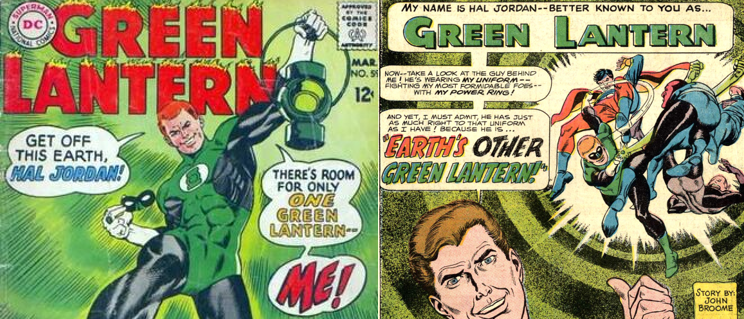
Story Title: “Earth’s Other Green Lantern!”
Published: March 1968
Writer: John Broome
Artist: Gil Kane
The Background:
Martin Nodell and Bill Finger’s original version of the Green Lantern, Alan Scott, was a magically empowered railroad engineer rather than a space-faring peacekeeper. However, following the successfully reinvention of the Flash in 1956, John Broome and artist Gil Kane changed the Green Lantern mythos forever with the introduction of test pilot Harold “Hal” Jordan, widely regarded as the greatest Green Lantern of all time, in 1959. Nearly ten years later, Groome and Kane revealed that Hal was just one of the potential candidates for Abin Sur’s power ring, the other being volatile Guy Gardner, who first debuted in this issue. Not only was Guy relegated to backup status, he soon found himself gravely injured and briefly trapped in the Phantom Zone. Then, he was replaced by another and developed brain damage, becoming even more hostile and egotistical, especially regarding his status as a Green Lantern. Guy is perhaps best known for his time on Justice League International, where he often clashed with his teammates, as much as his unstable temperament, which saw him kicked out of the Green Lantern Corps and wielding Thaal Sinestro’s yellow power ring. Guy’s backstory was significantly altered in the early-1990s, revealing him to be of Vuldarian heritage, before he returned to the Green Lantern Corps as one of Earth’s many emerald defenders. Whether wielding a green, yellow, or red power ring, though, Guy has maintained a vocal fanbase, despite his flaws. Though allegedly cut from the universally derived live-action film, Guy’s appeared, in some form or another, in various DC adaptations and is due to be portrayed by Nathan Fillion in James Gunn’s reimagined DC Universe movies.
The Review:
Our story opens with Hal Jordan on Oa, the headquarters of the Green Lantern Corps and home to the enigmatic Guardians of the Universe, for an intensive two-day training course. Yes, it seems even intergalactic space cops have to endure team meetings sometimes, folks! However, rather than learning trust exercises, Hal is shown a gigantic, Jack Kirby-esque telescope that displays current events all across the universe and even keeps a record of a person’s life after they die as a “mental post-mortem”. Hal jumps at the chance to see the last thoughts of his predecessor, Abin Sur, and to learn why he, of all the millions of people on Earth, was chosen to become his successor. As in Hal’s origin story, Abin is fatally injured in a crash and tasks his power battery to find a worthy inheritor of his power ring, but there’s a twist: the battery claims that there are two equally strong candidates! One is, of course, fearless test pilot Hal Jordan and the other is the hitherto-unknown Guy Gardner, a schoolteacher who lost out on becoming Green Lantern simply because Hal was closer. After reliving Abin’s dying soliloquy over the next few panels, Hal is left astonished to learn that there was another potential candidate. Luckily, the Guardians’ incredible machine can also show Hal potential alternative timelines and, at his request, program it to show what would’ve happened if Guy had been selected instead.
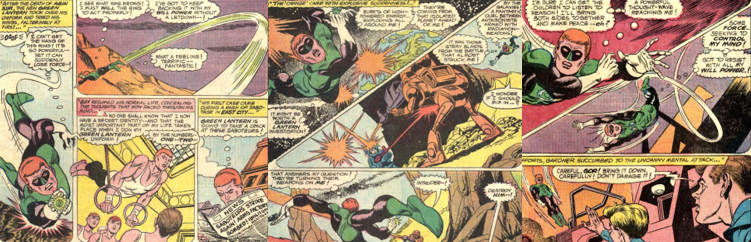
In this version of events, gym instructor Guy is whisked away by the green energy and readily accepts the ring. However, since he’s not subjected to the same monologue as Hal, it takes Guy a hot minute to figure out how to use the ring, though he’s no less committed to using its power to battle injustice as Green Lantern. Like Hal, Guy’s first mission was confronting a group of saboteurs. Unlike Hal, who phased through walls and bullets and was dazed by a yellow lamp, Guy crashes through walls and erects an energy shield to block their bullets, hesitating to directly use his ring against them in case he “[crushes] them to a pulp”. Instead, Guy relies on his physical superiority to beat them into submission. Victorious, he also embarked on a fantastical superhero career, tackling colourful supervillains and even defeating renegade Green Lantern Thaal Sinestro. This victory saw Guy finally summoned to Oa and learning the true extent of his powers and responsibilities, but it’s in his return journey home that the biggest deviations occur between Hal and Guy’s lives. Guy was distracted by a series of intergalactic explosions that saw him detour to the planet Ghera to interject in a duel between two alien robots. Their conflict quickly turns against him, though he easily bested the two droids and learned that the planet is populated solely by human children. The robots explain that the Gheran parents created them before being wiped out by a mysterious yellow plague. This same virus kept the children from growing and, in their boredom, they programmed the robots to engage in war games for their amusement, meaning the planet is constantly in a state of conflict between the orange side and the blue side. Amazed, Guy vows to show the children that they’re walking a dark path, confident that he can teach them the benefits of peace, only to suddenly find himself completely paralysed when the children of the blue side not only sense his presence but take control of his body with their mental powers (a feature the robots conveniently neglected to mention earlier).
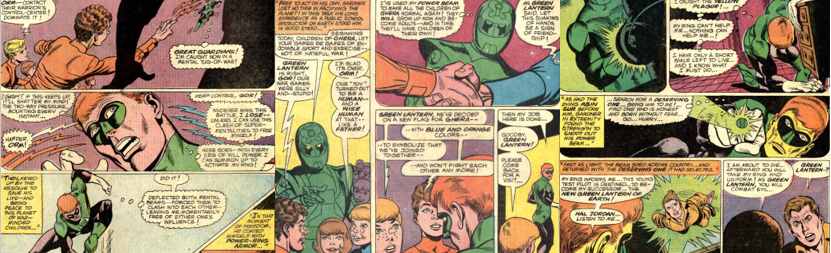
Thinking Guy is an advanced automaton and using their incredible psychic powers to learn his name (but, strangely, not his true purpose), they send him against their enemies. Completely under their sway, Guy has no choice but to obey and is forced to defend them against a mechanical bird the orange’s send to attack the blue’s city. Next, he’s set against the orange’s fish-like submarine, resisting its lightning attacks and scuppering it with a giant green energy hand. Impressed by his abilities, the blue’s send him to wage an all-out attack on the orange’s city. However, after besting their defences, he finds himself caught in a mental tug of war as both sides try to control his mind and body with their mental powers. Desperate to save himself, Guy summons all his willpower to break free and conjure a suit of armour to protect him from further mental attacks. This form is also enough to convince both sides to agree to a parlay; a simple suggestion for “enjoyable sport and exercise” is enough to convince the children to stop their conflict. However, it’s not just Guy’s words that sway the children; he uses his ring to subtly influence them, making them “normal” and unifying them in peace. Pleased, Guy leaves to recharge his ring (uttering an amended version of the classic Green Lantern oath), only to suddenly fall violently ill. Having contracted the yellow plague while on Ghera, Guy quickly finds himself facing certain death and wills his power ring to search out a replacement. The ring brings Hal to him and, just as in the main timeline, the stunned test pilot is gifted the power ring and the Green Lantern mantle, though he “makes up” his own oath since Guy never got to teach him it. Amazed by these visions, Hal returns to Earth to meet Guy in his civilian guise. He joins the same athletic club Guy attends and quickly becomes fast friends with him, eager to keep an eye on him out of respect for his candidacy for the mighty Green Lantern Corps.
The Summary:
“Earth’s Other Green Lantern!” is one of those classic misleading comic books as the cover advertises the promise of a physical confrontation between Hal and Guy, one that sees the upstart Gardner usurp Hal to become Earth’s only Green Lantern. In truth, this never happens, nor is Guy’s personality anything like the cover depicts. Ironically, the cover paints Guy as an egotistical hothead, which would become his defining personality trait, but the actual story shows him to be as bland and generically heroic as Hal. Indeed, much of the narrative is geared towards showing how similar the two are, which I feel is a massive missed opportunity. Hal is excited by the idea that he wasn’t the only one considered as Abin Sur’s replacement, but Hal and Guy’s superhero careers are functionally identical save for Guy having less initial instruction on the ring and his side quest to Ghera. I have no idea if Hal went to this planet and encountered the strange psychic children, but Guy’s time there isn’t massively significant except that it sees him prematurely killed and handing the mantle to Hal, meaning this alternative timeline really isn’t all that interesting. Now, if Guy had been his later cocky, overconfident self, utilising more direct or brutal methods, maybe things would’ve been more interesting. There are hints that Guy approaches his duties slightly differently, such as being more creative with his energy constructs and being more physically capable than Hal, but there’s not enough deviations between the two to really make me care.
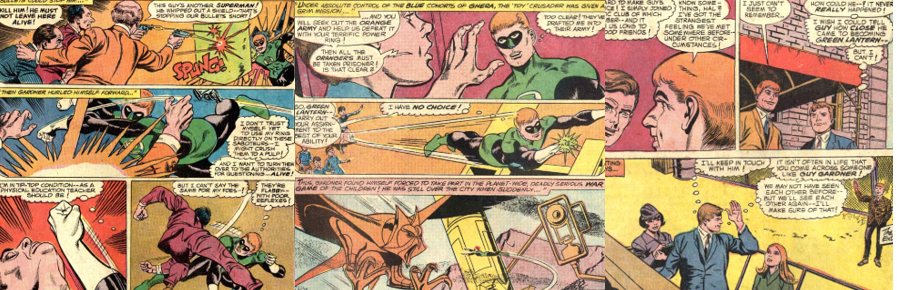
The story tries to say that things took a dramatic turn on Ghera but…they don’t, really, except that it sees Guy killed. It seems like it’s going in a different direction, maybe having the kids turn Guy rogue or expanding on him using his power ring to influence their behaviour and having him be reprimanded for that, but that doesn’t happen either. The Ghera sub-plot is actually quite dull. I enjoyed the Jack Kirby influences on the art and visuals of the planet, but the random mental powers came out of nowhere and their control over Guy seemed more like an excuse to show off his control of the power ring than anything else. Indeed, the whole escapade makes Guy seem secondary to Hal since it took him a while to summon the willpower to shake off their influence, and then he just ends their long-running thirst for war with a few words and subtle influences. I’ll admit that I wasn’t expecting Guy to die at the end, though I probably should’ve considering the nature of the yellow plague. Again, it might’ve been more interesting if the virus had been affecting him throughout the story, adding an extra dimension to his plight, but…again, no. In the end, this read like another of those crazy imaginary stories DC liked to publish in the Golden Age where nothing really matters because it’s all a dream or some elaborate fantasy. Sure, it led to Hal seeking Guy out by the end but even that is a bit weird. There’s no suggestion here that he befriends him in case he needs a backup, it’s more out of curiosity and respect, so I can’t help but feel like the whole issue can be skipped as it’s ultimately meaningless in the short term (and even in the long term, as Guy’s personality was eventually completely different).
My Rating:
Could Be Better
What did you think to Guy Gardner’s debut story? Were you shocked to learn that Abin Sur had two choices to pick from? What did you think to Guy’s characterisation here and were you disappointed by how bland he was? Would you have liked to see more differences between the two and more from the concept? Where does Guy rank in your Green Lantern hierarchy, and what are some of your favourite stories of his? There’s a comments section below, so share your thoughts there and go check out my other Green Lantern content!

 Dr. K's Waiting Room