Although February 2014 was dubbed “Green Lantern Day” (because, by the American calendar, the date read as “2814”, the sector of space assigned to Earth in DC Comics), the significance of this date has passed as the years have changed. Instead, as perhaps the most popular iteration of the character, Hal Jordan, first appeared in October of 1959, I’m choosing to dedicate every Sunday of October to the Green Lantern Corps!

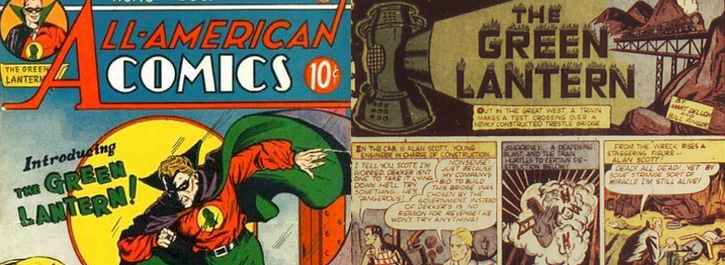
Story Title: “The Origin of Green Lantern” (or simply “The Green Lantern”)
Published: July 1940
Writer: Bill Finger
Artist: Martin Nodell
The Background:
The peacekeepers of the galaxy, the Green Lantern Corps, are popularly known as a space-faring force comprised of various creatures and aliens from across the cosmos, but this depiction of the Emerald Warriors has only been around since 1959. Originally, there was only one colourful superhero known as Green Lantern, Alan Scott. The brainchild of artist Martin Nodell, the Green Lantern was inspired by Richard Wagner’s Der Ring des Nibelungen (The Ring of the Nibelung), the sight of a trainman’s green railway lantern, and elements of Greek mythology. After his pitch for a superhero who wielded a magical ring was approved by DC Comics publisher Max Gaines, Nodell set to work crafting Alan Scott’s first story and soon brought in the legendary (and often forgotten) Bill Finger to help with the project, cementing a partnership that lasted for seven years. After his debut in this issue of All-American Comics, Alan Scott became a regular fixture of both the publication and DC’s first super team, the Justice Society of America (JSA). It’s this association with the JSA that I best know Alan for. As chairman of the group, he fought numerous intergalactic and Lovecraftian threats, gained a degree of eternal youth thanks to various magical enhancements and time dilations, and mentored a new generation of heroes, including his wayward son. Even after he was supplanted by his more sci-fi-orientated successors, Alan Scott remained a prominent figure in DC Comics, gaining additional relevance when he came out as gay in 2020, retroactively establishing him as DC’s first-ever gay superhero. Outside of the comics, however, Alan hasn’t been quite as significant. He missed out on appearing in Justice League (2001 to 2004) and has been largely absent or relegated to brief cameos in other cartoons and live-action shows, potentially due to Warner Bros. often blocking Green Lantern appearances after the critical mauling of Green Lantern (Campbell, 2011).
The Review:
The story opens “out in the Great West”, where s train is making a test crossing over a new-constructed trestle bridge. Alan Scott, the young engineer who spearheaded the bridge’s construction, is in the cab with a colleague to oversee the test run, which seems to be asking for trouble, in my opinion. Indeed, Alan’s colleague is anxious that Alan’s rival, Alert Dekker, might try to sabotage the operation since Alan’s “company” outbid Dekker’s and cost him a big, fat government contract. Although Alan is confident that Dekker wouldn’t try anything, his optimism is immediately proven wrong as the bridge explodes beneath them, sending the train, its carriages, and all aboard crashing into a ravine. By “some strange miracle”, Alan is the sole survivor, merely being shaken up and coming over all queasy as he holds onto a mysterious green lantern. Suddenly, the artifact bursts to life, emitting an “eerie green light” and, even more incredibly, speaking to him! The lantern tells a tale that begins back in ancient China, where a village’s evening prayers were suddenly interrupted by the arrival of a huge meteor. The meteor cracked open before impact, depositing a pool of flaming emerald liquid before their amazed eyes. This Green Flame spoke to them and delivered a fairly ominous prophecy: “Three times shall I flame green! First – to bring death! Second – to bring life, and third – to bring power!” The villagers were in awe, believing the Green Flame had come from the “Evil One”, a subject about which Chang, the lamp maker, knew a great deal thanks to his studies of the “Old Book”, which had raised some suspicions about his intentions.
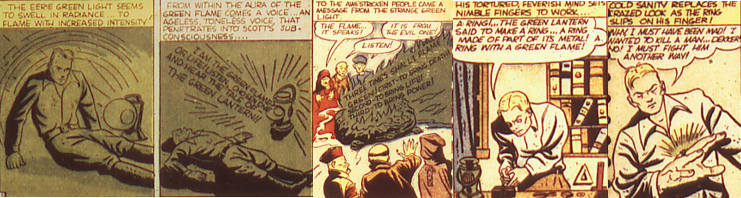
Chang used the Green Flame to forge a lamp, which the paranoid villagers believed will anger their Gods and bring them only suffering, so they barged in, burned Chang’s books, and attacked him, causing the lamp to burst to life and punish them all, bringing death as it foretold. Over the years, the strange lamp passed between many hands, bringing destruction to the bad and luck and fortune to the good, eventually appearing in the rubbish bin of an insane asylum. The staff decide to give the lamp to Billings, a harmless Chinese patient of theirs known for forging lanterns, and it’s Billings who transfigures the lamp into its more familiar lantern shape. In return, the lantern awakens once more an brings “life” by curing Billings of his insanity, allowing him to leave the asylum as a sane, free man. And, from there, the green lantern eventually made its way onto Alan Scott’s train and into his hand (how isn’t detailed here) to fulfil the final stage of its prophecy, bringing power to the dazed engineer. The lantern tasks Alan with using this great power to seek out and oppose evil, to be a light against the darkness, and that he will retain this power as long as he has “faith in [himself]” for “will power is the flame of the Green Lantern”. After seeking clarification, Alan is instructed to craft a ring for himself from the lantern’s metal so he can always carry its power with him, though he must touch the ring to the lantern every twenty-four hours to recharge it (because…ugh…I guess faith and will power isn’t all that powers the magic?) After gathering his wits, Alan initially believes the whole experience to have been some mad dream but, when he grabs the lantern and feels its power, he knows that it was all true and, angered at the sight of his dead colleagues and Dekker’s amoral actions, he vows to make his rival pay for his murderous ways. To that end, Alan does as the Green Flame instructed and makes himself a ring; but, when he puts it on, he realises that his murderous lust for revenge is wrong and that he must find a more virtuous way to fight Dekker.
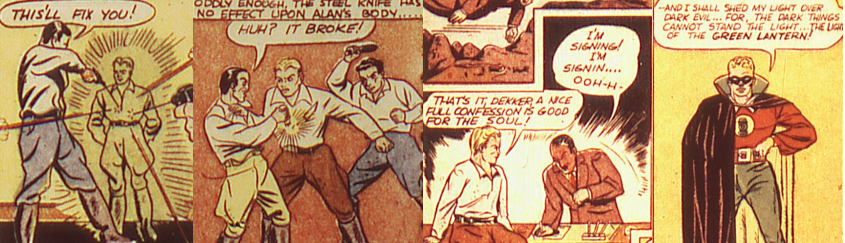
Alan then spends a few panels testing out his newfound powers; he wishes to fly to Dekker’s house and the ring allows it to be so. His desire to “[go] through the fourth dimension” allows him to easily pass through the walls of Dekker’s place and appear before the callous businessman and his mooks in a puff of green smoke and light. Appearing as a “wraithlike figure”, Alan seems to be a ghost to the astonished goons, but Dekker assumes it’s simply a trick and orders them to shoot the young engineer. Although the bullets just pass through Alan’s body and a knife simply breaks against his chest, a wooden club to the temple surprisingly brings Alan down, so he assumes that wood is his vulnerability. He also notes that he doesn’t possess superhuman strength (though, presumably, he could will himself to if he actually bothered…), but thankfully he’s skilled enough to overpower Dekker’s minions and scare them off. Fearing for his safety, Dekker attempts to barter, offering Alan money and his friendship, so Alan toys with his rival by flying him through the sky and threatening to drop him to his death to force a confession. Terrified, Dekker admits that he caused the explosion and promises to cover the payments and sign a confession. However, right after he does this, the stress of it all causes him o suffer a fatal heart attack. Mourning the waste of life, Alan retires to his unseen “sanctum” and pledges himself to fighting against evil in all its forms, realising that he needs a “bizarre” costume that will ensure evildoers never forget him once they encounter him. To that end, he fashions one of the gaudiest red and green numbers in all of comicdom and vows to “shed [his] light over dark evil” as the Green Lantern.
The Summary:
I don’t always have the greatest track record when it comes to Golden Age superhero stories; they’re often messy, rushed, and incredibly simplistic, echoing the pulp sensibilities that were so popular at the time. Thus, a degree of leeway must always be shown towards such stories, which are products of their time and restricted by the artistic style and expectations of the period. Having said that, I actually didn’t mind “The Origin of Green Lantern”. We don’t learn a great deal about Alan Scott beyond his profession, optimism, and thirst for justice, making him a bit of a blank slate in many ways, but there’s enough here to make him relatively intriguing. I liked that he was naïve enough to think Dekker would simply take losing out on the contract like a man, and his shock at seeing how far his rival will go to secure that government grant. It was very relatable that Alan’s first thought was to kill Dekker, though it’s not entirely clear why he has a sudden change of heart and opts to force a confession rather than kill his enemy. Alan doesn’t do anything particularly creative once he acquires the green ring, learning as he goes and testing the limits of his power with a whimsical theatricality that shows he’s getting a kick out of spooking Dekker’s men and shrugging off their attacks. Still, his stance towards injustice proves that the Green Flame chose wisely in bestowing him with its seemingly limitless power and thus leaves the door open for future stories to explore Alan’s abilities in more depth. It also allows enough wriggle room for the writers to pull whatever powers or limitations they can think of out of their asses.

While Dekker is simply a gangster posing as a businessman, Alan doesn’t don his awful costume until the final panel, and it’s not really clear how Alan survives the crash (though I assume it’s because he was holding onto the green lantern), the titular emerald lamp is the true enigma of the story. A miracle from the stars, the Green Flame is a seemingly menacing sentient element that promise to bring, death, life, and power, apparently at random and not just once since it changes the fortunes of numerous people during a time jump. Those who witness the Green Flame are filled with awe and dread, immediately believing it to be the work of some vague “Evil One” and lashing out in fear, meaning the prediction of “death” becomes a self-fulfilling prophecy. The Green Flame also seemingly supernaturally inspires individuals to forge it into new forms, such as a lamp, lantern, and a ring, so it can pass between new hands over the years. I’ve always found the idea of a magically empowered lantern to be one of the most random concepts in comics. Surely just the magic ring is more sensible, after all, and a superhero taking the name “Green Lantern” not only feels redundant but also announces his source of power to his enemies, not unlike his later JSA colleague, Rex Tyler/Hourman. The Green Flame is also quite vague in its limitations here. It’s said that willpower will allow Alan to wield great power, but he also needs to have a piece of the lantern on him at all times and recharge his ring every twenty-four hours. He’s then strangely injured by wood, of all things, a vulnerability that seems particularly dangerous when you stop and think about it. Still, the ring allows him to fly, pass through walls, and deflect all other attacks, and I have to assume that Alan is still too new to the superhero life to think about increasing his strength or trying anything fancy like creating hard-light constructs and such. In the end, this was a mostly inoffensive tale. It definitely could’ve been better in many ways, but I think it established its bizarre premise just enough to give us a colourful new superhero with a strong sense of justice. The story is worth a read just to see how the sprawling Green Lantern mythos started with one young train engineer and an ominous lantern from the stars.
My Rating:
Pretty Good
Have you ever read Alan Scott’s debut story? What did you think to it and how do you think it compares to other superhero origins from the Golden Age? Were you surprised that Alan Scott’s origins are so different from other Green Lanterns? Would you have liked to see more of the Green Flame’s time influencing others? What are some of your favourite Alan Scott stories and where does he rank for you in the Green Lantern hierarchy? How are you celebrating Green Lantern this month? Whatever your thoughts on Alan Scott, and the Green Lantern Corps, leave them down below orand be sure to check out my other Green Lantern content.

 Dr. K's Waiting Room
7 thoughts on “Back Issues [Brightest Month]: All-American Comics #16”