
In the decades since his first dramatic appearance in the pages of Detective Comics, Bruce Wayne/Batman has become a mainstream, worldwide, pop culture icon. The brainchild of writer Bob Kane, Batman was brought to life by artist Bill Finger and has been a popular staple of DC Comics and countless movies, videogames, and cartoons over the years. “Batman Day” falls on 21 September this year and I figured this was a perfect excuse to spend every Saturday celebrating comic’s grim and broody vigilante.

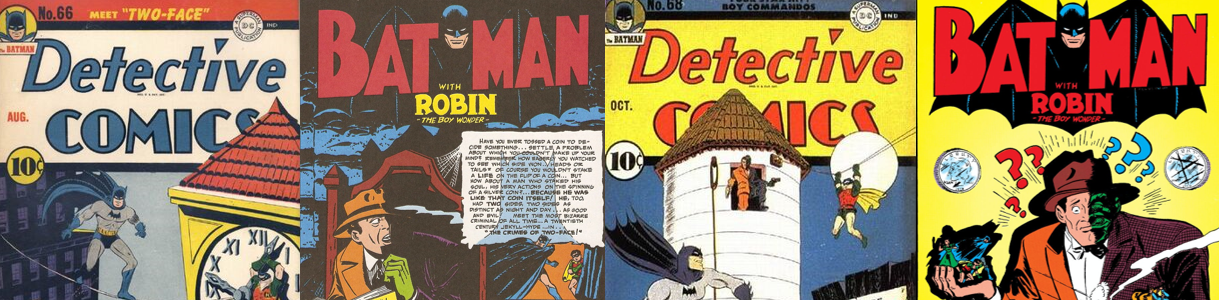
Story Title: “The Crimes of Two-Face”
Published: August 1942
Story Title: “The Man Who Led a Double Life”
Published: October 1942
The Background:
Following the huge success of Clark Kent/Superman, National Comics Publications had Bob Kane create another masked crimefighter to add to their repertoire. Thanks to the long-suppressed influence of artist Bill Finger, the “Bat-Man” soon became not only one of DC Comics’ most popular characters but also a mainstream cultural icon. In the years that followed, the Batman battled numerous costumed supervillains, but perhaps none are more tragic then former district attorney-turned-criminal Harvey Dent/Two-Face. Originally debuting in this two-part story as Harvey “Apollo” Kent, Two-Face was heavily inspired by the 1925 adaptation of The Phantom of the Opera (Leroux, 1909) and the 1931 adaptation of Strange Case of Dr Jekyll and Mr Hyde (Stevenson, 1886), both tales of a tortured soul, often gruesomely depicted or disfigured, who struggled with the duality of good and evil. Subsequent Two-Face stories have offered further insight into his tragic and abusive childhood, as well as further emphasising his complex relationship with Bruce Wayne, and the character is often a rival or litmus test for Batman’s different Robins. Widely regarded as one of Batman’s best villains, Two-Face has appeared as a prominent foe outside of the comics, from his renowned appearances in the acclaimed Batman: The Animated Series (1992 to 1999), Tommy Lee Jones’s bombastic portrayal in Batman Forever (Schumacher, 1995), and Aaron Eckhart’s understated turn in The Dark Knight (Nolan, 2008).
The Review:
This two-part story begins by introducing us to Harvey Kent, the dashing and famous district attorney beloved by the press and nicknamed “Apollo” for his courageous stance against organised crime, such as mob boss Sal “Boss” Moroni. Kent is the lead prosecutor in the case against Moroni and wastes no time in calling the Batman to take the stand as a key witness in Moroni’s trial. Amazingly, the testimony of a masked vigilante is seen as perfectly acceptable and admissible as evidence. Batman relates how Moroni shot “Bookie” Benson while escaping from a fight and Kent produces his most damning piece of evidence: Moroni’s lucky, two-headed silver dollar with his fingerprints on it! Moroni’s so incensed by Kent’s bravado that he tosses a vial of acid right at the district attorney! Although Batman intercepts the throw, Kent is hit with a concentrated splash of vitriol on one side of his face, leaving him wrapped in bandages for an entire month. When the time comes to reveal the extent of the damage, Kent is horrified to find that the left side of his face is “scarred and hideous”. He’s even more despondent to find that his only hope, a “European specialist” Batman knows of, is currently imprisoned in a Nazi concentration camp. The Batman simply peaces out after that, advising Kent to face his fiancée, Gilda, sooner rather than later, but Kent is distraught to find his gruesome visage frightens not only children, but also his beloved Gilda. Seeing the fear in her eyes, he flies into a rage, defacing a sculpture of his former chiselled features and terrifying her almost as much as his monstrous scarring.
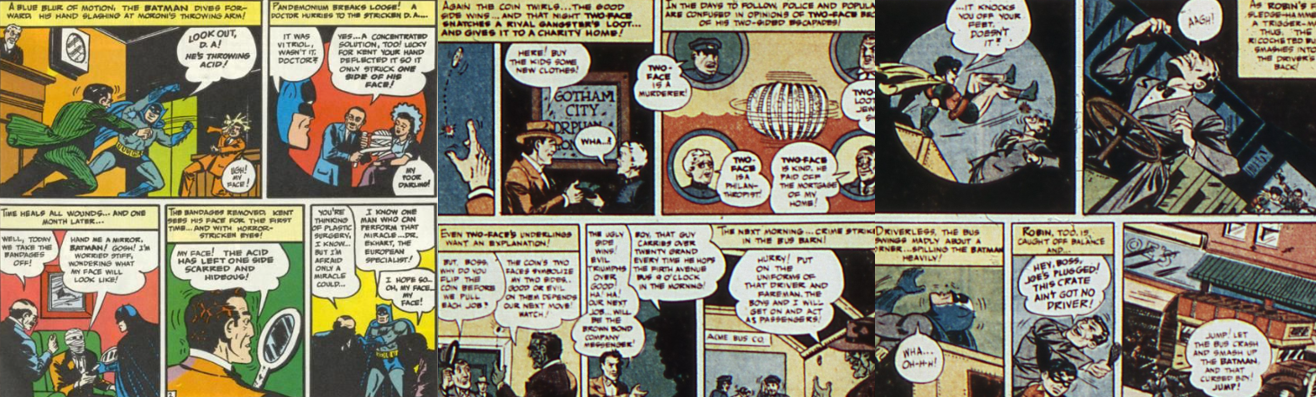
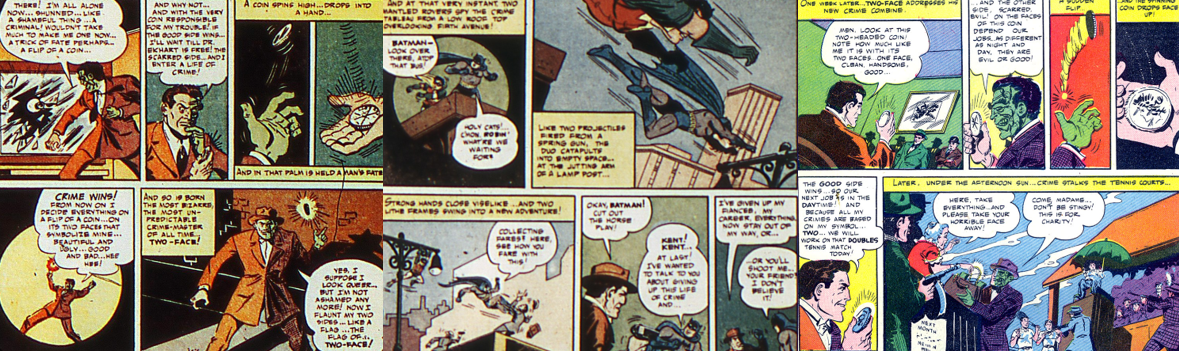
Tormented, driven to the brink of madness, Kent ponders this dichotomy of his explicit duality. He focuses his rage on Moroni’s silver dollar, defacing one side of it and lashing out at the cruelty of fate. Deciding that all life hinges on the flip of a coin, Kent projects his duality onto the now-scarred dollar. He resolves to decide his immediate future on a coin toss, promising to wait for Batman’s specialist to be freed if the unmarked side comes up or embark on a criminal career if the scarred side comes up. Of course, the scarred side wins and Kent rebrands himself “Two-Face”, adopting a suit to match his split face and putting his knowledge as district attorney to use in his crimes. Since everything he does is decided by this bizarre coin, one day he and his goons might rob a bank for illicit gain, but the next day he might donate his stolen money to charity! This causes public opinion of him to be fittingly divided, with some branding him a thief and a murderer and others a philanthropist and saviour. Even his goons are confused by Two-Face’s unpredictable nature, but they’re excited when the bad side wins and they undertake an elaborate scheme to rob the Brown Bond Company messenger that sees them hijack a double decker bus to rob the bondsman. As luck would have it, Batman and Robin happen to spot the mugging taking place and swoop in to intervene. Apparently well aware that Kent is Two-Face, Batman tries to talk him out of his life of crime but is stunned when his former friend pulls a gun on him and orders his men to toss him off the roof of the bus!
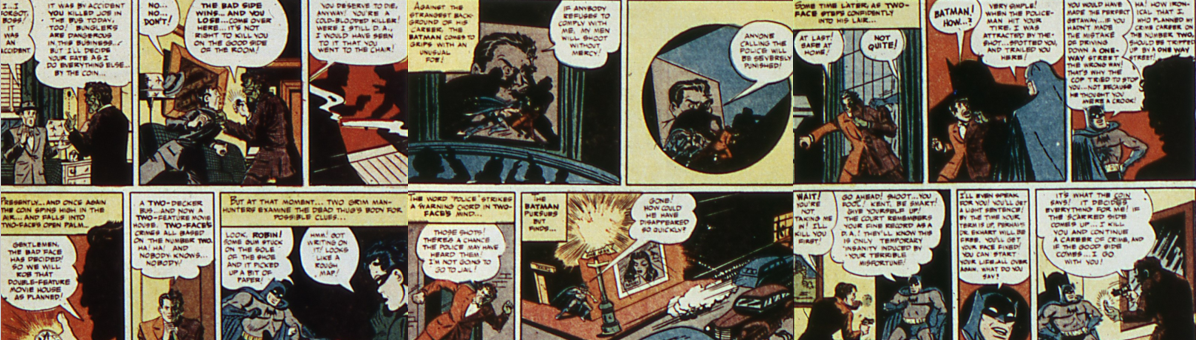
Although this doesn’t come to pass thanks to Robin accidentally causing the thug driving the bus to be killed, Batman is incapacitated in the fracas and the Dynamic Duo are left to die on the out of control vehicle, though Robin manages to get to the handbrake in time. Back at his thematically appropriate lair (one side is clean and pristine and the other is a shambles), Two-Face chastises himself for his actions. Believing that he’s killed his good friend, Two-Face almost regains his sanity before lashing out at the mirror and murdering his other goon after blaming him for causing the shambles on the bus. Two-Face then steps his game up by targeting the double-feature movie house, since he’s now committed to basing his crimes on the number two, but remains unaware that Batman and Robin survived the bus crash. Upon investigating the dead body of Two-Face’s goon, the Dynamic Duo happen to find a map stuck to the sole of his shoe by a piece of gum! This leads them to the Bijou Theatre, Two-Face’s next target, where Two-Face takes over the projection booth and demands that the audience hand over their loot. While Robin takes out the goons in the projection booth, Batman swoops onto the stage for a brief fight with Two-Face while his pre-recorded message looms and rants in the background. Somehow (it’s really not too clear), Two-Face slips away, but the Batman easily tracks him back to his lair by simply…y’know, following him after Two-Face made the error of driving down a one-way street and attracting police attention. Refusing to go down without a fight, Two-Face again threatens to shoot Batman, but the Dark Knight pleads with him to come along quietly. Batman promises to testify on his behalf to argue temporary insanity and to do everything he can to see Kent gets a light sentence until that specialist can fix his face, but Two-Face is unable to make a decision without flipping his beloved coin. Unfortunately for the tragic villain, cruel fate strikes again and the coin ends up standing on edge, leaving Two-Face conflicted and incapable of deciding whether he should give up his life of crime or kill Batman and continue down his dark path.
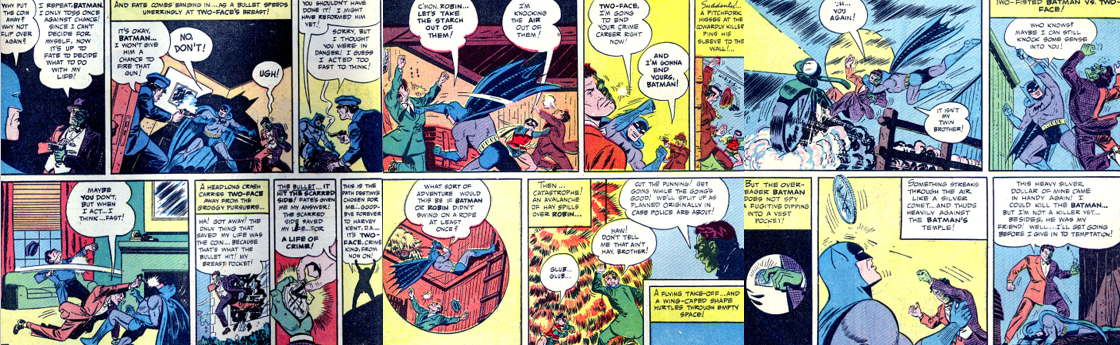
The story continued, fittingly two issues later, in “The Man Who Led a Double Life”, which picks up right where the first story ended and sees Two-Face pocketing his coin, resolving to let fate decide what he does with his life. Unfortunately, a trigger-happy cop bursts in and guns down Two-Face, believing he’s about to shoot Batman, but the bullet strikes the coin in Two-Face’s breast pocket, allowing him to survive and make a hasty retreat by leaping out of the window! Since the bullet hit the scarred side of the coin, Two-Face believes this is fate’s way of telling him to commit himself to his criminal career. His first act is to rob the doubles tennis match (during the daytime, since the coin landed good side up) and donate the cash to charity. Next, he and his goons kidnap matchstick mogul Henry Logan, whose entire home is apparently made out of matchsticks, but Batman and Robin are stunned to find it was actually the cantankerous tycoon’s double who was taken since Kent knew about Logan’s doppelganger from his time as district attorney. Batman and Robin are disgusted by Logan’s indifference towards his double’s fate and his selfishness, but the reclusive hobbyist agrees to pay Two-Face’s $200,000 ransom. However, when Logan and his wife arrive at the disused barn to make the transfer, Two-Face is enraged to find he’s been tricked and that it’s Batman and Robin in disguise! Batman and Robin easily overpower Two-Face and his mooks. Although one of the goons buries Robin under a pile of hay, Batman continues hammering Two-Face after the scarred villain tries escaping on a motorcycle. Laughably, Batman is felled when Two-Face tosses his coin at his forehead; however, Batman is spared since Two-Face “[is] not a killer yet” (despite it being said that he was in the first story) and still has some compassion for his former friend.
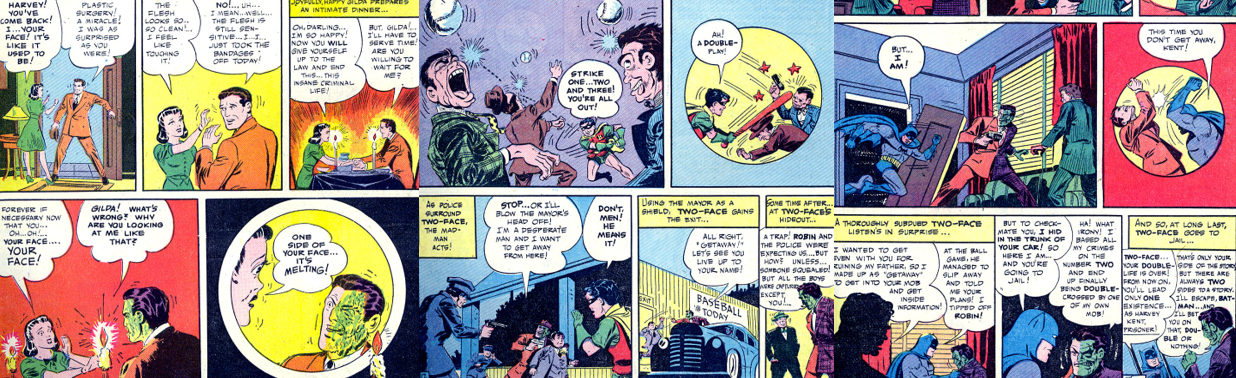
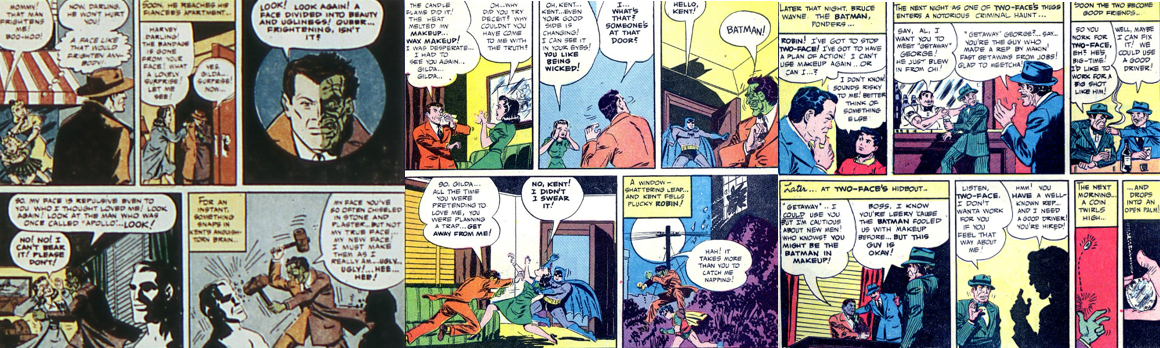
When Batman and Robin return the double to Logan, they find the tycoon to be as grating as ever, so Robin teaches him a lesson by dropping a lit match into his shoe, something the Batman simply laughs about despite the fact that the house place could’ve gone up in flames! Anyway, after spotting a loved-up couple in the street, Two-Face decides to pay a visit to his lost love, Gilda. Gilda is elated when the fully restored Harvey Kent surprises her at home, but he ensures she doesn’t get too close to his face. Over a candlelit dinner, he promises to come back to her and forgo his criminal ways if she waits for him, but is incensed when her happiness turns to horror after the heat from the candles melts the wax make-up covering his hideous scars. Gilda is driven to tears by the revelation that Kent has completely lost himself to wickedness and insanity, but Two-Face flies into a rage when Batman bursts in since he assumes she was colluding with the Dark Knight. Once again, Two-Face escapes through a window and he avenges his misfortune on the mask and make-up factory that cost him his love. Two-Face and his goons beat up the proprietors and torch the place, leaving the mask-maker destitute and his son swearing revenge. The story then leads us to believe that, despite Dick’s warnings, Bruce uses make-up to infiltrate Two-Face’s gang as “Getaway” George when the coin flips in his favour. Two-Face’s next target is the double-header baseball game between the city’s fire and police departments, in which honorary police officers Batman and Robin are publicly seen participating. Two-Face brazenly steals the $50,000 takings and even takes the mayor hostage at gunpoint after Robin beats up his minions. When Two-Face gets back to his lair and finds the cops waiting, he assumes that “Getaway” is Batman in disguise and is stunned when the real Dark Knight barges in to deliver a swift uppercut. It turns out that “Getaway” was the mask-maker’s son working in cahoots with Batman, and Two-Face bitterly comments on the irony of being double-crossed by one of his own gang in the end.
The Summary:
Two-Face’s links to Jekyll and Hyde aren’t simply thematic, they’re explicit. Hell, the first dialogue box on the opening page of “The Crimes of Two-Face” not only refers to Two-Face as “a twentieth-century Jekyll-Hyde” but even shows the disfigured criminal reading a copy of the book! I may be committing a literary sin here, but I haven’t actually read that book so I can only speak to the widely regarded themes of duality and man vs. monster that are at work in the text, but “The Crimes of Two-Face” definitely goes out of its way to draw parallels between Kent’s fate and that classic piece of gothic literature. They are, however, really only skin deep. Sure, we only see Kent for a few panels before he’s hideously scarred, but there’s no indication in either story that he was anything but a model citizen and champion of justice. More than once, he and Batman refer to each other as old friends and Two-Face is noticeably conflicted about the Dark Knight, more so than his criminal career, it seems. Indeed, it’s quite jarring when Kent just suddenly decides he has only two options: wait to be fixed or turn to crime, but it’s pretty well conveyed that his ghastly condition has caused him to snap. Batman refers to him suffering from temporary insanity, the text boxes allude to his rage, and Gilda’s reaction to his outburst all point towards this, but it’s still quite the sudden turn from model civil servant to notorious bank robber. One thing I did enjoy was that the reveal of Two-Face’s horrific visage is kept hidden to start with, so we only see it when he reluctantly reveals himself to Gilda, which builds a sense of anticipation about what he looks like. It’s a shame that he’s depicted with a literal line running down the middle of his face, but I can forgive that given the simplistic art of the time.
We’re well into Batman’s time as a much brighter, kid-friendly character here. He’s appearing in broad daylight, working alongside the police, and even taking to the witness stand and playing baseball, for God’s sake! Now fully deputised members of the police department, Batman and Robin are seen as assets rather than vigilantes and are specifically brought in by Police Commissioner James “Jim” Gordon to help with the Henry Logan kidnapping case. More importantly, the Batman had a close working relationship with Harvey Kent that sees him repeatedly appeal to his better half in “The Crimes of Two-Face”. Sadly, we never get to actually see the extent of their friendship. It’s simply said and inferred by their dialogue, and neither story explores Bruce’s reaction to his friend’s condition or delves into how conflicted he feels about Two-Face. Instead, Batman tries to out-think the tragic villain, occasionally begs him to listen to reason, and settles for socking him in the jaw when he refuses to come quietly. By the end, Batman views Two-Face as just another colourful supervillain and there’s no indication that he wants to try to help or rehabilitate his former friend; he just wants him locked up. As a villain, Two-Face is both visually interesting, surprisingly tragic, unpredictably volatile, and incredibly restrictive. Since he dictates his actions on a coin flip, his crimes can either be horribly violent or unnervingly charitable, casting him almost as an anti-villain since he’ll help those in need with ill-gotten gains and even kill his own men if they violate his rules. This makes the coin his most obvious Achilles’ heel, but it’s at least tied to his dual and conflicting nature. His obsession with the number two is far more of a crutch and I’m surprised that more wasn’t made of it. Once again, Batman and Robin do very little detective work here (they happen upon that map and Batman simply guesses that Kent would return to Gilda) so there’s no depictions of them trying to figure out Two-Face’s next scheme or running around the city looking for obscure references to the number two. It’s simply them reacting whenever Two-Face strikes or stumbling upon a lead.
Still, while Two-Face’s complex nature, volatile personality, and relationship with Batman is only touched upon or inferred in “The Crimes of Two-Face” and “The Man Who Led a Double Life”, both stories were surprisingly fun and unique tales. It’s not often that Batman’s villains had such a tragic twist to them back then and the references to Two-Face using his knowledge as district attorney for evil only add to the cruel twist of fate dealt to this once handsome and honourable man. I enjoyed Two-Face’s lamentations, which were suitably Phantom-esque, and his whole gimmick, including the split suit and lair. Despite seeing it as a handicap, I’ve always liked the double-headed coin aspect of the character and I enjoyed how quickly he became fixated on the coin’s decisions and how he was rendered panic-stricken and impotent when the coin landed on its side. I think “The Man Who Led a Double Life” would’ve been served better if it had begun with a babbling and broken Two-Face being taken into custody and seeing doctors try to salvage his mind and face until he inevitably returned to his evil ways, but that was kind of toyed with when he desperately resorted to a wax facsimile to reconnect with Gilda. Overall, the two tales didn’t exactly blow my socks off and there are definitely better Two-Face origin stories and tragic tales out there, but they were entertaining enough. Two-Face is an elaborate criminal with a unique, if narratively exhausting, gimmick and has (and continues to have) a tragic appeal to him that’s prominently introduced here, even with the lacklustre depiction of Kent’s time before his scarring.
My Rating:
Great Stuff
Have you ever read the two-part debut of Two-Face? If so, what did you think to it, which of the two was your favourite, and where would you rank Two-Face in Batman’s villain hierarchy? Would you have liked to see more backstory given to Harvey Kent? What did you think to his coin, obsession with the number two, and the depiction of his volatile duality? Did you enjoy Batman’s time as a brighter, friendlier character or do you prefer the brooding, grim Dark Knight? What are some of your favourite Two-Face stories and which interpretation of Two-Face is your favourite? Whatever your thoughts on Two-Face, share them below or on my social media, and be sure to check out my other Batman content!

 Dr. K's Waiting Room
One thought on “Back Issues [Bat-Month]: Detective Comics #66/68”