
In the decades since his first dramatic appearance in the pages of Detective Comics, Bruce Wayne/Batman has become a mainstream, worldwide, pop culture icon. The brainchild of writer Bob Kane, Batman was brought to life by artist Bill Finger and has been a popular staple of DC Comics and countless movies, videogames, and cartoons over the years. “Batman Day” falls on 21 September this year and I figured this was a perfect excuse to spend every Saturday celebrating comic’s grim and broody vigilante.

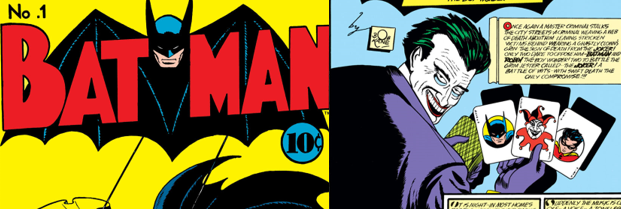
Story Title: Technically untitled, but commonly known as “The Joker”
Published: March 1940
Writer: Bill Finger
Artist: Bob Kane
The Background:
After seeing success with Clark Kent/Superman, National Comics Publications charged Bob Kane with creating another masked crimefighter to add to their portfolio and, thanks to the long-suppressed influence of artist Bill Finger, the “Bat-Man” soon became both a popular DC Comics character and a mainstream cultural icon. Over the years that followed, the Batman has matched wits against some of the most recognisable supervillains in all of comics, but unquestionable his greatest nemesis has always been the self-styled Clown Prince of Crime, the Joker. Bob Kane, Bill Finger, and Jerry Robinson all laid claim to creating the Harlequin of Hate, but what is widely known is that the character’s iconic, gruesome smile and clown-like visage was heavily influenced by Gwynplaine (Conrad Veidt) from The Man Who Laughs (Leni, 1928). It was a last-second decision by then-editor Whitney Ellsworth that saw the Joker survive his initial encounter with the Batman and, though the character was used less under the eye of editor Julius Schwartz, he rose to prominence thanks to the efforts of Dennis O’Neil and Neal Adams during the 1970s and 1980s. Since then, the Joker has become easily Batman’s most notorious and mainstream foe. In addition to terrorising Gotham City with laughing gas, the famously elusive and mysterious Joker crippled Barbara Gordon/Batgirl for many years, murdered both Jason Todd/Robin and Commissioner James Gordon’s second wife, had his face removed for a time, and has fought Batman to the death on numerous occasions, repeatedly returning to plague the Dark Knight, his allies, and Gotham City despite appearing to die more than once. The Joker has also been a prominent villain in Batman media outside the comics, often used as a primary antagonist in Batman videogames and brought to life with gleeful relish by many actors, such as Cesar Romero (who famously refused to shave his iconic moustache to portray the character), Jack Nicholson, and Mark Hamill (for many, the quintessential actor to tackle the role). The Joker has been the subject of numerous psychological and introspective debates and his popularity and infamy are such that he’s had his own self-titled comic, been a playable character in DC-related fighting games, and even appeared in standalone movies, with the first making over $1 billion at the box office!
The Review:
Our story wastes no time in introducing us not just to the Joker’s gruesome, grinning visage but also his menacing ways. A quintessential 1940s home is startled when the Joker’s cackling threats interrupt their nightly radio broadcast to issue an ominous threat against millionaire Henry Claridge, whom the Joker promises to kill and rob of his famed family diamond at midnight that night! Although some members of the public laugh it off as a gag akin to Orson Welles’ infamous War of the Worlds prank from 1938, the radio station is swamped with concerned calls and Henry Claridge is understandably panicked. His fears are allayed when the city police arrive and promise to watch over him, and his diamond, overnight and Claridge is overjoyed when his grandfather clock strikes twelve and he’s still alive. However, he suddenly convulses in agony and collapses dead to the ground with a ghastly rictus grin on his lifeless face – “the sign of death from the Joker!” As if that wasn’t bad enough, the cops are stunned when they inspect the Claridge diamond and find that it’s been replaced with an elaborate forgery and the Joker’s calling card, a literal joker-faced playing card, has been left behind to taunt them.
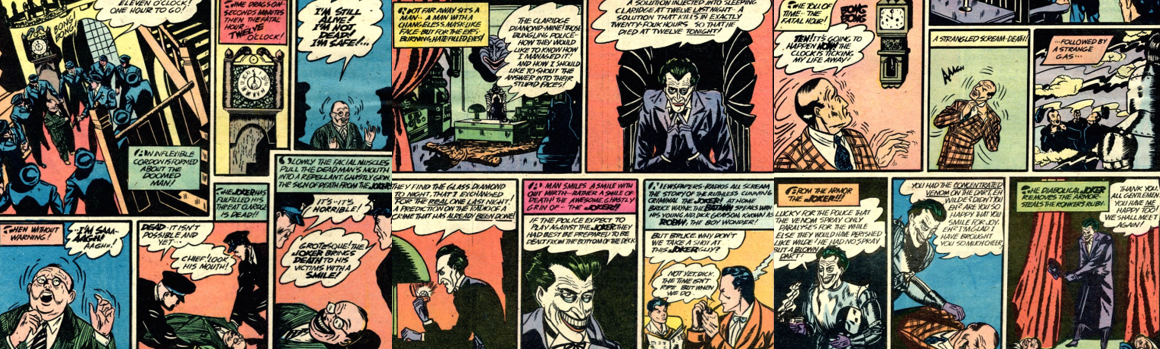
Luckily for us readers, the Joker is quite a loquacious fellow. When the story switches to his ornate lair to focus on the hate-filled harlequin, he openly explains how he delivered on his threat and outwitted the police: he simply injected Claridge with a slow-acting poison as he slept so that he would die at exactly twelve midnight. He also swiped and replaced the diamond while he was at it, and is immensely proud of his cunning, which has riled up Dick Grayson since he’s astounded by the Joker’s repeated acts of violence. However, his mentor, billionaire Bruce Wayne, believes that it’s not quite time for them to intervene as the crimefighting duo, Batman and Robin. Because of this, the Joker makes good on another threat. This time, he promises to kill Jay Wilde at ten o’clock and steal his ruby and his victim again collapses in pain, dropping dead with a smile, after being shot by a poisoned dart when the Joker easily hid amongst the cops in one of Wilde’s suits of armour. Luckily for the cops assigned to watch him, the Joker chooses simply to “paralyse” them with a gas; he then liberates his victim of his ruby and gleefully slips away. The city-wide manhunt for the Joker is met with embarrassing failure, but his actions have also riled up the city’s mobsters. Angry and envious that the Joker has been beating them to the punch, surly Brute Nelson vows to teach him a lesson and has his boys spread the word that he thinks the Joker is a “yeller rat”. Since those are fightin’ words during this time, the Joker bursts into Nelson’s home to confront him and is impressed to find that the mobster has lured him into a trap. Luckily for him, the Batman saw the mob’s interest in the Joker as enough of a reason to finally step in so he’s also in Nelson’s home and manages to get the drop on his goons despite his characteristic lack of stealth.
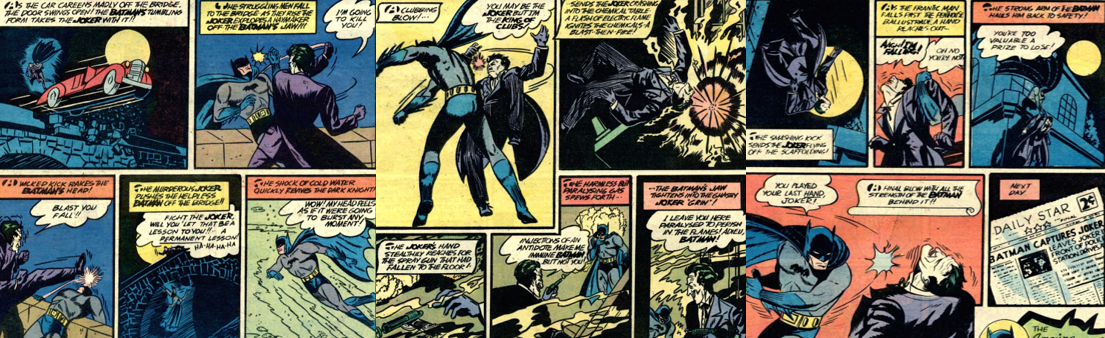
The Joker uses this distraction to his advantage, gunning the arrogant Nelson down in cold blood and making a quick getaway in his car. The Batman easily follows and leaps onto the speeding vehicle. However, when the two are launched from the car as it flies off a bridge, the Batman is surprisingly outmatched by the Joker, who socks him with a haymaker and delivers a kick that sends the Dark Knight plummeting to the water below. The Joker then takes a much more direct approach to target Judge Drake, the man who once sent him to prison. He disguises himself as the police chief (who he again chooses to simply subdue rather than kill) to get close to the judge and inject him with his gruesome poison. Although his disguise means the Joker gets away without suspicion, Robin takes his orders to “follow anyone that comes out of the judge’s house” literally and finds himself at the Joker’s hideout, where he’s summarily knocked out by the grinning maniac. The Batman, also staking out the judge’s house, uses his “infra-red lamp” to follow Robin’s trail and arrives just in time to save Robin from also being poisoned. Although the Batman overpowers the Joker, the Harlequin of Hate is knocked into a table of chemicals and a fire suddenly breaks out. Thanks to immunising himself from his poisons, the Joker sprays the Batman with a paralysing gas and leaves him to perish in the flames. However, the Batman simply recovers at superhuman speed and rescues Robin, who points him in the direction of the Joker’s next target: Otto Drexel and Cleopatra’s necklace. The Dynamic Duo arrive just as the Joker’s breaking into Drexel’s penthouse. The Joker’s driven to frustration by the Batman’s bulletproof vest and tries to make a death-defying getaway to a nearby construction site, only to be foiled by Robin and sent plunging to his doom. However, the Batman catches him and delivers a knockout blow, finally ending the Joker’s killing spree and seeing him behind bars…where he’s seen already plotting his escape!
The Summary:
I really enjoy seeing how “The Joker” influenced future live-action iterations of the titular villain. He’s shown broadcasting his threats over the radio, which is similar to how both Jack Nicholson and Heath Ledger’s portrayals would issue threats over the television. I believe Mark Hamill’s Joker used a similar system on more than one occasion, and the Joker would return to this method in future stories. The Joker’s entire persona here is one that is wholly unique to him and really helps him to stand out not just against the darker Batman but other comic book villains of this era. Not only does he have chalk-white make-up on and an unnerving lipstick grin, he’s decked out in the bizarre purple suit and hat that gives an unsettling air of menace to him. He’s also seen to be extremely cunning; he issues his threats as a method of intimidation and appears to be almost omniscient in the way he carries out his evil deeds, poisoning his victims ahead of time of hiding in plain sight to strike. Indeed, the Joker’s crimes have the police suitably baffled and even Batman, famously known as the “World’s Greatest Detective”, isn’t seen investigating or even trying to understand how the Joker pulls off his elaborate crimes. Beyond Bruce commenting that the Joker must use “some sort of drug” to give his victims their ghastly smiles, it’s up to the titular madman to explain his methods in an extended soliloquy, which actually goes a long way to show not just his theatricality but also how he’s got the guile and wits enough to bamboozle everyone.
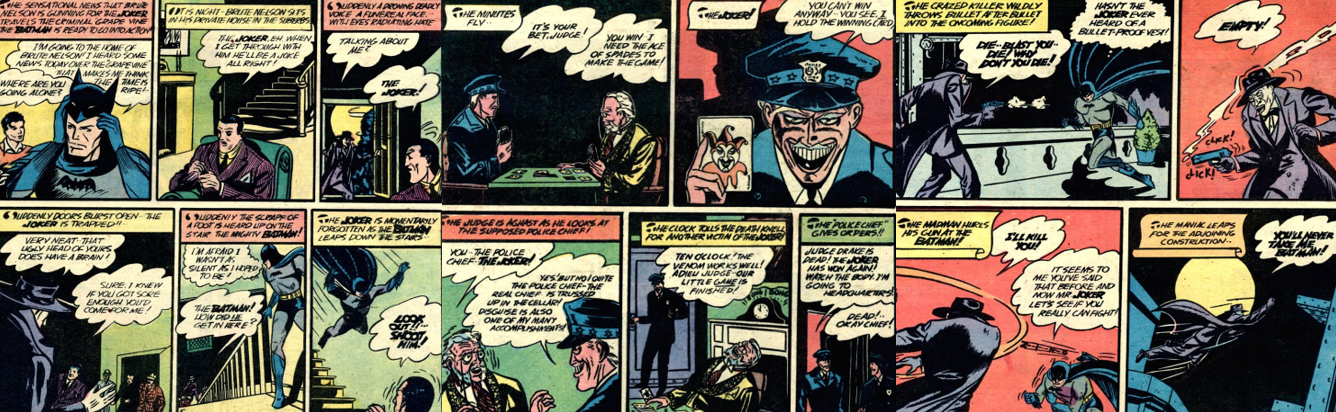
At the same time, the Joker isn’t above simply gunning a man down; a prideful man, he rises to Brute Nelson’s bait and targets not just the wealthy for their priceless possessions but also those who have wronged him in the past, like Judge Drake. Constantly portrayed as being one step ahead of everyone, the Joker always has a plan B, whether that’s disguising himself as the police chief, speeding off in his car, or boldly leaping to a construction site to evade the Batman. He’s also seen to be quite capable in a brawl; when they first tussle, the Joker gets the better of the Batman, who we’d seen overpowering multiple armed men on the previous page. One quirk of the tale I found amusing was Bruce’s hesitancy to get involved until “the time is ripe”, which indirectly causes the deaths of at least three men. This is probably because the Batman’s relationship with the city’s police isn’t yet as co-operative as we know it today, but I found it interesting that he didn’t get involved sooner, especially considering the baffling nature of the Joker’s methods. Batman is surprisingly light on gadgets here, too; he has his infra-red lamp and a bulletproof vest but that’s about it, so he’s far more reliant on his wits and incredible recuperative and physical powers. This actually puts him and the Joker on relatively equal ground, but Robin gives the Batman the edge. Sure, the Boy Wonder ends up captured and is nearly killed, but he’s enthusiastic to get after the Joker where Batman is more impassive and even almost kills the Clown Prince of Crime when he sends him plummeting from the construction site. As is to be expected of this era, the artwork is quite questionable; everything has a very sketchy, “pulp” feel to it that works in the context of the time, even if I find it a bit rudimentary. However, the Joker certainly makes a visual impression; we don’t get any backstory to him beyond him having once gone to prison and being full of hate, which adds to his allure, and I’d say this set a pretty good standard for future Joker stories to build upon his character and his complex rivalry with the Batman.
My Rating:
Pretty Good
Have you ever read “The Joker”? What did you think to the Joker’s debut story and the way he performed his kills? Were you surprised it took the Batman so long to get involved in the case? What are some of your favourite Joker stories? Which interpretation of the Joker, whether animated, pixelated, or live-action, is your favourite? Whatever you think about the Joker, share your thoughts below or leave comment on my social media, and be sure to check out my other Batman content across the site!

 Dr. K's Waiting Room
3 thoughts on “Back Issues [Bat-Month]: “The Joker” (Batman #1)”