
Easily Marvel Comic’s most recognisable and popular superhero, unsuspecting teenage nerd Peter Parker was first bitten by a radioactive spider and learned the true meaning of power and responsibility in Amazing Fantasy #15, which was first published in August 1962. Since then, the Amazing Spider-Man has featured in numerous cartoons, live-action movies, videogames, action figures, and countless comic book titles and, in celebration of his debut and his very own day of celebration, I’m dedicating every Tuesday of August to talk about everyone’s favourite web-head!

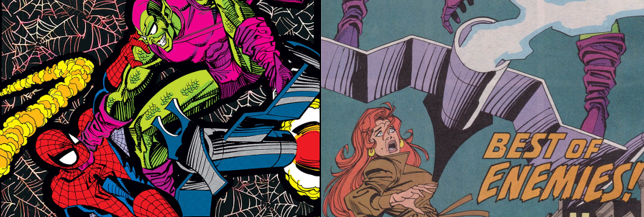
Story Title: “Best of Enemies!”
Published: May 1993
Writer: J.M. DeMatteis
Artist: Sal Buscema
The Background:
In 1962, Marvel Comics legend Stan Lee followed up his success with the Fantastic Four with Spider-Man. His Amazing Fantasy #15 debut proved to be one of Marvel’s best selling titles and his resultant popularity led to a solo title barely a year later. Spider-Man quickly amassed one of the most colourful and memorable rogues galleries in all of comics, with easily his most hated and iconic nemesis being the Green Goblin. Though many have assumed this elf-like guise, the most famous face behind the mask is Norman Osborn, industrialist and father to Peter’s best friend, Harry, and he and Spidey would have their most memorable clash during these days after Norman caused the death of Peter’s long-time love interest, Gwen Stacy. Although this storyline appeared to end with Norman’s death, the Green Goblin concept lived on through his son. First introduced in 1965, Harry famously turned to abusing drugs following his father’s demise, which fractured his grip on reality as much as his relationship with Peter. This culminated in Harry exposing himself to a modified version of his father’s Goblin formula, taking up the mantle of the Green Goblin, and ultimately perishing in this tale. However, this wouldn’t be the last time the Osborns would plague Spider-Man. Both would be resurrected time and time again for some of the web-slinger’s most controversial stories, both played pivotal roles in Spider-Man’s animated and live-action ventures, and Harry, especially, has been noted as being perhaps Spidey’s most tragic villain due to his complex and destructive relationship with both his best friend and his maniacal father.
The Review:
Our story begins, in suitably dramatic fashion, with Harry Osborn/The Green Goblin closing in on Peter’s wife, actress and model Mary Jane Watson-Parker/M. J. As M. J. walks through Central Park, she spots the Green Goblin coming for her and tries to run, but ends up in his clutches. Across town, in Harry’s apartment, a desperate Peter confronts Harry’s wife, Liz Allan; unfortunately, she’s as deluded as their son, young Norman “Normie” Osborn, is apparently psychotic and has blinded herself to the truth that her husband, already a recovering drug addict, has lost his mind to his father’s Goblin formula. Peter leaves and swings across the city as Spider-Man, lamenting the psychological instability of his best friend and the hatred Harry feels towards both his alter egos for his part in the death of his father. The maniacal Green Goblin flies M. J. to the George Washington Bridge, the very same location where Peter’s former flame, Gwen Stacy, died at the hands of her lover thanks to Norman’s machinations. Although M. J. is sure that Harry has brought her there to recreate the infamous moment, he surprises her by unmasking and opening up to her. Showing his vulnerable side, he expresses his love for her and promises that no matter how bad things get between him and Peter, he would never harm her. Naturally, she finds this a little hard to believe considering he just kidnapped her and the fact that he flies into a rage at the mere suggestion of his father’s involvement in the death of one of his friends, but M. J.’s left with no choice but to try and appeal to his better nature and their friendship to try and convince him to stop before it’s too late.
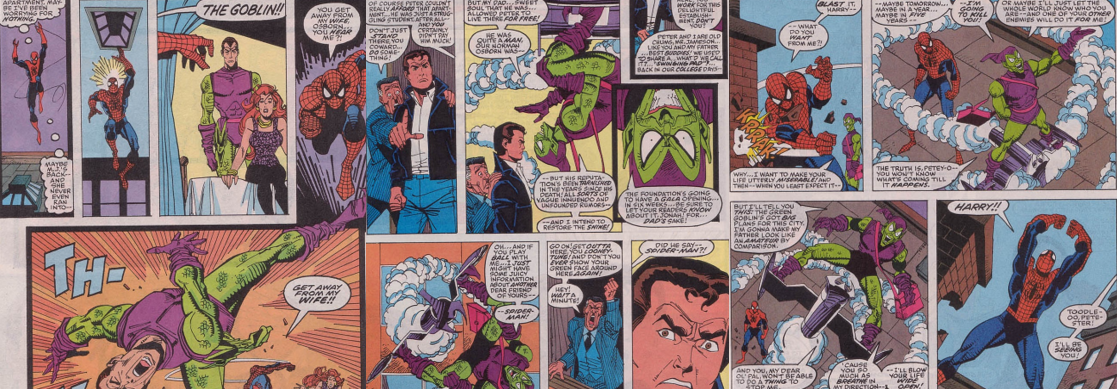
Despite the desperate nature of his search, Spider-Man takes the time to intercept some punks robbing an apartment but chastises himself when he almost loses his cool and takes his anger out on the lowlifes. When Spider-Man returns to his apartment, he’s stunned to find M. J. there alongside an unmasked Green Goblin; assuming that Harry means to harm her, he lunges for his former friend and knocks him clean across the room, but M. J. intervenes before things go too far. Scowling, Harry accuses Peter of always thinking the worst of him and flies off, leaving the two in such a state that M. J. sparks up a cigarette and suggests that maybe it’d be better for Peter’s identity to be exposed and Peter so riled up by it all that he lashes out in anger. A sweaty, neurotic Harry returns home to his equally deluded wife to play “happy families”. Neither of them think it’s unusual that Normie has such a venomous hatred for Spider-Man, and Harry’s temperament is on a razor’s edge, switching between violent outbursts and tender affection. The next day, Peter mulls over his options and is startled when the Green Goblin appears before him in broad daylight simply to taunt him. The Green Goblin then pays a visit to cantankerous Daily Bugle editor J. Jonah Jameson to ask for his help in advertising the “Norman Osborn Foundation”, a charitable organisation in his father’s honour that he plans to debut in six weeks. Peter arrives but is powerless to do more than look on as Jonah cowers behind him and the Green Goblin delivers a vague threat to reveal some “juicy information” to the publisher if he co-operates. Over the next few days, Harry tours the city spreading the word of his intentions and Peter is enraged to find the notoriously fickle public are completely onboard with the idea and assume the Green Goblin attire is simple the “odd affectation [of] a millionaire philanthropist”. Irritated by the entire debacle and frustrated at trying to figure out Harry’s endgame, Peter doesn’t hesitate to attack the Green Goblin as Spider-Man when he next sees him. Spider-Man warns his former friend that he’s sick of all the games and wants to settle their differences then and there but the Green Goblin not only refuses to fight him until he’s ready but also threatens to tarnish his image forever by filing legal action against him if he gives in to his anger. Instead, Harry delights in torturing Peter; he promises that they will throw down, and that he will emerge victorious, but only after his perverse desires are satisfied and vows to destroy his life if Spider-Man tries to stop him.
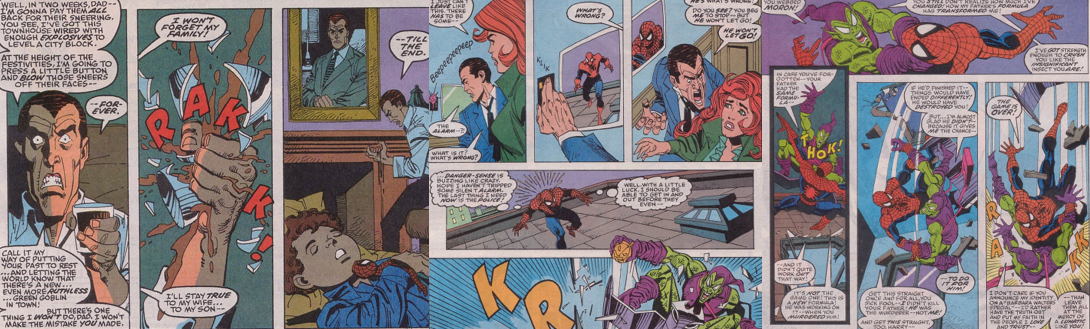
Liz is delighted at Harry’s newfound project but worries that he’s pushing himself too hard getting things ready for the foundation’s big unveiling; although Harry suffers from frequent bouts of nausea, he shrugs them (and Liz’s worrying) off and resolves to stay strong for his father. Of course, things are far from well in the mind of poor Harry Osborn; he openly converses to a large, ominous portrait of his father and delights in sharing how he’s been driving Peter batty, forcing him and M. J. to move to a new apartment, and promises that the foundation gala will be his ode to his father’s memory, where he’ll make all the enemies to the Osborn name pay for their insolence by blowing them all to kingdom come! The next day, M. J. tries to talk sense into Liz, but her delusion is so complete that she won’t drop either her unnerving smiling façade or her belief that Harry is a good man doing good things after a lifetime of adversity. Later, M. J. tries the same thing with Harry, storming into his apartment, fag on the go, and begging him to let go of his vendetta and rekindle his friendship with Peter. However, Harry refuses to listen to reason not just because of the unbridled power the Green Goblin offers him, but also the opportunity it creates to show the world the man he really is. After also briefly considering facing the consequences of going public, Spider-Man happens upon the George Washington Bridge and resolves to stop Harry no matter what rather than risk losing the woman he loves all over again. However, when he arrives at Harry’s apartment, the deranged Osborn flies into a rage; in his mind, Peter and Spider-Man are the problem and the true enemy, and just the mere sight of him makes Harry snap, throw on his suit, and burst up through the skylight to confront his adversary as the Green Goblin.
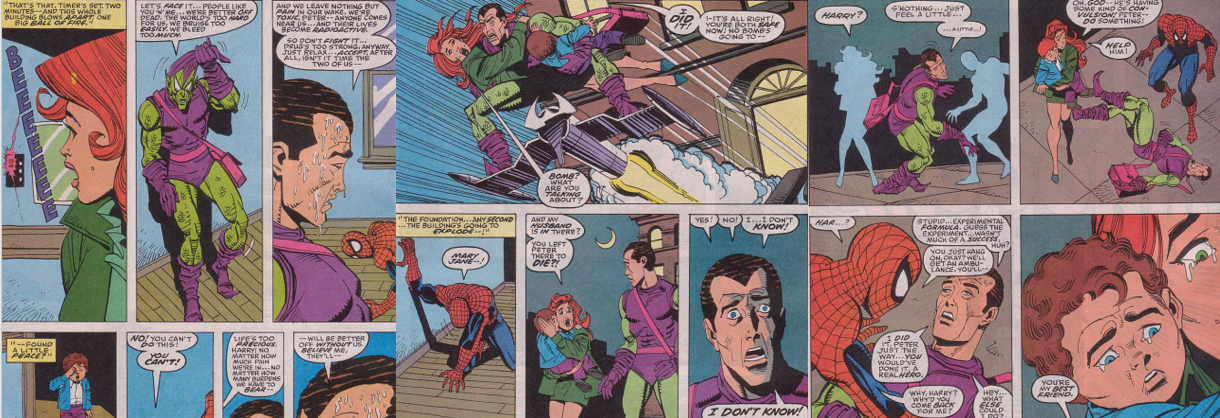
Both launch at each other with everything they have, refusing to hold back any longer; the Green Goblin again boasts that he now has the power to crush Spider-Man and even brags that he’s improved upon it since Norman’s days and that he’s glad that his father never killed Spider-Man since it gives him the chance to do so now. Spider-Man counters by arguing that Norman Osborn was a crazed murderer and that he no longer cares if Harry reveals his identity since he’d rather be exposed than leave his family at the Green Goblin’s mercy. Spidey also avoids being skewered by the Green Goblins glider but, when Harry bursts free of Spidey’s webbing, the two stop their war of words and simply trade blows for a few panels. However, Spidey is forced to admit that Harry was right; the new Goblin formula makes them evenly matched, so he suggests they find another, less brutal way of settling their differences, only to be caught off-guard and poisoned into unconsciousness by a hidden syringe in Harry’s glove. Harry’s plan is for the two of them to go up in flames, ridding the world of their toxic influence, but he is horrified when he realises that, in his mania, he forgot that M. J. and Normie were still in the house! Since he’s too out of it to act, Spider-Man begs Harry to set aside his self-doubt instilled in him by his father and save his loved ones. Despite his hysteria, Harry is moved by Peter’s belief in him and rockets M. J. and Normie to safety; Spider-Man collapses, seemingly doomed, but M. J. begs Harry to go back for him and is grateful beyond measure when Harry chooses to rescue Peter at the last second. However, Harry collapses in a violent convulsion as the Goblin formula finally takes its toll on his body. After expressing his gratitude to Peter and recognising him as his best friend, Harry dies before Peter’s eyes, leaving Spider-Man, M. J., and Normie distraught in a series of dramatic and wordless panels.
The Summary:
I don’t normally say this but I’m really not a fan of the art in this one; I’ve read a few Spider-Man stories illustrated by Sal Buscema and they’re all as visually bad as each other. Spider-Man and the Green Goblin don’t look so bad, but everyone has this weird angular took to them, the colours are super muted and dull, and Sal Buscema can’t draw faces for shit. It’s a very ugly looking comic and it’s a same since it’s such a pivotal Spider-Man story that’s let down by this atrocious art style. Otherwise, this is a very emotionally-charged story; it’s not often that one of Spider-Man’s villains learns his secret identity and I liked how Harry tormented the web-slinger at every turn, stalking him in broad daylight and threatening to expose him if he gets out of line. One interesting twist was M. J.’s suggestion that Peter get ahead of it by publicly revealing his identity; of course, Peter balks at this this idea since it would only cause more troubled him himself and his loved ones, but it was intriguing seeing him briefly consider it since it would remove Harry’s leverage. Like a lot of Spider-Man stories involving the Green Goblin, “Best of Enemies!” features many references to Gwen Stacy, but I don’t mind that here as it’s thematically relevant. It seems as though Harry’s going to recreate that impactful moment with M. J. at the start of the tale and returning to the site of her death reinvigorates Spider-Man’s fighting spirit, showcasing that there’s nothing he wouldn’t do to protect his loved ones and bringing him to the brink of facing Harry to the death, even though his better nature still keeps him from crossing that line.
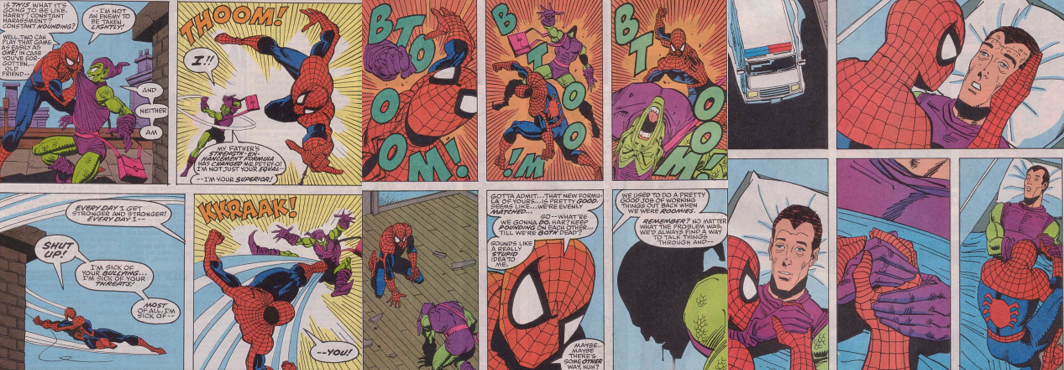
Harry’s vendetta is also an alluring one; he’s consumed by revenge and hatred towards Peter since he believes that he killed his father and is so obsessed with living up to Norman’s expectations and avenging him that he’s willing to die alongside Spider-Man in the finale. Harry’s always been a complex character; Norman casts a long shadow and his mistreatment of his son led to Harry developing an inferiority complex and turning to drugs long before he exposed himself to the Goblin formula. As the Green Goblin, Harry is more than a physical match for Spider-Man; he has all of his father’s technology and tricks, but relies more on mind games, intimidation, and dirty tactics than pumpkin bombs and his glider. I really enjoyed seeing him rile Peter up into an unbridled rage and cause him misery, and the wordless panels of them beating the hell out of each other only to find they’re evenly matched. All throughout the story, Harry is portrayed as a maniacal, sweaty psycho who can barely keep his emotions in check; this has had an extraordinarily destructive influence on his wife and child, as well as his friendships, but also takes its toll on his body, reason, and sanity. By the end, he’s convinced himself that he and Spider-Man are a blight on the world and need to be removed to keep from “infecting” others, and it’s only when one of his oldest friends and his beloved son are placed in mortal danger that he chooses to shake off his father’s influence. I really liked the hesitation he showed just before going back for Peter and their emotional reconciliation right before he died, and the wordless panels help to emphasise the impact of Harry’s death on all involved, leaving Spider-Man alone and heartbroken by the loss of his best friend. In the end, despite the terrible art, “Best of Enemies!” remains one of Spider-Man’s most poignant stories. Harry’s downward spiral and final, heroic sacrifice were executed so well that it genuinely annoys me that Marvel chose to bring both him and Norman back again and again rather than try something new, but it doesn’t detract from how crucial this story is to the overall Spider-Man mythos.
My Rating:
Great Stuff
What did you think to “Best of Enemies!”? Where would you rank it amongst Spider-Man’s many other stories and moments? Do you think I was too harsh on Sal Sal Buscema’s art style? What did you think to Harry as the Green Goblin and his descent into madness and mania? Did you enjoy seeing him torment Peter or would you have preferred to see them throw hands more often? What did you think to Harry’s heroic sacrifice and were you also annoyed to see him and Norman return later down the line? Which incarnation of the Green Goblin is your favourite and how are you celebrating Spider-Man this month? Whatever your thoughts on Spider-Man and the Green Goblin, go ahead and share them below or drop a comment on my social media and be sure to check out my other Spider-Man Month content!

 Dr. K's Waiting Room
One thought on “Back Issues [Spidey Month]: Spectacular Spider-Man #200”