
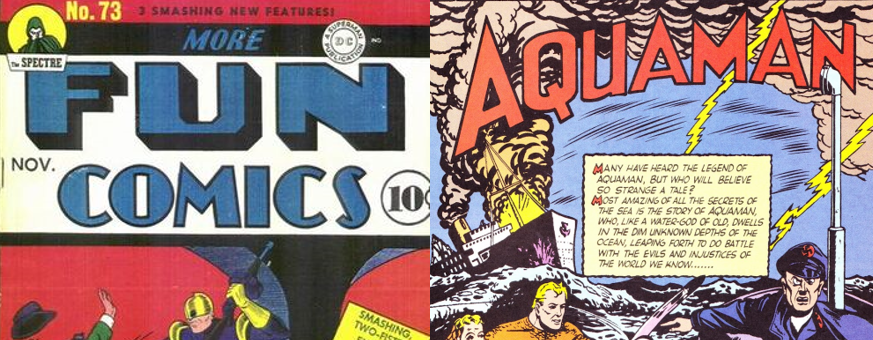
Story Title: “The Submarine Strikes”
Published: November 1941
Writer: Mort Weisinger
Artists: Paul Norris
The Background:
In April 1939, writer/artist Bill Everett introduced readers to Marvel Comic’s first Mutant, Prince Namor McKenzie/The Sub-Mariner, the superpowered prince of Atlantis who could live on land and in the sea and was just as likely to wage war against humanity as he was to defend it. While, on the surface, Arthur Curry/Aquaman appears to be another instance of blatant borrowing from their competitor, Mort Weisinger and Paul Norris’s aquatic superman couldn’t be more different. Aquaman was co-created by Weisinger after he moved to National Comics (the precursor to DC Comics) and was charged with coming up with some new costumed heroes to captialise on the success of Clark Kent/Superman and Bruce Wayne/Batman; after More Fun Comics changed its focus from superheroes to humour, Aquaman switched to Adventure Comics and was prominently featured throughout the 1950s. In addition to getting the cover spot on issues of Showcase and backup features in Detective Comics, Aquman had his own self-titled series, which saw him gain a wife, an ill-fated son, and undergo some pretty radical changes (including losing his hand). Often the subject of unfair ridicule for his ability to talk to fish and presumed uselessness, Aquaman has been part of DC’s biggest stories and proved popular enough to feature in numerous DC cartoons, a poorly-received videogame, and very nearly got his own teen drama show before Jason Momoa made a huge impression in his live-action debut as the character, portraying him as a bad-ass king of the deep and helping to change the character’s perception.
The Review:
As the story begins, a helpful text box informs the reader that many, especially those at sea, are well aware of the legend of the Aquaman, a water-dwelling do-gooder who emerges from the dark depths of the sea to battle evil and injustice, though even they consider him to be just that, a legend. While out on a mission of mercy, an unarmed ship is suddenly scuppered by a torpedo fired from an unseen submarine, the U-112; immediately, the captain orders an evacuation and stays behind to ensure that the crew and their consignment of refugees and hospital workers gets safely off the ship before he himself boards a lifeboat. At first, it’s not made clear where the enemy submarine is from or why they targeted the ship but it’s soon revealed that they’re goddamn Nazi sons-of-bitches who are determined to leave no witnesses to their heinous act. Luckily, just as the Nazis open fire upon the lifeboat, the scaled figure of the Aquaman arrives to help; his strength tempered by the crushing ocean depths, it’s no trouble at all for Aquaman to shunt the lifeboat out of the path of the submarine’s torpedo. Aquaman then turns his attention towards the “metal fish” and its maniacal crew.
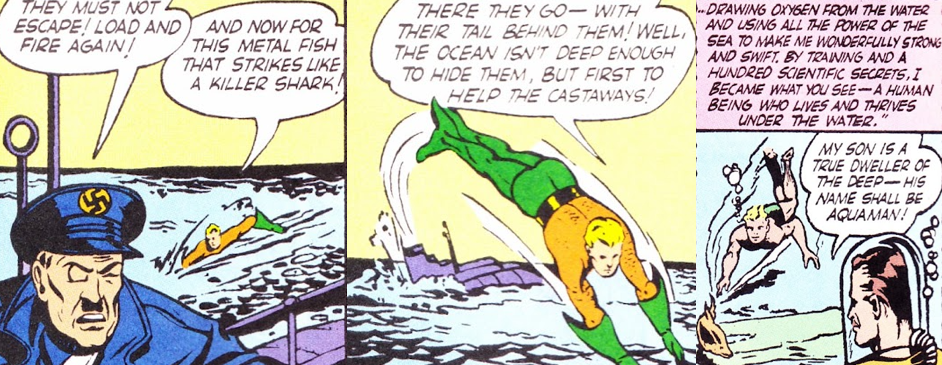
Aquaman leaps aboard, sending one Nazi overboard with a good kick to the chin, but the commander sends the sub into a dive and makes a getaway. Although Aquaman vows to track them down and make them pay, his first priority is the safety of the ship’s compliment; to that end, he commands a pod of dolphins to help push the boat to dry land. The porpoise purpose of this seems to be to demonstrate Aquaman’s ability to clearly and openly communicate with sea life as he could have easily pushed the lifeboat to shore himself, and while that works the cynic in me also views it as him kind of making slaves out of the dolphins. Anyway, once on dry land, the captain begs to know Aquaman’s secret and he freely relates his origin story: his father was a famous undersea explorer who vowed to discover the secrets of the ocean after his wife’s death. This eventually led to him discovering the lost kingdom of Atlantis and constructing a water-tight home within its ruins, where he read up on ancient tomes and learned the secret of living under the ocean from Atlantean science and writing. Somehow, by “drawing oxygen from the water and using all the power of the sea”, the man who would come to be known as Aquaman was able to thrive underwater and continues his father’s work at the bottom of the ocean. So…quite a different Aquaman origin than I am familiar with, and one that’s absolutely full of plot holes and unanswered questions.

With his story told, Aquaman dives back into the sea to get on the trail of the U-112, determined to do his share of punishing the evil that dwells on the surface world. By this point, the submarine has docked at a small island where the captain tells tales of his success and the strange sea-man who attacked them. Although his commanding officer balks at such an unlikely story, he’s forced to eat crow when Aquaman comes riding in on the back of a dolphin! Aquaman dives under the waters to avoid their bullets and, with a single powerful blow, sinks their submarine before their horrified eyes, trapping the Nazi bastards on their island. When Aquaman confronts them, he effortlessly swats away the commander’s pistol and chastises them for thinking him a “helpless refugee woman” but…somehow…the U-112 captain and his commander escape to their munitions house and then, even more startlingly, knock Aquaman unconscious by dropping a mallet on this head! Patting themselves on the back for their victory, the two tie Aquaman up, clamp weights to him, and toss him into the ocean, where he plummets into the mouth of an extinct sea-volcano. The sheer crushing depths restricting him, Aquaman desperately signals his dolphin friends by rubbing against a bulb-like plant and secreting an inky liquid (why he didn’t just shout for help isn’t clear; I guess he’s too deep?) The dolphins rush to his aid and allow him to easily break his bonds and return to confront the two Nazis. He knocks the submarine captain out with a stiff uppercut but the commander manages to slip back to the munitions room again; this time, he lobs a grenade at Aquaman’s head and, out of sheer instinct, he tosses it right back, blowing up the munitions storehouse and sending the commanding hurtling into the sky with comedic effect (but killing him nonetheless…) The deed done and the wicked punished, Aquaman returns to the sea, ready and willing to fight for justice in all its forms in the future.
The Summary:
So, yeah, Aquaman’s first story is decidedly different from his Marvel Comics counterpart; for one thing, Aquaman isn’t a murderous, ignorant fool ready to wage war against humanity but, and perhaps most strikingly, he’s not a native Atlantean and his powers don’t come from his heritage but are instead mysteriously and vaguely manufactured through a combination of “training” and “science”. It’s left incredibly vague exactly how Aquaman survives and breathes underwater or how he communicates with dolphins “in their own language” and, is so often the case in these early tales, we don’t really learn what his limits are (he can survive underwater but was effectively powerless when dumped in that sea-volcano because it was too deep; he can swim super-fast but is also seen riding dolphins, and he exhibits some superhuman strength but is knocked out by a mallet!) or even what his true name is! Garbed in a striking orange-scale outfit with green, fin-like gloves and a generally jovial personality, Aquaman stands out against his peers for lacking a cape and operating exclusively underwater; depicted as a highly trained and superhuman man, Aquaman is seen as the defender of injustice in all its forms, but especially out at sea, rather than being the Prince (or even King) of Atlantis.
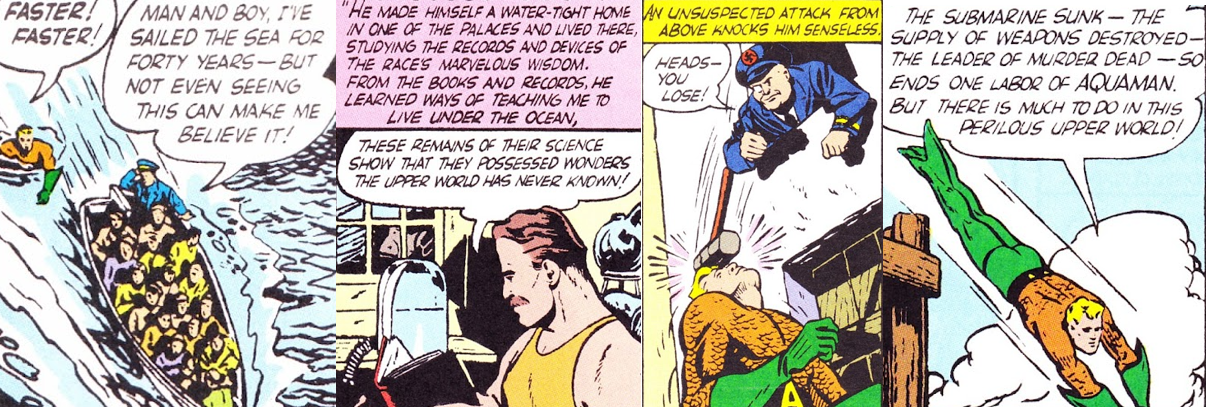
Nowhere is this more evident than in the story’s choice of antagonist; no one’s going to mourn the death and destruction of Nazi soldiers and munitions and depicting the Nazis as openly firing upon innocents and mocking their foes is a great way of depicting them as morally reprehensible, if a little cliché (both the captain and the commander wear monocles and snigger about their superiority over others). The action is almost as haphazard as the artwork, however; Paul Norris shines in depicting the Greek-God-like Aquaman, panels at sea, and scenes that take place underwater, but the Nazi island is a bit bland and it’s jarring that the Nazis are able to just run away from Aquaman, especially as he’s right there in front of them! They even get the drop on him, again making me question his powers and durability, but this also seems to just be another excuse to reinforce Aquaman’s knowledge of the sea and command over its denizens. When Aquaman does leap into action, it’s with a cringey pun or taunt and he’s swift and efficient, easily knocking grown men out cold and tossing back grenades even if he doesn’t understand what they are. In the end, I was a bit surprised that Aquaman’s origin didn’t originally tie him as a native of Atlantis; this skewed my perception of the story somewhat as it raises a lot of questions that naturally aren’t answered here, but it was a pretty whimsical and enjoyable little tail tale that stands out against those of other superheroes, if nothing else.
My Rating:
Pretty Good
What did you think to Aquaman’s debut story? Are you a fan of the character and, if so, what is it about him that you like? Were you also surprised by his differing origin and what do you think about his ability to talk to fish? What are some of your favourite Aquaman characters, stories, and moments and are you excited for his return to the big screen? Whatever you think about Aquaman, feel free to leave a comment below or start the discussion on my social media.

 Dr. K's Waiting Room
2 thoughts on “Back Issues: More Fun Comics #73”