
In the episode “Me2” (Bye, 1988) of the classic British science-fiction comedy show Red Dwarf (1988 to 2020), it is revealed the Arnold Rimmer’s (Chris Barrie) last words were “Gazpacho soup!” and that he made a point to celebrate November 25th as “Gazpacho Soup Day” after a particularly traumatising visit to the Captain’s Table.


Air Date: 6 September 1988 to 11 October 1988
Director: Ed Bye
Original Network: BBC2
Stars: Chris Barrie, Craig Charles, Danny John-Jules, Norman Lovett, David Ross, and Charles Augins
The Background:
Back in the mid-1980s, creative duo Rob Grant and Doug Naylor created Dave Hollins: Space Cadet, a sci-fi comedy show for BBC Radio 4 influenced by sci-fi classics like Dark Star (John Carpenter, 1974) and The Hitchhiker’s Guide to the Galaxy (Adams, 1978; Bell, 1981) and which laid the foundation for what would become Red Dwarf. Their concept of a comedy set in space was initially a hard sell due to its sci-fi trappings, despite the duo emphasising character and comedy over genre. With impressionist Chris Barrie and Liverpudlian “punk poet” Craig Charles cast as bickering duo Second Technician Arnold J. Rimmer and Third Technician Dave Lister, respectively, and joined by tardy singer and dancer Danny John-Jules and sardonic stand-up comedian Norman Lovett, Red Dwarf eventually came to TV screens in early-1988. Despite viewing figures dropping throughout the six-episode first series, five million viewers tuned in for the pilot episode and audience feedback was so strong that the BBC greenlit a second series, which was really where the show hit its stride. Afforded greater influence, and a bigger budget, Grant and Naylor took the chance to expand the show’s setting, even moving out of their comfort zone to introduce a mechanical character who would later join the main cast. Having established their audience, the second series was received far more favourably and was on its way to becoming a cult hit. Some ten years later, Grant and Naylor enhanced the first three seasons with additional digital effects, replacing model shots with CGI and even revising lines and jokes, which resulted in these Remastered episodes being largely criticised. Nevertheless, Red Dwarf proved consistently popular even after the duo parted ways; after a lengthy absence, Red Dwarf returned with a three-episode special in a questionable revival that arguably struggled to match the quality of its earliest seasons.
The Plot:
Deep space mining ship Red Dwarf drifts aimless in space three million years into the future, crewed only by Dave Lister, the last human being alive, Arnold Rimmer, a hologram of his deceased superior officer, a humanoid cat (John-Jules), and the ship’s neurotic computer, Holly (Lovett). Their long journey back to Earth is side-tracked by a distress call from confused android Kryten (Ross), an addictive virtual reality game, a leak in the fabric of space and time, and a journey to a parallel dimension where women are the dominant gender.
The Review:
Red Dwarf was a popular show in my house when I was a kid. I was too young to remember the first series, however, and our VHS collection of the show started here, with series two, presumably because my dad either didn’t have the means to record the first series when it first aired or never thought to do so. Re-runs of the first series wouldn’t come around until much later, so I grew up watching the second to fifth series with considerable regularity. When I finally did watch the first series, I wasn’t very impressed; there was something lifeless and stilted about the presentation and the jokes that was decidedly at odds with the presentation of later seasons, but even the second series, which aired later in the same year as the first (something I still find astounding; I would’ve expected it to come the following year), has improved dramatically in every way save for that oddly ominous, lengthy, and out of place introductory sequence that would thankfully be ditched for something more upbeat in the third series. Still, you can see how far the series has come just from Holly’s brief recap of the plot that accompanies each episode’s title sequence; not only is Holly rendered in a more aesthetically pleasing way, but his jokes land a lot better, with his quip about having to life at the bleakness of existence and his collection of singing potatoes being just two examples.

When we catch up with the Red Dwarf crew, things aren’t too far off from where we left them in the last series; although it seemed Lister and Rimmer came to an understanding and were prepared to show each other mutual respect, that’s not quite the case as Lister openly mocks Rimmer’s desperate attempts to learn Esperanto, proudly piles up his mail (despite it all being junk mail and useless mail order items) and winds Rimmer up about his $£8,500 debt to the “Outland Revenue”, and openly reads his diary (even narrating select sections to the Cat). Yet, their relationship is notably less antagonistic now; Lister bakes a spanner-shaped cake for Rimmer’s death day and not only seems genuinely happy to celebrate the occasion but also tries to help Rimmer’s intoxication with a triple fried egg sandwich with chilli sauce and chutney. Similarly, Rimmer, despite the fact that he can’t stand Lister, is dismayed that he would throw away their relationship in favour of three weeks of happiness with Kristine Kochanski (C. P. Grogan). Lister’s still the same cheerful slob; excited at making contact with another ship, he makes the effort shine his boots, toss on his cleanest t-shirt (“with only two curry stains on it”), and hammer his wretched socks to make himself somewhat presentable despite emphasising that they’re “not on the pull!” and Lister’s staunch refusal to refer to Rimmer as “Ace” leads to Rimmer encouraging him to wear his day-glow orange moonboots, which stink so badly that even the uptight hologram is reduced to tears by their rancid odour. What little emotion Lister showed at being the last man alive is mostly disregarded as he’s settled into his new, bizarre life, however he still craves happiness with Kochanski, to the point where he’s willing to die alongside her after discovering a stasis leak to the past, and is so distraught to find she’s already married that he launches into a great broken-hearted soliloquy about how women always leave him for “total smegheads”, nice guys they can rely on and who aren’t complete slobs. “Stasis Leak” (Bye, 1989) also sees Lister so elated to be reunited with Olaf Petersen (Mark Williams) that he embarrasses him in front of two ladies, and expressing excitement at seeing his long-dead friends again and a brief flash of regret at having taken them for granted. This episode also ends with the revelation that Lister will one day travel to the past and marry Kochanski, a plot point never revisited in future episodes (which is probably for the best as, while this Future-Lister is an arrogant jerk).
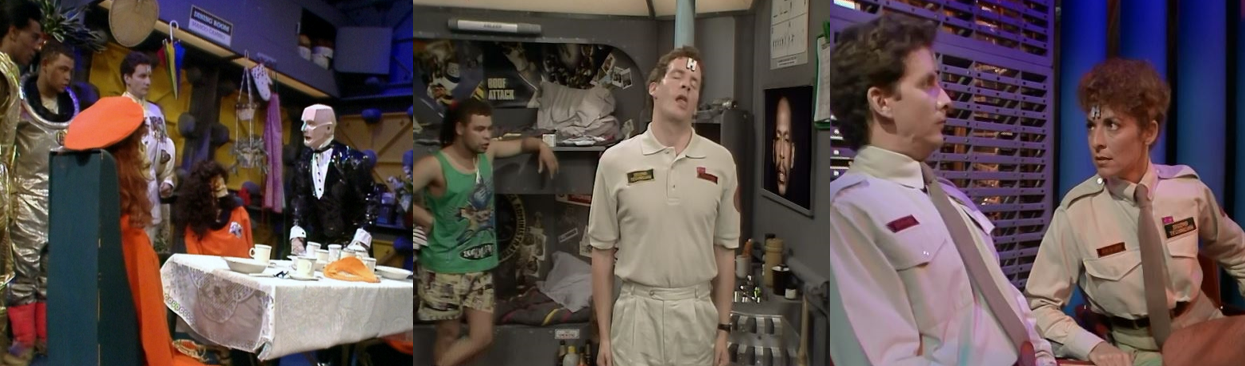
Much of Lister’s characterisation shifts towards advocating for equality, both for machines and women, whom Rimmer treats with equal measures of indifference, disrespect, and misogynistic apathy. The series introduces the concept of humanoid androids (or “mechanoids”) whose only function is to serve their human masters like butlers; Lister finds Kryten’s life of servitude particularly grating, seeing it as a form of slavery, and actively encourages him to think of himself, work towards his dreams of having a garden somewhere, and exposes him to the works of James Dean and Marlon Brando to try and break his programming and make him more independent. Rimmer is far less respectful and mindful, referred to Kryten as “it” and giving him a ridiculously long list of tasks, including painting a grandiose portrait of him. Lister also vouches for the Skutters (now referred to as Pinky and Perky and depicted as being obsessed with John Wayne and playing cowboys and Indians), reasoning that they only do what they’re told to do and cannot be expected to understand complex instructions or be pro-active, though he does later quip that he “wouldn’t trust them to open a can of beans” when Rimmer suggests they can perform a caesarean. When Holly endangers the crew in “Queeg” (Bye, 1989), drawing the ire of Rimmer and even the Cat, a new authoritarian artificial intelligence, Queeg 5000 (Augins), replaces Holly (accusing him of having an IQ of six, relying on the Junior Encyclopaedia of Space, and sending them in circles for over a year), reducing him to a nightwatchman and enforces far stricter rules. While Rimmer is initially impressed by Queeg’s regime, Lister is dismayed and hurt on Holly’s behalf; while Rimmer demonstrates a lack of empathy towards machines, Lister shares a half-baked story about a pair of shoes with artificial intelligence (or “souls”) and feels bad for Holly being replaced like he was expendable. Similarly, Lister attacks Rimmer’s reliance on cheap tricks, lines, and even hypnosis to deceive women, emphasising that they’re people who deserve respect rather than trickery or contempt. Lister is excited to explore a parallel universe, where females dominate, but Rimmer is disgusted and insulted by Arlene Rimmer’s (Suzanne Bertish), perverse magazines that depict “hugely deformed” male models draped themselves over sports cars and her attempts to hypnotise him and use the same tactics he was previously so proud of to try and seduce him. Since holograms can touch each other, he comes to fear Arlene’s aggressively sexual advances and refuses to acknowledge that she’s simply treating him with the same disrespect and fetishisation he showed women. Arlene even goes so far as to challenge Rimmer, accusing him of being a “boring masculinist”, which runs parallel to Deb Lister’s (Angela Bruce) descriptions of how males fought for equality in this universe.

Like Lister, Rimmer has largely become accustomed to his newfound life (or, in his case, death). Lister still accuses him of using his condition as an excuse to fail in “Better Than Life” (Bye, 1989), where Rimmer becomes despondent by his reliance on the Skutters since they’re so stupid that they cause more harm than good; he later gets his revenge, and demonstrates his adaptability (or, more accurately, cunning) by simply waiting for a Skutter to return to its duties so he can win a game of draughts by default. This series really expands on Rimmer’s fascination with aliens; mockery from Lister relates that Rimmer equates any strange happenings, however minor, to extraterresital lifeforms. His first guess when the crew wake up to find they’ve lost four days overnight in “Thanks for the Memory” (ibid) is aliens and he attempts to piece together evidence that they were abducted and had their memories erased in an elaborate attempt to communicate. We also learn much about Rimmer’s childhood, which goes a long way to explaining his neurotic and antagonistic character; he’s shaken when he receives a letter informing him of his father’s (John Abineri) death, something he was obviously aware of given they’ve been lost in space for three million years but which still rattles him. However, his turmoil comes not from sadness, as Lister assumes, but out of complex mixture of hatred and respect for his father, an abusive and judgemental patriarch who was so fixated on his sons getting into the Space Corps that he’d withhold food if they couldn’t answer astronavigation questions (resulting in Rimmer almost dying from malnutrition) and stretch them on a traction machine. Still, Rimmer desperately wanted his father’s approval and attempts to find some solace in Better Than Life; although initially ecstatic to get the autograph of his “all-time favourite fascist dictator”, Napoléon Bonaparte (Reece Clarke) (using his “bad hand”, no less), promoting himself Admiral, and even signing a copy of his memoirs, he’s denied hearing his father’s approval thanks to the Cat’s selfishness and the game’s more malevolent side soon comes through. Rimmer revels in rekindling his fling with Yvonne McGruder (Judy Hawkins) but is soon a desperate a despondent husband and father to seven unruly children; Rimmer’s brain cannot handle nice things happening to him, reducing him to an unkempt alcoholic in the blink of an eye and leaving the crew awaiting a slow and painful death by killer ants, earning him only further contempt from his ship mates because of his diseased mind.
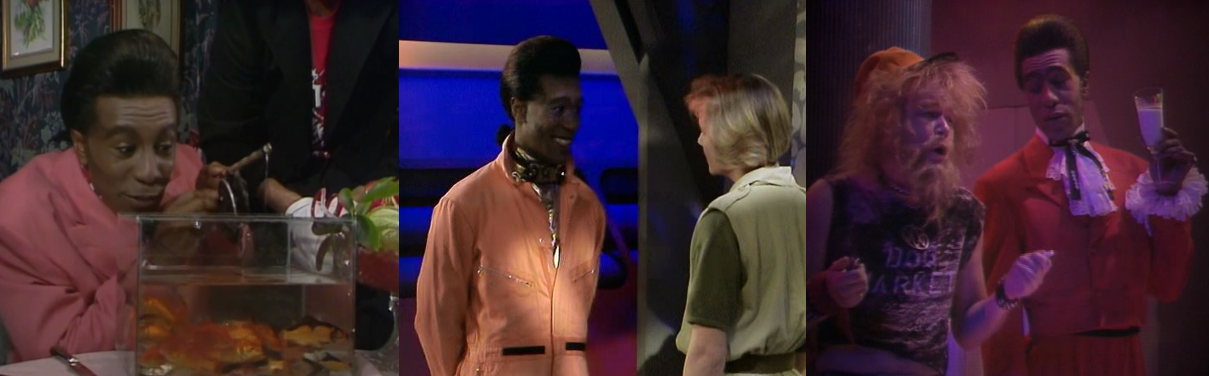
The Cat also noticeably grows as a character; while he’s still obsessed with food, fashion, and sex and largely self-absorbed, he often accompanies Lister on his jaunts around the ship and jumps at the chance to indulge himself in Better Than Life. He delights in ordering a tank of live goldish, seasoning them and singing a fun song as he toys with them, dreams up a wardrobe so big that it crosses an international time zone, and insists that he’s a pro at golf despite his strategy being to avoid hitting his “egg” in favour of hurling his club across the green. The Cat’s imagination also extends to a catchy dance number, “Tongue Tied”, that he views on the dream recorder. Although the Cat lacks the empathy to cheer Rimmer up after he’s shaken by his mother’s note, and actively scuppers Rimmer’s fantasy, he debuts his “wise old cat saying” gag to share his unique cat wisdom, and also disagrees with Kryten’s servant status (though more because he finds the idea of following orders ludicrous), and later admonishes Lister for screwing with Rimmer’s memory with a love affair with Lisa Yates (Sabra Williams). The Cat also showcases more of his love for fashion; he’s aghast at having to hide his colourful clothes in “Stasis Leak”, is distraught when Queeg forces him to work for food and ruins his hands, and even creates a garish customised gold spacesuit and needs to be literally dragged away form his own reflection! The Cat’s constant horniness comes up throughout the series; in “Better Than Life”, he dates both a mermaid, Miranda (Debbie King), whose top half is a fish in an amusing sight gag, and Marilyn Monroe (Debbie Ash), whose attentions eventually annoy him. The Cat is so excited to rescue the Nova 5’s crew that he spends a whole day getting ready and doesn’t seem bothered when they turn out to be dressed up skeletons. When he’s actually around women in “Stasis Leak”, however, he’s driven into such a frenzy that his usual cool is lost and he’s denied the chance to act on his libido. Rimmer later hypocritically scolds the Cat for only thinking about sex rather than a long-term commitment, though the Cat asserts that he’s willing to settle down with the seven or eight perfect girls. The Cat is ultimately disappointed and disgusted to find that his counterpart in the parallel universe isn’t a female cat, but a scruffy and overly enthusiastic dog (Matthew Devitt). Appalled by the Dog’s appearance and stench, the Cat actively avoids his counterpart, who eagerly tries to engage with the Cat and impress him with his dance moves.
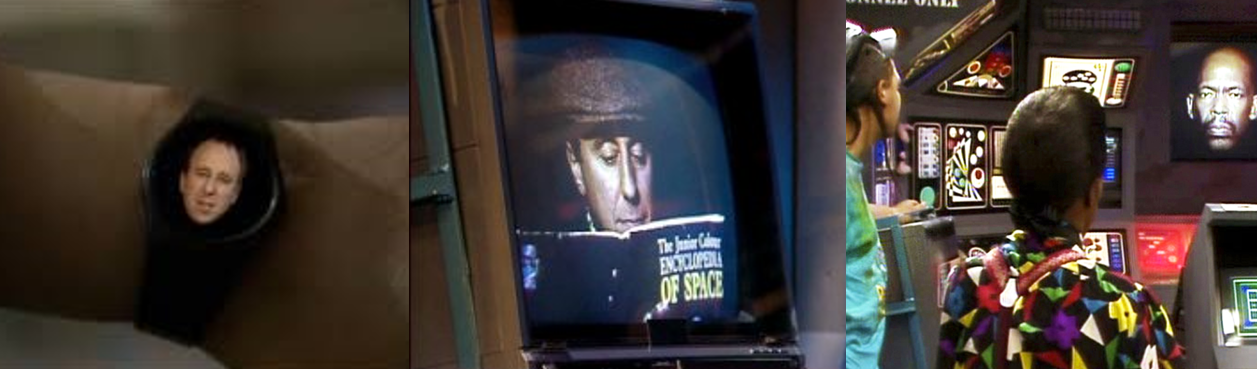
Holly is just as clueless as ever; still half-assing his duties at keeping Red Dwarf on track, he spends his time “totally [revolutionising] music” by decimalising it and inventing new notes, though this results in a completely impractical redesigning of traditional musical instruments that even Lister isn’t impressed by. Still, Holly is more interested in sharing this bizarre idea than in relating distress signals, would rather have the crew guess what his announcements are about even though they have no way of knowing what’s happened, and is even slow to warn of a meteor strike, resulting in them chastising his uselessness. Holly’s absent-mindedness makes him slow to tell Lister that Red Dwarf ran out of cow’s milk “yonks ago” and has been supplemented it with dog’s milk, but he’s still switched on enough to suggest hunting down the black box in “Thanks for the Memory” and to leave a pre-recorded message on the device warning the crew from watching it. Despite Holly’s animosity towards the postal service, he has been playing postal chess with Gordon (Gordon Salkilld), an eleventh-generation computer with an IQ of 8000 who proves to be as quirky and off his rocker as Holly, and even ends up joining the crew in their adventures either using a clunky mobile television unit or on Lister’s wristwatch. The crew’s despair at Holly’s unreliability means they’re understandably sceptical of his dimension-crossing “Holly Hop Drive”; although it doesn’t work as Holly intended, it does shunt them into the “fifth dimension”. Since this isn’t the first time Holly has “flamingo’d up”, it’s surprising when he’s able to explain how parallel dimensions work, especially as he wasn’t able to explain what a stasis leak was. Like the others, Holly also has a female counterpart, Hilly (Hattie Hayridge), who’s equally scatter-brained; unlike his doomed love affair with a Sinclair ZX-81, this relationship goes well for Holly, with Holly not even need a wig to impress Hilly. Series two spotlights Holly tremendously in “Queeg”; the crew loses their patience when Holly endangers them, with Rimmer in particular exasperated when damage to the hologram simulation suite causes him to glitch out (allowing Chris Barrie to showcase his impressions as he imitates Lister, the Cat, and Holly). Holly is initially resentful of them for not sticking up for him but is won over when Lister’s easily convinced of his capability even after witnessing him consult his book. Reinvigorated by the crew’s faith, Holly challenges Queeg for control; despite suggesting any other game, Holly’s forced to take his rival on in a game of chess and is resoundingly defeated, much to the despair of the crew. However, Holly delights in revealing that the totalitarian Queeg was an elaborate hoax to teach the crew to appreciate him, flaws and all.

Series two is also bolstered by some guest stars; some, like Petersen, Kochanski, and Captain Hollister (Mac McDonald) return from the last series thanks to the stasis leak and a flashback to prior to the accident that wiped out the crew. Things are kept interesting by the likes of the “Groovy Channel 27” presenter (Tina Jenkins) and a number of celebrity look-a-likes and other roles showcased in “Better Than Life”, the first time the show was filmed on location, but Kryten is easily the most memorable guest star. Kryten is an overly polite and affable mechanoid whose sole function is to serve; in fact, Rob Grant and Doug Naylor’s later novelisations revealed that Kryten’s overbearing cleanliness made him directly responsible for the Nova 5’s crash and the death of its crew (something alluded to in series seven). When he’s not serving humans without question, he enjoys watching Androids (an amusing parody of Australian soap opera Neighbours (1985 to 2022)) and dreams of a life tending to a garden. Kryten is a little different to how he’s portrayed in later episodes; slightly more effeminate and dressed up in a glossy penguin suit, he fusses over every little thing and admonishes his dead crew for their dishevelled appearances and unsociable eating habits (with the exception of the “absolutely perfect” Ms. Tracey). Because of his programming, and centuries of isolation, Kryten carries his duties out to the fullest extent and doesn’t seem to realise that the three are dead; when the Dwarfers force him to face the truth, though, it’s heavily implied that he was simply living in a state of intense denial. While it seems like Lister’s efforts to break his programming have gone to waste, Kryten eventually rebels in spectacular fashion, painting Rimmer sitting on a toilet and bombarding him with insults before heading out for a jaunt on Lister’s space bike. Lister finds a kindred spirit in his female counterpart, Deb, with them enjoying drinking contests and delighting in the two Rimmer’s awkwardness. They actually find common ground and hold a normal conversation, which is more than can be said of the Rimmers, who struggle to make small talk when Arlene’s not treating him like a sex object and being uncomfortably rapey in her advances, branding him “frigid” when he doesn’t put out and raising concerns over Rimmer’s treatment of women. Despite this, Lister isn’t impressed by Deb’s drinking and love for curries, criticising aspects of her that define his own character while simultaneously chastising Rimmer for not realising that Arlene reflects his despicable attitude towards women, and ending up being used and impregnated by his female counterpart to again raise some questions about our main character’s attitudes towards and treatment of women.
The Summary:
Even though it aired later in the same year as the first series, Red Dwarf’s second season definitely has a far more interesting and engaging visual presentation. It’s possible the creators were afforded a bigger budget as we’re no longer subjected to the same drab, boring ocean grey (or is it military grey…?) corridors of the titular ship; Red Dwarf’s corridors are darker, moodier, and sport arcade machines and grates to make them far more interesting to look at. We get to see more of the ship; although the general appearance of Lister and Rimmer’s quarters is basically the same, the overall presentation seems far livelier this time around. Similarly, the drive room has been completely redesigned; rather than being a largely lifeless and empty grey room with a simple bank of monitors, it’s now a bustling, colourful hub of activity with a distinctly 1960s sci-fi flair. Series two debuts the observation dome (where Lister shares his memories of Lisa Yates and his father’s death), the hologram simulation suite (where footage of previous episodes represents Rimmer’s dreams and memories (alongside him singing Frank Sinatra’s “Someone to Watch Over Me” sans trousers), and the introduction of other ships, such as the Nova 5 and the show’s first additional spacecraft, Blue Midget, an insect-like shuttle that allows the crew to venture off-ship; it’s not as iconic as its successor, Starbug, but it adds some visual variety and it’s fun seeing the cockpit all decked out like a trucker’s cab. Some of these additional effects are better than others; the transitions to Better Than Life and the visual effect of the multiple monitors in the hologram simulation suite is poorly implemented but some clever camera techniques allow the crew to celebrate Rimmer’s death on a small habitable moon (though Rimmer’s holographic projection cage wouldn’t appear again, and rightfully so as it doesn’t even make sense in this series as he was able to travel to the Nova 5 without issue). The Remastered version of the show adds some additional effects, such as all-CGI ships replacing the traditional models, a glitch effect being spliced onto Rimmer in “Queeg”, and removing the admittedly odd looking mermaid shot.

The writing was much tighter and more enjoyable overall this time around; the characters were given much more depth and more to do and interact with, which really helped the comedy. Some standouts include the revelation that Lister attended Art college but dropped out after ninety-seven minutes because of the unreasonable timetable, Kryten’s reaction to the unmistakable reality of his crew’s fate (resulting in one of the best reactions in the entire series, “My God! I was only away two minutes!”), and Rimmer flipping out over his Outland Revenue debt despite being three-million years into deep space and the human race being extinct. Other favourites of mine include a news report about a missing page from the Bible proving it to be fictious, the revelation that Rimmer’s only had sex once and his subsequent reaction to remembering this admission, the description of Rimmer’s psychedelic, hallucinogenic trip on “Freaky Fungus” that saw him attack two senior officers after mistaking them for armed giraffes, and Rimmer’s story about being betrayed by his childhood friend Porky Roebuck while in the Space Scouts. Surprisingly, considering how lax Red Dwarf became with its continuity, there are many references and ties to the first series: we get to see the dream recorder this time, Rimmer’s outfit is exactly the same and he wears his dress suit and medals again, and “Parallel Universe” finally answers how they got two babies without a woman onboard, though the idea of Lister taking a pill or having an abortion never comes up after he inexplicably falls pregnant. Similarly, “Stasis Leak” offers the first of many questionable plot threads; the visual effect allows the crew to travel to the past (but conveniently not bring anything back through, despite the crew being unaffected by the return trip), and ludicrously suggests that a space ship five miles long only has two stasis booths. Furthermore, Lister and Rimmer end up competing to try and rescue Kochanski and Rimmer’s past self, respectively (Rimmer’s even oddly excited at the idea of two versions of him being on the ship despite how badly it went in series one), rather than simply hijacking a Blue Midget and escaping (or staying on Ganymede) before the accident occurs; they even could’ve loaded others onto the ship as well, but this wouldn’t be the last time the show ignored a solution like this.

Still, series two is packed with great episodes; “Better Than Life” is probably the best episode of the series and was clearly a favourite of the show’s creators as it formed the basis for their second Red Dwarf novelisation, albeit in a far more sinister context. In the show, the “total-immersion videogame” Better Than Life is a relatively harmless virtual reality simulation that grants the players anything they desire, only for Rimmer’s deep-rooted neuroses and self-deprecation to ruin the experience; in the books, it traps the crew in their own personal haven, wasting their bodies away and causing them a great deal of pain and heartache. I also enjoy “Kryten”, though I wonder if it might’ve been better placed as a later episode in the series given how the character was promoted to the main cast going forward; I love Rimmer’s macho bravado somewhat akin to his later alter ego, “Ace” Rimmer, a façade that falters when Kryten flusters him with fluent Esperanto, and Kryten’s redecorating of their quarters, which sees him throw out a cup of mould that Lister was specifically breeding just to annoy Rimmer. “Thanks for the Memory” explores Lister and Rimmer’s changing relationship; Lister not only offers Rimmer practical advice, he’s genuinely motivated to help Rimmer experience true love when he implants Lisa Yates into his memory. This not only improves Rimmer’s mood and self-confidence but also amusingly creates a strange period of his life where he went on an eight-week bender living Lister’s life, remembers being an orphan despite his parents being alive, and had his appendix removed twice. Although Lister stresses that Rimmer’s love and appreciation for Lisa were stronger and more real than his own, Rimmer demands to literally erase and bury his humiliation. I also really enjoy “Queeg”, especially as a wake-up call for the crew and as an exploration of their dysfunctional friendship, and “Parallel Universe” was ahead of its time in many ways with its frank deconstruction of the male/female dynamic. Overall, Red Dwarf’s second series is a vast improvement over the first; the writing, jokes, and visuals and character dynamics make every episode a riot. From Holly’s praise for the benefits of dog’s milk and “blind spot” for sevens, the fantastically bleak elevator safety video (complete with cyanide pills), to Rimmer attacking the captain, the multiple character variants showcased by the confusion of time travel, to the idea that men routinely give birth in an alternative dimension, series two is better in almost every way compared to its predecessor. The ship is far livelier, the crew have more to do and toys to play with, and series two absolutely set the standard for subsequent seasons…until Doug Naylor randomly went back to the dullness of the first series for the eighth series.
My Rating:
Great Stuff
What did you think series two of Red Dwarf? Do you agree that it’s an improvement over the first series? Which of the jokes was your favourite? What did you think to the changes in the relationship dynamic between Lister and Rimmer, the exploration of Holly’s character, and the Cat’s development? Were you a fan of Kryten and Queeg? Which episode of series two was your favourite? Why do you think the crew didn’t just stay in the past? Would you like to see more seasons and specials, maybe one that finally closes the book on the Red Dwarf story, or do you think it’s best to leave it be for now? How are you celebrating Gazpacho Soup Day today? No matter what you think, feel free to leave a comment about Red Dwarf down in the comments and on my social media.

 Dr. K's Waiting Room
3 thoughts on “Screen Time [Gazpacho Soup Day]: Red Dwarf (Series Two)”