When readers were first introduced to the character of James Howlett, better known by the names “Logan” and “Wolverine”, it was in the pages of The Incredible Hulk. From his first full debut in issue 181 all the way back in November 1974 to him officially joining the X-Men in 1975, the character has become one of Marvel Comics’ most recognisable and enduring superheroes, regularly featuring in solo and team comics, cartoons, movies, videogames, and countless other merchandise.

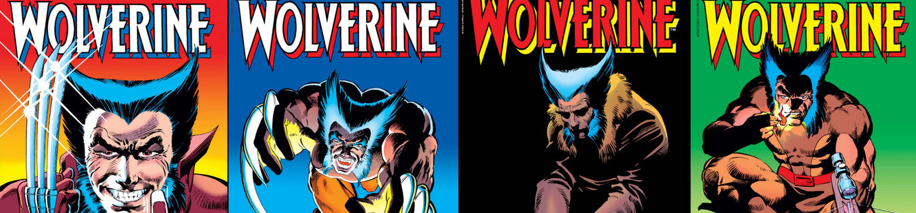
Story Title: “I’m Wolverine!”
Published: 1 June 1982 (cover-dated September 1982)
Story Title: “Debts and Obligations”
Published: 29 June 1982 (cover-dated October 1982)
Story Title: “Loss”
Published: 3 August 1982 (cover-dated November 1982)
Story Title: “Honor”
Published: 31 August 1982 (cover-dated December 1982)
The Background:
In 1974, Roy Thomas, editor-in-chief at Marvel Comics, tasked writer Len Wein with creating the first Canadian superhero; a short, feisty adventurer named “Wolverine” who would be as scrappy and fearsome as his namesake. Though the legendary John Romita Sr came up with the original concept art for Wolverine and his now-iconic retractable claws, it was artist Herb Trimbe who put the finishing touches to the character’s design. In what would become a staple for Wolverine for decades, Wolverine’s past and true identity was initially quite the mystery; yet, despite claims that Wolverine was originally conceived to be a mutated wolverine cub, Wein insisted this was false and that Wolverine was always intended to be a Mutant. These days, Wolverine is established as one of Marvel’s most popular characters thanks not only to him joining the X-Men a year after his debut but also the success of his first solo miniseries courtesy of X-Men scribe Chris Claremont and legendary comic book artist Frank Miller. Largely regarded as one of Marvel’s best miniseries, Claremont and Miller’s work helped to define many of Wolverine’s now recognisable character traits, from his time in Japan, his knack for brutality, and his iconic no-nonsense attitude. The popularity of the miniseries led to an ongoing solo book from 1988 but it’s not hyperbole to say that Wolverine probably wouldn’t be as big of a star as he is today without this influential four-issue series, which would come to inform the character’s later adaptations into films, cartoons, and videogames.
The Review:
Wolverine’s first solo outing begins within him freeclimbing his way through the Rocky Mountains, back in his home soil in Canada, on “business”; as he explains in his blunt and characteristically glib dialogue boxes, he’s “the best there is at what [he] does. But what [he] does isn’t very nice”, which may very well be the first instance of him saying this iconic catchphrase. He’s there to track, hunt, and kill a ferocious grizzly bear that’s been slaughtering locals as they venture onto the mountain; thanks to his heightened senses, Adamantium laced skeleton, and innate ability to tackle even a berserker grizzly bear head-on, Wolverine easily challenges, dismembers, and kills the beast with a minimum of fuss but he’s not happy about it. Not only does he recognise that the bear is simply being true to his nature, but he also spots an illegal poison-barbed arrow in the dead beast’s back, evidence of a hunter landing a hit on the bear but not sticking around to finish it off and thus driving it into a frenzy. With seven men, three women, and five kids dead as a result, Wolverine tracks the foolish hunter to a bar some fifty-seven miles away and confronts him; riled up, the hunter picks a fight, much to Wolverine’s pleasure. Though we don’t see what Wolverine does to the man, he assures the reader that he let the hunter live…and that the bear put up a better fight. He makes sure the hunter pays for his actions in a court of law and prepares to head home to the X-Men when he spots a pile of letters on his doorstep; they’ve all been returned, unopened, from an old flame of his: Mariko Yashida, the daughter of one of the oldest and most respected families in Japan. Although the Japanese embassy tells him that Mariko was called back to Japan, her home line hangs up on him, so Wolverine takes the next flight to Japan and meets up with an old contact of his, Asano Kimura, who informs him that Mariko’s long-lost father recently returned and reclaimed his position at the head of the Yashida clan and family, thus forcing Mariko to marry.
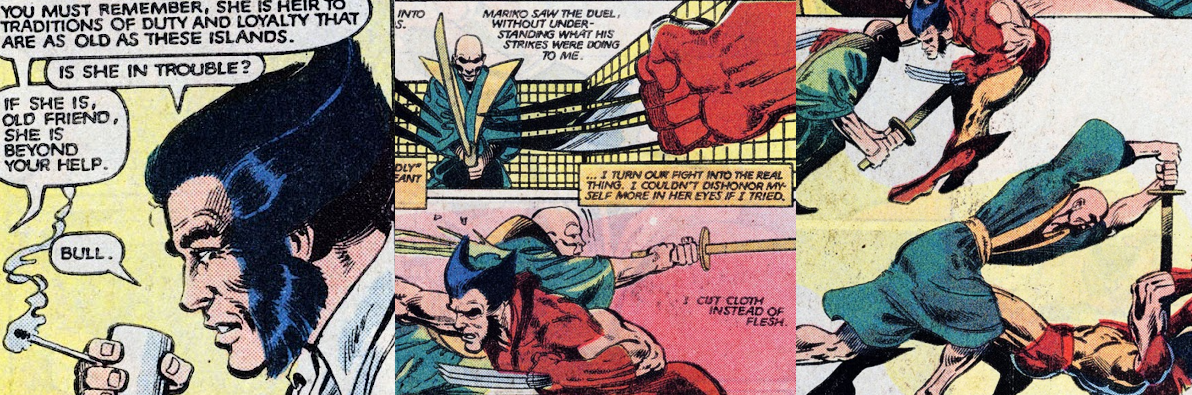
Despite the fact that Mariko was obligated by ages-old traditions of duty and honour, and Asano warning Wolverine off, Logan lets his anger and emotions overrule his common sense, dons his brown and yellow outfit, and forces his way into the Yashida ancestral stronghold and confront Mariko even though Asano may be legally obligated to hunt him down as a result. After easily bypassing Yashida’s near-feral guard dogs, Wolverine scales the main tower and conveniently comes across Mariko standing beneath a gigantic, ostentatious Buddha statue; Mariko tries to brush him off, citing the same explanations of duty and honour, and even accuses him of shaming her, but he’s enraged to find her face bruised. However, Mariko calms his rage and even admits that she loves him, but is bound to the will of her father, who promised her hand to another to pay a debt. When Mariko’s abusive husband, Noburu-Hideki, interrupts, Wolverine is ready to gut him on the spot, but allows Mariko to talk him out of it, only to be briefly rendered unconscious by a barrage of poisoned shuriken. Thanks to his superhuman healing factor, Wolverine recovers and is confronted by Mariko’s father, Lord Shingen, who brands him a gaijin (a derogatory term for an outsider) and chastises his arrogance. Deeming the X-Man unworthy, Lord Shingen challenges Logan to fight for Mariko’s affection with wooden swords (bokken, here referred to as “Bokan”). Although Lord Shingen is an old man, Logan is still feeling the effects of his poisoning and is out of practice with a sword; Lord Shingen also specifically targets nerve clusters and pressure points to cause maximum pain and rile him up to the point where he abandons his toy weapon and attacks with his claws, dishonouring himself before his beloved. Despite now having a lethal edge, Wolverine never gets the chance to land a mortal or killing blow; Lord Shingen’s skill half-cripples him and leaves him abandoned, beaten and humiliated, on the bustling streets of Tokyo.
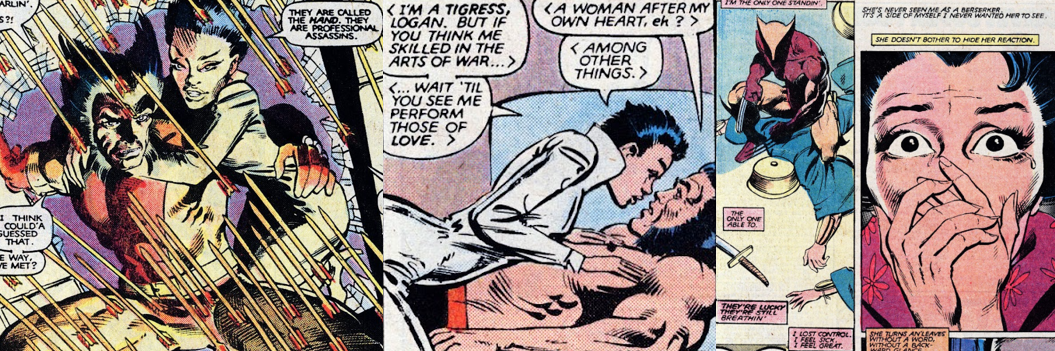
Naturally, Logan’s immediately set upon by punks and soon drawn into an all-out ambush with the highly skilled ninjas known as the Hand by the mysterious Yukio. The Hand have the superior numbers, and even wound Yukio, but Wolverine’s Mutant abilities and enhanced bones give him the edge and he leaves them all dead. Yukio is astounded by his regenerative abilities, which she would use to destroy the Hand, a supposedly peerless ninja clan commanded by a ruthless and powerful crime lord. Due to their shared killer instinct, things quickly get heated between them, but Wolverine can’t shake the image of Mariko and walks away, much to Yukio’s despair. An interlude sees her storm into Lord Shingen’s office, revealing he hired her to win Wolverine’s trust and lure him into a two-pronged attack that will see both Logan and Lord Shingen’s rival, Katsuyori, dead at Yukio’s hand. Although Wolverine notices Yukio’s changed demeanour, a half-veiled version of the truth is enough to convince him to accompany her in confronting Katsuyori at a theatre performance. Although Logan hesitates when he sees Mariko in the crowd, he leaps into action when the actors try to assassinate the Yashidas. While Wolverine cuts his way through the ninjas, driven berserk by their attack, Yukio takes out Katsuyori with a car bomb and is delighted when Mariko expresses shock and even fear at witnessing Wolverine’s bloodthirsty berserker rage. In the aftermath, Wolverine takes solace in alcohol, Yukio’s affections, and in a random brawl, but rebukes Asano’s pleas to assist in combating the recently united Japanese underworld. After narrowly avoiding being splattered by a bullet train simply so Yukio can get a sadistic thrill, Wolverine passes out and is tormented by dreams of his lost love. While he sleeps, Yukio is accosted by the Hand, who demand she redeem herself by cutting out Logan’s heart, but she opts to fight them off instead; however, when she tries to rouse him, she’s enraged when he speaks Mariko’s name and leaves him to his stupor, cursing her foolishness for believing he could ever love anyone but Mariko.

By the time Logan returns to their apartment, he’s dismayed to find Asano dead at Yukio’s hand. Finally, realising Yukio’s deception, he chases her across the rooftops of neon-drenched Tokyo and prepares to eviscerate her, regardless of their kinship, but is suddenly ensnared by roped arrows fired by the Hand. Angered at ignoring his instincts, Wolverine makes short work of the ninjas but Yukio slips away in the chaos. Determined to prove that he’s a man, rather than some mindless beast, Wolverine systematically disrupts Lord Shingen’s operation, angering the crime lord and forcing him into a rematch. After being captured, Yukio is given the chance to kill Lord Shingen in a desperate attempt to win back Wolverine’s affection after killing Asano, but she’s hopelessly outmatched compared by Lord Shingen’s strength, speed, and skill. Ultimately, she partially redeems herself when she frees Mariko from Noburu-Hideki’s abuse; unable to forgive her for Asano’s death, or repay her for saving Mariko, Wolverine simply allows her to leave so he can face Lord Shingen one-on-one. This time, Lord Shingen grabs a Muramasa katana to see if Logan is truly worthy and they engage in blood combat largely bereft of dialogue or sound effects. Although Wolverine gets impaled on Lord Shingen’s sword, this allows him to close the gap between them and end the crime lord’s life by stabbing him through the face and head with his claws (something kept off-panel but clearly implied by the artwork). Mariko is stunned by the sight; duty and honour, the two driving forces behind her entire life and unwanted marriage, dictate that she avenge her father’s death yet, despite being able to stop her and kill her even with his wounds, Wolverine chooses to do nothing. However, Mariko delivers a soliloquy about how her father’s actions brought shame to the Yashida clan; she bequeaths the sword to Wolverine and dubs him worthy not just of the blade but of the clan and her heart. Wolverine’s dialogue reveals that Marko fully planned to kill her father herself, and then commit ritualistic suicide, had Logan not emerged the victor, and the two recuperate in the mountains before sending a most unexpected invitation to their wedding to the X-Men!
The Summary:
I’m reasonably familiar with Frank Miller; I’ve read his work on Batman, Daredevil, RoboCop, and some of his original work, like 300 and Sin City and, as a rule, I’m not always his biggest fan. His writing is repetitive and atrocious most of the time, often to the point of self-parody, and his art can be ridiculously simplistic and childish in a lot of his work. Thankfully, that isn’t the case here; not only is he kept away from the script but his art is coherent and impressive, while still making great use of shadows, silhouettes, and panel positioning in a way that makes some of his later work look amateurish in comparison. The result is a very different presentation and atmosphere to the story, one decidedly at odds with the more colourful X-Men and deeply entrenched in the gritty, grounded, and realistic. The only ludicrous things happening in this miniseries are Wolverine’s status as a Mutant and the sheer number of Hand ninjas; no other Mutants appear, save for a brief cameo by the X-Men, and Wolverine opts to wear his darker, more serious costume rather than his bright yellow and blue X-Men outfit. The dialogue and writing are also far more mature than in your regular X-Men comic to take a deeper dive into Wolverine’s brutal nature, and that means getting a sense of his self-loathing, his acceptance of his animalistic side, and that he’s a well-travelled, highly experienced fighter and killer with a chequered past that we’re only just scraping the surface of.

This is explicit in the depiction of Wolverine’s relationship to Lady Mariko; while we don’t really get much sense of how they first met and their previous relationship here, it’s clear that Logan cares deeply for her (he describes her as the woman he loves on more than one occasion, to the point where he not only flies all the way to Japan to check on her but willingly dishonours himself by interjecting himself into her current situation. For her part, Mariko obviously loves Logan as well but it’s clear she’s torn; tradition, honour, and duty mean she must do as her father commands, even if it means enduring a loveless and abusive relationship, yet she also chastises Wolverine for his tardiness and for trying to force her out of her duties when he should know that she cannot disobey her father without bringing disgrace and shame upon her family. Submissive and unable to defy her father, Mariko even shuns Wolverine and his efforts to help, and is shocked by his berserker rage since, apparently, she’s never seen that side of him, hinting that she may not know him as completely as she claims. Yukio, on the other hand, is like Logan’s mirror opposite; like him, she’s a killer at heart, highly skilled, and delights in showcasing her skills through combat and death-defying situations. In this way, they’re naturally attracted to each other and make for a well-oiled unit yet, despite the passionate spark between them, Wolverine longs for the pure, innocent love he feels towards Mariko. As ever, Wolverine is torn between his animal instincts and his desire to rise above them and Mariko represents a chance for him to lay down his arms, so to speak, and have a normal life away from bloodshed and combat, and he’ll fight and kill whoever he has to just to see her happy, whether it’s with him or not.

This is startlingly brought to life throughout the miniseries; it’s not often that Marvel Comics were so explicitly violent back then but there’s a fair amount of blood, death, and injury throughout Wolverine’s first solo run. Even better, this is still at a time when Wolverine wasn’t some nigh-invincible force; it’s stated repeatedly that his Mutant abilities and Adamantium skeleton mean he can endure a great deal of punishment and heal from virtually any wound, yet he’s still slowed by injury, poison, and is hurt or knocked out from attacks. Lord Shingen bests him with an ease that, these days, would never be heard of and even random mooks draw blood by piercing him with arrows or blasting him in the nose. Wolverine is almost constantly receiving deep cuts and injuries throughout the mini, which keeps things grounded and levels the playing field for his opponents. More often than not, he gives as good as he gets and leaves an incalculable number of bodies in his wake, but it takes a toll and he still needs to recover rather than his body instantly sewing itself back together so he can tank through his fights. Similarly, he’s susceptible to alcohol, stumbling about and even passing out from over drinking, and significantly weakened by Yukio’s poisons, which leave him as vulnerable to Lord Shingen’s precise and measured attacks as his heartache over Mariko. Still, his keen senses and abilities (both superhuman and artificial) make him a fearsome and formidable individual; the driving force here is the question of worthiness. Wolverine knows that he can never truly be worthy of Mariko since he’s both a killer and a gaijin, yet he fights for her regardless; he eschews tradition and respect to ensure her safety and happiness and is even willing to dishonour himself in her eyes even it means she can be free. Ultimately, she chooses to see the best in him and offer a glimpse of the happiness that’s long eluded him, and it’s easy to see why this four-issue run is so well-regarded as so much of Wolverine’s character, his motivation and the dichotomy of his personality, were established here to portray him as a fiercely loyal and driven individual, but one surrounded by death and tragedy and his own feral nature, all of which he must constantly battle to overcome to be the lesser of two evils.
My Rating:
Great Stuff
What are your thoughts on Wolverine’s first solo run? Did you enjoy seeing him battling ninjas in Japan? What did you think to Wolverine’s depiction and characterisation here? Were you surprised at how vulnerable he was and the greater insight into his personality? What did you think to Mariko and Yukio and which of the two do you think is a better fit for Wolverine? Were you a fan of Claremont and Miller’s work with the character? How are you celebrating Wolverine’s debut this month? Whatever you think about this four-issue run, or Wolverine in general, leave a comment below or on my social media.

 Dr. K's Waiting Room
One thought on “Back Issues [Wolvie Wednesday]: Wolverine #1-4”