
In the decades since his first dramatic appearance in the pages of Detective Comics, Bruce Wayne/Batman has become a mainstream, worldwide, pop culture icon. The brainchild of writer Bob Kane, Batman was brought to life by artist Bill Finger and has been a popular staple of DC Comics and countless movies, videogames, and cartoons over the years. Today is “Batman Day” this year and I figured this was a perfect excuse to spend every Saturday celebrating comic’s grim and broody vigilante.

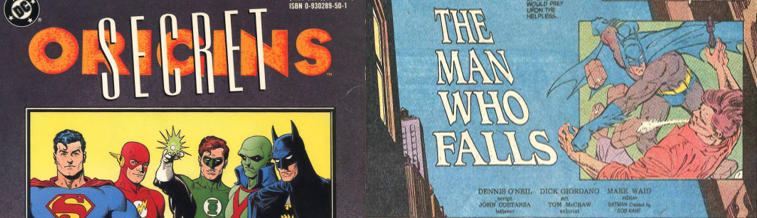
Story Title: “The Man Who Falls”
Published: March 1990
Writer: Dennis O’Neil
Artist: Dick Giordano
The Background:
Seeking to capitalise on the success of Clark Kent/Superman in their Action Comics publication, the editors of National Comics Publications wanted more superheroes under their banner. In response to this, artist Bob Kane, inspired by pulp heroes like Kit Walker/The Phantom and Lamont Cranston/The Shadow and Leonardo Da Vinci’s sketch of an ornithopter flying device, drew up a design for a masked crimefighter dubbed the “Bat-Man”. This design, however, was wildly different from the image of the Caped Crusader we know and love today and it was only thanks to the long-suppressed influence of artist Bill Finger that the Bat-Man gained his iconic cape, cowl, and darker, more gothic uniform. In the years since his debut, Batman has become not only one of DC Comics’ most popular characters but also a mainstream cultural icon, appearing in numerous other comics, movies, cartoons, and videogames. Many writers and artists have brought their own flair to the Batman and his colourful cast of characters, but one of the most influential for me (and an entire generation) was Dennis O’Neil, who removed many of the camp aspects of the character and reimagined Batman as a grim but sociable detective and even put his own spin on Batman’s famous origin in this story, first published as part of DC’s Secret Origins line (1961; 1973 to 1974; 1986 to 1990; 2014 to 2015) that specifically focused on detailing the origins and backgrounds of their many superheroes and villains.
The Review:
“The Man Who Falls” begins with anticipation; against a moonlight night sky, the Batman sits perched, ready to leap through the area and get the drop on a bunch of armed thugs. It’s something he’s done countless times before in the pursuit of justice, and never once has the Dark Knight ever entertained the notion that he would fail in his leap or to uphold his ideals. As he sits, poised for the jump, the Batman’s thoughts flash back to a time from his childhood when he did fall, tumbling through the rotten boards over a forgotten cave on his family’s estate as a child. There, bathed in darkness, young Bruce Wayne was overwhelmed by a hoard of startling, flapping bats; the boy cried out in terror, horrified by the experience, but soon found safety in the protective arms of his father, Doctor Thomas Wayne, who rescued young Bruce from the cave and admonished him for running off alone and putting himself in danger. Bruce’s mother, Martha, attempts to comfort him, assuring him that he was simply in a dark cave with scared animals rather than, as he believes, in Hell…but Bruce isn’t so easily reassured, and his thoughts remain haunted by his harrowing experience. Since then, the Batman considers whether he ever truly stopped falling deeper into the darkness; along the way, he watched others fall, including his beloved parents, who were viciously gunned down before his eyes, leaving only the broken shell of a child behind.

Spurned on by this traumatic event, Bruce found himself desperate for a purpose, a direction, some way to make sense of everything. To get around the greed and pity of others, a teenaged Bruce crafted clever forgeries that enabled him to leave Gotham City and travel the world using his family’s wealth. He became something of a nomad, enrolling in various learning institutions but never staying very long, while also moonlighting on the streets amongst the poor and desperate. While others turned their nose up at him, dismissing him as a “rich snot”, Bruce consoled his feelings of isolation and loneliness with the knowledge that there would always be another train, city, or teacher waiting for him. At age twenty, his wealth and academic achievements were more than enough to secure him a place in the Federal Bureau of Investigation (despite his poor marksmanship skills), but he was only able to stomach it for six months; frustrated by the sheer amount of red tape and legislation, Bruce realised that he wouldn’t find whatever he was searching for within the governmental system. Instead, he journeyed to Korea, to a mysterious temple high up the frigid Paektu-San Mountains. After three weeks of patiently waiting, Bruce was graced with the presence of Master Kirigi; after five months of menial tasks, he was finally deemed worthy to begin his martial arts training and took to it with a finesse and skill beyond his years. This saddened his master, who believed that Bruce’s natural inclination towards violence would eventually destroy him and urged his student to let him teach him to move past the trauma that has so badly scarred him. As this would take another twenty years, and he had no intention of forgetting the lessons he’s learned, Bruce departed the next morning, travelling to France and learning the art of manhunting from a brutal mercenary known as Ducard.
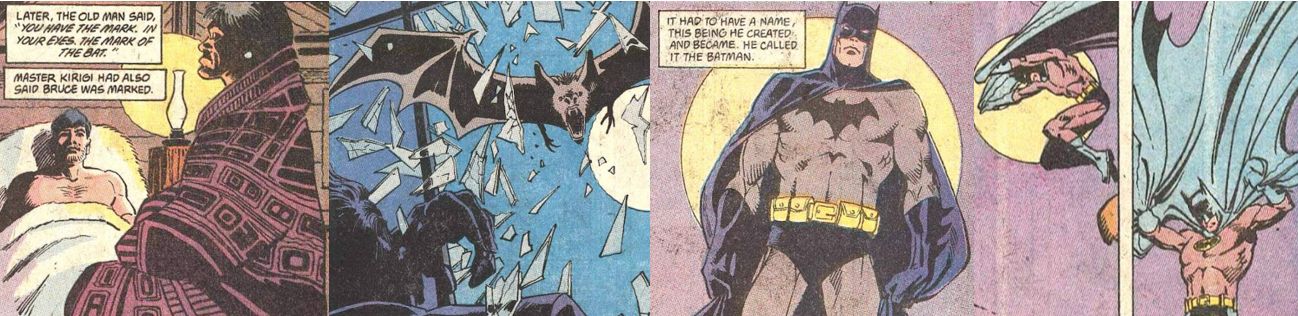
Protesting the man’s willingness to kill and shaken by his culpability in the murder, Bruce continued his travels and his studies; by his early twenties, he’d consulted with every prominent detective in the world save one: Willie Dogget. As gentle as Ducard was skilled, Dogget was also murdered before Bruce’s eyes and, in the scuffle with his murderer, Bruce indirectly took another life and was left wandering the frozen wastes of a mountain with little in the way of protection. Thankfully, he was rescued by an Indian shaman, one who wore the ceremonial mask of the bat and mused that Bruce had been “marked” by the winged creatures. Once he fully recovered, Bruce finally returned home to Gotham City, physically and mentally changed from his experiences and yet still pondering the true nature of his mission and its connection to the bats. Determined to put his skills to good use, Bruce’s first attempt at vigilante crimefighting is an abject failure that leaves him critically injured; humiliated, he retreats to his father’s library and contemplates the paradox of the criminal, a superstitious and cowardly lot who hide behind their guns. At that exact moment, the answer to all of his questions literally comes crashing through the window; a giant, terrifying bat that brings him both horror and an unexpected joy. In that moment, Bruce finally realises that he has to become something more than a man, something less than human and also more at the same time and dons his first ghastly visage as the Batman. Now, he is far beyond questioning his mission and his purpose; beyond fear, beyond doubt, the Batman leaps from his perch with nothing but confidence, committed to dedicating the rest of his life to taking such death-defying falls to bring justice to the same type of criminals that stole his childhood.
The Summary:
“The Man Who Falls” is an extremely simple tale; Secret Origins was a publication known for little more than retelling, recontextualising, or reframing the origin stories of DC Comics’ characters but one thing I enjoyed about the book was that it often gave a new spin on the narrative. Rather than the stories always just being a clear-cut narrative, there was often a framing device employed so you had a little more substance to the tale, and “The Man Who Falls” utilises such a device to really emphasise the bleak, never-ending crusade of the Dark Knight. For the Batman, his life has become a nightly routine of life-or-death situations, to the point where he really doesn’t think anything of leaping hundreds of feet from the air, crashing through a skylight, and tackling armed thugs despite the fact that he could die at any moment during even such a simple and mundane task as that. The Batman has no time for doubt or fear; all that matters to him is an unwavering commitment to his mission to battle injustice no matter the cost, and “The Man Who Falls” showcases that very well purely through its artwork and the grim narrative boxes that deliver more insight into the Batman’s background than ever before.
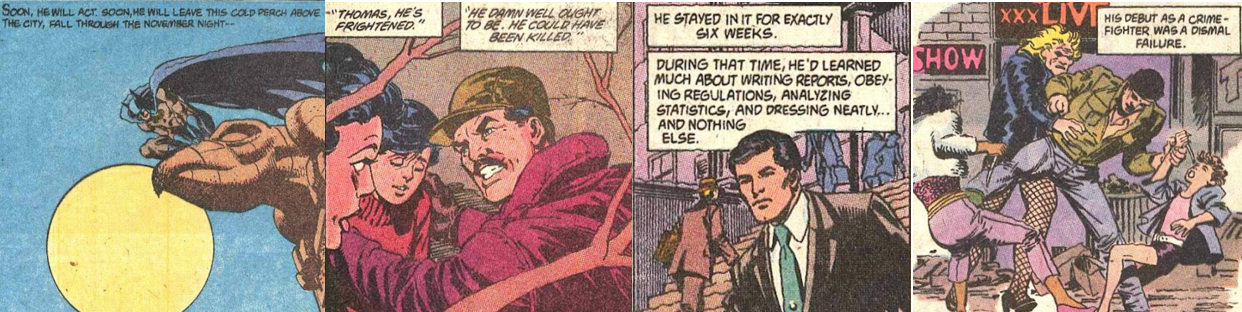
The story touches, albeit briefly, upon Bruce’s travels, that lost period of time between him losing his parents and returning to Gotham City to “become a bat”. Skipping over some of the intervening years when he was a boy, we find a teenaged Bruce Wayne travelling, searching for a purpose and a way to put his pain and anger to good use, and finding himself bored and unsatisfied by traditional academic environments. Still, while others question his focus and integrity, Bruce excels in his studies and has all the tools required to do whatever he desires, even pursue a career in the F.B.I. on his test scores alone, but remains unfulfilled and frustrated by the compromises and flaws of the traditional system. More than ever, we get a glimpse of the arduous physical and mental training Bruce endured on his travels and find that his childhood traumas not only left him ideally suited to mastering physical combat, but also on the path towards self-destruction and with a strong moral compass that’s only galvanised by witnessing (and being somewhat complicit in) further death. While the Batman’s original origin story was incredibly powerful despite its brevity, “The Man Who Falls” expands upon it beautifully, linking in with the events of Batman: Year One (Miller, et al, 1987) and emphasising that Bruce effectively was killed alongside his parents and what left that alleyway was a traumatised, driven child determined to put his anguish to good use no matter the cost.
My Rating:
Great Stuff
Have you ever read “The Man Who Falls”? What did you think to the way it expanded on Batman’s origin and background? Do you like seeing Bruce’s travels and training or do you think it’s best left ambiguous? What are some of your favourite stories and moments depicting Batman’s never-ending crusade and his early days of training? Whatever your thoughts, drop them below or leave a comment on my social media, and be sure to check out Batman content.

 Dr. K's Waiting Room
One thought on “Back Issues [Bat-Month]: Secret Origins (Vol. 2)”