
Easily Marvel Comic’s most recognisable and popular superhero, unsuspecting teenage nerd Peter Parker was first bitten by a radioactive spider and learned the true meaning of power and responsibility in Amazing Fantasy #15, which was published in August 1962. Since then, the Amazing Spider-Man has featured in numerous cartoons, live-action movies, videogames, action figures, and countless comic book titles and, in celebration of his debut and his very own day of celebration, I’m dedicating every Saturday of August to talk about everyone’s favourite web-head!

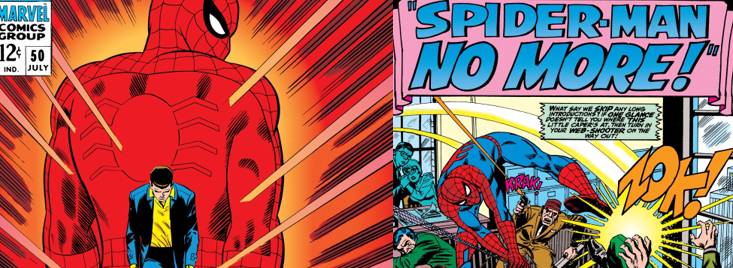
Story Title: “Spider-Man No More!”
Published: 11 April 1967 (cover-dated July 1967)
Writer: Stan Lee
Artist: John Romita Sr.
The Background:
Considering Spider-Man’s debut almost didn’t happen, it’s pretty ironic that Stan Lee and Steve Ditko‘s angst-ridden teenage superhero would go on to become the flagship character of Marvel Comics. Over the years, Spider-Man has been involved in some of Marvel’s most celebrated, and notorious, story arcs, and the troubled wall-crawler is often depicted battling his own personal woes as often as one (or more) of his colourful rogues. In 1967, he faced one of his most trying challenges when, burdened by J. Jonah Jameson’s hate campaign, Peter walked away from his responsibilities as a superhero in one of the character’s most influential stories, which also introduced readers to one of the most notorious Marvel villains, Wilson Fisk/The Kingpin.
The Review:
“Spider-Man No More!” kicks off with a bang courtesy of a visually stunning full-page splash from one of comic’s greatest artistic talents, John Romita, who practically wrote the book on how dramatic and spectacular Spider-Man’s depiction should be. With absolutely no context at all, we’re thrown right into the action as Spider-Man tackles a group of armed thugs who are in the process of pulling off some kind of heist. As is commonplace in sequences like this, the crooks are stunned at Spidey’s superhuman agility, which allows him to easily dodge bullets, and completely powerless against his superhuman spider strength, which easily allows him to shrug off even their combined assault and render them all unconscious with a few hard-hitting blows. However, despite saving the day in magnificent fashion, Spider-Man is met with fear and suspicion by one of the employees he saved, and he swings away cursing the efforts of grouchy Daily Bugle editor J. Jonah Jameson at painting him as a crazed masked maniac. Thanks to Jameson’s editorials, half of New York City is either terrified of him and thinks he’s just as bad as the many colourful supervillains in town and the other half thinks he’s mental, which he can’t help but be bothered by considering the populace celebrates other costumed superheroes like the Fantastic Four and the Avengers. Peter’s woes that, no matter what he does or how hard he tries, the public hates him more and more are only added to when he returns to his apartment and learns from his friend and roommate, Harry Osborn, that his beloved Aunt May has fallen ill. We’re not told what, exactly, May has been stricken by, however; she’s simply had “another attack” and been left bedbound. Naturally, Peter blames himself for his aunt’s condition; after all, if he’d been at home rather than putting his life on the line for his own sense of self-gratification, he would’ve been able to get there faster and he’s burdened by his unreliable nature due to his superheroics.
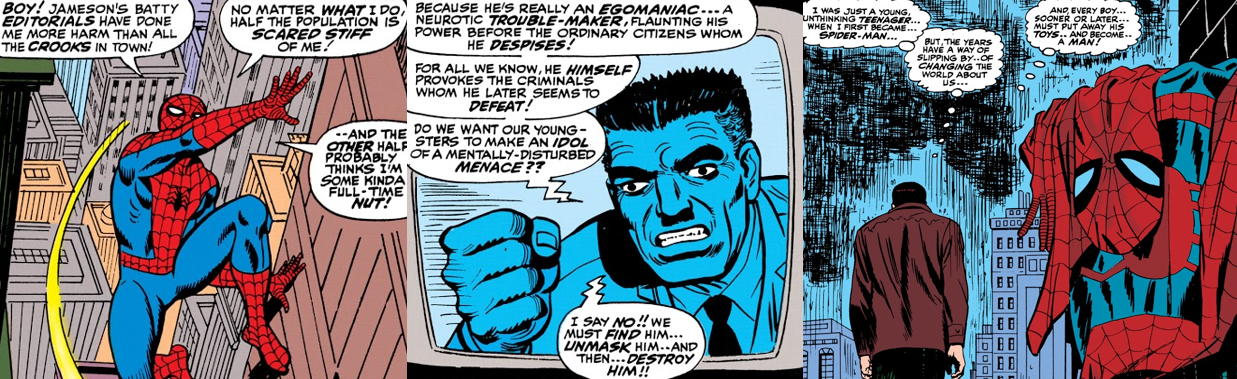
Beating himself up and already blaming himself for not being there for the only family he’s ever known and has left, Peter’s unable to concentrate on his studies, which directly translates into him struggling through a test the next day and receiving a kindly warning from his Physics teacher, Professor Miles Warren, about his steadily declining grades and that his once-impressive science record won’t allow him to coast along unless he puts in the work. To make matters worse, Peter’s so troubled by his aunt’s health and his failing grades that he’s forced to turn down a genuine offer from beautiful socialite Gwen Stacy, which only further adds to his woes as he kicks himself for not having the time or enthusiasm to find out if the likes of Gwen or seemingly scatter-brained Mary Jane Watson are really interested in him or have more depth to their personalities. Peter’s even had to turn down a fantastic job working for Harry’s dad, Norman Osborn, because he has to keep his evenings free in case Spider-Man is needed, and his troubles reach boiling point when he turns on the television and is faced with a malicious rant from Jameson painting Spider-Man as a neurotic trouble-maker who provokes villains for his own ego. Jameson’s so sure that Spider-Man is a menace to society that he offers a whopping $1000 reward for the capture and conviction of the web-slinger and Peter reaches his breaking point. Realising that his colourful alter ego has brought him and those around him nothing but pain, Peter begins to think that Jameson is right, that he’s been swinging all over town out of some childish, selfish desire for attention, and dramatically dumps his costume, and the identity of Spider-Man, in the trash once and for all.
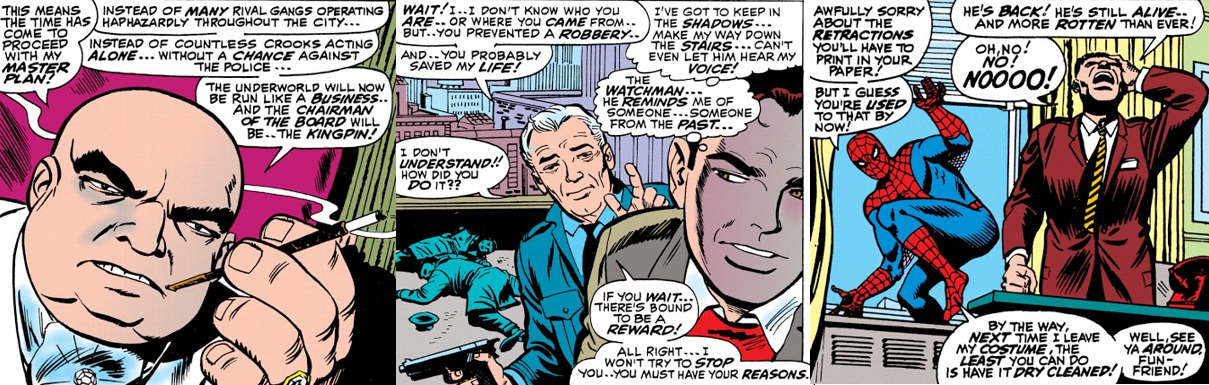
Of course, Jameson is overjoyed when a small boy delivers him Spider-Man’s costume and that his smear campaign has worked, publishing his victory on the front page to a largely incredulous New York City (it’s actually endearing how his readers see it as nothing more than a publicity stunt and actually show support for Spider-Man). Peter follows up his decision by quitting as Jameson’s lackey, much to his comical outrage, though the publisher delights in bragging about his triumph and proudly displays Spider-Man’s costume in a trophy cabinet in his office. Meanwhile, the city falls into anarchy as the Kingpin takes the opportunity to consolidate the city’s various mobsters and gangsters under his direct supervision, organising them in a way they’ve never been before and leading to a flurry of crimes, all of them in broad daylight, that threaten to tax the city’s police department to their limit. Peter, however, is having a whale of a time; no longer having to devote his time and energy to crimefighting, he’s finally able to socialise with Gwen, dote on his recovering aunt, and catch up on his studies. He’s even giving serious thought to taking up Norman’s job offer once Aunt May is fully recovered but, while he catches himself in the act of responding to the news of a robbery at the welfare office, he instinctively acts without hesitation when he sees a watchman being set upon by armed thugs. Chastising himself for going back on his promise so quickly, Peter is devastated when he realises that the kindly old watchman has the likeness of his beloved Uncle Ben. All at once, the pain and guilt of his irresponsibility catch up to the troubled teenager as he relives his childhood and his failure to us his great powers responsibly, which directly caused his uncle’s death, and he realises that it’s his burden, his duty, to set aside his personal woes and use his superpowers for the benefit of others to atone for that loss. Thus, he breaks into Jameson’s office, recovers his costume, and pranks the editor with the promise of flooding the city with more Spider-Men before swinging off into the city rejuvenated once more.
The Summary:
If you came into “Spider-Man No More!” expecting fast-paced, hard-hitting action and to see Spider-Man pummelling goons and supervillains galore, then you’re probably going to be disappointed. Instead, in keeping with the story being published in The Amazing Spider-Man’s fiftieth issue, what we have here is a deep dive into Peter’s troubles and a new spin on detailing exactly why he’s cursed to set aside friends and even family to save lives as Spider-Man. It’s not uncommon for comics, especially Spider-Man stories and tales from this era, to constantly rehash a character’s origin but I think it’s used to good effect here and almost makes The Amazing Spider-Man #50 a kind of starting off point for new readers. Thanks to being overwhelmed by his aunt’s failing health, his non-existent social life, his declining grades, and Jameson’s smear campaign, Peter has lost sight of his mission and fallen into a depression so deep and so dark that the only solution he can think of is to literally and figuratively ditch his costumed identity in one of comic’s most iconic panels. We see the effect this has on Peter right away; no longer does he have to shun Gwen or Mary Jane or his studies since he has the time and focus to think about things other than crimefighting or swinging off to help with the next emergency. He can be there for May, relax with his science books, and apply himself in far more productive ways, literally turning his frown into a smile as he happily goes about his daily business without the burden of Spider-Man weighing him down. Peter even takes a great deal of pleasure in quitting from the Daily Bugle, a job that has always underpaid and underappreciated him, and is perfectly happy to let the city police handle the escalating crime way sweeping across the town.
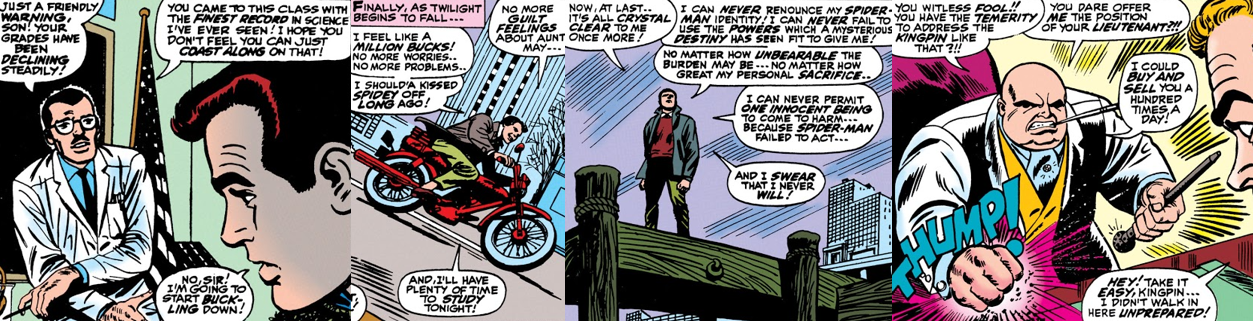
While New Yorkers are troubled by Spider-Man’s absence, the Kingpin sees it as a fantastic opportunity and makes an impact with his plan to consolidate the disparate gangs and criminals into something more akin to a business, with him as the chairman of the board. Though he doesn’t physically get involved in the action, he showcases his threat when Farley Stillwell tries to get in on the action and quickly makes a name for himself in the criminal underworld through his organisational skills and lofty goals. Although Peter is quick to chastise himself for reverting to type so quickly, he reasons that he had no choice but to act when he saw the watchman’s life in danger, and this brings back a flood of memories that we’re all keenly aware of but which serve as a stark reminder to the troubled youth that he has an obligation to use his gifts responsibly, regardless of the cost to his social life or his own desires. Having been reminded of his life’s mission, and perhaps feeling a sense of closure at having saved his uncle’s doppelgänger, Peter immediately returns to action as Spider-Man; though the story doesn’t resolve how he’s going to juggle his friends, family, and studies, it can be assumed that he’s at least more at peace with his duel identity for the time being and more than ready to make up for lost time. Overall, there’s a reason “Spider-Man No More!” is one of Spider-Man’s most celebrated adventures; what it lacks in action, it makes up for in interpersonal drama and a character study of everyone’s favourite web-head and the story is perhaps the quintessential reminder of the heavy burden Peter must carry lest he fail to use his gifts responsibly and indirectly cause more death or heartache. It’s a tragic tale, to be sure, but also one that encapsulates everything Spider-Man is; he sets aside his personal desires for the greater good and, even when he does take the time to be selfish for a change, his inherent need to help others will always win out, which is a message we could all stand to learn from.
My Rating:
Great Stuff
Are you a fan of “Spider-Man No More!”? Where would you rank it amongst Spider-Man’s many other stories and moments? What did you think to Peter’s troubles and his decision to quit being Spider-Man? Do you think Peter was maybe a little too angst-ridden and could’ve found a better way to balance his duel identities? What did you think to the Kingpin’s plot to unite the city’s criminals? Do you think the resolution to Peter’s anguish was a bit rushed or did you enjoy that he got to save his uncle’s proxy? Would you say that Spider-Man is an egomaniac and a menace or do you think he’s a benefit to the city? How are you celebrating Spider-Man this month? Whatever your thoughts on Spider-Man, and “Spider-Man No More!”, share them below or drop a comment on my social media and be sure to check out my other Spider-Man content!

 Dr. K's Waiting Room
One thought on “Back Issues [Spidey Month]: The Amazing Spider-Man #50”