
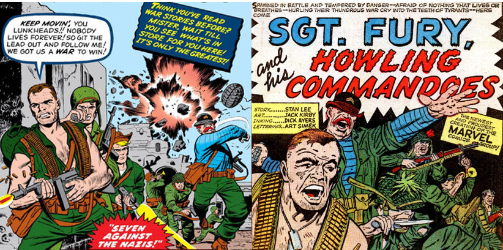
Story Title: “Seven Against the Nazis!”
Published: 5 March 1963 (cover-dated May 1963)
Writer: Stan Lee
Artists: Jack Kirby
The Background:
Over its many decades of existence, Marvel Comics has produced some of the most colourful and memorable characters in the entire industry. There was a time, generations ago, when comic books hadn’t quite found the niche they have today, leading to pulp tales, surreal horror-themed publications, and war comics. War tales were bolstered by spandex-clad heroes like Captain Steve Rogers/Captain America, who encouraged readers to buy war bonds and support their fighting troops overseas, leading to quite the booming period in Post-War America. For Marvel Comics, it was the legendary duo of Stan Lee and Jack Kirby who were responsible for creating some of their most popular characters through their unique “Marvel Method” of writer/artist collaboration, but it might surprise you to know that Nicholas “Nick” Joseph Fury, the eyepatch-wearing, cigar-chomping agent of super-spy agency Supreme Headquarters, International Espionage and Law-Enforcement Division (S.H.I.E.L.D.), actually came about as the result of a bet between h and his publisher, Martin Goodman, that Lee and Kirby could sell a comic with a ridiculous title like Sgt. Fury and his Howling Commandos. The racially and ethnically diverse titular squad would be led by a tough, no-nonsense sergeant as a more adult counterpart to DC Comics’ Boy Commandos, though Fury would be rebranded as more of a James Bond-type figure just two years after this debut appearance and is perhaps more famous for his association with S.H.I.E.L.D. and his duplicitous (and often contentious) dealings with Marvel’s superhero community. Although Nick Fury has featured in cartoons, videogames, and even got his own much-maligned live-action feature, he has been largely supplanted by his more recognisable African-American variant; General Nick Fury featured in Marvel’s comparatively short-lived Ultimate line of comics, where his design was based on Samuel L. Jackson, who would go on to portray a version of the character in the Marvel Cinematic Universe.
The Review:
The first couple of pages of Sgt. Fury and his Howling Commandos #1 are spent introducing us to the titular team of battle-tempered soldiers: we have “six foot two […] steel-muscled, iron-nerved” Sgt. Nick Fury who’s built a reputation for being one of the most feared men in the Army; Jonathan Juniper/Junior, the “cheerful eager-beaver” who’s “fast as a panther and just as dangerous”; Robert Ralston/Rebel, an ex-jockey who’s “tougher than his small size makes him appear”; Corporal “Dum-Dum” Dugan (whose real name isn’t revealed here), a former circus strongman garbed in a bowler hat; Gabriel Jones/Gabe, a proficient trumpet player; actor Dino Manelli; and scrappy, moustachioed mechanic Izzy Cohen. Rather than then jump into showing us these seven colourful characters interacting or showcasing their personalities and skills, the story switches to a French underground communications centre where two members of the French resistance, Pierre and Henri, scramble to warn the Howling Commandos of the Nazi’s latest plans. Although Henri is wounded and the two are captured, Henri successfully sends the message via Morse code, and it reaches the attention of executive officer “Happy Sam” Sawyer. Sawyer isn’t optimistic about the message, which requests that his Howling Commando division be sent in to rescue the leader of the French resistance, but the fate of Operation Neptune (or “D-Day”, as it’s most commonly known) is at hand so, while it might be a suicide mission, he orders Sgt. Fury to get his team ready. An abrasive, aggressive, stone-faced commander, Sgt. Fury goes to round up his troops, who are practising their manoeuvres in a most extreme way: Dum Dum is firing live ammo over their heads from a mounted machine gun as they crawl across a mine field! Sgt. Fury puts a stop to their “fun”, but his commandos relish the opportunity to get out into the field and go up against the Nazis, even if the odds are stacked against them; they’re so gung-ho that they even believe that they outnumber the Nazis!
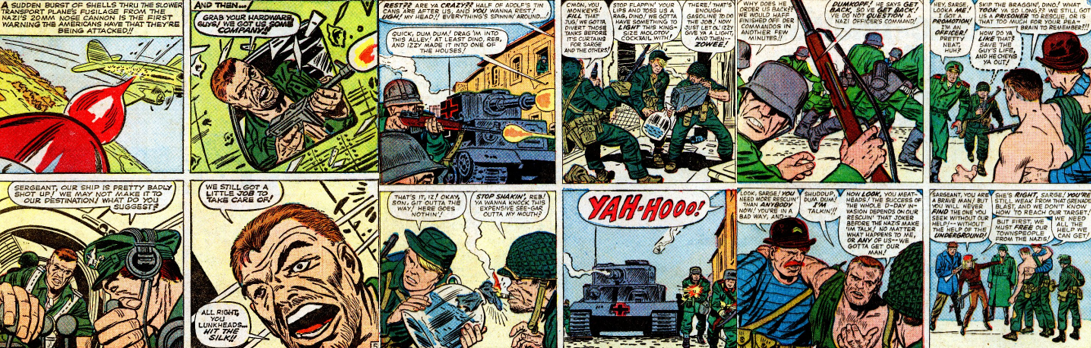
However, for all their macho bravado, the Howling Commandos’ plane is set upon by a squadron of Luftwaffe, forcing the troop to parachute to the ground (though Dum Dum is inexplicably able to take out one of the German planes with a well-aimed grenade toss). The soldiers reach a French town occupied by Nazis and, true to their name, the group fire upon the enemy, with Sgt. Fury taking out a tank-full of Nazis single-handily with his own grenade, all while howling with glee! The blast injures Sgt. Fury; though he’s too stubborn to rest, he, Dum Dum, and Junior are forced to take cover from the Nazi retaliation. Luckily, Dino, Rebel, and Izzy rig up a “king-sized Molotov cocktail”, which they hurl at the advancing troops and set their other tank ablaze. The Nazis quickly shower the Howling Commandos with bullets, pinning them down but not injuring or killing a single one of them; still, they’re helpless to fight back, so it’s up to the French resistance to bail them out by killing their attackers off-panel. Rebel and Izzy then steal the Nazi uniforms and Dino dresses up in the coat and cap of a Nazi officer, which is a disguise and performance good enough to convince the other Nazis to withdraw, thus saving Sgt. Fury and the others. Though wounded, Sgt. Fury is as pig-headed and determined as ever to complete his mission, but their saviours rightly point out that they haven’t a hope in hell without the underground’s help, and they’ll only assist them if they save the rest of the townsfolk from being executed by the Nazis. Still in disguise as “an imperious Nazi Ubergruppen-Feuhrer” Dino easily fools the firing squad, and the Commandos and the underground’s superior numbers, and firepower, quickly see the Nazis surrendering; Izzy then steals their truck and the allies climb aboard towards Louivers, where the ludicrously-named underground leader Monsieur LaBrave is being held captive in a Nazi-controlled fortress.
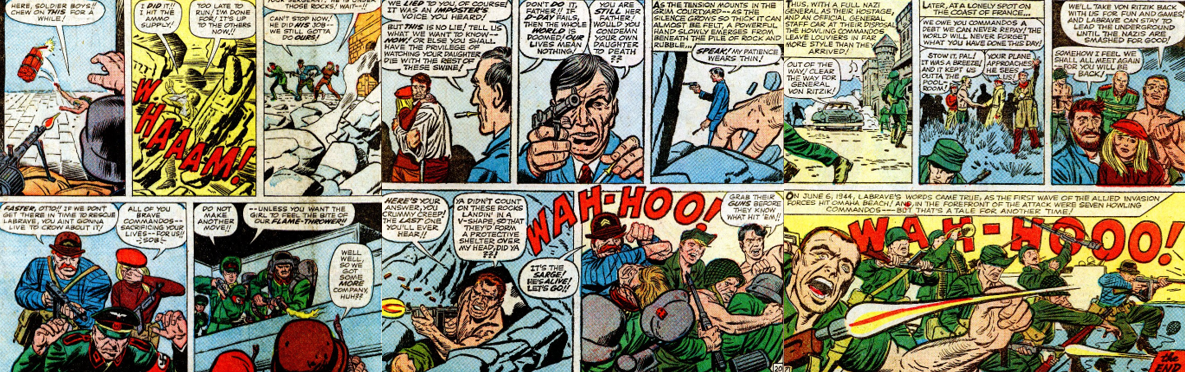
Though beaten and weary, LaBrave refuses to give in to his torture and reveal the plans for the D-Day assault; pressured by Adolf Hitler himself to get the information by any means necessary under pain of death, the Nazi General Von Ritzik hands over the interrogation to the feared Gestapo, who immediately kidnap LaBrave’s daughter and threaten to harm her if he doesn’t co-operate. Luckily, the Howling Commandos and their French ally (later named Marie) are closing in on the heavily-fortified Louivers; despite his injuries and the insanity of launching a daylight campaign, Sgt. Fury refuses to wait until dark or let himself or any of his soldiers rest for the coming battle and his stubborn, bull-headedness briefly raises the ire of Dum Dum. Posing as an old farmer pulling a cart of produce, the soldiers easily slip past the enemy guards and destroy their arsenal with a “holocaust” of an explosion! This diversion is enough to allow them to storm the fortress, where Gabe and Junior bravely hold back the advancing troops so the others can continue on the mission. When Junior is jumped by Nazis in his attempt to take out the machine gun placement laying down supressing fire in the courtyard, Sgt. Fury simply crawls along the cobblestone ground on his belly and chucks a bundle of dynamite at the Nazis, seemingly perishing in the blast as he’s buried under a pile of rocks. Although Marie turns her tears into an angry wrath and Dum Dun pushes on with the same dogged determination as his fallen commander, the two of them are soon captured and lined up alongside their comrades, and LaBrave, before another firing squad. It turns out that Marie is actually LaBrave’s daughter and that he was almost tricked into giving up their cause for her safety; however, now that she is actually there, the Gestapo threatens to shoot her before his eyes if he doesn’t spill the beans. Fortunately, Sgt. Fury is alive and well and comes bursting out from his tomb guns blazing! Galvanised by seeing their grim commander alive, the Howling Commandos easily fend off the Nazis and capture General Von Ritzik, who secures them save passage down to the coast so he can be shipped back to the Allies, and the story ends with the teaser that this victory gave the Howling Commandos and their allies the edge they needed in the subsequent D-Day assault.
The Summary:
So, here’s a fun fact: this is both the first issue of Sgt. Fury and his Howling Commandos and the first solo Nick Fury story I’ve ever read! I don’t think that’s much of a stretch of the imagination to believe, though, as Nick Fury is generally more of a background player or a supporting character in other Marvel stories and, quite frankly, that’s how I prefer him. This is a Nick Fury at the peak of his curmudgeonly ways; war has made him little more than a gruff bull who charges head-first into battle with no time for sentiment, rest, or even to tend to his own injuries. He’s hard on his soldiers, who are equally hungry to mix it up with the Nazis, and even harder on his enemies, who he attacks with little to no quarter. He expects nothing but total commitment from his men because that’s what he’s willing to give; he doesn’t care how stacked the odds are or how suicidal his missions are, he just wants to go in (and out) in a blaze of glory, chomping his cigar, firing off bullets, and ranting at his Nazi enemies as he goes down. He’s every bit the opposite of Captain America’s more righteous attitudes, but that makes sense as Sgt. Fury represents the hardened soldier on the front lines, one constantly forced to endure the dirt worst of conflict for the greater good, and thus Sgt. Fury embodies the indomitable American fighting spirit, one that will spit in your face and walk through Hell just to put down one more no-good Nazi.
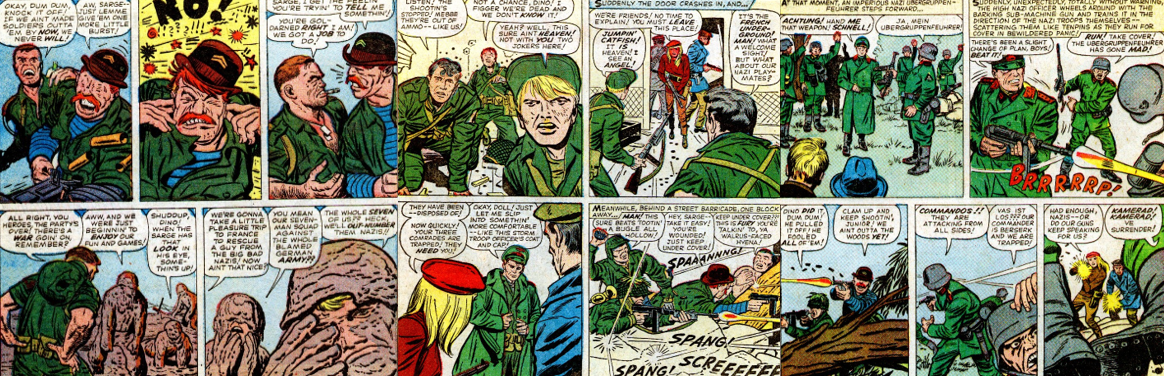
While I see a lot of parallels between Sgt. Fury and Ben Grimm/The Thing (both in their demeanour and their stony appearance), it’s a good thing that he stands out so much as his other Howling Commandos aren’t afforded such a luxury. It’s interesting that so much time is spent introducing each soldier and their basic characteristics as there aren’t many opportunities for them to shine in this story; Dum Dum is said to be a former circus strongman but exhibits no feats of strength and instead is portrayed as being a slightly less harsh version of Sgt. Fury, which leads them to butt heads a couple of times despite their deep respect for each other. Gabe is said to be quite the musician but never gets the chance to showcase this, the closest Izzy gets to using his mechanical skills is in commandeering a Nazi vehicle, and Junior is all excited about getting to blow shit up at the start of the story but ends up never getting the chance to actually use any explosives. Of them all, it’s Dino and Dum Dum who get the most chances to shine; Dum Dum makes an immediate impression with his stocky stature, thick moustache, and trademark hat but also appears to be half-crazed since his training methods are literally life or death for the Howling Commandos! Yet, when in the field, it’s Dum Dum who suggests they wait for the cover of darkness and tend to their wounds, only to be chewed out by his aggressive superior! Dino’s acting background comes into play when he disguises himself as a Nazi commander, but the story presents this in such a way that I would argue anyone could’ve done just as good a job as all he does is prance around in the uniform and bark orders in German; it’s not like he infiltrated the enemy and led them astray, or anything. Still, as disappointing as it is that most of the Howling Commandos don’t get the chance to do more than show off their fighting spirt and tenacity, it’s not entirely unexpected (there are seven main characters, after all) and they come off a lot better than Marie, who isn’t even named until right at the end of the comic and, for all her gumption, is still depicted as being more emotional compared to her war-hungry male counterparts.
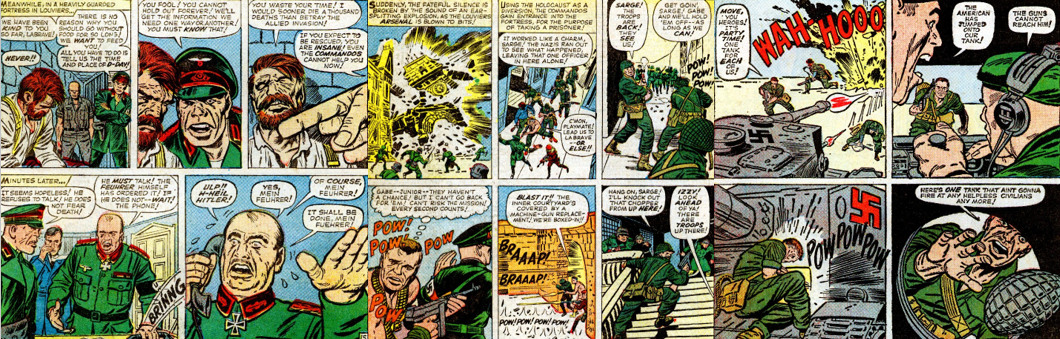
Surprisingly, Sgt. Fury and his Howling Commandos makes an effort to portray the Nazis as a genuine threat; their sheer numbers and evil intentions loom over the story like an oppressive cloud, driving Sgt. Fury and his allies on since they know how important this mission is to the larger war effort. While Adolf Hitler is portrayed as a braying, childish brat, he’s only included as a cameo and his soldiers are more than capable of dominating entire towns, threatening woman and children alike, and delight in lining up innocents and enemies before a firing squad. However, while they are a clearly superior force, their numbers and weapons are nothing compared to the Howling Commandos; the troop’s reputation as crazed maniacs proceed them and still the Nazis are easily foiled by the crowing soldiers, who blow up their planes, tanks, and munitions stores with barely a sweat. Even when the Nazis have them pinned down, the Howling Commandos take no damage; at one point, it seems like Gabe and Junior are being left for dead (Sgt. Fury even acknowledges that they have no chance against the Nazis) but no, they’re fine. The worst offender of this, however, is the titular, grouchy Sgt. Fury himself; not only does he shrug off the injuries he suffers from a grenade blast, but he’s also eventually revealed to be little more than dishevelled after being caught in another blast and buried under a pile of rocks! Again, this speaks to his tenacity, but I do wonder if killing off one of the Howling Commandos or at least treating their wounds more seriously would have helped reinforce the team as tough, but human and relatable, soldiers on the front lines. While I’m generally not a big fan of Jack Kirby’s more outlandish artwork, it actually worked really well in this war-time setting; everything has a gritty realism to it, though there are still some fun comic book moments peppered throughout, and the comic does a decent job of representing the violence and bloodshed of war even though a lot of the killing is either implied or takes place off-panel. In the end, this was a decent enough story, full of bravado and patriotic vigour, but I think it’ll strike more of a chord with fans of war comics than casual readers.
My Rating:
Pretty Good
Have you ever read Sgt. Fury and his Howling Commandos #1 or any of its subsequent issues? Are you a fan of Nick Fury and, if so, what are some of your favourite stories of his? Which of the Howling Commandos is your favourite and would you have liked to see their individual talents showcased more here? Are you a fan of war comics? Which version of Nick Fury do you prefer and why? Whatever your thoughts on Nick Fury, leave them down below or comment on my social media, and go check out my other Marvel content across the site.

 Dr. K's Waiting Room
One thought on “Back Issues: Sgt. Fury and his Howling Commandos #1”