
In the episode “Me2” (Bye, 1988) of the classic British science-fiction comedy show Red Dwarf (1988 to 2020), it is revealed the Arnold Rimmer’s (Chris Barrie) last words were “Gazpacho soup!” and that he made a point to celebrate November 25th as “Gazpacho Soup Day” after a particularly traumatising visit to the Captain’s Table.


Air Date: 14 November 1989 to 19 December 1989
Director: Ed Bye
Original Network: BBC2
Stars: Chris Barrie, Craig Charles, Danny John-Jules, Robert Llewellyn, and Hattie Hayridge
The Background:
In the mid-1980s, Rob Grant and Doug Naylor created Dave Hollins: Space Cadet, a BBC Radio 4 sci-fi comedy show influenced by classics of the genre like Dark Star (John Carpenter, 1974) and The Hitchhiker’s Guide to the Galaxy (Adams, 1978; Bell, 1981). Dave Hollins was also the prototype for Red Dwarf, a concept the duo struggled to sell despite emphasising character and comedy over genre. After casting impressionist Chris Barrie and Liverpudlian “punk poet” Craig Charles in the lead roles of Second Technician Arnold J. Rimmer and Third Technician Dave Lister, respectively, the cast was rounded out by singer and dancer Danny John-Jules and sardonic stand-up comedian Norman Lovett. Red Dwarf was eventually aired in early-1988 and, while viewing figures dropped during the first six-episode series, audience feedback was so strong that the BBC greenlit a second series. Granted a bigger budget, Grant and Naylor expanded the premise and, thanks to Red Dwarf now having an established audience, series two was more favourably received. The show was now a cult hit and afforded an even bigger budget for the third series, which saw a complete redesign of the sets and the introduction of a new model, and service mechanoid Kryten joining the crew (albeit now played by Robert Llewellyn). Widely regarded as one of the best sets of episodes throughout the show’s entire run, Grant and Naylor enhanced series three seasons with additional digital effects some ten years later, to some criticism. Since then, Red Dwarf continued to be consistently popular even after Grant and Naylor parted ways, returning from a lengthy absence with a series of specials and revivals that arguably struggled to match the quality of this season.
The Plot:
The mining ship Red Dwarf drifts through deep space three million years into the future, crewed by the last human being alive, Dave Lister, Arnold Rimmer, a hologram of his deceased superior officer, a humanoid cat (John-Jules), service mechanoid Kryten, and the ship’s neurotic computer, Holly (Hayridge). Their journey sees them visit a version of Earth where times runs backwards, dabble in time travel, swap bodies with each other, and the imminent arrival of Kryten’s ultra-modern replacement.
The Review:
Series three is really when Red Dwarf hit its stride, in many ways; at least, it is for me. Gone is the slow, strangely ominous opening sequence, replaced with a rockin’ cover of the main theme that plays over clips from the series to give a sense of the zany action viewers can expect. The first episode, “Backwards”, also starts with an amusing parody of the traditional Star Wars (Various, 1977 to present) opening scroll that flies past in the blink of an eye. Eagle-eyed viewers or those who slow down the footage will learn about how Lister returned his twins to the female-dominated parallel universe where they were conceived, how the ship’s computer, Holly, assumed the guise of his counterpart from that same reality after falling in love with her, and how service mechanoid Kryten suffered a horrific accident that saw him rebuilt by Lister to now join the crew. Additionally, Lister and Rimmer have now moved to the far more luxurious officer’s quarters, gaining bigger bunks, an en suite shower, and a far more comfortable and eye-catching space for them to socialize and bicker. Enough time has passed between Kryten’s offscreen repairs for the overly polite and submission mechanoid to have fully ingratiated into ship life, with him anxiously taking his pilot’s exam in the first episode as a way of introducing the show’s newest and most iconic ship-to-surface vehicle, the appropriately named Starbug. Even the ship’s corridors and layout have undergone a dramatic change, switching from the dull grey paintjob to a more ominous and dramatic hallways. Rather than recycle the sets from the first two series, series three introduces new areas, such as a dark room (where Kryten rocks out while developing photos), a club where the crew celebrate what’s believed to be Kryten’s final night before he’s forcibly replaced, and the science lab. The vending machines have a new design, we visit a claustrophobic cargo bay, and more episodes take place off-ship, with Rimmer and Lister literally being marooned on a frigid world at one point and the crew indulging in a bit of fun, if limited, time travel.
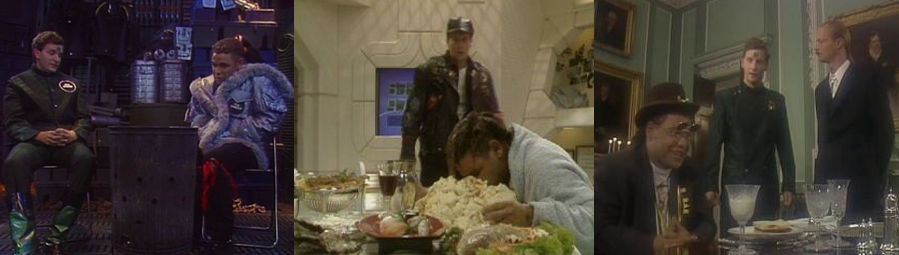
Lister and Rimmer’s contentious relationship remains a focal point of the series but has evolved to the point where Rimmer simply despairs of his slovenly roommate and Lister openly criticizes Rimmer’s boneheaded decisions. When Rimmer and Kryten prove a smash hit on the backwards version of Earth, Lister lists the many reasons why staying on such a bizarre world make little sense and openly challenges Rimmer’s tenuous authority when his fear is removed by the gruesome polymorph. The two are force to co-exist and we see a deeper representation of their dynamic in “Marooned”. Stuck with only each other for company, Lister must practically beg Rimmer to keep his mind off his seemingly inevitable slow death from either extreme cold or hunger and we explicitly see why Rimmer was chosen to keep Lister company after the ship’s crew were wiped out. Rimmer represents a smug, authoritarian antagonist Lister can focus his despair and loneliness onto and Rimmer fulfils this role admirably, chastising Lister’s short-focused greediness and trying to impress upon him the need to ration himself and make personal sacrifices to stay warm. Of course, Rimmer’s awe at Lister burning his beloved guitar soon turns to rage when he realises the devious slob has actually desecrated Rimmer’s prized camphorwood chest. Their relationship is further tested in “Bodyswap” when Rimmer sees a chance to experience the thrill of being alive once more. After failing to convince Lister to swap minds and bodies, Rimmer forces him to undergo the transfer and immediately indulges his every vice. Trapped in a hologrammatic body and powerless to prevent Rimmer from gorging himself, Lister is horrified when Rimmer hijacks his body and almost dies fleeing from reprisals in Starbug. Finally, the two clash in their attempts to alter the timeline using mutated developing fluid; discovering a limited means to travel to the past, they each vie to create the strangely popular “Tension Sheet” before the other. This gives a glimpse into Lister’s past as an ambitious but untalented musician and into an alternative life where he’s a successful rock star with a giant mansion and an obnoxious attitude. While Rimmer’s motivations for resetting the status quo are purely selfish for he wishes to have that life for himself, it also comes from a deep-seated desire to not be left alone on Red Dwarf, a fate worse than being trapped with people he barely tolerates let alone likes.

While still a flamboyant, self-serving, egotistical narcissist, the Cat is far more well-rounded here. An accomplished pilot in his own right, he’s often partnered with Lister as a far more amicable, if not less self-absorbed, alternative to Rimmer. The Cat and Lister regularly engage in game night, playing various tabletop and physical games to occupy themselves, and the Cat seems genuinely hurt when the despondent Lister refuses to play and lashes out in frustration at being stuck in deep space as the last man alive. While the Cat is seemingly nonplussed when Rimmer and Kryten disappear in “Backwards”, he’s so distraught at Lister’s own disappearance in “Marooned” that he doesn’t “buff his shoes for three days” and reacts with elation upon spotting the crashed Starbug. Additionally, when a sugar-high Rimmer takes Lister’s body hostage and goes for a joyride, the Cat immediately volunteers to pursue him in Blue Midget (though mainly to avoid giving Lister possession of his body) and joins the crew in celebrating Kryten’s life in “The Last Day”. Kryten adds a lot to the ship dynamic, being a logical and deadpan presence amidst such bombastic characters. Though his inclusion makes Holly superfluous since he has a physical presence and isn’t suffering from computer senility, Kryten makes a great impression by performing parlour tricks for the Backworld inhabitants with Rimmer, overseeing the mind swap procedure, and in his surprisingly emotional reaction to the crew risking their lives when Hudzen-10 (Gordon Kennedy) arrives to replace him. Indeed, while Kryten is happy to accept his replacement and inevitable shutdown, Lister rallies against it, openly criticising Kryten’s belief that he’ll be rewarded for a lifetime of servitude in “Silicon Heaven”. Surprisingly, it’s Rimmer who’s the voice of reason here; though also sad, in his own way, he chastises Lister for mocking Kryten’s beliefs, however illogical and unfair they seem. Of course, Kryten really steals the show in “Polymorph”, where we see his various groinal attachments at work, witness him desperately and suggestively remove Lister’s shrinking underpants, and get a taste of his occasional semi-rebellious attitude when the titular monster removes his guilt and he’s suddenly insulting his friends and happy to sacrifice them to the polymorph to save his own hide.
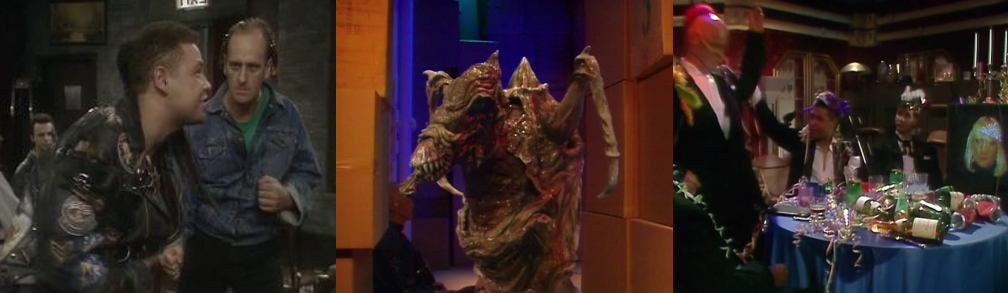
Indeed, in a series full of standout episodes, “Polymorph” is one of the best. In keeping with series tradition, the titular creature (which is totally not a Xenomorph) isn’t an alien, but a genetically engineered lifeform (GELF) bred to remove its victim’s emotions. Beginning as a comical slug-like creature, the polymorph changes shape to lure in its prey and grows larger and more monstrous the more it feeds. It even feeds on artificial emotions, removing Rimmer’s anger and Kryten’s guilt, turning the former into a peace-loving hippy and the latter into an outspoken rogue. The Cat, normally the most stylish and confident of the crew, is reduced to a whiskey swilling vagrant happy to throw away his life when the creature removes his vanity and Lister becomes an angry, trigger happy brute eager to tackle the creature even if it means “sacrificing his life in some stupid, pointless way”. With only Holly on hand as the voice of reason, the dramatically compromised crew only succeed through pure luck and, even then, the ending suggests that a second polymorph is lurking in the background. “Backwards” is also a favourite of mine; though Lister’s initially amazed to finally be back home, he soon realises that he cannot exist in a world where time runs in reverse. Kryten and Rimmer, however, find a niche as the “Sensational Reverse Brothers” and are prepared to stay before a “barroom tidy” sees them fired as pub entertainers. Finally, “Timeslides” is a fun episode that starts off exploring Lister’s loneliness and anger and evolves into a game of one-upmanship not unlike “Stasis Leak” (Bye, 1988) where Lister and Rimmer desperately travel to different snapshots of their pasts to try and invent a simple but profitable stress reliever and change their fates. When Lister convinces his past self (Emile Charles) to patent the Tension Sheet, he, Cat, and Kryten disappear from the timeline, leaving Rimmer alone with Holly. Refusing to accept this, Rimmer first tries to convince the now wealthy and successful Lister to rejoin the crew and then travels to an earlier point in time to beat him to the punch. While his younger self (Simon Gaffney) fails to follow his instructions, Rimmer inadvertently restores the timeline…and himself to life. However, his elation is short-lived as he accidentally blows himself up, completely restoring the status quo.
The Summary:
As with the previous two series, I generally watch the Remastered version of Red Dwarf’s third season (1998), which replaces all model shots with CGI models and a new opening sequence. Series three includes some additional changes, most notably in “Polymorph” where new CGI first-person shots of the slug-like polymorph’s travels were added alongside a text epilogue to the episode that states the polymorph died in Lister’s underpants drawer, and a bizarre redubbing of Rimmer’s mother (Kalli Greenwood). It’s also worth nothing that the DVD release of the series allows you to watch “Backwards” in reverse, meaning all the Backworld dialogue is now understandable and reveals that the pub manager’s (Arthur Smith) tirade at Rimmer and Kryten is simply the actor mocking the efforts of people to understand his dialogue! Rimmer debuts perhaps his most iconic look here and has become a foil for the entire crew, rather than just Lister. He despairs of Kryten’s constant subservient demeanour but doesn’t hesitate to take advantage of it when it suits him, is more than happy to gorge himself in Lister’s slovenly body, and bemoans Holly’s incompetence when she’s unable to tell the difference between specks of grit and black holes. Lister occasionally shows a surprising emotional maturity this season, desperate to convince Rimmer and Kryten to leave Backworld, revealing much of his chirpy disposition is covering a depressing pain at being the last man alive, and raging at the idea that Kryten could be so easily replaced. Both Lister and Rimmer reveal more about their pasts, such as their sexual experiences and childhoods, adding additional dimensions to their characters even as they try to compromise the other into burning their beloved possessions or change their fates. It’s great seeing their roles literally reversed in “Bodyswap”, where Lister’s powerless to keep Rimmer from ruining his body with cigars and food and Rimmer becomes addicted to the rush of being alive, a euphoria that no doubt informs his short-lived celebration at the conclusion of “Time Slides”.

Jokes in series three are absolutely top notch; all the characters feel far more familiar and the actors much more comfortable with each other so their rapport is even more natural. Even Kryten fits in like a glove, with Robert Llewellyn easily taking up the mantle from David Ross and making the character his own. Kryten’s interactions with Lister and Rimmer in episodes like “Polymorph” and “Body Swap” showcase how hilarious this group can be, with Kryten forced to obey every command “no matter how insane” and performing menial tasks by plugging appliances into his groin. I also enjoyed Lister repurposing medical supplies for his meal and scuffling with Adolf Hitler and Nuremberg, and that series three gives the actors a chance to explore different sides to their characters. “Polymorph” is the most obvious example as they all undergo extreme personality changes and are rendered even more inept as a result. “Timeslides” also shows us a version of Lister without his shady moral compass, and his naïve but charismatic younger self, while Rimmer develops a carefree and increasingly insane attitude when he hijacks Lister’s body. Kryten is also faced with his far more efficient, imposing replacement in “The Last Day”, a surprisingly emotional episode in which Lister first refuses to accept and then is determined to celebrate Kryten’s impending shutdown. The drunk crew share some emotional scenes that soon lead to accusations about Lister’s parentage and, though desperately hungover, resolve to defend Kryten from the maniacal Hudzen-10 even though they’re physically outmatched. Similarly, the crew are faced with their pending destruction when Lister accidentally activates the ship’s self-destruct sequence in “Body Swap”, a desperate situation masterfully subverted when it’s revealed Holly disposed of the bomb and never told the crew since they didn’t ask! Additionally, Lister faces his own impending demise in “Marooned” where he’s forced not only to rely on Rimmer for emotional support but also to choke down dog food and Pot Noodles. This is an equally torturous situation for Rimmer not just because he faces the very real possibility of watching the closest thing he has to a friend die before his eyes, but also because Lister burns Rimmer’s prized possessions to stay alive. Interestingly, Rimmer seems to connect with the younger Lister, though his enthusiasm for the “Om” song could easily be interpreted as sarcasm. Still, his impassioned plea to the time-altered Lister seems genuine, though born from his fears of loneliness.

As much as I enjoyed series two, series three of Red Dwarf is where the show really started to land with me. Every episode is a gold mine of comedic situations and memorable moments. While many of these are in “Polymorph” (still one of the best episodes of the entire show), each episode shines as the writers explore the boundaries of the show’s unique sci-fi setting. Kryten was a welcome presence, adding additional comedy by playing the logical but still awkward straight man to his more volatile crewmates. It was fun seeing the crew bumble about on Backworld, riding and driving backwards without really realising it and performing simple tasks to the amazement of their audience, with the reverse brawl being an obvious highlight. I enjoyed exploring Rimmer and Lister’s relationship in “Marooned”, how they genuinely seemed to connect and yet Lister couldn’t help but sabotage Rimmer’s beloved family heirloom to safeguard his guitar. “Polymorph” explored extreme opposites of their personalities, showing that this ragtag crew may be dysfunctional but support each other well despite being very different personalities. “Body Swap” explored these personalities in a fun new way, with Lister left disapproving of Rimmer’s outrageous antics and getting a taste of how helpless Rimmer often feels as a hologram. While there are some logic gaps in “Timeslides”, the time travel shenanigans were fun and I enjoyed exploring a world where Lister never got marooned in deep space yet was still a slob, despite his great wealth. “The Last Day” is a great character showcase for Kryten, showing how much the crew care for him (Lister especially) to the point where they willingly defend him even though Hudzen-10 deems them all “viable targets” for termination. The resolution to this is as ingenious as it is hilarious: the menacing mechanoid is forced into a “metaphysical dichotomy” when Kryten lies about the existence of Silicon Heaven, cementing his place in the crew. Series three is easily the best of the classic era of Red Dwarf and a must-watch for anyone looking to get into the show. It’s sci-fi sit-com at its finest and showcases some of the best and most amusing moments for the crew and remains as appealing today as it was all those years ago.
My Rating:
Fantastic
Is series three of Red Dwarf your favourite of the show’s run? What did you think to Kryten becoming a full-time member of the crew? Did you enjoy the exploration of Lister and Rimmer’s relationship and their constant one-upmanship? What did you think to the depiction of time travel and solidarity the crew showed towards Kryten? Which episode was your favourite and how are you celebrated Gazpacho Soup Day today? Feel free to share your thoughts and memories of Red Dwarf down in the comments and be sure to check out my other Red Dwarf content on the site.

 Dr. K's Waiting Room
3 thoughts on “Screen Time [Gazpacho Soup Day]: Red Dwarf (Series Three)”